Advertisement
Advertisement

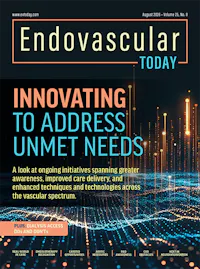
Over the course of my career, one of the things for which I am most grateful is the opportunity to collaborate with problem solvers. Across all vascular specialties, there is unwavering spirit of solution-oriented endeavor, and in my experience, we are at our best when we are working together to identify and address our patients’ most pressing needs. This extends to our colleagues in the operating room and cath lab and our colleagues in industry, all of whom dedicate their careers to the same goals we share of improving patient care. In this spirit of gratitude and collaboration, I am excited to introduce this unique edition of Endovascular Today, which focuses on some of the most critical unmet needs in the fields that comprise modern vascular interventional care, as well as the ongoing efforts to meet them.
To begin, D. Chris Metzger, MD, and Nicolas J. Mouawad, MD, discuss the evolving roles of CEA, TF-CAS, and TCAR, highlighting key unmet needs in carotid revascularization and opportunities for future innovation. Guilherme Dabus, MD, then considers the future of neurovascular intervention, from expanding treatment capabilities and technology guiding the next phase of care, to persistent barriers to patient access. Next, we asked Niten Singh, MD, and Frank R. Arko, III, MD, to explore the needs and opportunities driving complex aortic repair today, from personalized treatment planning and reintervention to innovations with potential to transform care.
An interview with Robert A. Lookstein, MD, examines how recent randomized pulmonary embolism trials are reshaping patient selection, multidisciplinary care, and the implementation of clinical evidence into everyday practice. We also gathered Parag J. Patel, MD; Constantino S. Peña, MD; and Amy Taylor, MD, for a conversation about expanding awareness of embolotherapy among the broader medical community, tackling misconceptions, greater clinical ownership among interventionalists, and the role of professional societies.
Stephen A. Black, MD, reflects on the underdiagnosis and undertreatment of chronic venous occlusion in many patients, sharing thoughts on technical challenges, patient selection questions, major unmet device needs, and gaps in training. Rounding out our series on unmet needs, Eric A. Secemsky, MD, contemplates why amputation rates remain high despite advances in peripheral artery disease awareness, diagnosis, and treatment, and where the greatest opportunities for progress remain.
Also featured in this issue is a selection of articles on dialysis access, assembled by the Endovascular Today editors. Kicking off this series are two pieces on percutaneous arteriovenous fistulas (pAVFs). Bart L. Dolmatch, MD; Andrew J. Gunn, MD; and Luke R. Wilkins, MD, give us a behind-the-scenes look into the development of the recent Society of Interventional Radiology pAVF practice guidance document, emphasizing how successful pAVF programs are built on careful patient selection, multidisciplinary collaboration, and coordinated long-term follow-up. Rishi Razdan, MD, then turns to the technical side of pAVFs, outlining three essential strategies for successful pAVF maturation, emphasizing optimized inflow, flow direction, and development of a cannulation-ready vein. Vandana Dua Niyyar, MD, closes us out with practical considerations for mechanical percutaneous thrombectomy of AV dialysis access in the outpatient setting.
Elsewhere in this issue, Amit N. Vora, MD, shares insights into ALARA+ (as low and light as reasonably achievable), a collaborative, multisociety approach to radiation safety that focuses on not only dose reduction but also orthopedic strain and long-term occupational risk. Radiation safety and occupational health represent a major unmet need as well as innovation opportunity, one that is close to my heart. I encourage all readers to invest time into education and optimal protection strategies.
We conclude with an interview featuring an influential interventional leader. This month, we highlight Gloria M. Martinez Salazar, MD, who reflects on academic interventional radiology as a driver of innovation, peer referral for the EMBOLIZE trial, creating pathways for underrepresented groups, and the role of mentorship and sponsorship in career development.
As you can see, we have a packed issue, but to be honest, we have barely begun to cover the myriad opportunities to improve the care we provide. I extend my sincere gratitude to all our contributors, who continue to answer the call of sharing their expertise in service of our field.
Finally, a special “Thank You” to the team at Endovascular Today. They have connected us all for over 2 decades now, keeping us abreast of the new technologies, the latest treatment algorithms, and ways to provide the best care for our patients. They spend a lot of time away from their families at meetings to make Endovascular Today a success. Their efforts do not go unnoticed and are much appreciated.
Guest Chief Medical Editor
Patrick Muck, MD
Advertisement
Advertisement