Advertisement
Advertisement
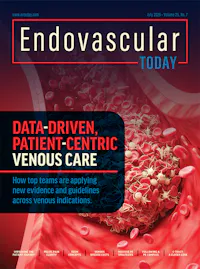
This is an exciting time for venous thromboembolism (VTE) care. The field is experiencing a convergence of landmark clinical evidence, deepening pathobiologic understanding, technological innovation, and the boom of artificial intelligence (AI), all of which are reshaping how we diagnose, treat, and follow patients with venous disease. The publication of the C-TRACT trial—the first large, multicenter, randomized trial to demonstrate that endovascular iliac vein stenting reduces postthrombotic syndrome severity and improves quality of life—represents a watershed moment, providing the rigorous evidence that our field has long needed to support catheter-based interventions for chronic venous obstruction. At the same time, the release of the first-ever American Heart Association/American College of Cardiology acute pulmonary embolism (PE) guideline, with its new clinical classification system and formal endorsement of multidisciplinary PE response teams, established a comprehensive framework for evidence-based PE management.
Advances in catheter-based technologies for both deep vein thrombosis and PE continue to expand the interventional tool kit, while AI-powered decision support tools and predictive models hold the promise of improving individualized risk stratification, accelerating diagnosis, and guiding treatment selection in ways that were unimaginable just a few years ago. Perhaps most importantly, the greatest gains ahead may not come from any single device or drug but from reimagining the patient journey itself, through multidisciplinary care models and a commitment to measuring what matters most to patients: quality of life, functional outcomes, and long-term well-being. This issue of Endovascular Today brings together thought leaders who are driving these advances across the full spectrum of venous care.
James M. Horowitz, MD, starts us off with a conversation on improving the VTE patient’s journey, exploring how multidisciplinary care, standardized follow-up, and shared decision-making can enhance outcomes and continuity of care for these patients.
Next, Eri Fukaya, MD, and Manj S. Gohel, MD, do a deep dive into the multidisciplinary lower extremity venous care model, examining how coordinated care, clear ownership, and collaborative referral pathways can strengthen care and improve long-term patient outcomes.
In a Literature Highlights article, we provide a closer look at the landmark C-TRACT trial of iliac vein stenting for postthrombotic syndrome, followed by insights from lead investigator Suresh Vedantham, MD, on what the trial findings mean for current practice.
Continuing our coverage, Mona Ranade, MD, introduces PE Compass, an AI-assisted decision support tool designed to translate the recent American Heart Association/American College of Cardiology acute PE guideline into a consistent, practical workflow for decision-making.
We also have an interview with Julie Bulman, MD, on the “true costs” of venous disease, focusing on how long-term outcomes, quality of life, and indirect economic burdens should be incorporated into value-based care and treatment decision-making.
Last, Claire S. Kaufman, MD; Zoe VanderHoek, BS; and Teodora Bochnakova, MD, lay out three keys to addressing the frequent confusion and variability in evaluation and treatment of venous-origin chronic pelvic pain: consistent nomenclature, accurate diagnosis and evaluation, and use of patient-reported outcomes to evaluate treatment response.
Elsewhere in this issue, our featured interview is with Mina S. Makary, MD, who discusses patient-centered innovation, use of AI in disease management, developing new service lines for interventional radiology, and the value of mentorship and multidisciplinary work.
Taken together, the articles in this issue reflect a field that is not only advancing technically but also maturing in how it thinks about patients. We hope these contributions inspire you to bring these innovations into your own practice and continue pushing the boundaries of what is possible for patients with venous disease.
Vivian Bishay, MD
Guest Chief Medical Editor
Advertisement
Advertisement