Advertisement
Advertisement
October 2026 Supplement
Sponsored by Medtronic
Case Study: Acute Thrombus in the Proximal SFA Managed With the Liberant™ Thrombectomy System

PATIENT PRESENTATION
A woman in her late 60s presented to the emergency department with a 10-day history of worsening right leg pain and new-onset numbness that disrupted her sleep after undergoing a left lower extremity angiography at an outpatient clinic (Figure 1A). The patient reported she could walk only short distances with a cane because of the new pain. Her medical record included coronary artery disease with stent placement, hypertension, hyperlipidemia, liver cirrhosis, hyperthyroidism, vertigo, stage 1 chronic kidney disease, and peripheral artery disease.
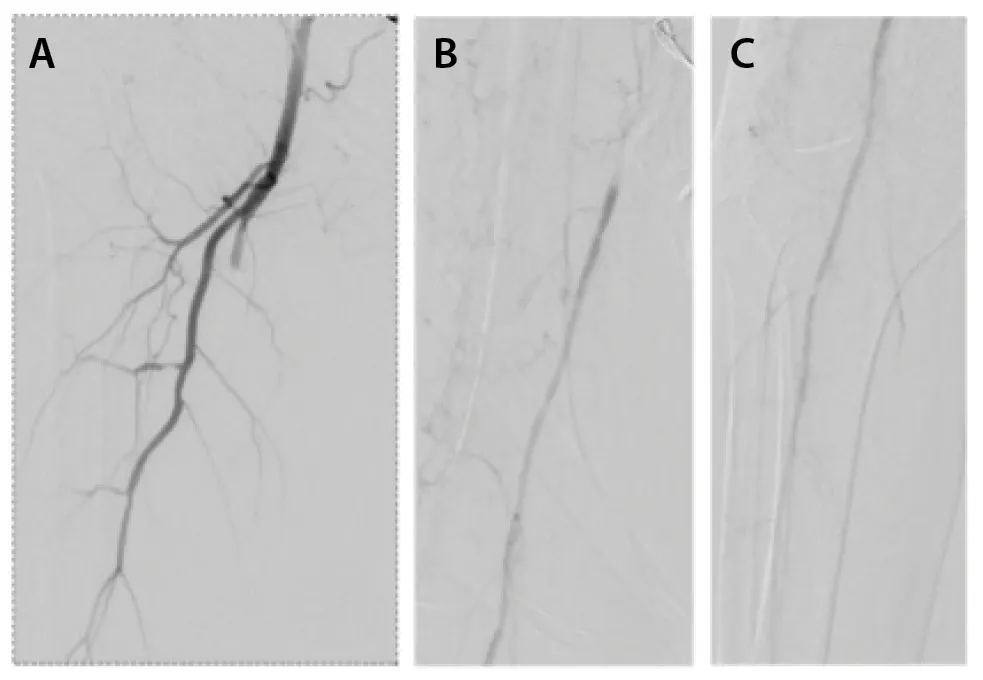
Figure 1. Angiography demonstrated an occlusion of the SFA through the closure device (A), an acute clot in the proximal SFA (B), and peroneal runoff (C).
PROCEDURAL DETAILS
During diagnostic evaluation, the patient’s right foot was cold to the touch. Motor function and sensation in the toes were intact, and the foot was nontender. She had a prior right hallux amputation and nonpalpable distal pulses. Doppler ultrasound findings were consistent with Rutherford class 2a acute limb ischemia (ALI) of the right leg, with superficial femoral artery (SFA) occlusion and peroneal runoff (Figure 1A).
Device Selection
Based on symptom presentation and CTA (Figure 1B and 1C), we determined that an acute thrombus was present in the proximal SFA, likely related to a prior interventional closure device injury. We selected the Liberant™ thrombectomy system (Medtronic) because of our clinic’s confidence in the device’s radiographic trackability and ease of use.
We used the 6-Fr Liberant catheter in the SFA, followed by the HawkOne™ directional atherectomy system, 5-mm SpiderFX™ embolic protection system, and IN.PACT™ 018 drug-coated balloon (DCB) (all Medtronic) in the popliteal artery. Our clinic prefers directional atherectomy for plaque removal to help reduce downstream disease progression. We have performed a tremendous number of directional atherectomy cases without adverse events, supporting the rigorous clinical research in safety data available.1
Procedure Techniques and Outcomes
Three passes with the Liberant system were completed, resulting in clot removal and vessel patency (Figure 2A and 2B). Six passes with the HawkOne directional atherectomy system were then performed to remove plaque buildup in the popliteal artery, followed by DCB angioplasty (Figure 2C and 2D). A closure device–related injury caused a dissection that required bailout stenting with a 5.5- X 60-mm Supera™* stent (Abbott) and a 6- X 40-mm EverFlex™ self-expanding stent system (Medtronic). The intervention was successful, and no adverse events were reported.
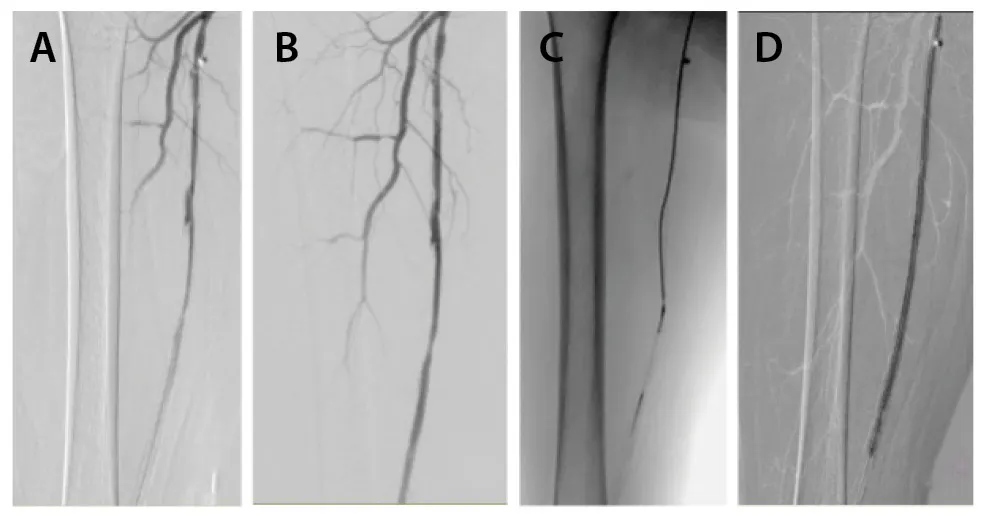
Figure 2. Angiogram after one back-and-forth pass (A) and two additional passes (B) with the 6-Fr Liberant catheter. Calcified vessel before directional atherectomy using the HawkOne device (C) and post-DCB angioplasty of the diseased segment (D).
The patient was discharged the same day on an anticoagulation regimen, with no recurrence and significant improvement upon clinical examination. At the 3-month follow-up visit, duplex ultrasound continued to show a patent popliteal artery and tibioperoneal runoff, with resolution of disease post-intervention (Figure 3).
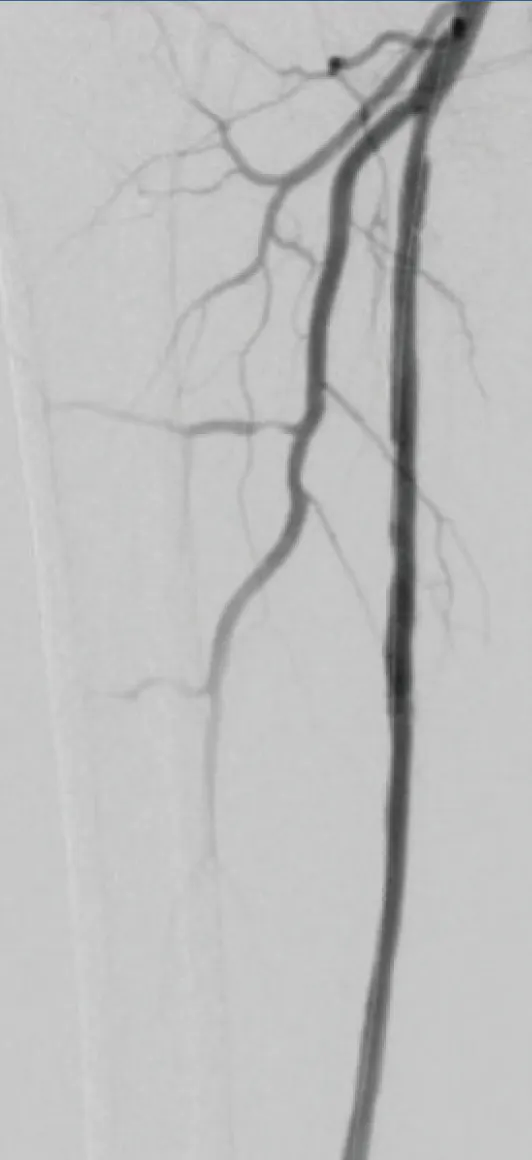
Figure 3. Angiogram demonstrating patent flow and resolution of disease post-intervention.
Rationale for Treatment Approach
ALI at an advanced Rutherford stage requires prompt revascularization. In this setting, clinicians should use a technology with a high likelihood of success or consider open surgery. In our practice, the Liberant system has been effective and easy to use, with no adverse events observed. The device is gentle enough to support trackability yet robust enough to achieve effective thrombus removal.
REFLECTIONS
The guiding principle for device selection is deliverability. Thrombectomy devices have one primary purpose: to clear the clot. When a device performs efficiently, it can increase procedural confidence and support interventional performance. Without that efficiency, interventionalists may need to convert to open surgery and/or lengthy endovascular options with higher resource utilization and risks. Training has strengthened our team’s ability to select the appropriate device for each patient and provided valuable support in managing these cases.
1. Carr JG, Langhoff R, DeRubertis BG, et al. Published evidence on peripheral atherectomy: a meta-analysis and systematic literature review of more than 300 original investigations. J Soc Cardiovasc Angiogr Interv. 2025;4:104009. doi: 10.1016/j.jscai.2025.104009
Disclosures: Consultant to Medtronic.
Advertisement
Advertisement