Advertisement
Advertisement

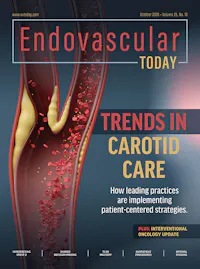
The management of carotid artery disease continues to evolve as new evidence informs treatment selection alongside advances in imaging, techniques, and care delivery models. With the CREST-2 findings now part of the clinical conversation, our task is to determine how best to apply these data to the patients we see each day. Doing so requires careful assessment of anatomy and procedural risk, a clear understanding of the available therapies, and meaningful discussion of each patient’s goals and preferences.
In this issue of Endovascular Today, we bring together perspectives on the decisions and practical considerations that shape contemporary carotid care. We begin with William A. Gray, MD, who discusses how he incorporates clinical evidence, anatomic suitability, operator experience, and patient preferences into conversations about medical therapy and revascularization.
Next, my colleagues Vinay Jaikumar, MD; Collin Liu, MD; and Jaims Lim, MD; and I examine how multimodal imaging can characterize plaque and cerebral perfusion, guide procedural strategy, assess stent deployment, and identify postprocedural cerebral injury.
Irina Kanzafarova, MD, and Michael Stoner, MD, then draw on their high-volume center’s experience to offer practical guidance on preoperative preparation, operating room setup, team communication, carotid access, and the procedural details that optimize transcarotid artery revascularization.
Turning to care delivery, Devan Patel, MD; Pui Man Rosalind Lai, MD; and Elad I. Levy, MD, describe their approach to selecting patients for ambulatory carotid artery stenting and establishing the staffing, equipment, monitoring, and emergency response capabilities needed to support it.
To close our carotid feature, Dr. Gray reflects on differing specialty responses to CREST-2 and calls for collaborative treatment pathways that match each patient with the most appropriate revascularization strategy.
Beyond our carotid focus, the Endovascular Today editors have assembled an interventional oncology feature, which begins with Eric P. Wehrenberg-Klee, MD, and Suvranu Ganguli, MD, who assess recent evidence on combining locoregional treatments, bridging patients to liver transplantation, and using ablation alongside immunotherapy or as definitive treatment for medically inoperable lung cancer.
Next, Nadine Abi-Jaoudeh, MD; Zachary T. Berman, MD; and Ammar Sarwar, MD, discuss where their approaches to yttrium-90, conventional transarterial chemoembolization, and ablation for hepatocellular carcinoma converge and differ, including how tumor distribution, liver function, transplant potential, and treatment goals influence their recommendations.
Francis G. Celii, MD; Justin A. Ahrar; and Mohamed E. Abdelsalam, MD, then examine how preablation tumor devascularization may improve lesion visibility, limit bleeding and heat-sink effects, and facilitate treatment while preserving uninvolved renal tissue in renal cell carcinoma.
We close the issue with an interview with Andres Schanzer, MD, who reflects on creating teams that enable others to succeed, using multicenter data to refine complex aortic repair, and measuring quality across the full patient care journey.
Across these contributions, a common priority emerges: translating evidence and technical progress into care that serves the individual patient. Continued collaboration, thoughtful evaluation of our outcomes, and a commitment to understanding patients’ needs will remain essential as we move our fields forward.
Adnan H. Siddiqui, MD, PhD
Guest Chief Medical Editor
Advertisement
Advertisement