Advertisement
Advertisement
September 2026
Sponsored by Johnson & Johnson MedTech
Shockwave Javelin: Building Confidence in Complex CLTI Intervention
The role of Shockwave Javelin in enabling predictable calcium modification in balloon-hostile BTK and CLTI anatomy.


You both treat some of the most complex chronic limb-threatening ischemia (CLTI) patients. What treatment challenges were you encountering previously that led you to initially evaluate Shockwave™ Javelin (Shockwave Medical, now a part of J&J MedTech)?
Dr. Bailey: All interventionalists have encountered the heavily calcified, restrictive, high-friction lesions wherein you’ve managed to thread a wire through but struggle to get any adjunctive or final treatment devices to pass. We all try the same steps of wire escalation, increasing sheath or through-wire support, telescoping crossing catheters, etc. Ultimately, and in the best of scenarios, we resort to using some small-diameter microballoon to predilate, in hopes of creating a working lumen. This is where and when I started using Shockwave Javelin, and my confidence and application of the device have continued to grow considerably since.
In an era of mounting enthusiasm and evidence in support of vessel preparation, especially in the smaller-caliber, calcified tibial segment, adopting Shockwave Javelin just seemed logical. Why resort to predilatation with a small-caliber balloon when I can use Shockwave Javelin to not only create a lumen but also modify the calcific plaque and prepare the vessel wall in the process? My aforementioned treatment algorithm for calcified lesions, especially below the knee, always included vessel modification with Shockwave intravascular lithotripsy (IVL). Now, regardless of anatomic level, when faced with the “tough-to-traverse” lesions, Shockwave Javelin is the tool I rely on to pave the way: create a lumen, define the path, modify the plaque, and move efficiently forward toward my planned definitive treatment therapies and devices.
Dr. Garg: Calcified lesions increase the technical complexity of all peripheral interventions. Stiff vessels prevent easy device passage, as the vessels don’t easily conform. As such, you often lose support and pushability. Furthermore, when treating calcified lesions, conventional therapies may fail to safely modify the plaque. IVL has been a huge step forward in addressing some of these lesions. It helps modify the plaque without risk of embolization and with minimal risk of rupture.2 However, some recalcitrant lesions prevent passage of catheters when the wire is across, and this is where I have had success with Shockwave Javelin. If I am struggling to advance a small catheter, I will reach for Shockwave Javelin to help modify the plaque and cross the lesion. At this point, further therapies may be delivered to treat the lesion. The device also allows for treatment of smaller vessels, particularly the distal tibial vessels and plantar arteries, where deliverability can be challenging.
CASE SPOTLIGHT: RECANALIZATION OF THE DISTAL AT AND PEDAL-PLANTAR LOOP
By Charles J. Bailey, MD, RPVI, FSVS
Case Presentation
PROCEDURE AND POSTPROCEDURAL RESULT
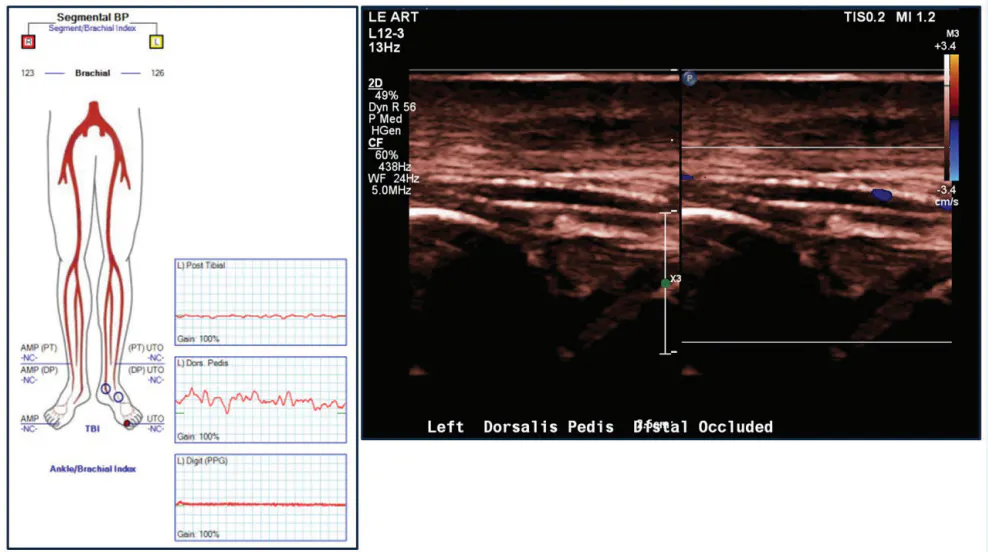
Figure 1. Preprocedure duplex ultrasound illustrating absent toe pressure and occlusion of the distal AT and DP artery bypass graft outflow.
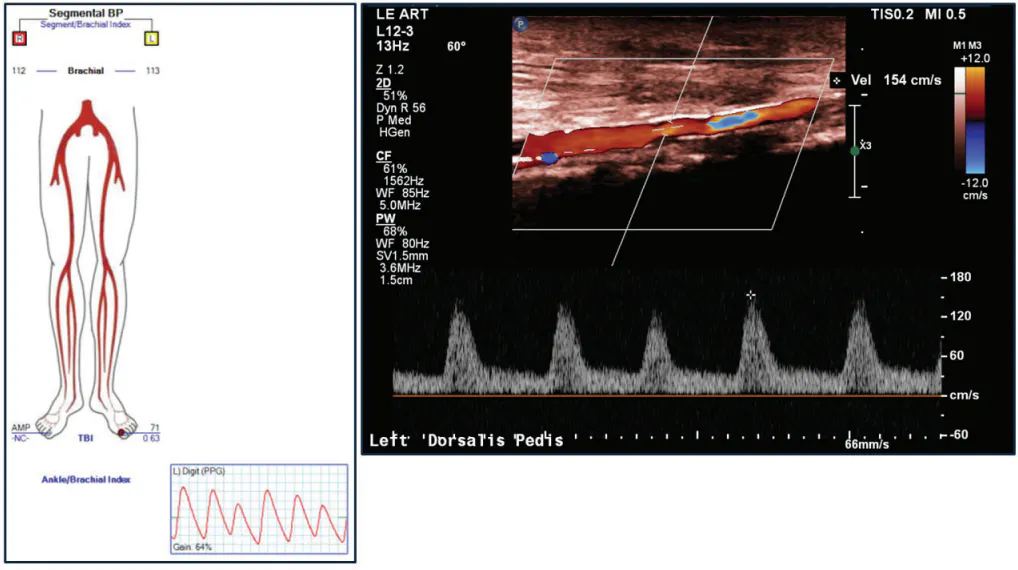
Figure 2. Procedural angiography demonstrating chronic occlusion of distal AT and DP outflow, with branch vessel collateral perfusion to the PT circulation medial and lateral plantar branches (A); advancement of the wire and Shockwave Javelin catheter across the pedal-plantar loop (B); the distal AT, DP, pedal-plantar loop, and plantar branches after Shockwave Javelin IVL (C); and the final result after Shockwave Javelin IVL and 2-mm balloon angioplasty (D).
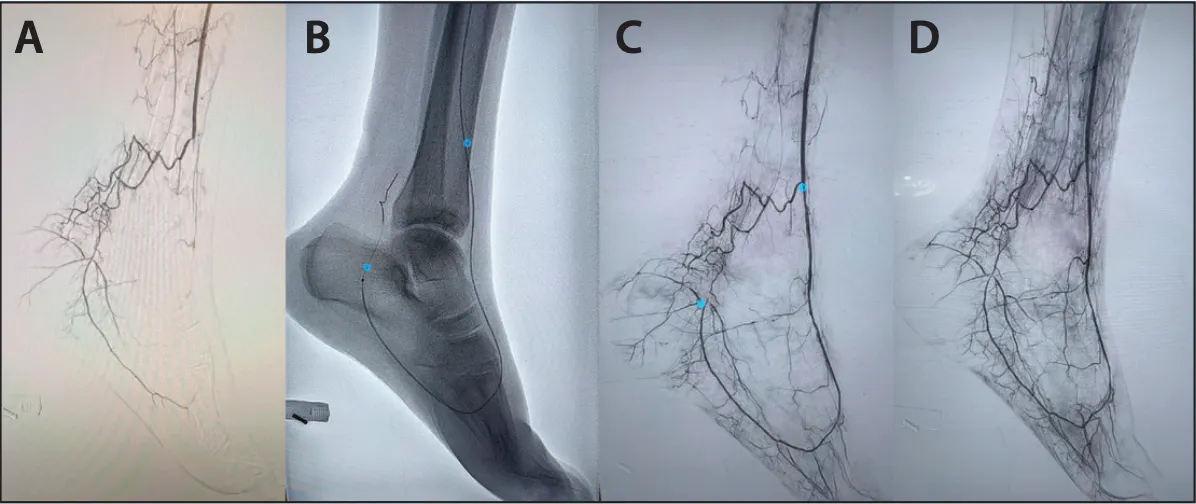
Figure 3. Postprocedure duplex ultrasound revealing marked increase in the great toe pressure (71 mm Hg), with restored patency and multiphasic flow across the AT and DP.
Many physicians are comfortable with chronic total occlusion (CTO) crossing tools and balloon angioplasty. What gap does Shockwave Javelin fill that wasn’t adequately addressed by existing technologies?
Dr. Garg: Getting across with a wire is usually the challenging part of treating complex CTOs. But that may not be the end of the story. If devices cannot track, the intervention cannot be performed. Shockwave Javelin’s unique design, with a single distal emitter placed 3 mm from the catheter's tip, offers a new approach to getting across tenacious, calcified lesions that may prevent deliverability of devices. Additionally, the small profile allows for treatment of small pedal vessels.
Dr. Bailey: What Shockwave Javelin supports with complex lesions is a true economy of motion. As a novel, catheter-based vessel preparation device, the lithotripsy emitter is active as you engage and advance forward and naturally supports crossing through the lesion (parallel processing, if you will). As Shockwave Javelin crosses the lesion, it creates a small lumen and enhances vessel wall compliance1; in doing so, it efficiently prepares the lesion for the next step in endovascular treatment.
The gap it addresses is inefficiency in the linear and sequential step treatment algorithms we have come to embrace: wire, crossing catheter, predilatation, plus/minus vessel preparation, and endovascular therapy, rinse and repeat. But, if you can do two things at once safely and effectively, interventionalists should embrace that built-in efficiency. Shockwave Javelin improves efficiency as a device with the novel combined actions of vessel preparation and lesion traversal.
How do you currently identify patients who might benefit from Shockwave Javelin during procedural planning?
Dr. Bailey: It starts preprocedure with simple reflection on the patient’s clinical risk factors and review of their baseline imaging. We know that peripheral artery disease (PAD) patients with diabetes or chronic kidney disease are at the highest risk for tibial and small vessel occlusive disease, and the disease pattern is quite commonly calcified and circumferential. This is the anatomy most amenable to lithotripsy, and the small-caliber calcified vessel is the ideal place to introduce and embrace Shockwave Javelin. My treatment algorithm for calcified lesions has relied heavily on IVL, and Shockwave Javelin has redefined my approach to tibial level disease, especially in the diabetic or chronic kidney disease patient.
There are also clues during the procedure that identify who may benefit from Shockwave Javelin. The classic “lead pipe” infrainguinal vessels with circumferentially calcified walls, tibial vessels with high medial artery calcification scores, or angiography with a lengthy CTO are all scenarios where Shockwave Javelin would greatly aid lesion crossing and preparation. Also, a challenging lesion that a 0.014-inch wire will traverse but a standard catheter or balloon may not follow is the perfect anatomy to utilize this device and keep the procedure moving forward.
Dr. Garg: Patients in my practice whom I consider for Shockwave Javelin usually share a series of similarities: Most present with isolated tibial disease and heavily calcified lesions, often in the setting of diabetes, older age, or chronic kidney disease. I have also used Shockwave Javelin frequently in patients who have undergone a kidney transplant. As a rule, these patients present with CLTI.
I may obtain CTA along with arterial duplex ultrasound. Often, heavily calcified lesions on ultrasonography are an indicator that Shockwave Javelin may be appropriate. When intervening on this subset of patients, I am aggressive with revascularization, considering anything from open bypass to retrograde pedal access. This cohort of patients usually has elements of disease that are well suited to Shockwave Javelin.
CASE SPOTLIGHT: CROSSING A COMPLEX DISTAL AT OCCLUSION
By Karan Garg, MD
Case Presentation
PROCEDURE AND POSTPROCEDURAL RESULT
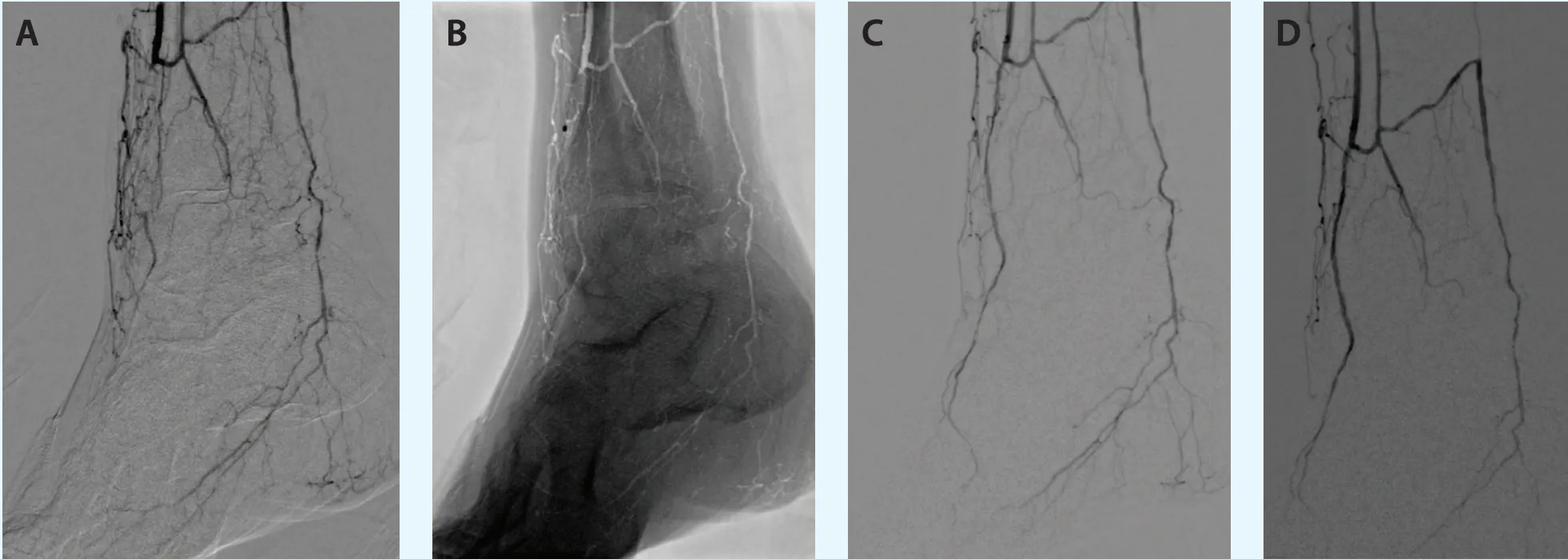
Figure 1. Right distal DP occlusion; the wire is across but no catheter has been advanced (A). The Shockwave Javelin catheter partially crossed (B). A lumen was created with Shockwave Javelin alone (C). Final angioplasty with flow down the AT and into the DP (D).
Dr. Bailey, has your use of Shockwave Javelin expanded beyond initial expectations? For example, are you treating lesion subsets today that you might not have considered in your early experience?
Dr. Bailey: My observed real-world clinical effectiveness with Shockwave Javelin is what has built my confidence in the therapy and expanded its use. It has all but replaced the step of “plain old balloon angioplasty (POBA) to create a channel because nothing else will pass” in complex lesions. My endovascular PAD cases commonly involve patients with diabetes and end-stage renal disease who present with long-segment, multilevel tibiopedal occlusive disease and small-caliber, calcified vessels. In these challenging anatomic and patient cohorts, my use of Shockwave Javelin has evolved and expanded to include treatment of distal tibial and inframalleolar vascular beds. I see incredible potential and promise at the inframalleolar level, as this is where we have the fewest treatment options. Traditional POBA has not proven to be durable, effective, or safe as a standalone treatment in tibial- or pedal-level disease. From experience, Shockwave Javelin navigates the distal tibials, pedal and plantar branches, and across the pedal-plantar loop, allowing these very small, calcified branches to now be treated with a true vessel-modifying device as either a stand-alone or adjunctive therapy.
Dr. Bailey, your experience has highlighted treatment of distal anterior tibial (AT) and pedal circulation disease. Why is successful treatment in these vascular territories so critical for limb salvage?
Dr. Bailey: The clinical impact of restoring and/or maintaining a patent pedal-plantar loop cannot be overstated. In CLTI, the goal is restoration of inline axial flow beyond the malleolus, improving perfusion directly to the wound bed, not via collateral paths. Treating beyond the malleolus is often critical for optimal outcomes. In my experience, a patent pedal-plantar loop is an independent predictor of wound healing, is associated with improved freedom from major amputation and limb salvage, and can positively impact limb-based patency of lower leg revascularizations by increasing outflow paths. From an endovascular technique standpoint, a patent pedal-plantar loop also can be quite useful as a bridge to performing in situ retrograde recanalization of an anterior or posterior tibial (PT) vessel, either as a path to treatment or for simple increased wire support (ie, antegrade down one vessel, cross the pedal-plantar loop, come up retrograde into the other).
Dr. Garg, after your first few cases, you were still uncertain about the technology—what changed?
Dr. Garg: Success with Shockwave Javelin requires patience, and there can be a learning curve. My initial cases were not always successful, and this was a bit disappointing. However, with more experience with the device, I understood the changes I needed to make in my approach and how I defined success. One must understand that Shockwave Javelin might not get across the entire lesion and just work at the cap. This allows the next set of definitive therapies to be delivered. Additionally, when faced with the toughest lesions, you need to be prepared to fail. Having a bit of expectation readjustment has allowed me to better adapt this technology in my practice.
Dr. Garg, how has your procedural strategy evolved as you’ve gained experience with the device?
Dr. Garg: Shockwave Javelin is a novel device that takes a few cases before you become facile using it. I initially used the device for lesions where the wire crossed but the catheter did not. However, I was not always well planned with my approach, so the success rate varied. With better understanding has come better success. Some technical aspects to consider are site of access. I will generally obtain antegrade common femoral artery or very proximal superficial femoral artery access. I then place a long sheath for added support as I’m trying to cross the lesion. This singular change has improved my procedural success. Another consideration is lesion type. I pick calcified lesions with a reasonable vessel caliber. In my experience, anything smaller than 2 mm can be challenging to cross. Once treating, I keep gentle forward tension; even if I am unable to traverse the entire occlusion, even a partial crossing can lead to success. The proximal cap tends to be the toughest and even a few millimeters of progress can allow for successful revascularization. Finally, for below-the-ankle vessels, Shockwave Javelin is an excellent device for plaque modification and works very effectively.
For physicians considering their first cases with Shockwave Javelin, what would you tell them after your real-world experience?
Dr. Bailey: Experience breeds confidence and competence. The device setup is intuitive, the mechanism of action is reliable, and the learning curve is steep and fast. Similar to the adoption of any new endovascular technology, it is only “in the trenches” when you can really learn all the nuances of the device to optimize procedural outcomes, as well as the strengths and potential limitations of the catheter-based lithotripsy emitter. Choose your initial patients carefully, and select anatomy that lends itself to a successful intervention so that your comfort, confidence, and expertise can blossom.
Dr. Garg: The key is patience and managing expectations. The device works best when you set yourself up for success. Some keys are picking focal calcified lesions and working through a sheath positioned close to the action.
1. Corl J, Clair D, Mwipatayi P, et al. FORWARD PAD IDE/feasibility studies: primary endpoint analysis of a novel non–balloon-based peripheral IVL catheter. J Am Coll Cardiol Intv. 2025;18:398-399. doi: 10.1016/j.jcin.2024.10.035
2. Armstrong EJ, Adams G, Soukas PA, et al. Intravascular lithotripsy for peripheral artery calcification: 30-day outcomes from the Disrupt PAD III observational study. J Endovasc Ther. 2026;33:853-862. doi: 10.1177/15266028241283716
Shockwave Javelin Peripheral IVL Catheter Safety Information
In the United States: Rx only.
Indications for Use—The Shockwave Medical IVL System with the Javelin Peripheral IVL Catheter is intended for lithotripsy-enabled modification and crossing of calcified lesions in the peripheral vasculature, including the iliac, femoral, ilio-femoral, popliteal, and infra-popliteal arteries, prior to final treatment.
Not for use in coronary, carotid, or cerebral vasculature. Additionally, not for use in pulmonary vasculature in the U.S. and New Zealand.
Contraindications—Do not use if unable to pass 0.014" (0.36 mm) guidewire across the treatment site-Not intended for treatment of in-stent restenosis or in coronary, carotid, cerebral or pulmonary arteries.
Warnings—Only to be used by physicians who are familiar with interventional vascular procedures—Physicians must be trained prior to use of the device— Use the generator in accordance with recommended settings as stated in the Operator’s Manual.
Precautions—Avoid applying acoustic pressure pulses while IVL window is not filled with sterile saline— Appropriate anticoagulant therapy should be administered by the physician— Decision regarding use of distal protection should be made based on physician assessment of treatment lesion morphology.
Adverse effects—Possible adverse effects consistent with standard angioplasty include-Access site complications- Allergy to contrast or blood thinner-Arterial bypass surgery—Bleeding complications—Death—Fracture of guidewire or device—Hypertension/Hypotension—Infection/sepsis—Placement of a stent—renal failure— Shock/pulmonary edema—target vessel stenosis or occlusion—Vascular complications. Risks unique to the device and its use—Allergy to catheter material(s)—Device malfunction or failure.
Prior to use, please reference the Instructions for Use for more information on indications, contraindications, warnings, precautions and adverse events. www.shockwavemedical.com/IFU
© Shockwave Medical, Inc. All Rights Reserved. SPL 83103 Rev. A.
Dr Bailey & Dr Garg are paid consultants of Shockwave Medical. The views expressed are those of the authors and not necessarily those of Shockwave Medical.
Advertisement
Advertisement
