Advertisement
Advertisement
March 18, 2024
CVRx Barostim’s Safety and Effectiveness Evaluated in Long-Term Data From BeAT-HF Trial
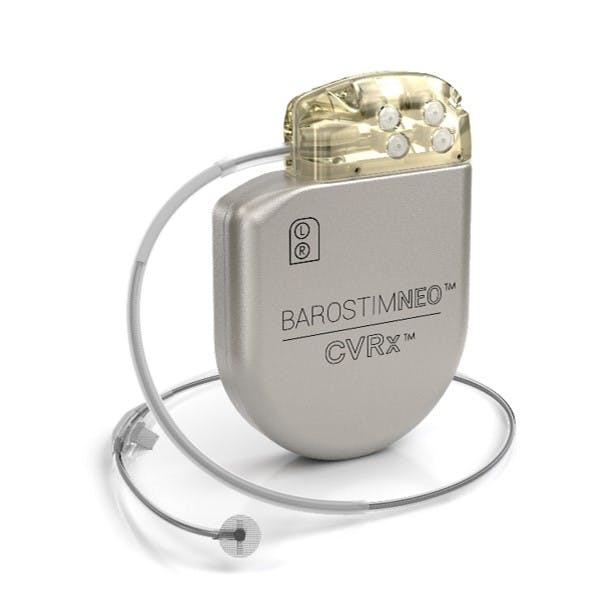 March 18, 2024—The BeAT-HF trial—Baroreflex Activation Therapy (BAT) for Heart Failure (HF)—evaluated treatment using Barostim (CVRx, Inc.) plus guideline-directed medical therapy (GDMT) in patients with New York Heart Association (NYHA) class II/III HF compared to patients on GDMT alone.
Barostim is an extravascular, device-based therapy that is designed to deliver electrical stimulation to carotid baroceptors to increase baroreceptor signaling, which is reduced in HF patients. This imbalance in the autonomic nervous system can lead to deleterious effects on cardiovascular homeostasis and cardiac function. Stimulating the carotid baroreceptors is intended to restore balance to the autonomic nervous system and reduce patients’ HF symptoms.
Findings from the BeAT-HF trial were presented at the 51st annual symposium of the Society for Clinical Vascular Surgeons (SCVS), held March 16-20 in Scottsdale, Arizona.
At SCVS, Miguel F. Manzur, MD, et al presented “Surgical Experience and Long-Term Safety of Baroreflex Activation Therapy in Heart Failure,” which included procedural information as well as safety and efficacy data that were collected as part of the BeAT-HF trial.
Vascular surgeons have been the predominant implanters because of their knowledge of carotid and cranial nerve anatomy, noted the SCVS presentation abstract.
The study investigators concluded, “BAT appears to be an effective therapy for patients with NYHA class II/III HF. Despite the significant risk profile of this patient population, surgical implantation of the BAT system was attended by low perioperative and long-term complications.”
As detailed in the SCVS abstract, the study included a total of 159 patients who were implanted with the BAT system. The average carotid sinus mapping time was 20.1 ± 12.0 minutes, which showed improvement with experience. Additionally, surgical experience documented that the majority of electrodes (87%) were placed at the anteromedial aspect of the internal carotid artery.
In the abstract, the investigators reported that the freedom from major adverse neurologic and cardiovascular events was 96.9%. System or procedure-related complication rates were 6.3% at 30 days and 1.3% from 30 days to 6 months. At follow up of 41.9 ± 15.4 (1.2-72.1) months, there was a 92.5% complication-free rate.
Overall, the 12- to 24-month therapeutic benefit from BAT was consistent with previously reported efficacy through 6 months. There was a durable and clinically meaningful improvement in quality of life, 6-minute hall walk distance, and NYHA class, stated the investigators.
Barostim, which received Breakthrough Device designation, is FDA approved for use in HF patients in the United States. Additionally, Barostim received CE Mark approval for HF and resistant hypertension in the European Economic Area.
In late 2023, the company announced that the FDA approved revised Instructions for Use (IFU) for Barostim. The IFU now incorporates key long-term clinical data from the BeAT-HF randomized clinical trial. The revised IFU document can be found at www.cvrx.com/ifu.
Advertisement
Advertisement