Advertisement
Advertisement
The European Society for Vascular Surgery (ESVS) published its first-ever clinical practice guideline recommendations on radiation safety in European Journal of Vascular and Endovascular Surgery, aiming to inform operators about radiation physics and radiation dosimetry, raise awareness about the risks of ionizing radiation, describe the available methods for protecting against radiation exposure, and outline key issues and recommendations for best practice.1
The Guideline Writing Committee consisted of physicians and scientists with expertise in the management of radiation exposure, and the guideline document was reviewed and approved by the ESVS Guidelines Committee, as well as 25 document reviewers. Recommendations are based on the European Society of Cardiology grading system, with the level of evidence graded as A, B, or C and recommendations noted as class I, IIa, IIb, or III.
As noted by the authors, adequate training on the principles of working with radiation and safe exposure limits is important and should be regularly repeated. ESVS guidelines recommend the use of air kerma area product and air kerma to set diagnostic reference levels for endovascular procedures, in agreement with the International Commission on Radiation Protection (ICRP). As such, all radiation-exposed works must comply with European and national regulations and must be monitored (class I law), and pathways must exist for pregnant employees to review dose history and manage subsequent occupational radiation exposure (class I law).
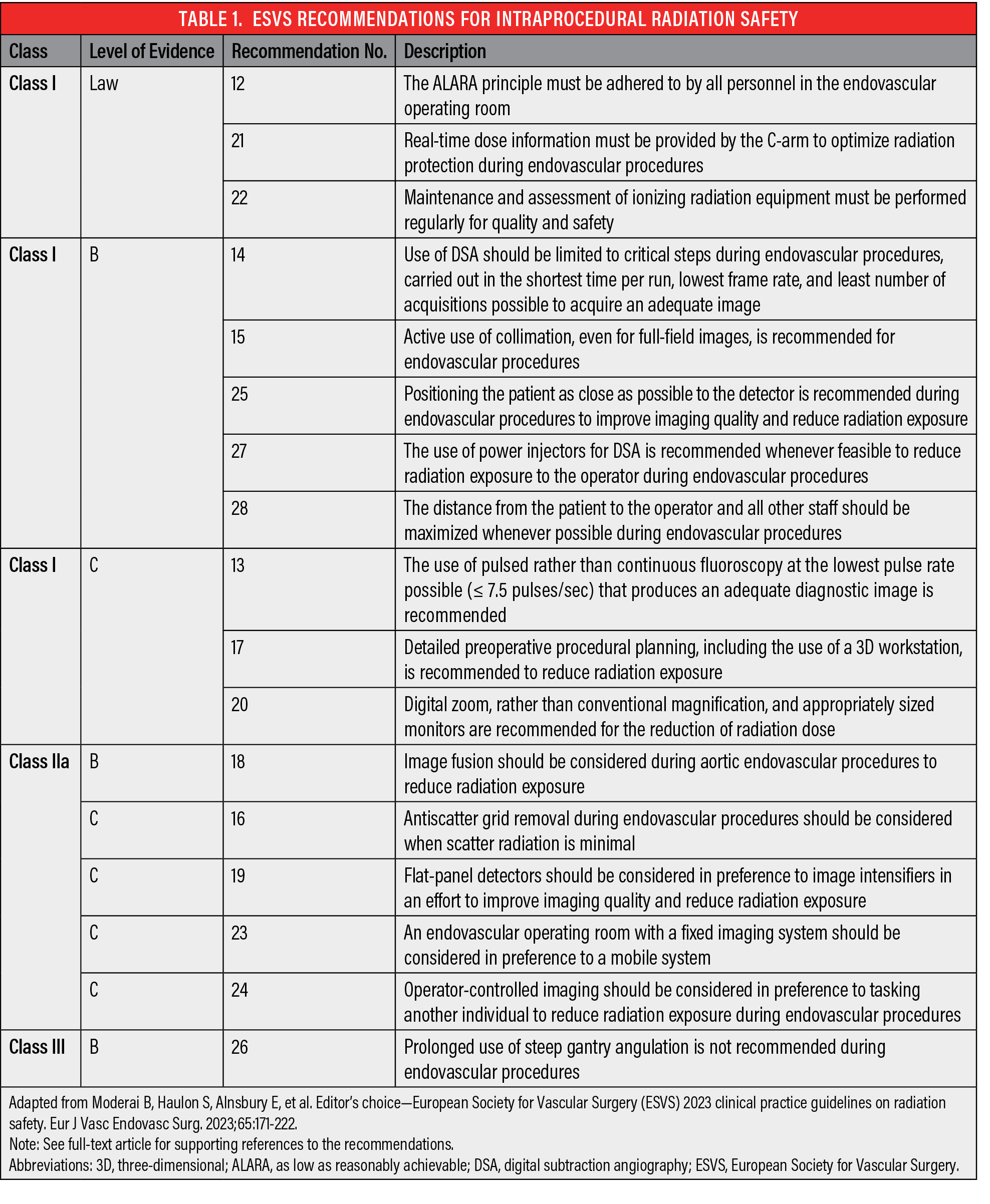
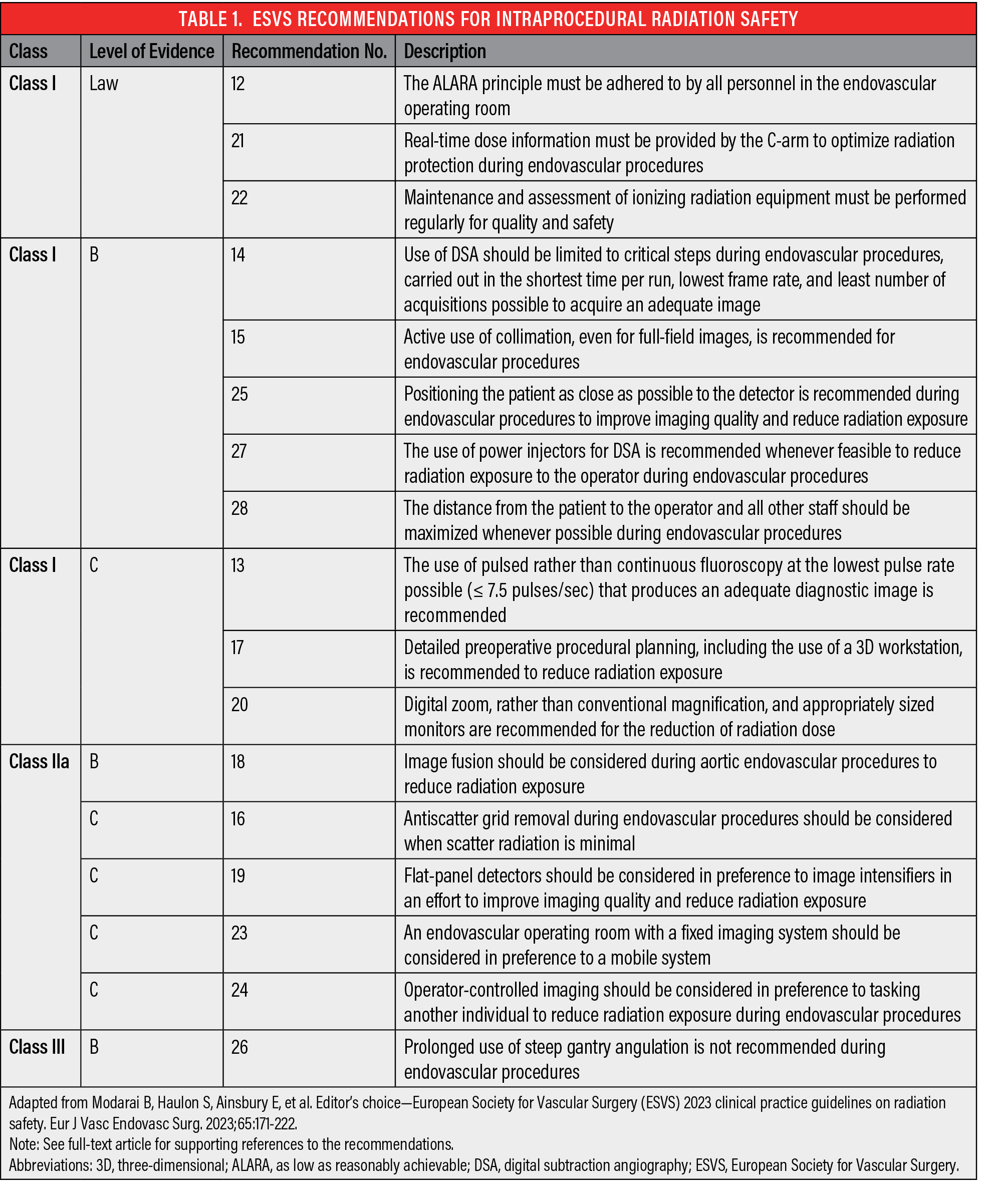
Also in agreement with the ICRP and National Council on Radiation Protection and Measurements, ESVS recommends the use of two radiation dosimeters (one under the protective apron and one unshielded above the apron) to be worn by all personnel regularly exposed to radiation in the operating room (class I law), with additional dosimeters at eye and finger level (class IIb, level C) and real-time dosimetry considered (class IIa, level C). Specific recommendations for intraprocedural radiation safety are outlined in Table 1.
Personal protection devices should include well-fitting lead aprons of ≥ 0.35-mm lead thickness, thyroid collars, and appropriately fitted lead glasses with ≥ 0.75‑mm lead equivalence (all class I, level B). Use of axillary supplements, sleeves, and wings should be considered for adequate fit for female operators, as well as leg shields and table-mounted skirts (both class IIa, level C). Gloves and head caps are not indicated (class III, level C).
The Guideline Writing Committee noted that many recommendations are supported by level C evidence, indicating that additional studies are needed to strengthen the evidence on radiation protection. They also stressed the importance of structured radiation safety training programs that are updated regularly, with re-training planned at least every 36 months or when there is a change in technique or risk.
With the introduction of new technologies such as three-dimensional navigation, robotic tracking, and artificial intelligence applications aiming to reduce radiation doses, multicenter trials are needed to evaluate their costs versus their impact on radiation exposure, noted the investigators.
1. Modarai B, Haulon S, Ainsbury E, et al. Editor’s choice - European Society for Vascular Surgery (ESVS) 2023 clinical practice guidelines on radiation safety. Eur J Vasc Endovasc Surg. 2023;65:171-222. doi: 10.1016/j.ejvs.2022.09.005
ENDOVASCULAR TODAY ASKS…
We asked Tara M. Mastracci, MD, one of the document reviewers for the clinical practice guidelines and vascular surgeon with St. Bartholomew’s Hospital in London, to comment on the importance of radiation safety in practice and raising awareness.
Throughout your career, you have been a proponent of the need to focus on the potential effects of radiation exposure and promote the safety of patients and operators alike. First, how would you characterize the current overall landscape regarding radiation safety, both awareness and practice?
I think the marked improvement in awareness and practice is a tribute to how hard the endovascular community has worked on this over the years. It is wonderful to see this issue front and center and the subject of new guidelines when it was much lower on the agenda 10 or 20 years ago.
As younger surgeons enter the field and are staring down the barrel of a life in the endovascular suite, long-term occupational health outcomes take on new meaning, and the entire field has refocused. It is a great step forward.
What are the key practical takeaways of the ESVS clinical practice guidelines in your view?
I think the most important role these guidelines play is that they set a benchmark against which we can measure practice in current times. As a body of work, they represent a very thorough review of the literature about radiation protection for endovascular interventionalists and have direct applicability to our practice. This means they provide guidance for hybrid theater environments, which can be orphans in the radiology and cardiac cath lab ecosystem that has existed for so long. This “orphan” status has meant it can be difficult to point to published guidance when building a hybrid environment. These guidelines will be a resource for planners and surgeons who can now point to best practice and have evidence to support it.
The importance of teaching and training radiation safety really comes across well in these guidelines. A golden thread throughout the manuscript is the importance of ensuring safety is center to all work in the hybrid theater and how we must help each other learn best practices. Online modules for learning are important, but I think this guideline encourages those of us who are senior in the room to model good behavior and propagate safe practice.
Recommendation 24, encouraging operator-controlled imaging, will likely be controversial in some jurisdictions. However, I think this shows the courage of the guidelines—an interpretation of evidence that might challenge the norm is what the field needs to evolve. I think it would be absolutely wonderful if this started a discussion about roles and responsibilities in the hybrid theater that reimagined the team structure and function around a principle of patient and occupational safety.
I am also excited to see how prominent technology, and specifically the use of image guidance, has become part of our practice. This guideline not only acknowledges the importance it has evolved to have in patient safety and procedure efficiency but also leaves room for a fantastic future where so many new technologies may be incorporated into hybrid theater life.
Finally, I cannot underscore how important the section on personal protective equipment (PPE) is for all endovascular interventionalists. Protecting ourselves, not just as an afterthought with PPE that are castoffs from the cath lab but with bespoke equipment, is key. It’s also important for the entire team to take this seriously and be vigilant to be sure exposure is a minimum; this means empowering anesthesia colleagues and nursing to be properly protected. Women, for whom generic lead gowns are slightly lacking, are given particular attention, and I would urge everyone to heed the accommodations needed for different body shapes and sizes.
What advice can you offer to help operators overcome any real-world obstacles in implementing these recommendations?
Patient and occupational safety are incredibly powerful motivators for hospitals. This guideline normalizes the investments and goes further to say that they are mandatory to the safe function of an endovascular team. In well-resourced health care systems, this should be the additional driver needed to change current practice.
The truth is that the richer a health care system is, the more likely they will be able to afford investment in radiation safety. So those who need the greatest assistance are those who work in systems where this investment is not possible or requires sacrifice of other therapies. I believe it is up to all those involved in innovating this technology to pay particular attention to this issue and develop ways that being safe doesn’t cost more. I’m not sure what the answer is yet, but I’m dedicated to continuing to work toward it.
Advertisement
Advertisement
Find more Literature Highlights.
Browse additional literature summaries, key findings, and investigator commentaries across the vascular interventional field.
Read More