Advertisement
Advertisement
March 30, 2021
Fluidx Reports on Investigative Cases of GPX Embolic Device to Block Vessels Feeding Malignant Tumors
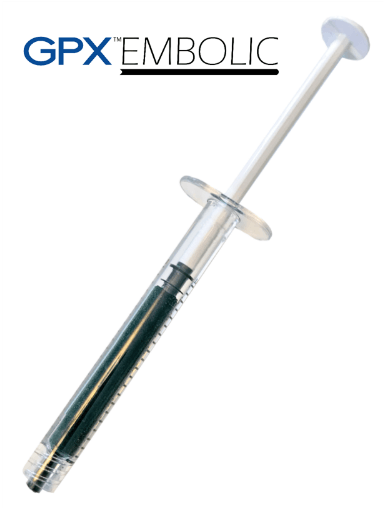 March 30, 2021—Fluidx Medical Technology, Inc. announced details on the clinical use of the investigational GPX embolic device for blocking flow to small microvasculature and large tumor-feeding vessels.
The GPX embolic device is under development and available for investigational use only in New Zealand. It does not have marketing clearance or approval in any market.
According to Fluidx, the GPX embolic device is an innovative embolic designed to combine the benefits of other embolics like coils, particles, and liquids with simplified preparation, delivery, precision, and control, leading to durable, long-term occlusions. GPX technology is a low-viscosity, aqueous-based solution in a syringe that solidifies into a durable embolic material on delivery without polymerization or dimethyl-sulfoxide precipitation.
“The versatility of the GPX product has been demonstrated in a variety of interventional oncology uses,” commented Andrew Holden, MD, in the Fluidx press release. “We have seen excellent distal penetration and backfilling of larger vessels in our tumor cases.” Dr. Holden is Director of Interventional Radiology at Auckland City Hospital in Auckland, New Zealand.
The company noted that in a recent case at Christchurch Hospital in Christchurch, New Zealand, the GPX embolic device was delivered through long, thin microcatheters, including the 2-F, 130 cm in length Progreat Alpha microcatheter (Terumo Interventional Systems) with an inner diameter of 0.48 mm.
Martin Krauss, MD, Head of Interventional Radiology at Christchurch Hospital commented in the company’s announcement, “We saw excellent filling of the distal branches and complete tumor devascularization. The patient exhibited marked decrease in hematuria (blood in urine) following the procedure. Since we were not worried about catheter entrapment, we could take our time and ensure that we occluded all the feeding vessels of the tumor.”
Advertisement
Advertisement
