Advertisement
Advertisement
April 18, 2023
GE HealthCare’s CT-Navigation Solution Introduced
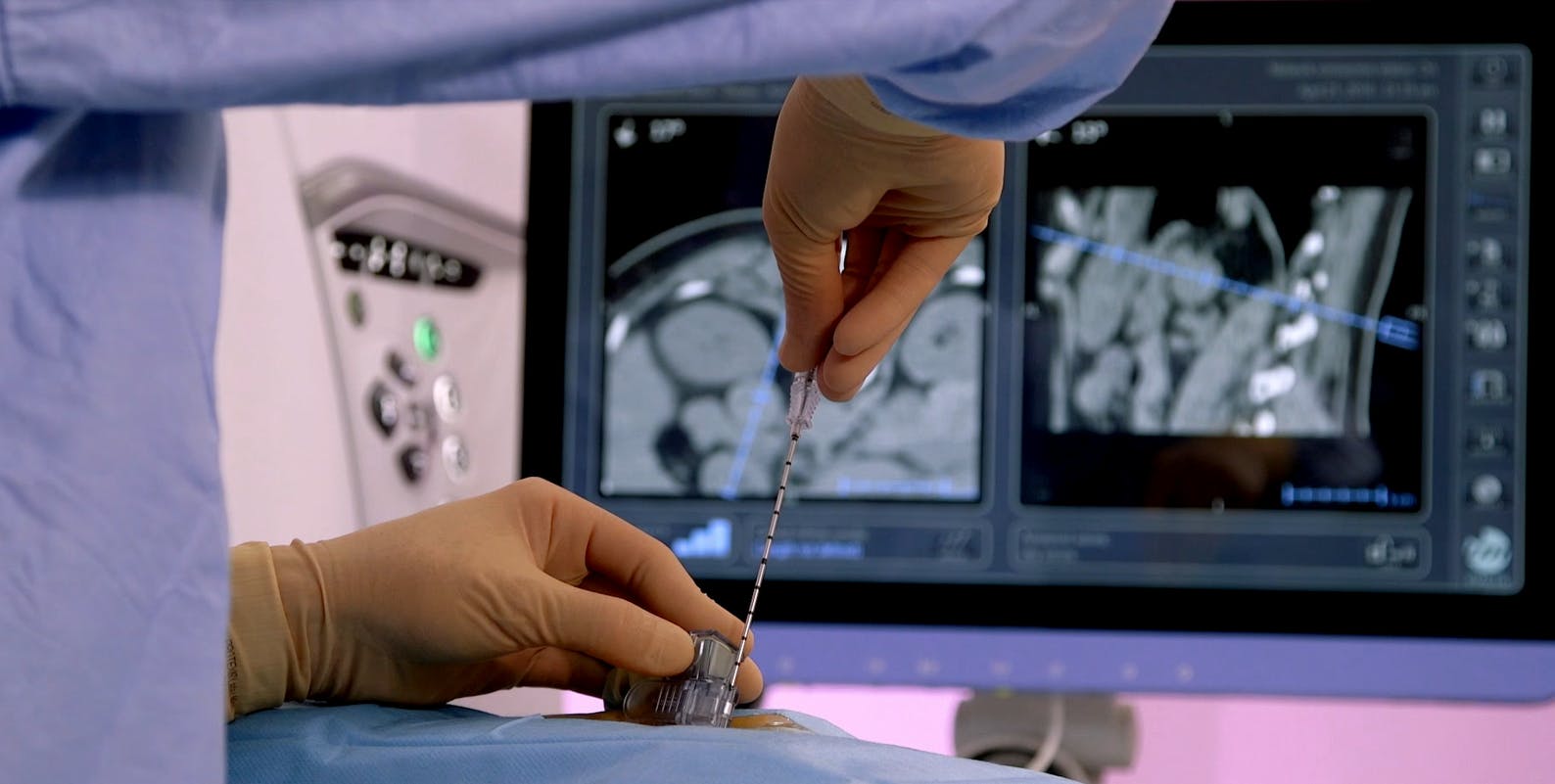 April 18, 2023—GE HealthCare announced the introduction of CT-Navigation, which offers clinicians detailed, real-time, three-dimensional CT images for stereotactic needle guidance across an array of care areas, including interventional and oncological procedures as well as biopsies, ablations, drainage, therapeutics, and more. GE HealthCare is showcasing CT-Navigation at ECIO 2023, the European Conference on Interventional Oncology held April 16-19 in Stockholm, Sweden.
CT-Navigation was developed by Imactis, a Grenoble, France-based company, and became part of the GE HealthCare portfolio with the acquisition of Imactis, which was announced in January 2023. Although currently focusing solely on CT applications, GE HealthCare plans to expand the technology to its image-guided therapy business in the near future, advised the company.
The CT-Navigation system includes a mobile workstation, guidance software, and a disposable procedure kit. It has received CE Mark approval under the European Union’s Medical Devices Regulation and has FDA clearance for use in the United States. GE HealthCare’s install base and global scale provide opportunities for the adoption of CT-Navigation and enhanced practice of precision care at existing client sites, noted the press release.
“Consistent and accurate navigation through the body is key in delivering precision care,” commented Professor Laura Crocetti, MD, in the company’s press release. “CT-Navigation is an intuitive technology that helps us achieve this by enabling clinicians to select and follow an out-of-plane trajectory for a safer path that avoids critical organs and reaches deep-located targets with impressive accuracy while reducing procedure time and possibly radiation dose. Altogether, it helps us ensure better patient outcomes while expanding the boundaries of our practice.”
Prof. Crocetti, who serves as deputy chairperson of the ECIO, is Associate Professor of Radiology, Division of Interventional Radiology, at the University of Pisa in Pisa, Italy.
According to GE HealthCare, the CT-Navigation system was designed to improve safety, increase accuracy, and enhance the intervention workflow. Rather than requiring interventionalists to take multiple control scans and awkwardly position themselves and the needle inside the gantry of a CT system (and increasing the risk of radiation exposure to the clinician), CT-Navigation allows interventionalists to simply place a sensor on the patient inside the gantry instead of working wholly within the CT system’s narrow bore. CT-Navigation enables a more comfortable and safe experience than many CT-guided solutions.
After scans are complete and the patient is removed from inside the system, interventionalists have a full range of motion while navigating a needle more easily and safely through the patient’s anatomy using the placed sensor and detailed CT images, stated the company.
Advertisement
Advertisement
