Advertisement
Advertisement
May 6, 2024
Medtronic’s In.Pact AV DCB Evaluated at 60 Months in the IN.PACT AV Access Study
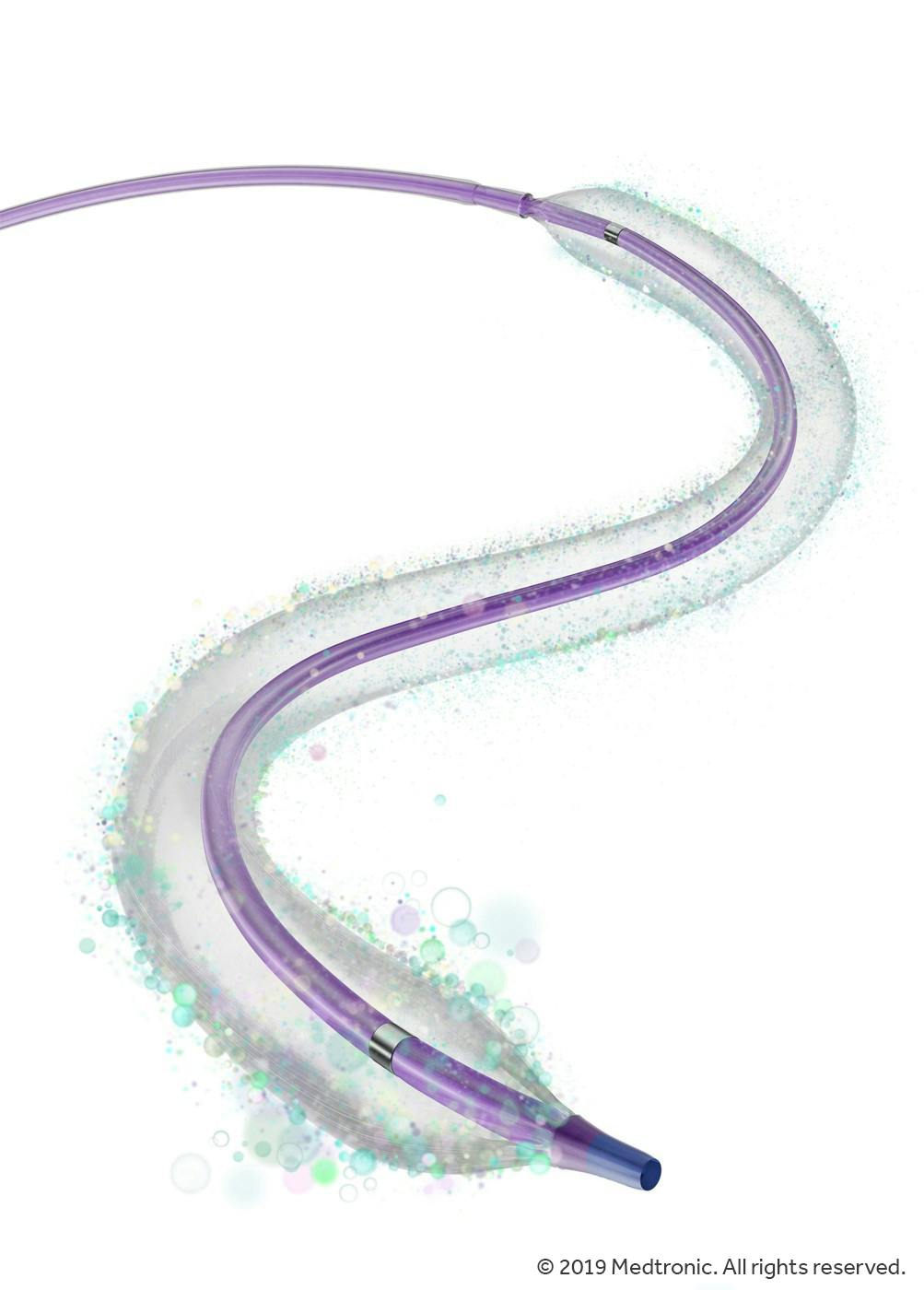 May 6, 2024—The IN.PACT AV Access randomized controlled trial continues to compare Medtronic’s In.Pact AV drug-coated balloon (DCB) to standard percutaneous transluminal angioplasty (PTA) in patients with de novo or nonstented restenotic arteriovenous (AV) fistula lesions. The study, which was originally planned for 24 months, enrolled a total of 330 patents (In.Pact AV DCB, n = 170; standard PTA, n = 160) at 29 sites in the United States, Japan, and New Zealand.
In the latest data, the IN.PACT AV Access investigators evaluated mortality in the 60-month data using Kaplan-Meier analysis. The time-to-event analysis used time to death or last follow-up date through 5 years. The 5-year extension required reconsenting by patients.
The “podium first” data were presented by Professor Andrew Holden, MBChB, at the 2024 Charing Cross International Symposium (CXS) held April 23-25 in London, United Kingdom. Prof. Holden, who serves as a principal investigator of the IN.PACT AV Access study, is Director of Interventional Radiology and Associate Professor of Radiology at Auckland University School of Medicine in Auckland, New Zealand.
As noted in the CXS 2024 presentation, the data included a smaller pool of participants who completed the 5-year follow-up visits (In.Pact AV DCB, n = 57 versus standard PTA, n = 41). The reasons for not completing follow-up from the index procedure and the 60-month timepoint included death (46 vs 39), withdrawal (36 vs 37), declined consent (21 vs 33), and other (10 vs 10).
At CXS 2024, Prof. Holden reported the following:
- The incidence of all-cause mortality post vital status update was 41% for In.Pact AV DCB versus 46.5% for standard PTA (log rank P = .51).
- The mortality rate of patients on hemodialysis in the United States (dialysis onset 2017; includes COVID-19 pandemic) was 60.4%.
- All-cause mortality remained comparable between DCB and PTA through 60 months.
“The IN.PACT AV Access study is the only randomized pivotal trial of a device treating dysfunctional AV fistulas to demonstrate consistent and sustained clinical benefit through 36 months,” commented Prof. Holden to Endovascular Today. “Superior long-term patency has been achieved across all types of AV fistulas and in all locations compared to plain balloon angioplasty. Cost-effectiveness has also been shown in multiple health systems. This durable long-term data suggest the use of IN.PACT AV DCB as a standard of care for AV fistula maintenance in patients with end-stage kidney disease.”
In August 2020, the initial results of the IN.PACT AV Access study were published by Robert A. Lookstein, MD, et al in The New England Journal of Medicine (2020;383:733-742). The trial met both its primary safety and effectiveness endpoints—showing promise for the use of the In.Pact AV DCB to treat AV fistula lesions in patient with end-stage renal disease. Through 6 months, target lesion primary patency was 82.2% in the DCB group compared to 59.5% in the PTA group (log-rank P < .001) and there was a 56% reduction in reinterventions.
Results have continued to demonstrate a durable and sustained treatment effect of the In.Pact AV DCB compared to PTA through 12 months, 24 months (presented at CXS in April 2021), and 36 months (presented at CXS in April 2022).
Recently published studies based on this data from the 12-month time point include the following:
- Clinical outcomes by Prof. Holden et al in Journal of Vascular and Interventional Radiology (2022;33:884-894)
- Economic outcomes by Jan B. Pietzsch, PhD, et al in Journal of Vascular and Interventional Radiology (2022;33:895-902)
- Economic outcomes focused on the Japanese and South Korean health care system by Ho Jong Chun, MD, et al in Nephrology (2022;27:859-868)
- Clinical outcomes of Japanese patients by Hiroaki Haruguchi, MD, et al in Therapeutic Apheresis and Dialysis (2023;27:682-69)
In April 2023, Medtronic announced that Prof. Holden presented 36-month data from a subanalysis of the IN.PACT AV Access study, as well as 48-month vital status outcomes. The company stated that the presentation showed durable, long-term results that demonstrated the sustained and superior performance of DCB compared to PTA through 36 months, with no difference in mortality through 48 months and sustained benefit seen in several subgroups. These data were published by Dr. Lookstein et al in Journal of Vascular and Interventional Radiology (2023;34:2093-2102).
Advertisement
Advertisement