Advertisement
Advertisement
June 26, 2023
SNIS Updates Guidelines on Use of Antiplatelet and Antithrombotic Therapy in Neurointerventional Procedures
June 26, 2023—In an update to guidelines from 2014 published in Journal of NeuroInterventional Surgery, Schirmer et al and the Society of NeuroInterventional Surgery (SNIS) Standards and Guidelines Committee outline a revised and advanced set of recommendations for the use of antiplatelet and antithrombotic therapy in neurointerventional procedures. These updated guidelines aim to educate practitioners on the treatment of specific pathologies and patients with specific comorbidities.
The guidelines were written via a consensus conference among the authors and supported with additional input from the SNIS Standards and Guidelines Committee and the SNIS Board of Directors.
All recommendations were formed from the data collected after a robust literature review of all research published since the previous guidelines were published in 2014 (December 2013-September 2022). According to the authors, the literature consisted of a mix of case studies and nonrandomized, single-center studies.
The first two recommendations help address platelet testing and when it is appropriate to resume anticoagulation and guide practice decisions. The remainder of the recommendations then address disease-specific considerations or comorbidities. The areas described include ruptured and unruptured brain aneurysms and patient comorbidities such as venous thrombosis, atrial fibrillation, brain arteriovenous malformations, intracranial atherosclerotic disease, elective and emergent carotid artery stenting, and cerebral venous thrombosis (Table 1).
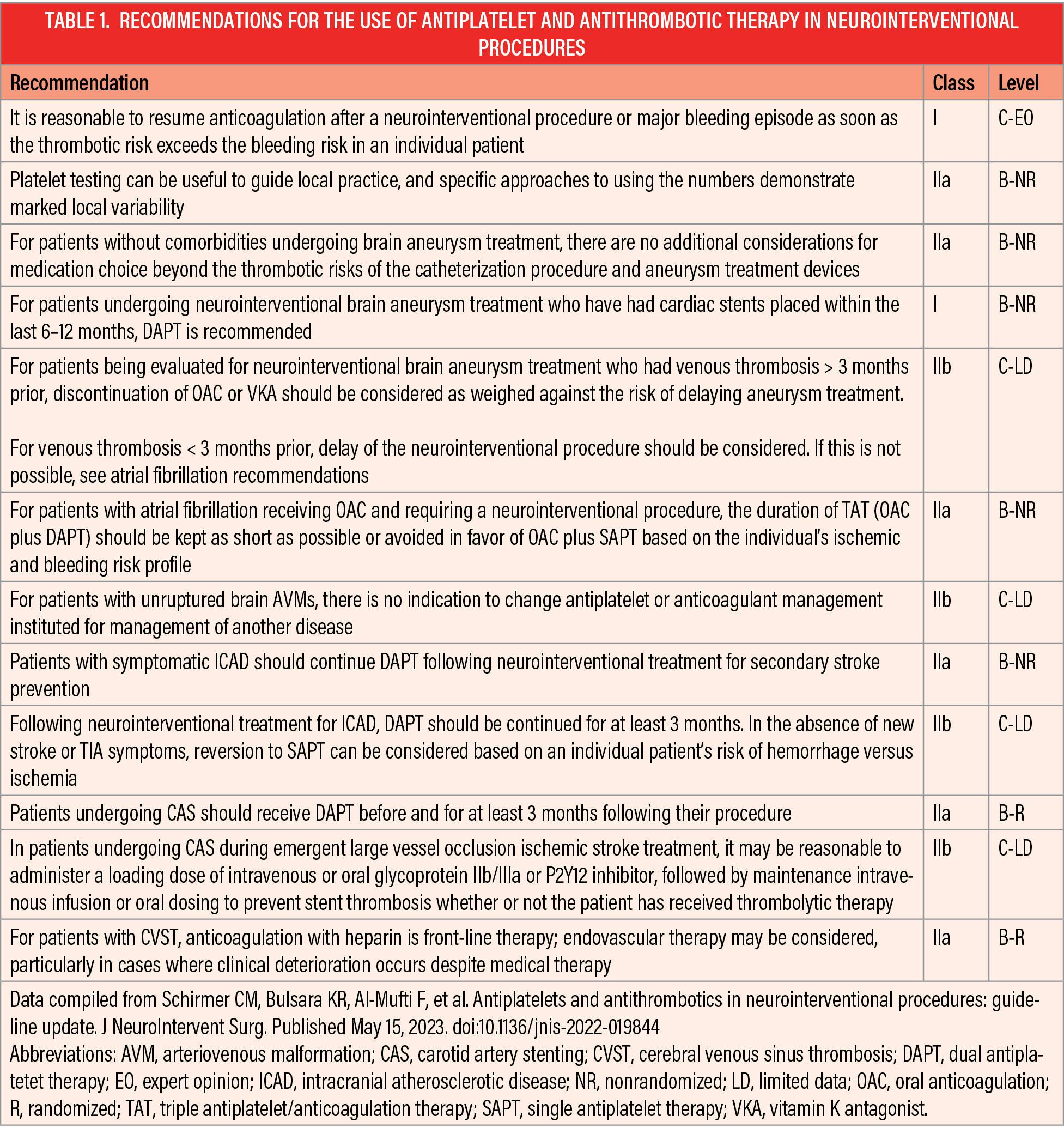
In addition to providing recommendations, the authors also used this update to convey important distinctions on how the use of direct oral anticoagulants (DOACs) impacts neurointerventional procedures. It was explained that the use of DOACs, such as dabigatran, apixaban, betrixaban, edoxaban, and rivaroxaban, had significantly increased since the previous guidelines were released. As such, the authors offered an explanation on how these agents can be reversed in both urgent and emergent settings when necessary. In a brief overview, the authors discuss the approach for reversal of two categories of DOACs: direct thrombin inhibitors and direct factor Xa inhibitors.
The authors conclude that while there is a lower quality of evidence than compared with coronary interventions, the management of antiplatelets and antithrombotics for neurointerventional procedures is similar. However, additional prospective and randomized studies are needed to further strengthen these recommendations.
Endovascular Today Asks…
Lead author, Steven W. Hetts, MD, with the University of California, San Francisco, offers some additional context regarding the development and practical use of these recommendations.
What are the most significant updates/additions to these guidelines since 2014?
We have a lot more experience with endovascular devices like stents, and we have a lot more experience with patients with comorbidities, such as atrial fibrillation and recent surgery. So, really, the most significant difference between the previous guideline and this guideline update is we tried to develop a matrix of when to use dual antiplatelets versus single antiplatelets based on comorbidity, for example when you have a patient with a brain aneurysm and deep vein thrombosis. So, looking at how do you adjust your medication regimen to take into account those multiple different conditions.
Stroke treatment paradigms have changed considerably between the publications of the 2014 and 2023 guidelines, as have other neurointerventional procedural settings. How would you characterize the importance of highlighting the evolving role of DOACs in patient care and how they impact neurointerventional procedures in the current guidelines?
DOACs are much more commonly used now, and we run into them incidental to our practice, much more than we did a decade ago. So, investigating how they might interact with other medications we might prescribe for our patients is really helpful. We were really aided in this guideline by Lucie Thibault, who is a pharmacologist who spends a lot of time evaluating drug-drug interactions and optimal medical regimens. So, she was a big part of the team that helped make these guidelines more reflective of modern practice.
What advice can you provide on how physicians can incorporate these recommendations into their treatment algorithms?
We tried to format the guidelines so that a physician can go to the tables, review the conditions, and see the universe of medical regimens that they should think about to optimize patient care. Other tables can be used to guide how to switch between agents, making it a user-friendly and easy reference.
Advertisement
Advertisement
Find more Literature Highlights.
Browse additional literature summaries, key findings, and investigator commentaries across the vascular interventional field.
Read More