Advertisement
Advertisement
September 28, 2022
Study Evaluates Risk Factors and Reintervention Outcomes of Acute Iliofemoral DVT Intervention; Classification System Developed
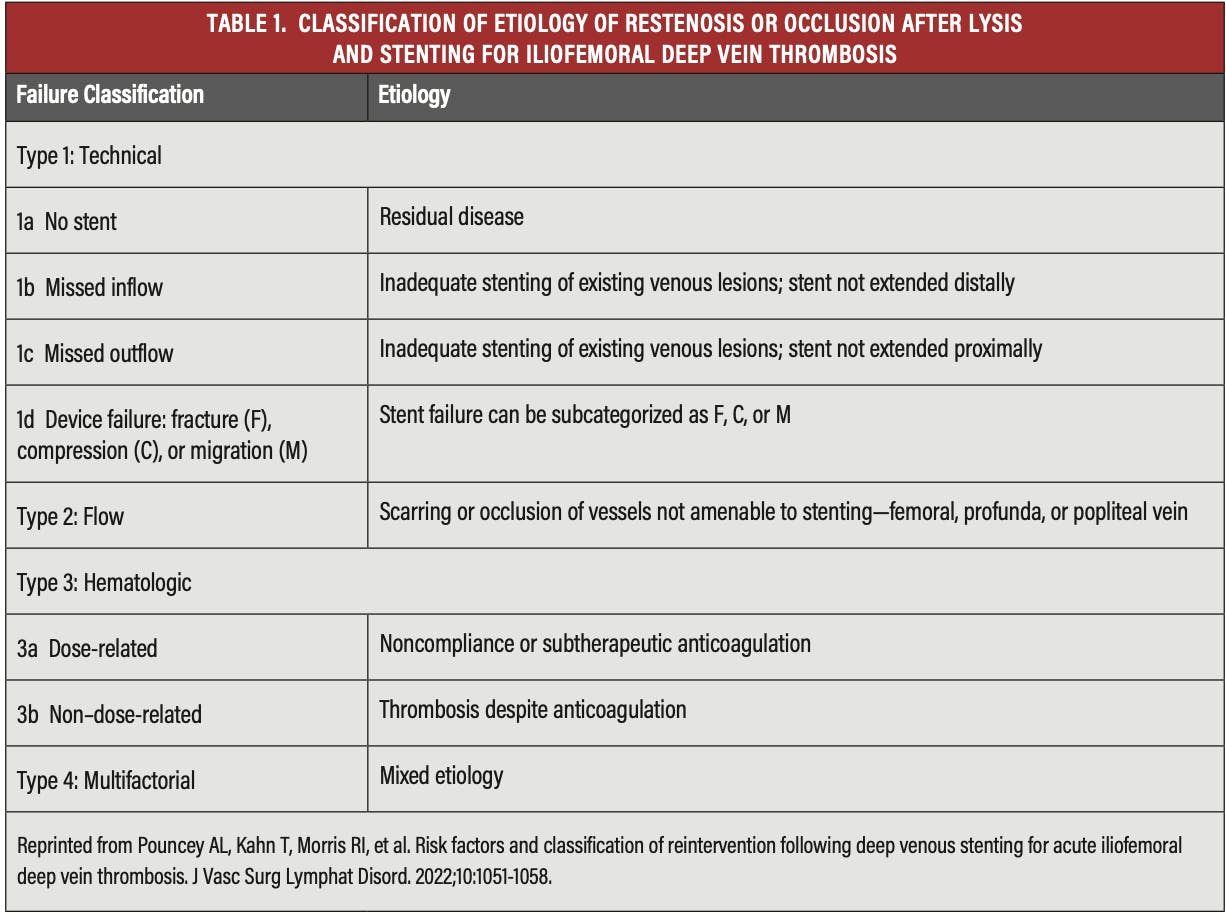
September 28, 2022—In a single-center, retrospective cohort study published in Journal of Vascular Surgery: Venous and Lymphatic Disorders, Pouncey et al found that a significant proportion of patients who underwent deep venous stenting for acute iliofemoral deep vein thrombosis (DVT) required reintervention due to potentially preventable factors. A classification system was developed to help standardize analysis of treatment outcomes for use in practice and future research (Table 1).
KEY FINDINGS
- 33.6% of limbs required reintervention for stenosis or occlusion after iliofemoral deep venous thrombolysis, with a median time to intervention of 45 days.
- The likelihood of reintervention was significantly associated with IVC involvement, profunda occlusion, stenting across the inguinal ligament, and anticoagulation noncompliance.
- Technical issues were seen in 54.2% of cases requiring intervention.
- Hematologic issues were identified in 33.3% of cases requiring intervention; 81% of these were related to noncompliance or subtherapeutic anticoagulation.
- Flow-related issues were found in 43.8% of reintervention cases.
Investigators identified patients who presented from November 2013 to 2017 with symptomatic acute or subacute iliofemoral DVT lasting ≤ 28 days, underwent successful lysis, and had a minimum follow-up of 12 months. Reinterventions were performed for symptom recurrence (with > 50% reduction in stent diameter), a threatened stent, a correctable anatomic issue, or after stent occlusion.
After reintervention, duplex ultrasound surveillance was performed on day 1, at 2, 6, 12, and 26 weeks, and annually thereafter to assess ongoing vessel patency without reintervention (primary) and with (primary-assisted) and with occlusion (secondary).
Data on patient demographics, risk factors, extent of initial and residual thrombus, stent insertion, anatomic coverage, in-stent stenosis, time to reintervention and type of reintervention performed, and procedural success were retrospectively analyzed, as were intraprocedural venographic imaging records. Severity of postthrombotic syndrome (PTS) was measured using the Villalta score.
Investigators subsequently developed a failure classification system to assess reintervention cases, breaking failure types into technical, flow-related, hematologic, or multifactorial (Table 1).
Of 143 limbs (133 patients), 95 (66.4%; 88 patients) remained patent and 48 (33.6%; 45 patients) required reintervention, 25 (17.4%) of which presented with reocclusion (with six cases unsuitable for further endovascular treatment). Median time to reintervention was 45 days (range, 5-773 days).
In risk factor analysis, younger age was significantly associated with reintervention (32 vs 46 years; P < .01). The likelihood of reintervention was significantly associated with inferior vena cava (IVC) involvement (risk ratio [RR], 2.16; 95% CI, 1.40-3.31; P < .01), profunda occlusion (RR, 2.78; 95% CI, 1.87-4.11; P < .01), stenting across the inguinal ligament (RR, 2.08; 95% CI, 1.35-3.21; P < .01), and anticoagulation noncompliance (RR, 7.09; 95% CI, 2.18-23.04; P < .01).
Successful reintervention was achieved in 64.6% (31/48) of cases overall; however, all unsuccessful cases were after complete vessel occlusion (RR, 32.31; 95% CI, 2.05-508.36; P < .01). At 3 years, there was a significant difference in secondary patency between reintervention before and after occlusion (100% and 19%; P < .001). Patients requiring reintervention had a greater incidence of any PTS at 1 year (median Villalta score for reintervention vs no reintervention, 3 [IQR, 1-5] vs 1 [IQR, 1-4]; RR, 2.28; 95% CI, 1.00-4.75; P = .029).
Using the classification system, technical issues were found in 54.2% of reintervention cases versus 6.3% of cases not requiring reintervention (P < .01), hematologic issues were found in 33% versus 1.1% (P < .01; 81% were dose-related), and flow-related issues were seen in 43.8% versus 0% (P < .01); 27.1% of all cases were multifactorial.
Based on these results, the investigators stressed the importance of stenting technique, postprocedural surveillance, and adherence to anticoagulation therapy to optimize patient outcomes.
ENDOVASCULAR TODAY ASKS…
Study investigators Anna Pouncey, BA(Hons), BMBCh, and Stephen Black, MD, expanded on the study’s results and discussed their classification system for restenosis or occlusion after lysis and iliofemoral DVT stenting.
The classification system you proposed and validated in this study helped show that most reintervention cases resulted from potentially preventable causes, with technical issues observed in almost 55% of cases. What do you hope this classification system achieves, and how can it be further used in clinical practice?
First, we wished to report these findings to generate a culture of transparency and a long-term outlook in management of patients with deep venous disease. In a way, the rate of avoidable factors (technologic and hematologic issues) is encouraging, as it shows there are further measures we can take to improve outcomes for our patients. We hope that adopting this classification system will allow for quality checks and monitoring in clinical practice, provide guidance regarding the most appropriate reintervention strategy, and allow for comparability when reporting outcomes in the literature.
In the most practical sense, it is a reminder to ask ourselves: First, is this patient suitable for intervention? Then, during the procedure: What is the inflow like? What is the outflow like? Have I covered all residual disease? For this, we also recommend the use of intravascular ultrasound (IVUS). Our findings suggest the importance of careful monitoring to enable us to intervene before complete reocclusion occurs and to work closely with our hematology colleagues, ensuring that we engage and educate our patients appropriately about the importance of anticoagulation therapy after stenting.
The rate of technical errors found in your study suggests the need for additional training to achieve technical expertise. What factors affect the learning curve for iliofemoral venous stenting, and what approaches can be used to help reduce it?
Temporal analysis of the proportion of technical errors at our center revealed an initial increase following rapid service expansion in 2014 to 2015, which was followed by a significant decrease (−21.5%) in the following 2 years. This is unsurprising, as we have consistently observed that deep venous stenting requires differing expertise to arterial stenting and considerable attention to detail.
Measures to reduce the learning curve include ensuring that appropriate mentoring is available for procedural planning, troubleshooting difficult cases in your center, and practicing within a close multidisciplinary team. If you wish to expand your practice beyond the resources currently available, there are a variety of courses and a wealth of tutorials that are regularly delivered by experts in the field. They are also often more than willing to provide opportunity for observational attendance in their theaters and provide support as you build your practice.
There were no significant differences in risk factors or extent of thrombus between patients who had undergone reintervention before and after occlusion. In addition, risk factors for intervention included IVC involvement and stenting across the inguinal ligament, which you noted are markers of thrombus burden and inflow. In both instances, you highlighted the importance of duplex ultrasound assessment. What are your institution’s duplex ultrasound protocols, and how can duplex ultrasound assessment of inflow guide treatment?
We time our surveillance to day 1, at 2, 6, 12, and 26 weeks, and annually thereafter, in accordance with our observations regarding timing of in-stent stenosis. During surveillance, percentage reduction of in-stent diameter is assessed using B-mode ultrasound by comparing the patent nonstenosed stent diameter and diameter of the stenosed segment. Further information regarding ultrasound surveillance for the detection of obstructed iliocaval venous stents is available in an excellent paper by Sebastian and colleagues.1 Findings on ultrasound are correlated with the patient’s clinical status (presence of PTS symptoms) and verified on venography and IVUS prior to any reintervention performed. We will tend to reintervene for patients with PTS symptoms with > 50% stenosis or for patients with 70% to 80% stenosis or progressive stenosis suggestive of impending vessel occlusion. Significant inflow disease of the common femoral vein is a common cause of stent failure. Thus, confirmation of adequate inflow is vital before the placement of a venous stent.
Noncompliance with anticoagulation was associated with an increased risk of stenosis or reocclusion. What approaches can be used to mitigate nonadherence to recommended therapy?
Anticoagulation noncompliance has been a long-standing issue in clinical practice and studies. This comes back to working closely with our hematology colleagues, ensuring that we engage and educate our patients appropriately about anticoagulation therapy. It is important to note that for many of these patients, this may be the first medication that they have had to regularly take and may have significant impact on their lifestyle. This is also an area in which further research would be valuable to explore patient opinions, lived experience, and barriers to compliance.
1. Sebastian T, Barco S, Engelberger RP, et al. Duplex ultrasound investigation for the detection of obstructed iliocaval venous stents. Eur J Vasc Endovasc Surg. 2020;60:443-450. doi: 10.1016/j.ejvs.2020.05.011
Advertisement
Advertisement
Find more Literature Highlights.
Browse additional literature summaries, key findings, and investigator commentaries across the vascular interventional field.
Read More