Advertisement
Advertisement
June 20, 2023
Surmodics’ SurVeil DCB Receives FDA Approval
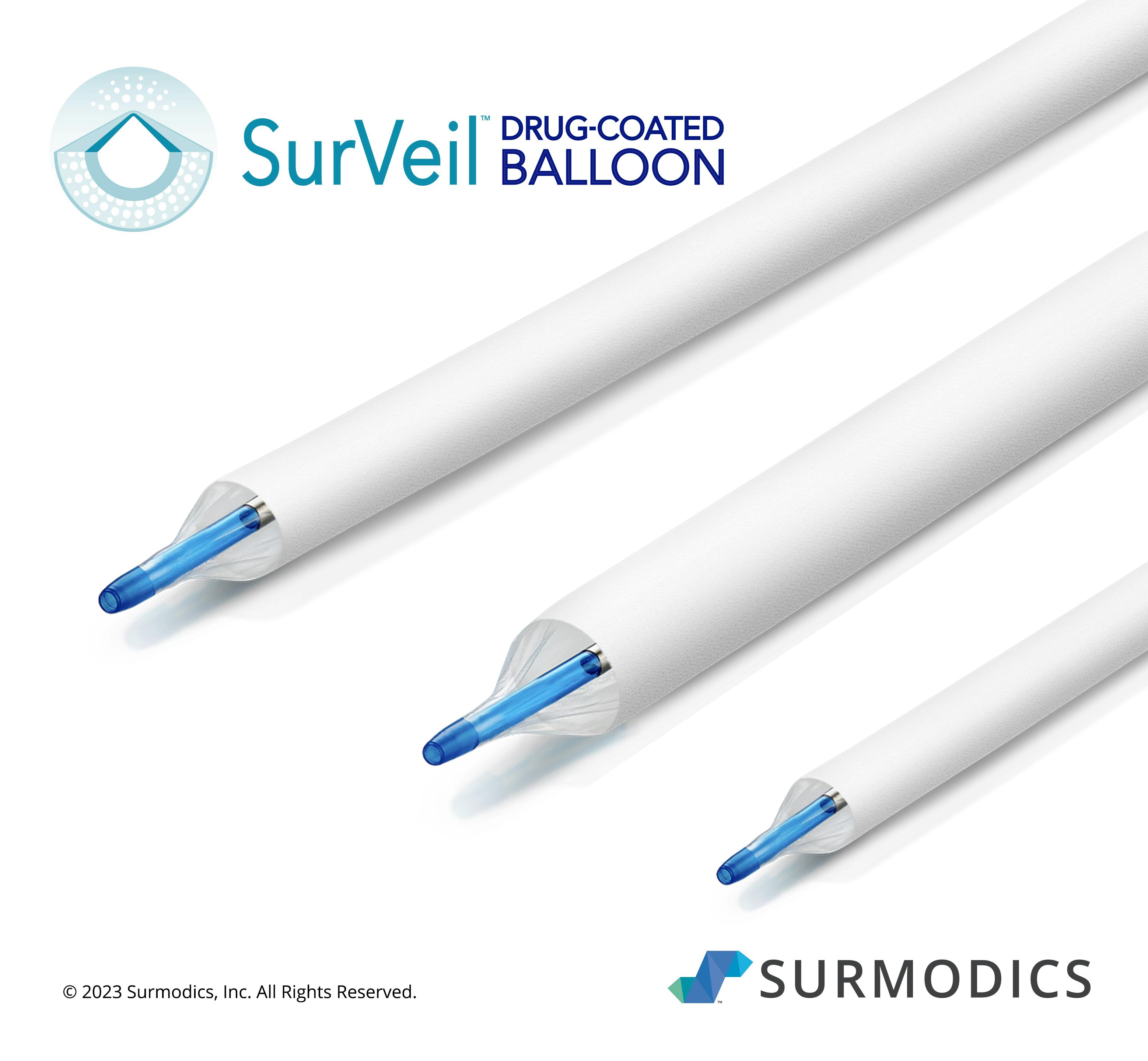 June 20, 2023—Surmodics, Inc. announced FDA approval for the SurVeil drug-coated balloon (DCB), the company’s next-generation device for the treatment of peripheral artery disease (PAD). The Surveil DCB includes the company’s drug-excipient formulation for a durable balloon coating and is manufactured using an innovative process to improve coating uniformity, stated Surmodics.
The SurVeil DCB will now be marketed in the United States for percutaneous transluminal angioplasty, after appropriate vessel preparation, of de novo or restenotic lesions (≤ 180 mm in length) in femoral and popliteal arteries with reference vessel diameters of 4 to 7 mm. The SurVeil DCB received CE Mark certification in the European Union in June 2020.
Surmodics advised that Abbott has exclusive worldwide commercialization rights for the SurVeil DCB. Surmodics will manufacture and supply the product and realize revenue from product sales to Abbott and a share of profits from Abbott’s third-party sales. Surmodics will also receive a $27 million milestone payment from Abbott. The companies’ commercialization agreement was announced in February 2018.
“I am excited that the Surveil DCB will be available to treat patients in the United States,” commented Kenneth Rosenfield, MD, in Surmodics’ press release. “The Surveil DCB is the next-generation DCB as established by results from the TRANSCEND trial, which is the only head-to-head pivotal study that has been conducted versus the market-leading DCB. The Surveil DCB successfully demonstrated noninferior safety and effectiveness at 2 years posttreatment with a substantially lower drug dose.”
Dr. Rosenfield, who is coprincipal investigator of the TRANSCEND clinical trial, presented the 24-month follow-up results from the study at the VIVA Foundation’s VIVA22 conference.
The TRANSCEND study compared outcomes for the SurVeil DCB compared with a high-dose DCB (In.Pact Admiral, Medtronic) for the treatment of patients with symptomatic PAD caused by stenosis of the femoral and/or popliteal arteries. The global, multicenter, pivotal investigational device exemption TRANSCEND clinical trial enrolled 446 patients with femoropopliteal disease and Rutherford class (RC) 2 to 4. Investigators randomized the patients to either the low-dose (2.0 µg/mm²) paclitaxel SurVeil DCB (n = 222) or the high-dose (3.5 µg/mm²) paclitaxel In.Pact DCB (n = 224).
As summarized in the company’s press release, the 24-month clinical trial results demonstrated the sustained durability of the SurVeil DCB’s safety and efficacy outcomes. The SurVeil DCB remained noninferior to the In.Pact Admiral DCB at a substantially lower drug dose.
The 24-month results included the following:
- 81.8% of patients treated with the SurVeil DCB met the secondary safety endpoint, a composite of freedom from device- and procedure-related death through 30 days postindex procedure and freedom from major target limb amputation (above the ankle) and clinically driven target vessel revascularization (CD-TVR) versus 83.2% of patients treated with the In.Pact Admiral DCB
- Less than 15% of patients in both arms of the trial required repeat revascularization procedures; one patient in the In.Pact group required major leg amputation
- The primary patency rate for SurVeil DCB patients was 70.8% versus 70.4% for In.Pact Admiral patients
Surmodics noted that both the SurVeil and In.Pact Admiral utilize paclitaxel drug coatings. However, the In.Pact Admiral DCB has a 75% higher drug load of paclitaxel (3.5 µg/mm²) than the SurVeil DCB’s drug load (2.0 µg/mm²). The design of the SurVeil DCB is intended to provide more uniform drug distribution, better efficiency of drug transfer, and fewer downstream particulates and downstream emboli, stated the company.
Advertisement
Advertisement
