Advertisement
Advertisement
February 2012 Supplement
Sponsored by Gore & Associates
Optimizing Clinical Outcomes for Thoracic Aneurysms
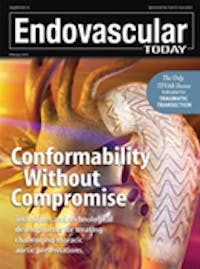
The variability of treatment diameters with the new Conformable GORE® TAG® Device offers improved management for a wide variety of patients.
Since receiving US Food and Drug Administration (FDA) approval in 2005, endovascular repair of thoracic aortic aneurysms (TEVAR) has experienced a dramatic increase in clinical application to a wide variety of pathologies. Although the initial trial and application of this technology was intended for degenerative aneurysm disease, the commercial availability created an opportunity for clinicians to use the GORE® TAG® Device (Gore & Associates, Flagstaff, AZ) in areas beyond aneurysm disease. Specifically, the GORE® TAG® Device has been used for occlusive disease (such as aortic coarctation), aortic dissection, and traumatic aortic disruption—most of which are clinical scenarios that were not listed in the instructions for use until the recent indication for isolated lesions (not including dissections). According to a recent report of 10,288 patients who underwent endovascular repair of infrarenal abdominal aortic aneurysms, 31% to 58% underwent a procedure in which the endograft was used in an anatomical situation that was not within the manufacturers' instruction for use.1
After commercialization, thoracic endografting has suffered a similar fate but the large-scale details of this practice are not as thoroughly studied from an anatomic perspective. 2 As a result of this broadened real-world application, new failure modes for TEVAR were identified. Specifically, proximal device compression has been seen in small aortas when an oversized graft is used. Additionally, the large-diameter thoracic endografts have created problems related to delivery of the prosthesis through small or diseased iliac arteries. By analyzing some of these failure modes, the designing engineers gained valuable information to design a better endograft. The Conformable GORE® TAG® Thoracic Endoprosthesis (Gore & Associates) has been developed to leverage these lessons learned to create a better graft for standard and difficult anatomic situations.
TRACKABILITY
The Conformable GORE® TAG® Device is designed to provide more trackability through tortuous iliac vessels and, ultimately, to land in healthy or nondiseased aortic arches. The single larger-diameter nitinol wire is wound with an additional apex that creates increased structural integrity to avoid collapse yet allow trackability through diseased iliacs. For example, the device was used in a patient who had one occluded iliac system, with severe tortuosity of the contralateral patent iliac. The patient was an 83-year-old man who first suffered a ruptured abdominal aortic aneurysm 14 years earlier and was successfully treated with open repair. He also required a femoral-to-femoral bypass for right leg ischemia. However, this was further complicated by a prolonged hospital course and recovery after discharge. When it was discovered that he had a thoracic aneurysm, he promptly sought treatment but with a less-invasive approach. His preoperative computed tomography scan showed the infrarenal Dacron tube graft with a 4-cm paraanastomic aneurysm at his renal arteries and a patent femoral graft (Figure 1). Additionally, the thoracic aorta was rather tortuous above and below the aneurysmal segment, yet the Conformable GORE® TAG® Device tracked, treated, and sealed this aneurysm without complication (Figures 2 through 4).
CONFORMABILITY
When the first GORE® TAG® Device prosthesis was used for treating aneurysm disease, the results were consistent with findings from the original clinical trial, which provided the safety and efficacy data that led to FDA approval and subsequent commercial availability in March 2005. As is typical in the medical community, an approved device is commonly used in clinical circumstances that do not match the exact tested clinical environment that is outlined in the clinical trial that gained FDA approval based on the specific instructions for use.3
As reports of these various clinical scenarios became available, we learned of potential failure modes when the original GORE® TAG® Device was used in relatively small aortas with a very acute aortic arch, particularly in the face of acute traumatic aortic injury. These patients sometimes suffered compression of the proximal endograft when oversizing was > 30 % of the normal aortic diameter. After further analysis and evaluation of these failure modes, the new Conformable GORE® TAG® Device provides greater variability of treatment diameters, with improved compression resistance, particularly in the proximal aortic segment near the left subclavian artery. Figure 5 shows a sagittal image of the Conformable GORE® TAG® Device in a proximal aorta as it closely conforms to the inner radius of the arch (Figure 6).
With better attachment on the inner radius of the aortic arch, fewer pieces and adjunctive maneuvers are required to maintain clinical success. Also, the catastrophic and potentially life-threatening problem of proximal endograft collapse has not been reported as this endograft has been applied in clinical trials and after early release in the United States and Europe.
VERSATILITY
An additional challenge of treating thoracic aortic disease includes optimizing graft diameters in a diseased aorta that commonly has great variations in diameter between the proximal and distal landing zones. Interventionists commonly found it necessary to use shorter endograft pieces with a stepwise increase in diameter to reach the appropriate proximal diameter. Not uncommonly, this clinical scenario may require four endografts to achieve a good clinical result. The Conformable GORE® TAG® Device provides a wider range of treatment diameters for each endograft size to allow wider applicability in different aortic diameters. In effect, this variability provides a “tapered graft” approach when treating patients with variable diameters of the proximal and distal landing zones. Figure 7 shows the treatment diameters for this new graft along with the corresponding intended treatment diameters for the original GORE® TAG® Device.
We recently treated a 70-year-old man with hypertension, hyperlipidemia, prior history of smoking, and a previous stroke, who had a 6-mm increase of a thoracic aneurysm to 6.3 cm during a 6-month surveillance period. His proximal and distal landing zone diameters were 31 mm proximally and 26 mm distally (Figures 8 and 9).
The Conformable GORE® TAG® Device with the broader range of treatment diameters allows for this patient to be treated with a single 34-mm X 20-cm Conformable GORE® TAG® Device with good clinical result. Not only does this simplicity translate to an easier treatment but also a reduced device cost, as two devices are no longer needed. As the financial pressures of the current endovascular practice creates pressure to limit costs for treating these patients, we look for opportunities to reduce cost yet still maintain a high standard of treatment with the latest technologic advances. Most clinicians welcome the variability of treatment diameters and are afforded fewer restrictions in choosing a graft for a clinical application. The measurements during the planning phase of the procedure do not require the precision that may be needed with a less-flexible endograft. Additionally, if continued budget restrictions limit the resources available to maintain an in-hospital inventory to treat patients, fewer grafts are needed to provide treatment for a variety of patients. After a recent review of GORE® TAG® Device use at our own hospital, we identified 66 patients who were treated with 120 GORE® TAG® Endografts. With reconsideration of the sizing, these same 66 patients would have required 21% fewer (95) pieces, representing a substantial cost savings.
EARLY TRIAL RESULTS FOR THE CONFORMABLE GORE® TAG® DEVICE
After these design changes were incorporated and approved, the premarket approval clinical trial was initiated in October 2009. Fifty-one patients were enrolled from multiple clinical sites within 1 year, with 15 patients added as part of the continued access arm for a total of 66 patients followed. The early results showed 98.5% survival (one multisystem failure mortality). At 30 days, with 46 CTs available, there were two minor proximal type I endoleaks (4.3%), with no endograft migration, compression, graft failure, rupture, or stent fracture. None of these endoleaks had significant aneurysm filling, and most of these were related to grafts that were placed proximal to the aortic arch near the subclavian origin. Each patient required an average of 1.7 endografts for treatment, but the landing zone diameters were noted to have a mean difference of 3.4 mm, which allowed the patients to be treated with a device that could adapt across a wider range of diameters.4
CONCLUSION
TEVAR has been explored for 2 decades in the United States, but the first approved thoracic aortic endograft was introduced to the general medical community in 2005. In 6 short years, there have been lessons learned that provided important clinical feedback to the manufacturing companies. The engineers then processed these concerns, examined the successes, and produced a new, improved product that has now completed a premarket approval clinical trial. The results of this trial have led to the approval of the Conformable GORE® TAG® Device. This new endograft provides the aortic clinician reassurance that they can gain a new and improved product in relatively short order to treat patients with challenging clinical situations.
William D. Jordan Jr, MD, is Holt A. McDowell Professor and Chief, Section of Vascular Surgery and Endovascular Therapy at the University of Alabama at Birmingham in Birmingham, Alabama. He has disclosed that he is a paid consultant to and receives grant/research funding from Gore & Associates. Dr. Jordan may be reached at (205) 934-2006; william.jordan@ccc.uab.edu.
- Schanzer A, Greenberg RK, Hevelone N, et al. Predictors of abdominal aortic aneurysm sac enlargement after endovascular repair. Circulation. 2011;123:2848-2855.
- Matsumura JS. Worldwide survey of thoracic endografts: practical clinical application. J Vasc Surg. 2006;43:A20-A21.
- Makaroun MS, Dillavou ED, Kee ST, et al. Endovascular treatment of thoracic aortic aneurysms: results of the phase II multicenter trial of the GORE TAG thoracic endoprosthesis. J Vasc Surg. 2005;41:1-9.
- Jordan WD. Thoracic Endoprosthesis for Treatment of Aneurysm of the Descending Thoracic Aortic. ClinicalTrials.gov Web site. http://www.clinicaltrials.gov/ct2/show/NCT00874250. Accessed: October 18, 2011.
Advertisement
Advertisement