Advertisement
Advertisement
December 2013 Supplement
Sponsored by Medtronic, Inc.
From Benchtop to Bedside With the Valiant Mona LSA Thoracic Stent Graft
How physicians, engineers, and regulatory agencies can work together to best serve patients with new technologies.
Left subclavian artery (LSA) coverage during thoracic endovascular aortic repair (TEVAR) is often necessary due to anatomic factors and is performed in up to 40% of TEVAR procedures.1 Society for Vascular Surgery practice guidelines recommend that preoperative revascularization should be performed in patients who need elective TEVAR in which proximal seal necessitates coverage of the LSA. Furthermore, routine preoperative LSA revascularization is strongly recommended in selected patients who have anatomy that compromises perfusion to critical organs. However, in patients who need urgent TEVAR in which LSA coverage is necessary, revascularization should be individualized and addressed expectantly.2
Data to date are inconclusive as to the appropriate management of the LSA during TEVAR. LSA coverage is associated with an increased risk of arm ischemia, vertebrobasilar ischemia, and possibly spinal cord ischemia and anterior circulation stroke; left subclavian revascularization should be performed before coverage.3,4 However, others have found that the use of selective revascularization is safe and does not appear to increase the risk of neurologic events.5,6
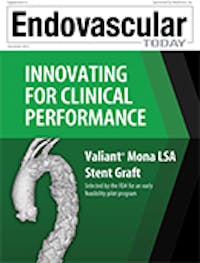
The Valiant® Mona LSA Stent Graft (Medtronic, Inc., Minneapolis, MN), the clinical configuration of the new Thoracic Branch Stent Grafta program, was developed to solve these clinical challenges and extend the benefits of endovascular repair without surgery to more patients with thoracic aortic aneurysms.
The intention was to design a technology leveraging the proven clinical effectiveness of the FDA-approved Medtronic Valiant Thoracic Stent Graft in the management of thoracic aortic disease while maintaining flow to the LSA without the need for surgical bypass.
The Valiant Thoracic Stent Graft consists of a monofilament polyester fabric graft with nitinol springs. It is indicated for the treatment of isolated lesions (excluding dissections) of the descending thoracic aorta. The stent graft system incorporates an eight-peak proximal stent design that distributes radial force evenly across the aortic wall. There is no connecting bar between stents, which makes the graft highly conformable. Advantages of the delivery system include tip capture for enhanced control and precise deployment, as well as a hydrophilic coating that facilitates delivery through difficult access vessels.
Multiple publications have addressed the use of the Valiant Stent Graft in the treatment of thoracic aortic pathology, including the TRAVIATA registry, the VIRTUE registry, the Valiant® Captivia® registry, and the pivotal results of the VALOR II trial.7-11 The VALOR II trial reported 30-day, 12-month, and 3-year results of the Valiant Stent Graft in patients with thoracic aortic aneurysms. This was a prospective, nonrandomized, pivotal trial at 24 sites in the United States that enrolled a total of 160 patients. Technical success was achieved in 96.3% of patients being treated. Perioperative mortality was 3.1%, with 0.6% paraplegia, 1.9% paraparesis, and 2.5% stroke rates. Aneurysm-related mortality at 1 year was 4%, with no ruptures or conversions to open surgery. The 3-year outcomes presented at the TCT conference in 201211 showed an aneurysm-related death rate from 1 to 3 years of 0.9%, with no conversion and only two ruptures. These results demonstrate that the Valiant Stent Graft is safe and effective in the treatment of descending thoracic aortic aneurysms.10
The development of the Valiant Mona LSA Stent Graft leveraged this clinical performance and combined the physician/engineer teams, thus maximizing the understanding of anatomy and physiology with complex engineering principles to limit the potential risks of extending a device into the aortic arch. The key to success was to develop a stent graft and branch graft that would accommodate the aortic anatomy rather than forcing the aorta to accommodate to the stent graft.
THE VALIANT MONA LSA STENT GRAFT
The Valiant Mona LSA Stent Graft is a modified Valiant Captivia device (Medtronic, Inc., Minneapolis, MN) with a single-branch stent graft designed to perfuse the LSA. It is an off-the-shelf device that utilizes the Valiant Captivia tip-capture mechanism for accurate deployment. The main body of the graft has the same eight-peak, self-expanding FreeFlo proximal design (Figure 1). The modification to the device is the addition of a flexible cuff with a radiopaque coil at the base.
The stent graft delivery system is a modified Valiant Captivia system. It has a dual-wire lumen, with the main lumen over the entire device and a second lumen that precannulates the flexible cuff. This allows for loading the branch graft on the back table with a hydrophilic wire that is ≥ 260 cm in length (Figure 2). The proximal nose cone has four grooves that allow for passage of the wire out of the branch while the outer sheath constrains the main device; these grooves allow resheathing of the device over the second wire.
The left subclavian branch stent graft itself is composed of a nitinol helical wireform and a polyester graft material with a proximal flare to provide a seal between components. The branch graft itself comes in three sizes of 10, 12, and 14 mm in diameter, with an overall length of 40 mm. It is delivered from a femoral approach through a 15-F hydrophilic delivery system (Figure 3).
STENT GRAFT DEPLOYMENT AND DELIVERY
Indications for the device require a minimum of 10 mm of distance between the left carotid artery and the LSA. Based on preoperative CT angiography with 3D reconstructions, appropriate angles for deployment of the stent graft can be utilized to identify the anatomy, orient the device, and limit any manipulations of the device in the arch. A pigtail catheter is placed up the contralateral groin through a 5-F sheath. Placement of a stiff wire up over the arch through the ipsilateral femoral artery is performed. A 260-cm hydrophilic wire is advanced through the second lumen port, cannulating the cuff. Left brachial access is achieved with ultrasound guidance, and a 55-cm, 7-F sheath is advanced to the LSA origin. An 18- X 30-mm EnSnare (Merit Medical Systems, South Jordan, UT) is placed just within the aortic arch from the left subclavian orifice along the greater curve. The main device is then advanced over the stiff wire to just proximal from the left subclavian orifice. Care is taken to keep the orientation of the cuff toward the greater curvature.
With the main device in the descending aorta just proximal to the LSA, the second wire is advanced and snared along the greater curvature. At this point, wire wrap needs to be evaluated and prevented. The second lumen wire is then snared and brought out of the 7-F sheath in the brachial artery. Utilizing the preoperative angles, there should be clear separation of the two-wire system as the device is advanced to the LSA. Aortography utilizing preoperative imaging is then performed to allow for any minor adjustment and alignment of the cuff with the orifice of the LSA. Any major realignment of the graft should be performed in the descending aorta to minimize torque on the device and the risk of embolization and stroke in the arch.
The main stent graft is then deployed slowly and advanced forward while constrained, bringing the main body of the graft to the level of the left carotid artery while there is gentle pulling of the second wire from the brachial sheath to engage the cuff in the orifice of the LSA. The main graft is fully deployed with release of the tip-capture mechanism. It is important to remember that the cuff has been designed so that it does not need to extend into the orifice of the LSA. Furthermore, the design of the cuff allows for alignment to be off by up to 30º without affecting the branch graft patency. The delivery system is resheathed after recapture of the tip and then removed from the patient. The proximal stent graft may be molded with a Reliant® balloon (Medtronic, Inc., Minneapolis, MN). The LSA branch graft is advanced over the second wire and deployed through the branch cuff, allowing the proximal flared portion of the branch graft to seal against the branch cuff. Retrograde arteriography through the brachial sheath is performed to identify the orifice of the left vertebral artery. Deployment of the branch graft should maintain patency of this artery. Standard ballooning may be performed between the components of the graft, and completion aortography is used to assess the patency of the arch vessels and the left subclavian branch graft. Assessment for endoleaks is also performed at this time.
The Valiant Mona LSA Stent Graft is manufactured in a 150-cm length. Thus, in thoracic aneurysms that require more than one component, a distal Valiant® device may be implanted as well.
FIRST IN-HUMAN EXPERIENCE
The Valiant Mona LSA Stent Graft was selected by the US Food and Drug Administration (FDA) for participation in the FDA’s innovation pathway. This new program allows for early clinical investigation within the United States. The Guidance on Early Feasibility studies limits enrollment to fewer than 10 patients for devices in early development for a specific indication. The innovation pathway allows for proof of principle and initial clinical safety. It is a key principle of the program that an early feasibility study is appropriate when nonclinical testing is not adequate to advance development, and clinical experience is necessary. However, this early feasibility study must be justified by an appropriate risk-benefit analysis with adequate human subject protection. FDA approval of the early feasibility study IDE application may be based on less nonclinical data than expected for a traditional feasibility or pivotal trial.
The first in-human Valiant Mona LSA Stent Grafts were implanted as part of this program in seven patients at two sites, including the Carolinas Medical Center in Charlotte, North Carolina, and the Cleveland Clinic in Cleveland, Ohio. The first human implant was performed at Sanger Heart and Vascular Institute at the Carolinas Medical Center on April 11, 2013. The patient was an 81-year-old woman with a 6.1-cm thoracic aneurysm that required LSA coverage. The proximal seal zone was 42 mm in diameter, with the distance between the left common carotid artery and the LSA being 11 mm. The LSA origin was 8.5 mm in diameter. Coverage was to the celiac artery, as it was a dumbbell-shaped aneurysm (Figure 4). The planned treatment was performed through a left iliac conduit. The patient was treated with the distal component (46–46-mm distal extension) with a 46-mm Valiant Mona LSA in the arch. The branch graft implanted was a 10-mm branch stent graft (Figures 5 and 6). The patient did well without any complications and was discharged home 5 days after the procedure. Follow-up CTA at 30 days (Figure 7) demonstrated excellent proximal and distal seal without any evidence of an endoleak. Aneurysm diameter remained unchanged.
DISCUSSION
Conventional repair of aortic arch pathology is associated with significant mortality and stroke rates of 6% to 20% and 2% to 18%, respectively.12,13 Aneurysms involving the aortic arch have been treated with open surgical techniques that require cardiopulmonary bypass with hypothermic circulatory arrest. The use of endovascular stent grafts has clearly allowed for the application of interventions in the descending aorta as well as the visceral aorta.
Given the current results of open surgical repair, these techniques have been extended for use in the aortic arch. Techniques have included the use of in situ fenestrations utilizing different tools, branch grafts, and chimney grafts placed parallel to the thoracic graft, with varying results in small numbers of patients. Utilization of a hybrid approach will typically be performed in stages, with the first surgical stage typically being a carotid-carotid bypass and/or a carotid-subclavian revascularization. This is followed by thoracic stent graft repair with placement of the graft to the innominate or left carotid artery, respectively.
Chimney grafts parallel to the main thoracic graft, typically in the carotid or subclavian arteries, have been used in the aortic arch with varying results. Concerns regarding this technique include its unknown and untested durability and the continued risk of type I endoleaks between components through the curvature of the arch.14 The use of in situ techniques to create fenestrations within the graft after deployment across the supra-aortic vessels has been reported. As first reported by Murphy et al, good results have been shown with the use of a laser for in situ techniques.15,16 As is seen in other series evaluating endovascular repair of aortic arch pathology, the number of patients treated is small, with limited follow-up.
There have also been case reports describing favorable outcomes with the use of homemade branch grafts.17,18 Any method that requires treatment of the arch should be performed with careful preoperative planning (comprising preoperative imaging, ease of device use, durability, and the absence of access issues), expert endovascular skills, and appropriate imaging equipment, as these are imperative for a successful result.
The goal of the Medtronic early feasibility study of the Valiant Mona LSA Stent Graft was to validate the procedure in humans and to assess safety and performance acutely and at 30 days, with continued follow-up to 5 years. Specific imaging data were collected to further augment current understandings within the thoracic arch. Results of acute performance will be presented at the 2013 VEITH Symposium.
If successful, the Valiant Mona LSA system could potentially obviate the need for LSA bypass, extend the benefits of endovascular repair without surgery to more patients with thoracic aortic aneurysms, and quell the controversy that is related to whether the LSA needs to be, should be, or can be covered.
Frank R. Arko, III, MD, is with the Department of Vascular and Endovascular Surgery, Sanger Heart and Vascular Institute, in Charlotte, North Carolina. Dr. Arko has disclosed that he is a consultant for Medtronic, Inc. Dr. Arko may be reached at farkomd@gmail.com.
aTechnology under development, not approved commercially anywhere.
- Chung J, Kasirajan K, Veeraswamy RK, et al. Left subclavian artery coverage during thoracic endovascular aortic repair and risk of perioperative stroke or death. J Vasc Surg. 2011;54:979-984.
- Matsumura JS, Lee WA, Mitchell RS, et al. The Society for Vascular Surgery Practice Guidelines: management of the left subclavian artery with thoracic endovascular aortic repair. J Vasc Surg. 2009;50:1155-1158.
- Rizvi AZ, Murad MH, Fairman RM, et al. The effect of left subclavian artery coverage on morbidity and mortality in patients undergoing endovascular thoracic aortic interventions: a systematic review and meta-analysis. J Vasc Surg. 2009;50:1159-1169.
- Weigang E, Parker JA, Czerny M, et al. Should intentional endovascular stent-graft coverage of the left subclavian artery be preceded by prophylactic revascularization? Eur J Cardiothorac Surg. 2011;40:858-868.
- Lee TC, Anderson ND, Williams JB, et al. Results with a selective revascularization strategy for left subclavian artery coverage during thoracic endovascular aortic repair. Ann Thorac Surg. 2011;92:97-102.
- Riesenman PJ, Farber MA, Mendes RR, et al. Coverage of the left subclavian artery during thoracic endovascular aortic repair. J Vasc Surg. 2007;45:90-94.
- Torsello GB, Torsello GF, Osada N, et all. Midterm results from the Traviata registry: treatment of thoracic aortic disease with the Valiant stent graft. J Endovasc Ther. 2010;17:137-150.
- Virtue Registry Investigators. The VIRTUE registry of type B thoracic dissections—study design and early results. Eur J Vasc Endovasc Surg. 2011;41:159-166.
- Heijmen RH, Thompson MM, Fattori R, et al. Valiant thoracic stent-graft deployed with the new captivia delivery system: procedural and 30-day results of the Valiant Captivia registry. J Endovasc Ther. 2012;19:213-225.
- Fairman RM, Tuchek JM, Lee WA, et al. Pivotal results for the Medtronic Valiant Thoracic stent graft system in the Valor II trial. J Vasc Surg. In press.
- Krajcer Z. The Impact of Later Generation Thoracic Aortic Stent Grafts as Demonstrated in the Valor II Trial, TCT Conference, November 2012.
- Murphy EH, Stanley GA, Ilves M, et al. Thoracic endovascular repair in the management of aortic arch pathology. Ann Vasc Surg. 2012;26:55-66.
- Moon MC, Morales JP, Greenberg RK. The aortic arch and ascending aorta: are they within the endovascular realm? Semin Vasc Surg. 2007;20:97-107.
- Gehringhof B, Torsello G, Pitoulias GA, et al. Use of chimney grafts in aortic arch pathologies involving the supra-aortic branches. J Endovasc Ther. 2011;18:650-655.
- Murphy EH, Dimaio JM, Dean W, et al. Endovascular repair of acute traumatic thoracic aortic transection with laserassisted in-situ fenestration of a stent-graft covering the left subclavian artery. J Endovasc Ther. 2009;16:457-463.
- Ahanchi SS, Almaroof B, Stout CL, Panneton JM. In situ laser fenestration for revascularization of the left subclavian artery during emergent thoracic endovascular aortic repair. J Endovasc Ther. 2012;19:226-230.
- Murphy EH, Dimaio JM, Jessen ME, Arko FR. Technique for branched thoracic stent-graft repair of a chronic type a aortic dissection in a patient with multiple prior sternotomies. J Endovasc Ther. 2011;18:359-364.
- Chuter TA, Schneider DB. Endovascular repair of the aortic arch. Perspect Vasc Surg Endovasc Ther. 2007;19:188-192.
Advertisement
Advertisement