Advertisement
Advertisement
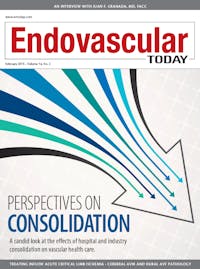
This month, Endovascular Today has asked me to help guide a discussion that primarily takes place outside the four walls of an interventional suite, but one that will undoubtedly affect what happens within and around them. By now, we’ve all no doubt experienced some of the many forces of the consolidation taking place at several levels: from physicians moving from private practices to hospitals, to hospitals continuing to consolidate into larger health care systems, and to industry consolidating by way of mergers and acquisitions. In order to explore consolidation at each of these levels, we’ve asked a diverse group of experts to provide their candid views.
To open our feature, Brian Contos of the Advisory Board Company looks into which factors lead to successful health care systems. Importantly, it’s not just about who gets biggest, fastest. It’s all about strategy.
Next, Gary M. Ansel, MD, addresses the challenges of maintaining a high level of quality patient care as service lines expand from the private practice setting to hospital employment, where alignment must fit within the larger realm of the growing hospital system. Dr. Ansel describes his experiences with key factors such as physician payment models, retaining staff, and internal peer review processes.
For a closer look at the modern industry landscape during a time of mergers and acquisitions both large and small, we asked Robert A. Hopkins, Equity Research Director at Bank of America, to explain some of the forces behind current trends. Mr. Hopkins compares cardiovascular M&A to other medical markets and addresses these merger effects on startups, venture capital support, and innovation.
Just after our interview with Mr. Hopkins, you will find an infographic displaying the many corporate mergers and acquisitions that have taken place in our field from 2000 to the present. It is extremely helpful in understanding how today’s vascular marketplace took shape, though I caution you, with the pace of corporate acquisitions, it is also likely to be dated by the time the ink dries on this edition.
Dovetailing with Dr. Ansel’s discussion on service line expansion and Mr. Hopkins’ look at industry consolidation, Sean Lyden, MD, provides his unique perspective as head of Supply Chain for the Cleveland Clinic as to how purchasing power and cost control might affect how shelves are stocked with devices in the near future. However, as Dr. Lyden details, this is not merely an exercise in limiting our options for the sake of saving the hospital money. The process begins with an introspective collaboration among vascular specialists aimed at determining the true value of each option, with a very deep look at the data needed for truly informed decision making. After all, it’s not just about the trial results these days—cost “effectiveness” is a critical analysis required for every technology being used.
Continuing the theme that consolidation does not have to mean limitation or stagnation, Barry T. Katzen, MD, shares his health care system’s experiences in expanding a flagship facility despite a global economic downturn and increased emphasis on cost cutting in modern health care.
To close out our feature on consolidation, we’ve asked leading voices from some of today’s pre-eminent vascular meetings to discuss how industry M&A might affect professional physician education in the future, as well as how they plan to adapt their educational offerings to continue to provide an experience that attracts attendees and supporters alike.
We also wanted to include clinical content in an edition that largely explores forces outside of the cath labs and ORs. We’re delighted to present the first in a three-part series on arteriovenous malformations and dural arteriovenous fistulas, as well as an interesting case showing the challenge of managing inflow-related acute critical limb ischemia due to a thrombosed femorofemoral bypass graft in a patient for whom little previous history was known. Finally, we close the issue with an interview with Juan F. Granada, MD, who predicts what 2015 will bring for drug-coated balloon use, the importance of preclinical testing, and how wearable technology might affect vascular care.
It is impossible to cover all of the forces and effects of consolidation in a single setting, so Endovascular Today aims to continue addressing this month’s feature in greater detail in future issues. We hope you find this diverse and unique edition to be an eye-opening start to this discussion in our journal and in your hallways.
Michael R. Jaff, DO
Guest Chief Medical Editor
Advertisement
Advertisement