Advertisement
Advertisement
January 2021
Diagnosis and Management of Acute Mesenteric Ischemia
A review of the mechanisms, clinical presentation, and endovascular and surgical techniques.
Although relatively uncommon, mesenteric ischemia is responsible for significant morbidity and mortality in affected individuals. Prompt diagnosis and management are paramount because any delay can lead to catastrophic consequences. The rapid mobilization of a multidisciplinary team consisting of vascular surgeons, general surgeons, intensivists, and radiologists is crucial to address the needs of this critically ill patient population.
Acute mesenteric ischemia is caused by one of four mechanisms: acute arterial embolism (40%-50%), acute arterial thrombosis (20%-30%), nonocclusive mesenteric ischemia (NOMI) (20%), and mesenteric venous thrombosis (5%-15%).1 Regardless of the etiology, the end result is diminished perfusion to the gastrointestinal mucosa, which rapidly leads to perforation, peritonitis, and death if not recognized in a timely fashion. The classic presentation of “pain out of proportion to exam” should trigger a workup focused on diagnosis of mesenteric ischemia. Patients often present with pain that is nonspecific and difficult to localize. Although laboratory derangements may be present, elevated lactate, abnormal leukocyte counts, and acute renal insufficiency are not always present. More than 50% of all patients presenting with a vascular abdominal emergency will not have a straightforward presentation.2
CLINICAL PRESENTATION AND DIAGNOSIS
Arterial insufficiency can present as acute, subacute, or chronic. The presentation often is dictated by the underlying pathology; for example, acute mesenteric ischemia is frequently a result of embolism to the superior mesenteric artery (SMA), and subacute or chronic mesenteric ischemia is caused by thrombosis in the setting of preexisting atherosclerotic disease. The diagnosis of acute mesenteric ischemia can be made by either duplex ultrasonography or CTA. Duplex ultrasonography may be limited by a patient’s body habitus and is technician dependent, whereas CTA has supplanted conventional angiography as the diagnostic gold standard. CTA provides details not only for the location and nature of the vascular lesion but also important information as to the degree of intestinal compromise. The presence of pneumatosis or portal venous gas may alter the surgical approach from an endovascular to an open procedure.
Due to its 45° angulation originating off the aorta, emboli tend to occur most frequently in the SMA. The vessel progressively narrows as the clot travels distally in the mesentery, and most clots lodge beyond the first jejunal branch. This location leads to ischemia extending from the mid jejunum to the right colon. The intestinal vasculature is rich in potential collateral pathways within the mesenteric arcades as well as communications between the middle colic artery and inferior mesenteric artery. Thus, the transverse and descending colon are frequently spared from ischemia in this scenario. Patients who present with acute-onset abdominal pain, in atrial fibrillation upon presentation and not therapeutically anticoagulated, and those found to have aortic thrombus are likely to have embolic acute mesenteric ischemia.
Patients who present with acute mesenteric ischemia and known atherosclerosis frequently have ischemia related to thrombosis. Either in situ orifical calcific disease or aortic disease extending into the SMA can lead to thrombosis of the proximal SMA, which extends for a variable distance distally. Upon close questioning, many patients will endorse a history of abdominal pain that is consistent with chronic mesenteric ischemia. The degree of vascular compromise is also influenced by the presence of disease within the celiac and inferior mesenteric artery.
A recent review of 45 observational studies including 3,692 acute mesenteric ischemia patients reported 70% in-hospital mortality. This number increased to almost 100% in untreated patients.3 Nearly 100 years ago, Dr. Cokkins noted about mesenteric ischemia, “The diagnosis is impossible, the prognosis hopeless, and the treatment useless.”4 Although these modern-day numbers may echo the pessimism of a century ago, innovative, cutting-edge techniques offer some hope for the improved management of acute mesenteric ischemia.
MANAGEMENT OF ACUTE MESENTERIC ISCHEMIA
Initial management of acute mesenteric ischemia must focus on aggressive resuscitative measures. The aim is to improve systemic perfusion and prevent multisystem organ failure to the extent possible. The administration of crystalloid fluid initially, followed by blood as necessary, should start in the emergency department. Broad-spectrum antibiotics directed against normal gut flora should also be given prior to proceeding to the operating room. The permeability of the ischemic gut mucosa not only lends itself to large fluid shifts but also encourages bacterial translocation, often leading to overwhelming septic shock. Lastly, systemic heparinization should be initiated with a bolus dose of 100 units/kg as soon as acute mesenteric ischemia is suspected. Most importantly, anticoagulation should run continuously and not be paused for surgery.
Endovascular Approach
Over the last 20 years, as endovascular techniques have become increasingly sophisticated and practitioners more adept at employing them, minimally invasive approaches to mesenteric ischemia have gained popularity. Although initially used in patients with chronic mesenteric ischemia, the practice has gradually expanded to encompass patients with acute intestinal ischemia as well. Endovascular techniques have expanded past percutaneous transluminal angioplasty and stenting to now include mechanical thrombectomy involving aspiration, pharmacologic thrombolysis (EkoSonic endovascular system, Boston Scientific Corporation), or a rheolytic system (AngioJet, Boston Scientific Corporation). A recent single-center study of 70 patients with acute mesenteric ischemia undergoing endovascular revascularization reported 87% technical success and a mortality rate of 36% compared to 50% in patients treated by open surgery.5
The Society for Vascular Surgery and the American College of Cardiology/American Heart Association consensus guidelines support the use of percutaneous revascularization in certain situations. This class IIb recommendation was made on the grounds that traditional, open surgery yields poor results, and thus, percutaneous interventions are appropriate in selected patients with acute intestinal ischemia caused by arterial obstruction. These recommendations caution the need for vigilance in assessing the degree of intestinal ischemia and encourage physicians to keep in mind that patients treated endovascularly may still require laparotomy.6
If an endovascular-first approach is taken, percutaneous access can be achieved through either the brachial or femoral arteries. A steerable sheath can be helpful in engaging the origin of a diseased artery. A sheath that is at least 7 F should be used to ensure that a stent can be advanced through the sheath if necessary. Once the origin is engaged, either a 0.035- or 0.014-inch guidewire can be advanced. After the lesion has been crossed, it is critical to perform angiography to ensure the wire is within the true lumen so that further interventions are not performed in a dissection plane. If the lesion is thrombotic, any disease at the origin should be managed with angioplasty and stenting.
Although the endovascular approach frequently yields excellent technical results, potential pitfalls exist. There is the risk of traditional complications related to percutaneous access and mesenteric manipulation. However, beyond this, one must remember mesenteric revascularization is always accompanied by some degree of endotoxin/cytokine release and potassium washout. If significant, this can lead to profound cardiovascular collapse. It is critical that percutaneous revascularization is performed in an area equipped to convert to an operating room if urgent laparotomy becomes necessary and staffed by an anesthesia team capable of providing resuscitation.
Open Surgical Management
If the decision is made to start with laparotomy, a transperitoneal incision is made to expose the entire abdominal contents. A transverse arteriotomy is performed distal to the diseased area, which allows for balloon embolectomy. The arteriotomy is then either closed, or if additional longitudinal lengthening is necessary, a patch angioplasty may be performed. The origin of the SMA must be carefully interrogated to ensure no residual disease is left behind. If an inflow procedure is necessary due to orifical disease, two options are available: open bypass or retrograde stenting. Open bypasses can be performed in either an antegrade (originating from the supraceliac aorta) or retrograde (originating from the infrarenal aorta or iliac artery) fashion. The location of the proximal bypass should be based on the patient’s anatomic factors, such as significant calcification in either location as well as their ability to tolerate a supraceliac clamp. The conduit can either be prosthetic or autologous. Prosthetic materials should be avoided in the setting of any bowel perforation or spillage. Autologous conduit can be either the femoral or saphenous vein. To expedite revascularization, retrograde SMA stenting can be considered.
After thrombectomy, the arteriotomy is closed and the artery is accessed proximal to this site in a retrograde fashion. The shorter working distance and additional support provided by selecting a closer access point, as well as the elimination of acute angulation, can assist in successful recannulation of a diseased artery. Once the wire is past the orifice and into the aorta, standard angioplasty and stenting can proceed. My preference is to use covered, balloon-expandable stents with flaring into the abdominal aorta several millimeters. Patients are then kept on systemic anticoagulation as well as dual antiplatelet agents for 1 month postprocedure. Additional duration of anticoagulation is based on the etiology of the inciting event.
Although rare, thrombosis or low flow in the SMA due to dissection can lead to significant morbidity, including pain, infarction, and hemorrhage.7 When the pathology is due to aortic dissection, in most instances, treating an acute type B dissection with coverage of the proximal entry tear leads to expansion of the true lumen and improved filling of the visceral vessels. In some cases, this is insufficient and additional stenting of the SMA may be necessary to resolve compression or thrombosis (Figure 1).
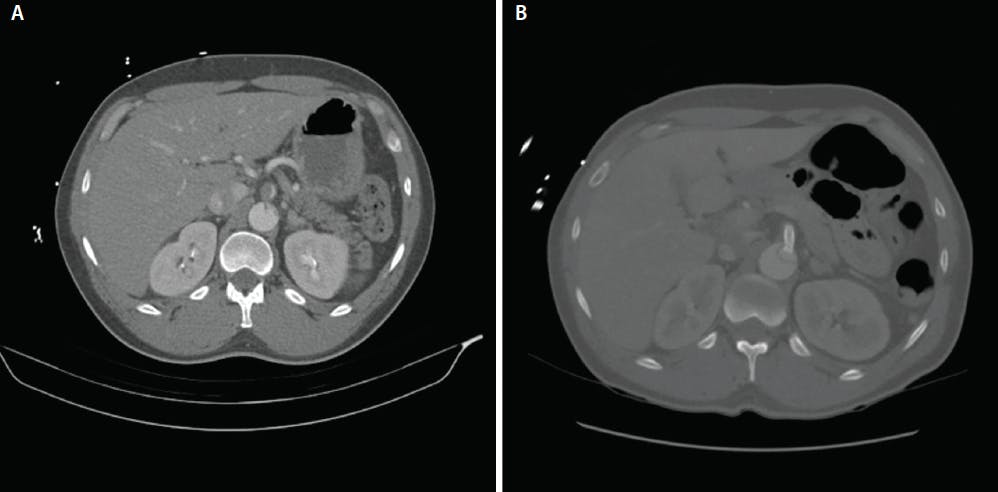
Figure 1. Acute type B aortic dissection with near obliteration of the true lumen (A). After thoracic endovascular aortic repair and placement of covered stent in the SMA, normal visceral perfusion was restored (B).
APPROACH TO NOMI AND MESENTERIC VEIN THROMBOSIS
NOMI can result from systemic or regional low flow states. These can be a result of shock (septic, cardiogenic, or hypovolemic), leading to activation of the renin-angiotensin-aldosterone pathway and subsequently causing splanchnic vasoconstriction. NOMI classically presents in elderly, critically ill patients with poor cardiac function who require hemodynamic support. Additionally, vasoconstrictive substances or medications such as cocaine, ergots, vasopressin, and norepinephrine may also lead to splanchnic constriction, resulting in critically diminished blood flow.8 First and foremost, patients should be treated for their underlying disease. If improvement is not noted, arteriography should be considered for both diagnostic and therapeutic purposes. This allows for placement of an intraarterial catheter and instillation of vasodilators such as papaverine to correct the vasoconstriction.9
Mesenteric vein thrombosis may also lead to bowel infarction with a mortality rate of 13% to 50%.10 This condition is often related to underlying hypercoagulable disorders including celiac disease, cancer, or genetic predispositions. Other risk factors include cirrhosis, abdominal infections (pancreatitis, cholangitis), or irritable bowel disease.11 This outflow obstruction leads to bowel wall edema and an influx of intraluminal fluid. The massive pressurization of the bowel leads to obstruction of the capillaries as well, effectively inhibiting gas exchange and resulting in secondary arterial compromise. Therapy is initiated with systemic anticoagulation and bowel resection in the setting of necrosis. If patients do not experience improvement within 24 to 48 hours, consideration should be given to intervention. The superior mesenteric vein can be accessed directly through percutaneous transhepatic/transjugular intrahepatic puncture or indirectly via an arterial puncture of the SMA. Aspiration thrombectomy and intravenous thrombolysis can then be performed. Transjugular intrahepatic portosystemic shunts, which create low-pressure runoff, can also be performed as a last resort.12 As with any form of mesenteric ischemia, patients need to be closely evaluated for the need for bowel resection.
CONCLUSION
Although survival for all causes of mesenteric ischemia is relatively poor, prompt recognition and intervention are key to improving outcomes. The broader application of endovascular techniques shows promise in treating these complex patients. A multidisciplinary approach focused on resuscitation and expiated revascularization is critical to ensure optimal outcomes.
1. Lim S, Halandras PM, Bechara C, et al. Contemporary management of acute mesenteric ischemia in the endovascular era. Vasc Endovascular Surg. 2019;53:42-50. doi: 10.1177/1538574418805228
2. Rothrock SG, Green SM. Abdominal aortic aneurysms: current clinical strategies for avoiding disaster. Emerg Med Rep. 1994;15:125-136.
3. Schoots IG, Koffeman GI, Legemate DA, et al. Systematic review of survival after acute mesenteric ischaemia according to disease aetiology. Br J Surg. 2004;91:17-27. doi: 10.1002/bjs.4459
4. Cokkins AJ. Mesenteric Vascular Occlusion. London: Bailliere, Tindall and Cox; 1926.
5. Arthurs ZM, Titus J, Bannazadeh M, et al. A comparison of endovascular revascularization with traditional therapy for the treatment of acute mesenteric ischemia. J Vasc Surg. 2011;53:698-704. doi: 10.1016/j.jvs.2010.09.049
6. Hirsch AT, Haskal ZJ, Hertzer NR, et al. ACC/AHA 2005 Practice Guidelines for the management of patients with peripheral arterial disease (lower extremity, renal, mesenteric, and abdominal aortic): a collaborative report from the American Association for Vascular Surgery/Society for Vascular Surgery, Society for Cardiovascular Angiography and Interventions, Society for Vascular Medicine and Biology, Society of Interventional Radiology, and the ACC/AHA Task Force on Practice Guidelines (Writing Committee to Develop Guidelines for the Management of Patients With Peripheral Arterial Disease): endorsed by the American Association of Cardiovascular and Pulmonary Rehabilitation; National Heart, Lung, and Blood Institute; Society for Vascular Nursing; TransAtlantic Inter-Society Consensus; and Vascular Disease Foundation. Circulation. 2006;113:e463-654. doi: 10.1161/CIRCULATIONAHA.106.174526
7. Park YJ, Park KB, Kim DI, et al. Natural history of spontaneous isolated superior mesenteric artery dissection derived from follow-up after conservative treatment. J Vasc Surg. 2011;54:1727-1733. doi: 10.1016/j.jvs.2011.07.052
8. Björck M, Wanhainen A. Nonocclusive mesenteric hypoperfusion syndromes: recognition and treatment. Semin Vasc Surg. 2010;23:54-64. doi: 10.1053/j.semvascsurg.2009.12.009
9. Gallego AM, Ramírez P, Rodríguez JM, et al. Role of urokinase in the superior mesenteric artery embolism. Surgery. 1996;120:111-113. doi: 10.1016/s0039-6060(96)80249-2
10. Yang S, Liu B, Ding W, et al. Acute superior mesenteric venous thrombosis: transcatheter thrombolysis and aspiration thrombectomy therapy by combined route of superior mesenteric vein and artery in eight patients. Cardiovasc Intervent Radiol. 2015;38:88-99. doi: 10.1007/s00270-014-0896-z
11. Plessier A, Rautou PE, Valla DC. Management of hepatic vascular diseases. J Hepatol. 2012;56(suppl 1):S25-38. doi: 10.1016/S0168-8278(12)60004-X
12. Wang MQ, Liu FY, Duan F, et al. Acute symptomatic mesenteric venous thrombosis: treatment by catheter-directed thrombolysis with transjugular intrahepatic route. Abdom Imaging. 2011;36:390-398. doi: 10.1007/s00261-010-9637-1
Advertisement
Advertisement