Advertisement
Advertisement
January 2021
Vascular Emergencies in Athletes
A discussion of common and less common causes of upper and lower extremity arterial injury, with cases illustrating unusual presentations related to sport-specific repetitive motion.
By Bernadette Goudreau, MD, MS; Manasa Kanneganti, MD; and Margaret Tracci, MD, JD
Athletes are susceptible to a range of injuries to the arteries of the upper and lower extremities. The article discusses both common and less common etiologies of upper and lower extremity arterial injury, focusing on several cases representing unusual presentations associated with sport-specific repetitive motion.
LOWER EXTREMITY INJURIES
Popliteal Artery Injury Associated With Fracture or Dislocation
Popliteal artery injury associated with fracture or dislocation is perhaps the most commonly encountered arterial injury in athletes. Knee dislocations are classified based on the direction of translation of the tibia relative to the femur. Fractures are classified by the pattern of tibial plateau disruption. Injury due to posterior knee dislocation is incurred when disruption of both stabilizing cruciate ligaments permits enough translation to result in complete transection of the vessel, although intimal flaps and thromboses are more common in both posterior and anterior dislocations.
As blunt popliteal trauma with resulting ischemia carries a significant risk of limb loss, the associated orthopedic injuries should be approached with a high index of suspicion, and ischemia should be addressed with alacrity. Injury presenting with a pulse deficit or other significant ischemia necessitates surgical repair, classically with autogenous vein reconstruction via a medial around-knee approach. In general, the posterior approach should be reserved for injuries known to be focal. In the modern era, injuries ranging from occlusion to intimal flaps have been successfully managed using covered stents as well; however, open repair is still considered the standard approach by most surgeons.1
Thrombosis and Embolism Associated With Repetitive Trauma
Less frequently, athletes may present with acute thromboembolic events due to repetitive motion-induced lesions of the popliteal or iliac arteries. The former is typically associated with anatomic entrapment of the popliteal artery. Although the presentation of popliteal artery entrapment syndrome (PAES) is most commonly marked by lower leg pain, paresthesias, and fatigue associated with exercise, occasionally sudden thrombosis of a diseased popliteal artery may occur, along with acute or chronic distal embolization. Classification of PAES is shown in Figure 1.2 Misdiagnosis of these less common manifestations in a population not generally considered at risk for vascular disease can be catastrophic. Case examples of PAES presenting with acute occlusion and chronic embolization/limb loss are described in Figure 2 and Figure 3, respectively.
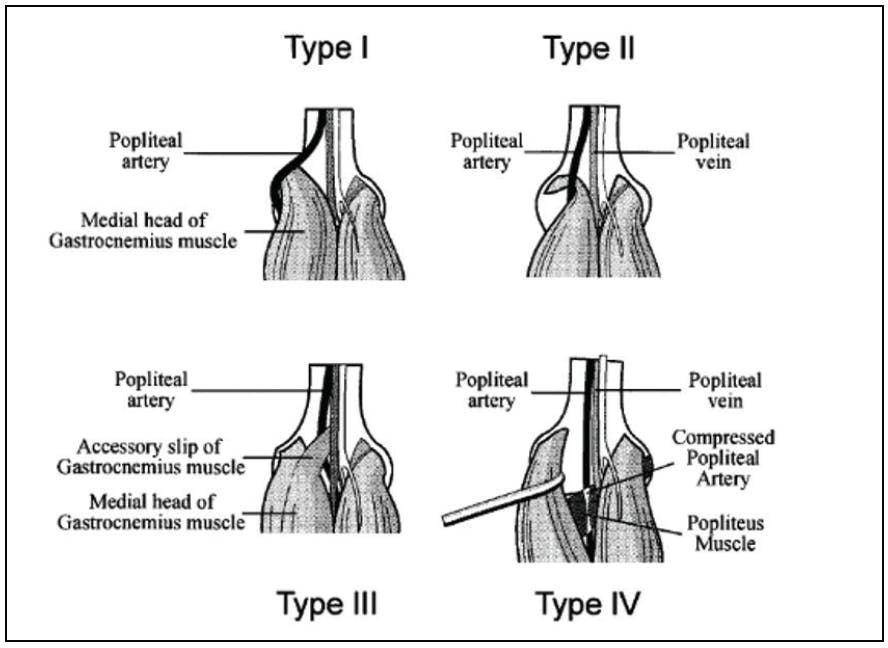
Figure 1. Classification of PAES. A type V entrapment is described as involvement of both artery and vein by any of these anatomic variants, and type VI is often referred to as functional entrapment and attributed to hypertrophy of the gastrocnemius or more subtle midline attachment of the medial head of the muscle. Reprinted from Journal of Vascular Surgery, 30, Levien LJ, Veller MG. Popliteal artery entrapment syndrome: more common than previously recognized, 590, 1999, with permission from Elsevier.
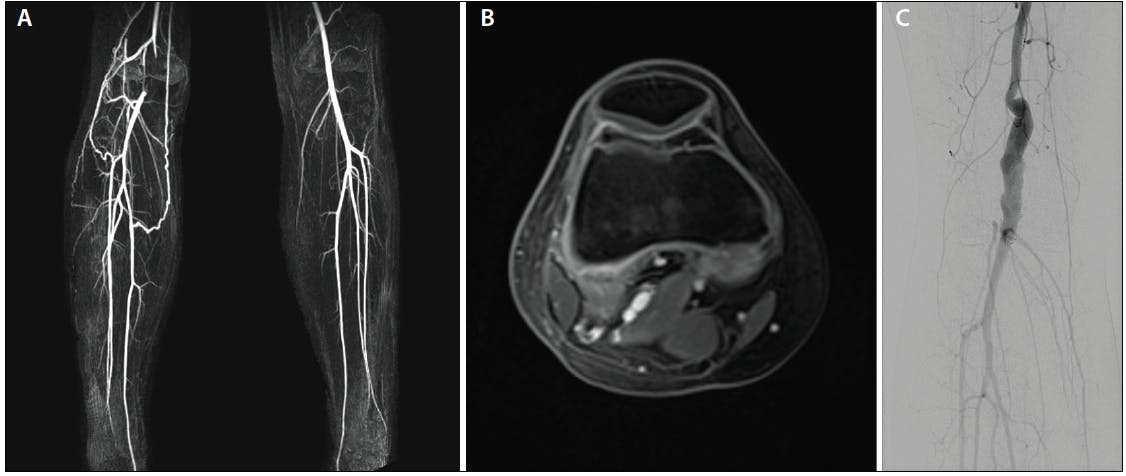
Figure 2. PAES presenting with acute occlusion. A teenage competitive athlete, active in multiple sports, with a several-year history of calf pain with exertion and previously treated with four-compartment fasciotomy, presented with sudden worsening of symptoms. The ankle-brachial index on the symptomatic side was 0.76, and MRA demonstrated popliteal artery occlusion (A) and type 1 entrapment of the popliteal artery, with arterial deviation around the medial head of the gastrocnemius (B). The artery was reconstructed using reversed autogenous vein as an interposition graft via a posterior approach (C).
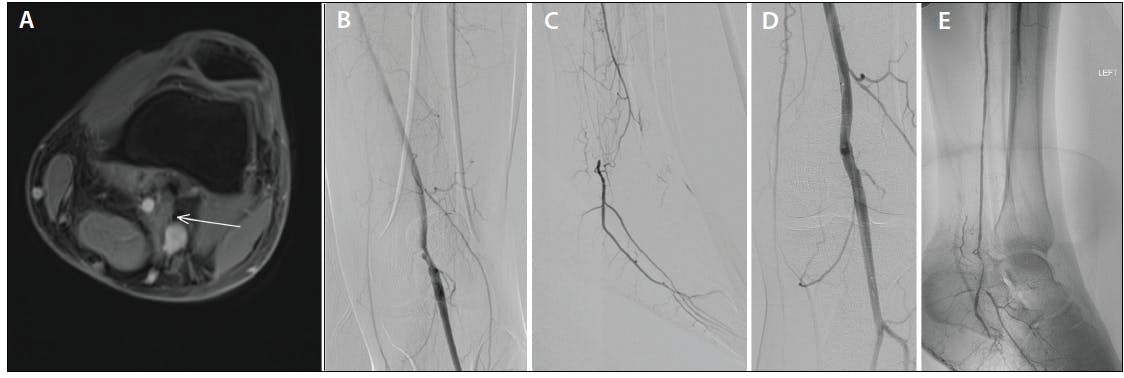
Figure 3. PAES presenting with chronic embolization resulting in subsequent limb loss. A patient in their mid-40s presented with approximately 8 to 10 days of progressive left foot numbness and pain with color changes and coolness of toes over 2 to 3 days prior to admission. MRA demonstrated type 3 popliteal entrapment (A). CT and catheter-based angiography demonstrated a lesion of the popliteal artery with associated thrombus (B), as well as occlusion of all tibial arteries midcalf with distal reconstitution of the posterior tibial artery at the malleolus (B, C). Thrombolysis was attempted without significant improvement. Surgical thromboembolectomy restored in-line flow to the posterior tibial artery (D, E) and the popliteal artery was released and reconstructed, but the patient’s tissue loss ultimately necessitated amputation below the knee.
UPPER EXTREMITY INJURIES
Humerus Fracture With Brachial Artery Injury
An injury to the brachial artery, which ranges from intimal injury, thrombus, entrapment, or much less commonly transection, can be identified in 8% to 12% of patients with displaced fractures of the humerus (Gartland type III classification). These fractures typically occur as a result of elbow extension injuries secondary to a fall on an outstretched hand. Injuries to the anterior interosseous nerve (most common), median, radial, and ulnar nerves can occur concurrently in these patients. The suspicion for an arterial injury should be significantly elevated in the setting of nerve deficits. When identifying the arterial injury, it is important to assess the clinical status of the extremity, which can be normal, pulseless with a pink hand (due to extensive collateral flow proximally to the brachial injury), or pulseless with a pallid hand.
The mainstay of management in a pulseless hand is to reduce the fracture and pin the bone; this typically results in return of pulse in a majority of patients due to decompression and reduction of arterial tethering by bone. Improvement in the vascular status is then assessed, and if the hand appears to be well-perfused, the patient is monitored in an intensive care unit setting, with a low threshold for return to the operating room with any signs of ischemia (particularly for a pink, pulseless hand). If at any point there is any question regarding the perfusion of the hand, the vessel is explored and repaired either primarily or with an interposition vein graft through the anterior approach with prophylactic forearm fasciotomies when the period of ischemia is longer than 6 hours.3,4
Axillary Arterial Injuries Due to Repetitive Motion
Athletes whose sports involve overhead throwing may also be subject to repetitive traumatic injury to the axillary artery. The mechanics may involve compression related to anterior displacement of the humeral head, compression by the pectoralis minor, and compression by the coracobrachialis muscle. The throwing motion involved in pitching, the most common inciting activity, involves extreme abduction with significant displacement of the humeral head as well as a range of motion from supination to extreme pronation. These phenomena may result in stenosis, thrombosis, embolization, or the formation of aneurysms or pseudoaneurysms involving branch vessels of the distal axillary artery. The subscapular and circumflex humeral arteries represent points of fixation of the axillary artery and are subject to stretch injury, resulting in thrombosis or pseudoaneurysm formation, potentially accompanied by distal embolization.
Figure 4 describes an athlete with an axillary lesion with distal embolization. Although paresthesias and vasomotor phenomena may be observed in association with nerve compression, as in neurogenic thoracic outlet syndrome, this case illustrates that symptoms of digital ischemia necessitate thorough evaluation5 and that unilateral symptoms prompt a high index of suspicion for a proximal embolic source, such as the axillary artery in the case patient or the subclavian artery in the event of arterial thoracic outlet syndrome.6,7
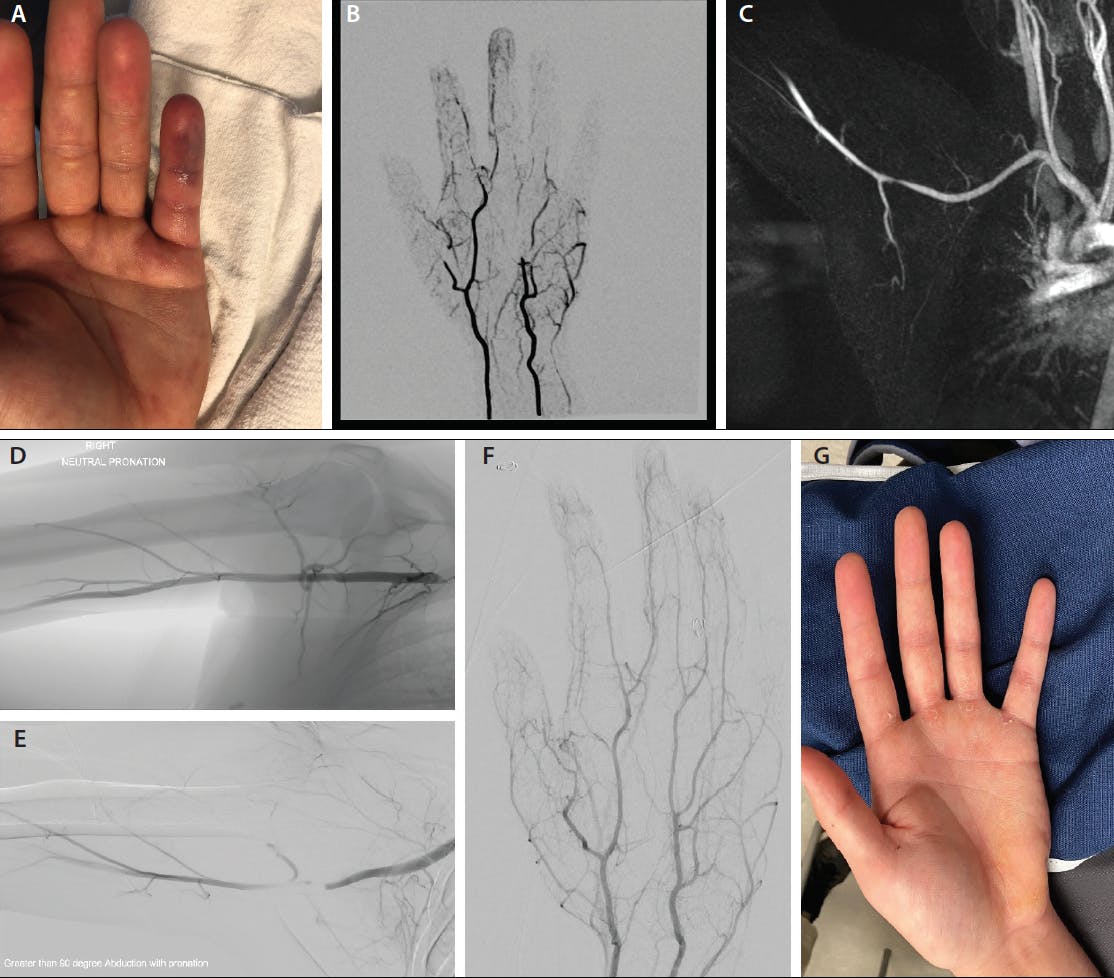
Figure 4. A teenage right-handed baseball pitcher had observed several months of intermittent color change and tingling in the fourth and fifth digits, which typically resolved within several hours of exercise. After a particularly strenuous session, the symptoms became more pronounced without interval resolution. On evaluation, there was evidence of embolization to the hand, more pronounced in the ulnar distribution, as well as an incomplete palmar arch (A). Further imaging demonstrated a subtle lesion of the distal axillary artery, with severe compression noted on abduction of the arm (B, C). Provocative testing showed no evidence of an axillary artery lesion until occlusion of the axillary artery was seen on > 90° abduction with pronation (D, E). The patient underwent thrombolysis, with significant improvement of digital perfusion, followed by endarterectomy and patch angioplasty of the axillary artery using autogenous saphenous vein (F). Gross examination showed full perfusion to the extremity and no evidence of residual deficits or tissue loss (G).
Occlusion of Distal Vessels Due to Repetitive Impact
Distal occlusions may also result from repetitive local trauma to the ulnar or radial arteries, as in hypothenar or thenar hammer syndromes. The damage can range from intimal injury to arterial thrombosis to aneurysmal degeneration of the vessels. Patients present with symptoms of Raynaud phenomenon, such as cold intolerance, rest pain, and ischemic ulceration of the fingers, although there is usually collateral flow from the contralateral artery to perfuse the hand. This has been observed in athletes participating in activities ranging from baseball to volleyball, handball, Frisbee, hockey, mountain biking, karate, and golf. In hypothenar hammer syndrome, the ulnar artery is susceptible to injury where it courses over the hook of the hamate bone. Similarly, the radial artery may be injured where it passes over the scaphoid bone. Treatment is typically nonoperative with lifestyle modification, smoking cessation, and use of calcium channel blockers. Surgical options include cervical sympathectomy for patients with rest pain and tissue loss, ligation of artery in the setting of a complete palmar arch to prevent embolization, and resection of the damaged segment with interposition grafting with autogenous vein. For patients with thrombus, preoperative thrombolysis is used prior to surgical management.8
SUMMARY
Although the incidence of arterial injury in athletes is relatively low, it is imperative to correctly identify and diagnose these conditions to achieve the best possible functional outcomes. The clinical vignettes are real-world examples and outcomes, demonstrating our preferred approach to the management of these conditions and some of the associated opportunities and pitfalls.
1. Macedo FIB, Sciaretta JD, Salsamendi J, et al. Repair of an acute blunt popliteal artery trauma via endovascular approach. Ann Vasc Surg. 2015;29:366.e5-366.e10. doi: 10.1016/j.avsg.2014.10.017
2. Levien LJ, Veller MG. Popliteal artery entrapment syndrome: more common than previously recognized. J Vasc Surg. 1999;30:587-598.
3. Badkoobehi H, Choi PD, Bae DS, Skaggs DL. Management of the pulseless pediatric supracondylar humeral fracture. J Bone Joint Surg Am. 2015;97:937-943. doi: 10.2106/JBJS.N.00983
4. Kumar V, Singh A. Fracture supracondylar humerus: a review. J Clin Diagn Res. 2016;10:RE01-RE06. doi: 10.7860/JCDR/2016/21647.8942
5. Ohman JW, Thompson RW. Thoracic outlet syndrome in the overhead athlete: diagnosis and treatment recommendations. Curr Rev Musculoskelet Med. 2020;13:457-471. doi: 10.1007/s12178-020-09643-x
6. Leake SS, Sandhu H, Charlton-Ouw KM, Azizzadeh A. Axillary artery thrombosis in a baseball pitcher. J Vasc Surg Cases. 2015;1:168-170. doi: 10.1016/j.jvsc.2015.04.006
7. Duwayri YM, Emergy VB, Driskill MR, et al. Positional compression of the axillary artery causing upper extremity thrombosis and embolism in the elite overhead throwing athlete. J Vasc Surg. 2011;53:1329-1340. doi: 10.1016/j.jvs.2010.11.031
8. McCready RA, Bryant MA, Divelbiss JL. Combined thenar and hypothenar hammer syndromes: case report and review of the literature. J Vasc Surg. 2008;48:741-744. doi: 10.1016/j.jvs.2008.03.055
Advertisement
Advertisement