Advertisement
Advertisement
May 2021 Supplement
Sponsored by Philips
Dissection Healing After Below-the-Knee Revascularization of CLTI Patients
Reviewing the 12-month TOBA II BTK data.
Chronic limb-threatening ischemia (CLTI) is the most severe presentation of peripheral artery disease (PAD) and is associated with high rates of amputation and mortality. In patients aged > 50 years, 5% to 10% will develop CLTI within 5 years.1 Patients with CLTI have a poor life expectancy with a mortality rate of 20% after 1 year and 40% to 70% after 5 years.2 Only 40% of all patients are mobile 2 years after a below-knee amputation.3
CLTI manifests clinically as lower extremity ischemic rest pain and/or ischemic tissue. As a result of lower procedure-related complication rates, shorter length of stay, and faster recovery, infrapopliteal percutaneous transluminal angioplasty (PTA) has become widely accepted as primary therapy to establish a direct line of blood flow to the foot to assist wound healing and relieve rest pain, especially in patients at high perioperative risk.4
USE of the Tack Endovascular System for BTK Disease
Long lesions in small-diameter vessels with medial calcification add to the complex nature of PTA in the below-the-knee (BTK) arteries. The mechanism of PTA consists of plaque fracture, localized dissection, and permanent medial overstretching, often with dehiscence of the intima and media. Post-PTA dissection adversely impacts clinical outcome and can be a predictor for infrapopliteal restenosis.5 If prolonged balloon inflation cannot resolve the dissection, stent implantation is the treatment of choice at present. However, in addition to the risk of in-stent restenosis and stent fracture, stents increase the stiffness of the vessel and may lead to chronic injury due to persistent outward force and friction between struts and artery walls. Thus, optimizing BTK PTA outcomes will provide durable vessel patency, reduce reinterventions, and promote limb preservation.
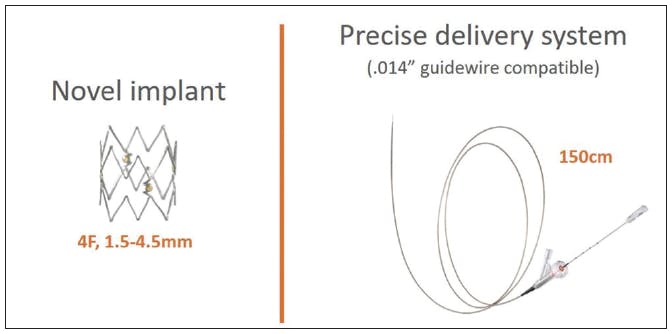
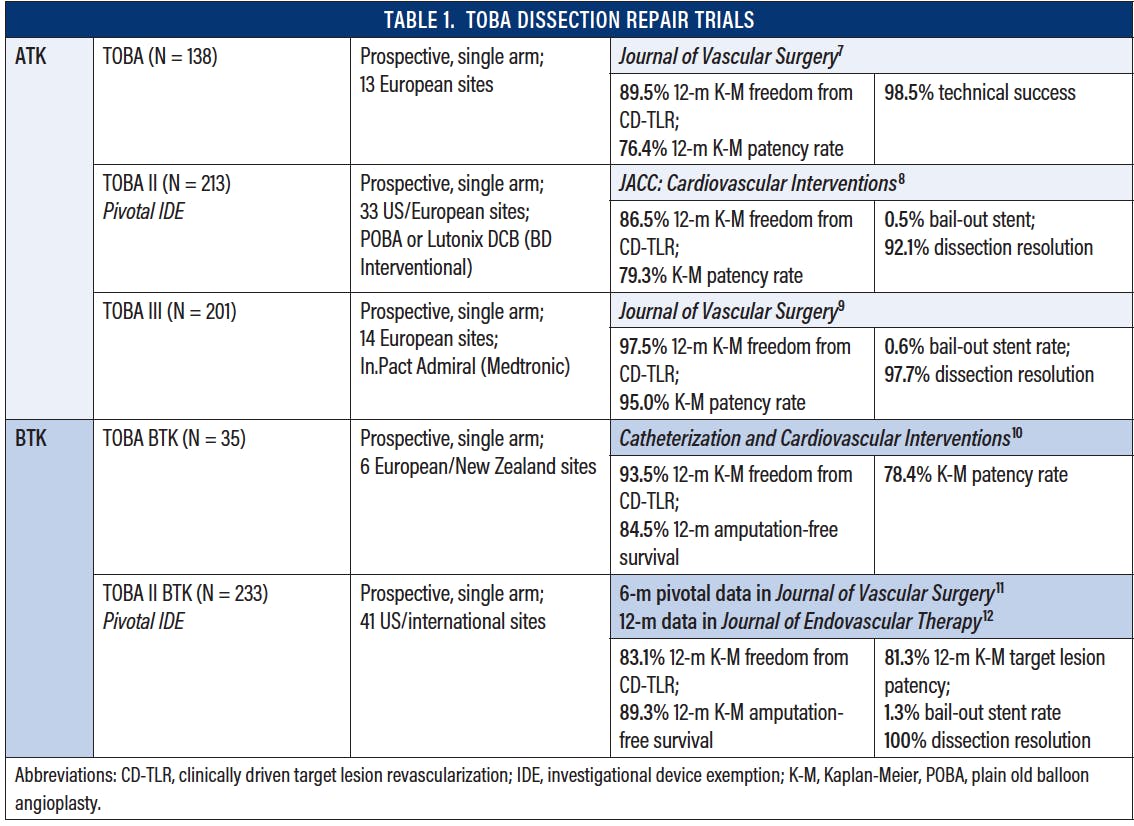
The Tack endovascular system (Philips) includes multiple, short 6-mm nitinol implants that can be deployed separately (Figure 1). It provides a targeted repair of dissected segments and preserves the flexibility of the artery. Preclinical data revealed less inflammation and neointima formation at 3 months with Tack implants compared to stents.6 This is attributed to small dimensions, open-cell design, and the low outward force of the implants. Tack implants may effectively complement plain old balloon angioplasty (POBA) or drug-coated balloon angioplasty in case of dissections as a cautious strategy even compared to spot stenting. To avoid tissue irritation and inflammation, the outward force of Tack implants is relatively low. An open-cell design reduces the contact surface between metal and artery wall. In case of an irregular wall structure of the lesion, multiple short Tack implants might better guarantee for complete apposition than longer stents. Previous Tack-Optimized Balloon Angioplasty (TOBA) studies (Table 1) have offered promising technical success and safety.7-12
TOBA II BTK TRIAL
Recently, the 12-month outcome data of the TOBA II BTK trial demonstrated the efficacy and safety of the Tack endovascular system for the treatment of persistent dissection after POBA in BTK arteries.12 TOBA II BTK was the first study to evaluate a BTK implant for post-PTA dissection repair (Figure 2). A total of 233 patients with Rutherford class 3 to 5 disease and lower extremity ischemia were included in this investigational device exemption trial. Baseline data collection included standard demographic data along with history and physical exam, laboratory testing, ankle-brachial index, toe-brachial index, Rutherford classification, Wound Ischemia and foot Infection classification, EQ-5D-3L quality-of-life questionnaire, and Walking Impairment Questionnaire. Patients underwent infrapopliteal intervention after successful screening, baseline data collection, and providing informed consent. These patients were eligible for enrollment during the index procedure if angioplasty resulted in dissection(s) of the P2/P3 popliteal artery segments, tibioperoneal trunk, anterior tibial, posterior tibial, and/or peroneal arteries that the investigator would have otherwise treated with repeat angioplasty or off-label stent deployment. Post-PTA dissections were identified using the angiographic core laboratory protocol, requiring imaging in at least two planes with ≥ 45° difference and use of magnification. Dissection(s) were graded by the operator using the National, Heart, Lung and Blood Institute classification system. Finally, patients were then eligible for enrollment if the investigator concluded that the dissection(s) required repair. A patient was enrolled when the Tack delivery system was advanced through the introducer sheath. Clinical follow-up was performed at 30 days and 6 and 12 months with planned follow-up to 36 months.
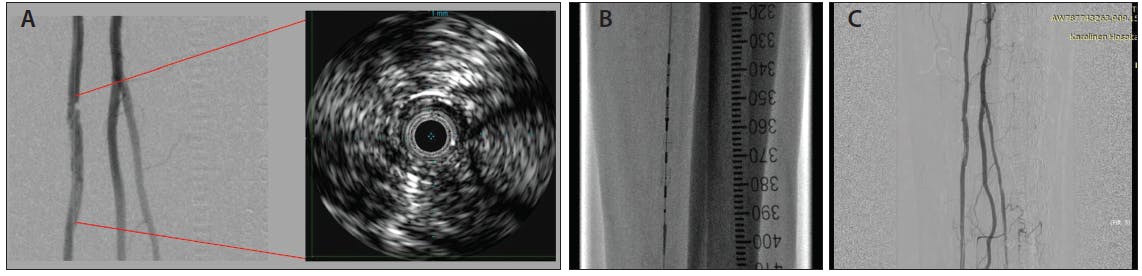
Figure 2. Persistent dissection with slow flow after recanalization of the posterior tibial artery with a 3- X 150-mm uncoated balloon. Intravascular ultrasound revealed a dissection and persistent high-grade stenosis (A). Implantation of two 4-F Tack devices (B). Complete healing of the dissection after Tack implantation with direct inflow and outflow (C).
Half (50.2%) of patients were classified as Rutherford class 5, 33.5% as Rutherford class 4, and 16.3% as Rutherford class 3. The mean baseline target lesion length was 80 ± 49 mm, and PTA-treated length was 154 ± 110 mm. Moderate to severe calcium was present in 35.8% of lesions. Standard PTA was performed in 248 target lesions, resulting in 341 post-PTA dissections requiring repair. Most lesions were located within the anterior tibial (41.1%), posterior tibial (22.6%), and peroneal (21%) arteries. All patients were treated with at least one Tack implant, averaging 4 ± 2.8 Tacks per patient. The device success rate was 96.5%, and target lesion success and procedural success were 98.8% and 98.7%, respectively.
The angiographic core laboratory adjudicated 100% dissection resolution with Tack treatment. Safety analysis within the first 30 days reported three (1.3%) major adverse limb events (MALEs) and perioperative death occurrences (PODs); in total there were two above-ankle amputations and one patient death. The primary effectiveness endpoint, freedom from MALE at 6 months plus POD at 30 days, was 95.6% with a lower limit of the 97.5% confidence interval of 91.8%. Secondary outcome measurements included 12-month primary patency of the target lesions and Tacked segments including a 12-month Tacked segment patency of 81.3%. Kaplan-Meier estimate for target limb salvage at 12 months for all patients was 96.8%. Twelve-month Kaplan-Meier freedom from clinically driven target lesion revascularization was 83.1% in all patients, and 81.8% in CLTI patients. Kaplan-Meier freedom from clinically driven target vessel revascularization at 12 months was 82.7% and 81.4% in all patients and CLTI patients, respectively. At 12 months, Kaplan-Meier survival in all patients was 91.7% and 91.9% in Rutherford class 4/5 patients. Amputation-free survival was 89.3% overall and 89% in Rutherford class 4/5 patients. Rutherford class significantly improved between baseline to 6 months and was sustained through 12 months.
CONCLUSION
Previous analysis concluded that decreasing the rate of immediate technical failure (including recoil, dissection, and persistent stenosis) is integral to limb preservation and improving patency. Post-PTA dissection adversely impacts clinical outcome and can be a predictor for infrapopliteal restenosis.5 Treatment options include the use of bare-metal or drug-eluting stents in an attempt to improve patency and reduce restenosis, depending on the location of the lesion. Especially in long persistent dissections and bifurcations, these scaffolds are not adequate to resolve immediate technical failures and could impact technical revascularization options after reocclusion. Based on the promising TOBA II BTK data, Tack implants may effectively complement angioplasty in case of dissections as a cautious strategy even compared to spot stenting. To avoid tissue irritation and inflammation, the outward force of Tack implants is relatively low. An open-cell design reduces the contact surface between metal and artery wall. In case of an irregular wall structure of the lesion, multiple short Tack implants might better guarantee for complete apposition than longer stents. Finally, Tack implants allow for bypass surgery at a later stage if required.
1. Norgren L, Hiatt WR, Dormandy JA, et al. Inter-society consensus for the management of peripheral arterial disease (TASC II). Eur J Vasc Endovasc Surg. 2007;33 (Suppl 1):S1-75. doi: 10.1016/j.ejvs.2006.09.024
2. Dormandy J, Heeck L, Vig S. The fate of patients with critical leg ischemia. Semin Vasc Surg. 1999;12:142-147.
3. Dormandy J, Heeck L, Vig S. Major amputations: clinical patterns and predictors. Semin Vasc Surg. 1999;12:154-161.
4. Goodney PP, Beck AW, Nagle J, et al. National trends in lower extremity bypass surgery, endovascular interventions, and major amputations. J Vasc Surg. 2009;50:54-60. doi: 10.1016/j.jvs.2009.01.035
5. Giannopoulos S, Varcoe RL, Lichtenberg M, et al. Balloon angioplasty of infrapopliteal arteries: a systematic review and proposed algorithm for optimal endovascular therapy. J Endovasc Ther. 2020;27:547-564. doi: 10.1177/1526602820931488
6. Schneider PA, Giasolli R, Ebner A, et al. Early experimental and clinical experience with a focal implant for lower extremity post-angioplasty dissection. JACC Cardiovasc Interv. 2015;8:347-354. doi: 10.1016/j.jcin.2014.07.032
7. Bosiers M, Scheinert D, Hendriks JMH, et al. Results from the Tack Optimized Balloon Angioplasty (TOBA) study demonstrate the benefits of minimal metal implants for dissection repair after angioplasty. J Vasc Surg. 2016;64:109-116. doi: 10.1016/j.jvs.2016.02.043
8. Gray WM, Cardenas JA, Brodmann M, et al. Treating post-angioplasty dissection in the femoropopliteal arteries using the Tack endovascular system: 12-month results from the TOBA II study . JACC Cardiovasc Interv. 2019;12:2375-2384. doi: 10.1016/j.jcin.2019.08.005
9. Brodmann M, Wissgott C, Brechtel K, et al. Optimized drug-coated balloon angioplasty of the superficial femoral and proximal popliteal arteries using the Tack Endovascular System: TOBA III 12-month results. J Vasc Surg. 2020;72:1636-1647.e1. doi: 10.1016/j.jvs.2020.01.078
10. Brodmann M, Wissgott C, Holden A, et al. Treatment of infrapopliteal post-PTA dissection with tack implants: 12-month results from the TOBA-BTK study. Catheter Cardiovasc Interv. 2018;92:96-105. doi: 10.1002/ccd.27568
11. Geraghty PJ, Adams G, Schmidt A, et al. Six-month pivotal results of tack optimized balloon angioplasty using the Tack Endovascular System in below-the-knee arteries. J Vasc Surg. 2021;73:918-929.e5. doi: 10.1016/j.jvs.2020.08.135
12. Geraghty P, Adams G, Schmidt A, et al. Twelve-month results of tack-optimized balloon angioplasty using the Tack endovascular system in below-the-knee arteries (TOBA II BTK). J Endovasc Ther. 2020;27:626-636. doi: 10.1177/1526602820944402
Advertisement
Advertisement