Advertisement
Advertisement
November 2021
Sponsored by Medtronic
Appropriateness in Venous Stenting: A Nonthrombotic Iliac Vein Obstruction Case Review
Nonthrombotic iliac vein lesions (NIVL), most commonly caused by compression of the left common iliac vein (CIV) by the right common iliac artery, are a recognized cause of symptomatic chronic venous disease and are primarily treated with self-expanding venous stent placement.1 Patients with clinically significant NIVL may have a spectrum of symptoms, including edema with extended period of standing or ambulation that progresses throughout the day, pain with use of the affected extremity (known as venous claudication), and, its most severe forms, dermatitis or skin ulceration.2 Further, in female patients, NIVL may result in chronic pelvic pain.3
However, the presence of compression does not always connote the presence of disease; several studies have demonstrated that anatomic compression is commonly clinically silent.4,5 Treatment of such patients would not yield clinical benefit and would only add theoretic risk of a permanent indwelling device. This issue is potentially magnified by the reality that patients with NIVLs are often considerably younger than their arterial counterparts, and the time horizon for device failure thus extends to several decades. Appropriate selection of patients who may actually benefit from stent placement is of paramount importance.
The key to appropriate selection is a thorough history and physical examination, with exclusion of other potential causes of the patient’s symptoms. Given that a significant number of patients have clinically silent NIVL, the diagnosis of a compression that is causing symptoms is that of exclusion. Evaluation for causes such as isolated superficial venous disease and lymphedema is critical. Patients with bilateral swelling and no antecedent history of deep vein thrombosis (DVT) or intracaval device should trigger an evaluation for heart disease, medication-induced swelling, liver disease, and endocrine dysfunction—amongst other causes. If NIVL is suspected, patients should be evaluated with venous metric scales (eg, Venous Clinical Severity Score [VCSS]). Noninvasive imaging should then be undertaken, such as iliac vein duplex ultrasound to identify whether a compression is present and whether secondary signs, such as reversal of flow in the internal iliac vein, are present. Alternatively, axial imaging such as CT venography (CTV), may be performed based on local practice.
If noninvasive testing suggests that a NIVL is present, venography and intravascular ultrasound (IVUS) are the next steps in diagnosis and, ultimately, treatment planning. Multiplanar venography may reveal the presence of crosspelvic or ascending lumbar venous drainage, along with the appearance of extrinsic compression on the iliac vein. However, venography might not reveal a compression. Therefore, evaluating the iliac vein with IVUS is a critical tool. Studies have demonstrated that IVUS has greater sensitivity for anatomic compression of the iliac vein.6 A prospective single-arm study demonstrated that a threshold of a 61% diameter stenosis of the compressed segment, relative to a normal ipsilateral venous reference diameter (ie, the caudal external iliac vein [EIV]), yielded clinical improvement in NIVL patients treated with iliac vein stents.6 Additionally, IVUS enables accurate intraluminal measurements to promote proper stent sizing. Improper stent sizing can result in devastating clinical consequences, such as migration with undersized stents or severe and unrelenting pain with gross oversizing of stents. The following case study demonstrates the workup and treatment of a NIVL patient, illustrating decision-making and technical steps to achieve an optimal clinical outcome.
CASE STUDY
A female patient in her late 20s presented with left lower extremity swelling, pain with activity, and pelvic pain centered in her low pelvis and back that was noncyclical and worsened after intercourse. She had two previous pregnancies. She had intermittently used compression in the past with limited symptom improvement. On exam, her left leg was asymmetrically larger than her right, to the level of her thigh; no extremity varicosities were present. She had no antecedent history of DVT or any other potentially contributory past medical history. The VCSS of her left leg was 8.
CTV demonstrated an NIVL of the left CIV caused by compression from the right common iliac artery. Lower extremity duplex was unremarkable.
During the procedure, access was achieved in the left great saphenous vein immediately caudal to the saphenofemoral junction. After placement of a sheath and wire into the inferior vena cava, venography was performed, as shown in Figure 1A. There was no clear evidence of collateral drainage on venography, although a subtle “double density” was present at the compression site. IVUS was then performed, as shown in Figure 1B, revealing clear compression of the left CIV and near obliteration of the lumen. This was then compared to the normal reference segment, with a measurement obtained in the EIV at the intended caudal landing site of the stent (Figure 2). Taking the average of the two dimensions after rounding up, the average diameter was 13 mm. With the information gathered from IVUS, we confirmed that there was a NIVL lesion that was > 61% stenotic according to diameter, providing us with enough information to guide stent size selection.
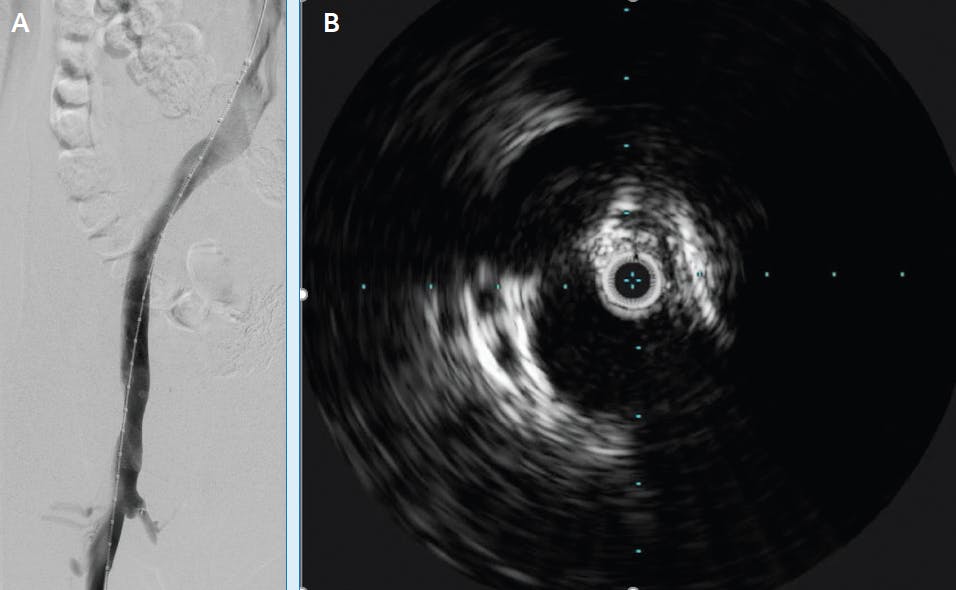
Figure 1. The initial venogram demonstrates CIV compression (A). Note the wire bias that the IVUS catheter demonstrates here. Initial IVUS confirms stenosis of CIV (B).
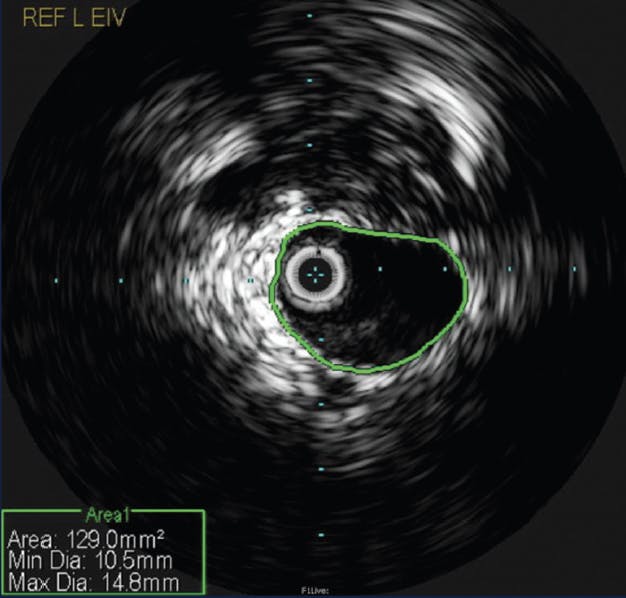
Figure 2. IVUS determined the reference vessel diameter (RVD) via the healthy EIV.
When selecting a stent, some oversizing is necessary. Typically, 1 to 2 mm is preferred, but reference the device instructions for use for further guidance on stent sizing. With that in mind, a 14-mm-diameter nitinol stent in this patient would be ideal because the normal reference segment demonstrated an average diameter of 13 mm (likely, slightly less because the dimensions were rounded up). It is critical not to measure the prestenotic dilation of the CIV immediately caudal to the compression because this is not a normal vessel. Next, select an appropriate length. Do not place a short stent because (1) a stent that ends in the deep portion of the pelvis may erode through the iliac vein and cause pain, and (2) a short stent may migrate because it is not well seated in a normal iliac vein. Thus, stents should ideally be placed through the curve of the iliac vein into the mid to caudal EIV, which would resemble a “C” configuration if looking at it in a lateral projection. To help select the appropriate length, an IVUS catheter can be positioned at the intended cranial stent landing site, and the markers on the catheter can be counted to the level of the EIV.
Before deploying the stent in this case, a 14-mm-diameter balloon predilation was performed at the site of the NIVL lesion. A 14- X 120-mm Abre™ venous self-expanding stent (Medtronic) was then placed. Finally, the 14-mm balloon was reinserted, and postdilation of the entire stent was performed.
After the stent was placed, venography and IVUS were performed to assess the stent placement. The venogram in Figure 3A showed a patent stent, and the IVUS image in Figure 3B demonstrated resolution of the compression. This patient was discharged on 81 mg of aspirin daily, indefinitely, with instructions to follow-up at 1 month, 6 months, and annually thereafter. At 1-month follow-up, duplex ultrasound was used to confirm stent patency, and the patient’s left lower extremity and pelvic symptoms had completely resolved.
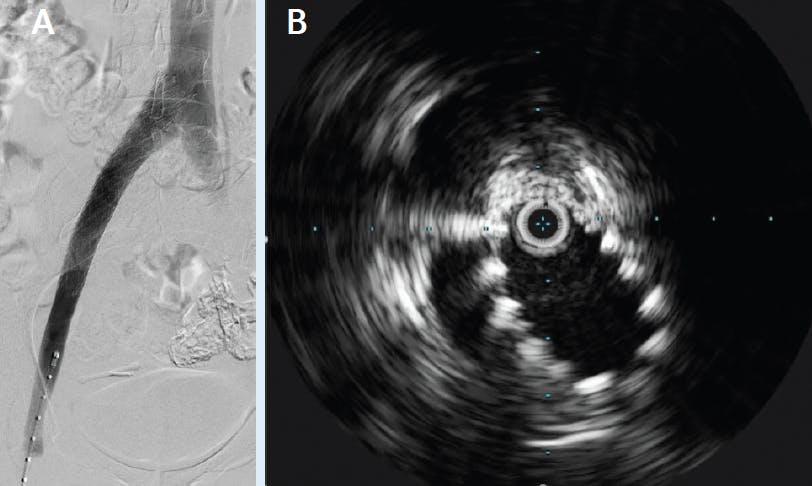
Figure 3. Venogram (A) and an IVUS still shot (B) show the stented vein.
To learn more about the Abre Study and deep venous educational resources, visit the Deep Venous Medtronic Academy website.
1. Raju S, Neglen P. High prevalence of nonthrombotic iliac vein lesions in chronic venous disease: a permissive role in pathogenicity. J Vasc Surg. 2006;44:136-43; discussion 144. doi: 10.1016/j.jvs.2006.02.065
2. Joh M, Desai KR. Treatment of nonthrombotic iliac vein lesions. Semin Intervent Radiol. 2021;38:155-159. doi: 10.1055/s-0041-1727101
3. Santoshi RKN, Lakhanpal S, Satwah V, et al. Iliac vein stenosis is an underdiagnosed cause of pelvic venous insufficiency. J Vasc Surg Venous Lymphat Disord. 2018;6:202-211. doi: 10.1016/j.jvsv.2017.09.007
4. van Vuuren TMAJ, Kurstjens RLM, Wittens CHA, et al. Illusory angiographic signs of significant iliac vein compression in healthy volunteers. Eur J Vasc Endovasc Surg. 2018;56:874-879. doi: 10.1016/j.ejvs.2018.07.022
5. Kibbe MR, Ujiki M, Goodwin AL, et al. Iliac vein compression in an asymptomatic patient population. J Vasc Surg. 2004;39:937-943. doi: 10.1016/j.jvs.2003.12.032
6. Gagne PJ, Gasparis A, Black S, et al. Analysis of threshold stenosis by multiplanar venogram and intravascular ultrasound examination for predicting clinical improvement after iliofemoral vein stenting in the VIDIO trial. J Vasc Surg Venous Lymphat Disord. 2018;6:48-56 e1. doi: 10.1016/j.jvsv.2017.07.009

Abre™ venous self-expanding stent system Brief Statement
Intended Use/Indications: The Abre™ venous self-expanding stent system (Abre™ stent system) is indicated for use in the iliofemoral veins for the treatment of symptomatic venous outflow obstruction.
Contraindications: Do not use the Abre™ stent system with patients with known hypersensitivity to nickel titanium (nitinol), with patients who are judged to have a lesion that prevents complete inflation of a balloon dilatation catheter or proper placement of the stent or the stent delivery system, and with patients in whom anticoagulant or antiplatelet therapy is contraindicated.
Potential Adverse Effects of the Device on Health: The potential adverse effects (e.g., complications) associated with the use of the Abre™ stent system include, but are not limited to, access failure, access site infection, allergic reaction to contrast medium or procedure medications; aneurysm; AV fistula; bleeding; bruising; death; device breakage; device maldeployment; edema; embolization; fever; hematoma; hypertension; hypotension, nausea, or other vasovagal response; infection; myocardial infarction, arrhythmia, or other cardiovascular insufficiency; open surgical repair; pain; pseudoaneurysm; renal insufficiency or renal failure (new or worsening); respiratory distress or pulmonary embolism; sepsis; stent fracture; stent malapposition; stent malposition; stent migration; stroke, paradoxical embolism, transient ischemic attack, or intracerebral hemorrhage; tissue necrosis; venous occlusion, restenosis, or thrombosis, within or outside of stented segment; and vessel damage, including intimal injury, dissection, perforation, or rupture.
Warnings, precautions, and instructions for use can be found in the product labeling at http://manuals.medtronic.com.
CAUTION: Federal (USA) law restricts this device to sale by or on the order of a physician.
500925 ©2021 Medtronic. Medtronic, Medtronic logo are trademarks of Medtronic.
All other brands are trademarks of Medtronic. For global distribution. 11/2021
Advertisement
Advertisement
