Advertisement
Advertisement
March 2022
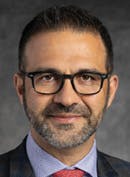
An Interview With Mehdi H. Shishehbor, DO, MPH, PhD
Dr. Shishehbor discusses the Limb Salvage Advisory Council and other work in his role as President of University Hospitals Harrington Heart & Vascular Institute, thought processes for using a new device or therapy, the important role of multidisciplinary collaboration systems, and more.
What are your goals in your new role as President of University Hospitals Harrington Heart & Vascular Institute, and what have been the highlights so far?
It is an incredible honor for me to have the opportunity to impact the care of our patients across Northeast Ohio. University Hospitals Harrington Heart & Vascular Institute encompasses three divisions—cardiovascular medicine, cardiothoracic surgery, and vascular surgery—across a major academic center, ten community hospitals, and nearly 30 other outpatient health centers and office locations. We have > 2,000 employees and 33 cath labs, and we perform > 20,000 cardiac and vascular procedures a year across the system. My goal is to create unified interdisciplinary teams that work across all of these hospitals and locations. We are developing systems of care that revolve around a patient-centered therapeutic approach—not around hospitals, doctors, or divisions. This is challenging! Unfortunately, historical academic departments were siloed and not enough was done to address the complexities of hospitals, markets, and operations. We are creating an institute, or system of care, that ensures integration and coordination in a matrix format.
The biggest highlights from 2021 were our resolve and commitment to each other and our patients. Collectively, I was amazed by the perseverance of our team and their selfless dedication to both colleagues and patients. While addressing COVID-related challenges, we had some fantastic wins. Our Limb Salvage Advisory Council (LSAC), an interdisciplinary council of vascular surgeons, interventional cardiologists, vascular medicine specialists, and podiatrists, saved many limbs, and that work was published in the January 2022 issue of Circulation: Cardiovascular Interventions.1 I am very proud of this work because we were able to successfully implement our goals related to both patient-centered care and bringing various specialties together to impact care.
Over the years, you’ve had a lot of experience incorporating novel technologic advances into daily practice and participating in the development of some of these technologies. Can you walk us through your process of determining whether you’ll use a new device or therapy?
My thought process has evolved through the years. Early on, I wanted to be a part of innovation and try new devices and technologies. Over time, I learned that I need to take a broader view and look into the added benefit of value-based care. I ask myself: Does this technology improve quality of care? Does it reduce cost? Does it improve outcomes? After answering these questions, I make a decision. We have also developed an institute-wide supply chain committee to review and independently provide feedback. I value this committee’s input and expertise and always learn from the discussions.
In the peripheral realm, one focus of your research has been on peripheral artery disease and chronic limb-threatening ischemia (CLTI), and you outlined the field’s advances in this area in a recent Vascular Medicine paper.2 What further advances and changes in practice do you hope we’ll see in the next decade?
I am very excited about the future of our field, but the road ahead will not be without challenges. The biggest advances in my opinion will be around interdisciplinary care, national quality databases that break siloed specialties, and newer technologies that improve patency and quality of life. We can have the best technologies, but if patients are not receiving them, then we have failed. All peripheral specialists have seen patients who have arrived at our clinics just a little too late. We need to continue to educate and advocate for early intervention and interdisciplinary care. In addition, the vascular field has lagged behind cardiac surgery and cardiovascular medicine in terms of national registries like the Society of Thoracic Surgeons/American College of Cardiology Transcatheter Valve Therapy registry and the National Cardiovascular Data registry (NCDR) that hold providers accountable and soon will be publicly available in some measure. In vascular, this is not consistent. We have the now-merged Vascular Quality Initiative and NCDR Peripheral Vascular Intervention registry, but we need mandated reporting and accountability that are agnostic to specialty. I am still optimistic about biologic therapy for CLTI and hope that advances in drug delivery and antirestenotic medications will continue to improve patency and quality of life.
The limb salvage program you lead at University Hospitals Harrington Heart & Vascular Institute aims to help “no-option” patients at risk of lower extremity amputation, and the positive impact of the associated LSAC has been profiled in a recent paper.1 Can you tell us about the makeup of these two systems and how you’ve seen them influence patient care? What advice would you share with those wanting to implement an LSAC?
This has been one of the highlights of my career. I am inspired by our devoted team of vascular surgeons, interventional cardiologists, vascular medicine specialists, and podiatrists. Basically, we are asking our doctors to check their ego at the door, forget about their department, and focus on each patient’s needs. It was not easy at first, but I think everyone has realized that this is the best—and only—way forward. This is what we call “adaptive change.” We need to get leaders in one room and agree about the need for change. Start small and continue to evolve. Keep a close eye on the data and outcomes, and make sure the decisions are balanced. Everyone should have equity in this process, and these councils are important quality initiatives for any organization.
What is your philosophy on how best to build a relationship between provider and patient that ensures a patient-centered therapeutic approach as well as long-term follow-up and optimal wound care?
We need proactive rather than reactive care. For us, it means building a relationship with our patients before they need procedures and operations. It means active follow-up. But it also means going beyond the clinical issues and expanding to social determinants of health (SDoH). I believe SDoH are as important as prescribing statins. Building strong relationships with our patients requires time, which has become increasingly harder to find. Utilize a team approach, including novel technologies and programs like telehealth, as well as “hospital at home” initiatives.
Another multidisciplinary system you’re involved in is the pulmonary embolism response team (PERT), and in a 2021 paper, you identified a need for guidelines to direct PERT activation.3 Can you tell us about PERT activation at your center?
We have found PERT to be another very important interdisciplinary intervention. Colleagues across pulmonary, cardiology, radiology, and vascular medicine work together to provide the highest level of care. Our data have shown that PERT is associated with lower mortality, bleeding, and readmission. To help streamline the time commitment, we are using artificial intelligence and our research to identify intermediate- and high-risk patients.
What other conditions could benefit from the implementation of a multidisciplinary collaboration system?
Many other conditions would benefit from interdisciplinary collaboration. At University Hospitals Harrington Heart & Vascular Institute, we have successfully implemented other unified, multidisciplinary collaborations in our valve and structural heart disease center for transcatheter interventions and, as noted, our LSAC and PERT, but why not also for acute deep vein thrombosis, carotid disease, and acute aortic care teams? In addition to the interdisciplinary expertise these teams provide, they also offer a better continuum of care and allow for more concentrated preventive and follow-up patient care over time.
1. Shishehbor MH, Hammad TA, Rhone TJ, et al. Impact of interdisciplinary system-wide limb salvage advisory council on lower extremity major amputation. Circ Cardiovasc Interv. 2022;15:e011306. doi: 10.1161/CIRCINTERVENTIONS.121.011306
2. Hammad TA, Shishehbor MH. Advances in chronic limb-threatening ischemia. Vasc Med. 2021;26:126-130. doi: 10.1177/1358863X21998436
3. Parikh M, Chahine NM, Hammad TA, et al. Predictors and potential advantages of PERT and advanced therapy use in acute pulmonary embolism. Catheter Cardiovasc Interv. 2021;97:1430-1437. doi: 10.1002/ccd.29697
Advertisement
Advertisement
Interested in reading more interviews?
To read more interviews with thought leaders in the vascular field, check out our Profiles & Perspectives hub.
Read More