Advertisement
Advertisement
March 2022
Endovascular Total Arch Repair
An overview of the most common indications for reintervention after endovascular arch repair with branched endografts and a discussion of strategies to minimize complications.
Aortic arch aneurysms typically represent either distal extension of ascending aortic pathology or the proximal extent of thoracic and thoracoabdominal aortic aneurysms (TAAAs). The evolution of endovascular techniques prompted the application of minimally invasive approaches to treat aortic arch and ascending aneurysms and dissections.1,2 Several options have been used, ranging from hybrid repair with surgical debranching to total endovascular repair with parallel stent grafts, in situ fenestrations, and manufactured fenestrated and branched devices.3-6 In practical terms, most patients are treated either with a proximal repair into zone 0 or a distal repair into zone 2. Because of the relative proximity of the left carotid artery and innominate artery (IA), use of zone 1 for repair is rarely possible.
Device designs vary based on technique of implantation and number of incorporated vessels. For example, the Gore TAG thoracic branch endoprosthesis (Gore & Associates) is designed for single-vessel incorporation with a retrograde portal, typically with zone 0 or zone 2 deployment.7 In contrast, the Zenith arch branch graft (Cook Medical) manufactures patient-specific options with two or three inner branches for the IA, left common carotid arteries (LCCAs), and left subclavian artery (LSA) or an alternative for zone 2 that includes a retrograde branch for the LSA and a triple-wide scallop for the LCCA.8 Regardless, careful patient selection, thoughtful device design, and use of intraoperative adjuncts and imaging techniques have yielded a high technical success for endovascular total arch repair. A multicenter global feasibility study evaluating three-vessel inner-branch stent grafts for treatment of aneurysms and dissections boasted 100% technical success.8 In that study, freedom from secondary intervention was 60% at 1 year, with five cervical incision–related complications and six target vessel endoleaks among the 39 patients. Many of these complications occurred in the first 3 months and potentially could have been preventable. Similar to other techniques of fenestrated and branched endovascular aneurysm repair (FB-EVAR), close surveillance is of paramount importance.8
ACCESS SITE COMPLICATIONS
The use of small bilateral cervical incisions for access and sequential clamping of the IA and LCCAs during inner-branch cannulation and stenting has been advocated as a means to prevent distal embolization (Figure 1). Some operators have used axillary artery access as an alternative. Although the global multicenter study reported impressive results with high technical success rate using inner branches, the early reintervention rate was high at 18%. The majority of these secondary procedures (13%) were for cervical access site complications, including hematomas requiring evacuation in three patients, flow-limiting dissection of the right common carotid arteries (RCCAs) treated with interposition graft in one, and pseudoaneurysm requiring patch angioplasty in another.8 Similar outcomes were reported by Verscheure et al in a retrospective, international, multicenter review of 70 patients treated with branched endografts for postdissection arch aneurysms. Early reintervention was performed in 17%, again with vascular access complications being most common.9 This predominance of early reinterventions due to carotid access site complications is also mirrored in other studies from single high-volume centers.10
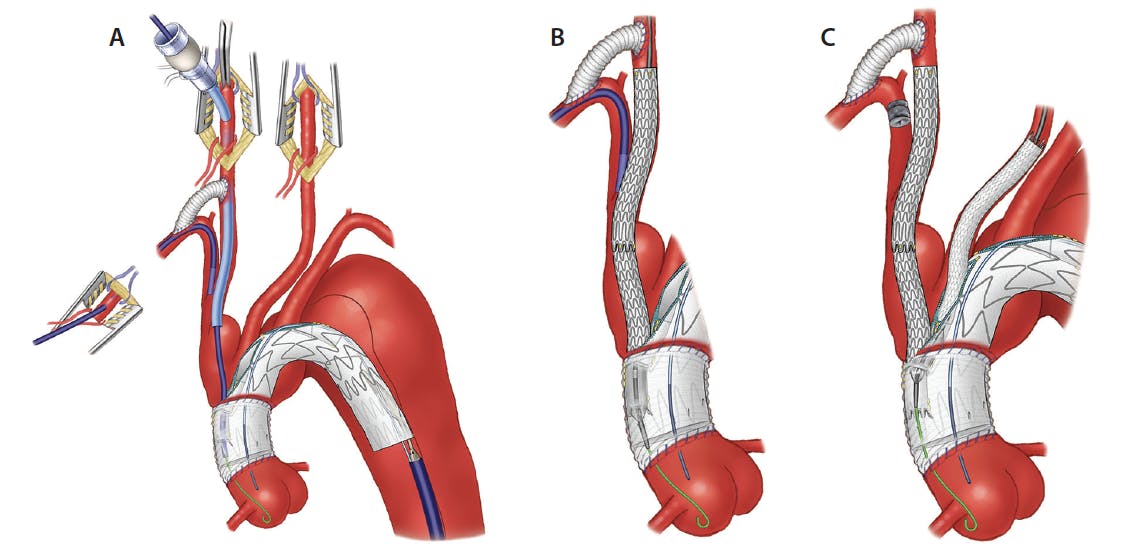
Figure 1. Illustration demonstrating endovascular repair of a postdissection aortic arch aneurysm after previous surgical ascending aortic repair. After right carotid-subclavian bypass, small bilateral cervical incisions are used for access and sequential clamping of the bilateral common carotid arteries to prevent distal embolization during inner-branch cannulation and stenting. Surgical access of the right proximal brachial artery is also achieved to permit access to the right subclavian artery (A). Sequential stenting is then performed of the IA branch with extension into the RCCA (B), followed by the LCCA (C). Right proximal brachial access allows embolization of the proximal right subclavian artery to prevent a type II endoleak.
Strategies to reduce access-related secondary procedures certainly include meticulous hemostasis and closure, but higher intraoperative activated clotting times and a generally lower threshold for hematoma decompression in the neck may inevitably predispose these access sites to more frequent reinterventions. Therefore, in an attempt to reduce the risk of cervical access issues, the use of percutaneous approaches via femoral and axillary access or total femoral access have been proposed. The development of steerable sheaths has allowed direct access to the inner branches and sequential stenting of the LCCAs and, in some cases, the IA.11 Experience with percutaneous axillary artery for TAAA FB-EVAR has also prompted its use for arch repair.12,13 Steerable sheaths have included larger (18 F) or smaller (8.5 F) profiles.14,15 More recently, a report led by Mougin et al described the first three-vessel, totally percutaneous aortic arch repairs using inner branches in two patients.16 Incorporation of all three vessels was accomplished from the femoral approach for the LCCA and LSA and the right axillary artery for the IA, avoiding the need for cervical incisions and its potential complication risks (Figure 2). Although neither patient experienced neurologic deficit despite the lack of sequential carotid clamping, the question remains which patients should be selected for total percutaneous versus open cervical access techniques and how we can prevent emboli when using a percutaneous approach. Currently, it seems prudent to select patients based on underlying pathology along with the quality of the arch and supra-aortic trunks, with the ideal candidates having prior ascending aortic repair and no evidence of any atheromatous disease in the arch.
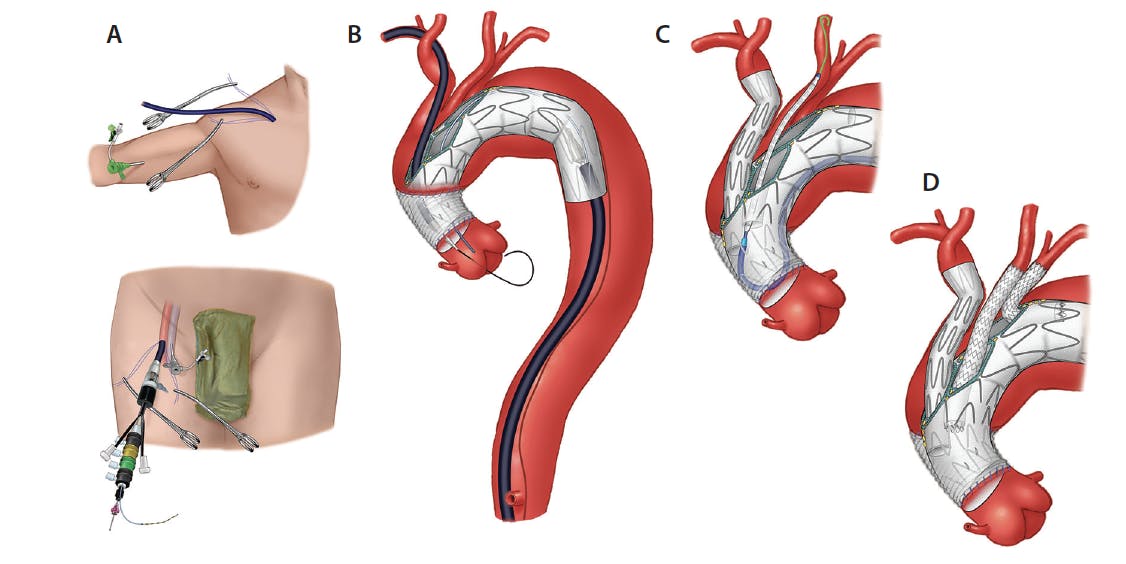
Figure 2. Illustration demonstrating percutaneous access of the left common femoral artery and right axillary artery using the preclosure technique during endovascular arch repair (A). The right axillary approach is used for retrograde cannulation of the IA branch (B), whereas the femoral approach is used for antegrade cannulation of the LCCA branch (C), avoiding the need for cervical incisions. The LSA branch is also cannulated in an antegrade fashion from the femoral approach (D).
TARGET VESSEL ENDOLEAKS
Target vessel endoleaks represent the other major indication for reintervention after endovascular arch repair. Although many of these occurred because of liberal indications in patients with dissections extending into the supra-aortic trunks, mechanisms of failure include endoleaks at the distal site of bridging stents, kinks, and potential risk of stenosis or occlusion. In the multicenter global study by Tenorio et al, there were six reinterventions for endoleaks.8 The source of an endoleak can be persistent false lumen flow in patients with dissections that extend into side branches or retrograde flow via the subclavian artery in patients with a previous carotid-subclavian bypass with incomplete occlusion of the subclavian artery. Patients with postdissection aneurysms can be challenging to treat due to the large branch vessels affected by dissection that are not ideally suited for current iterations of bridging stents. Management of target vessel false lumen perfusion often includes false lumen embolization and target vessel stent extension.8
Other authors have described high rates of reinterventions for endoleak.9 Because most of these endoleaks involve target vessels affected by dissection, one strategy is to stage the repair with replacement of a segment of the carotid artery to create an optimal landing zone (Figure 3). This allows for a total femoral approach at the time of the arch repair, thereby mitigating the risk of both target vessel endoleak and cervical access site complications. Lastly, the use of intraoperative adjunctive tools such as cone-beam CT should be used to identify intraoperative issues so they can be remedied prior to leaving the operating room.
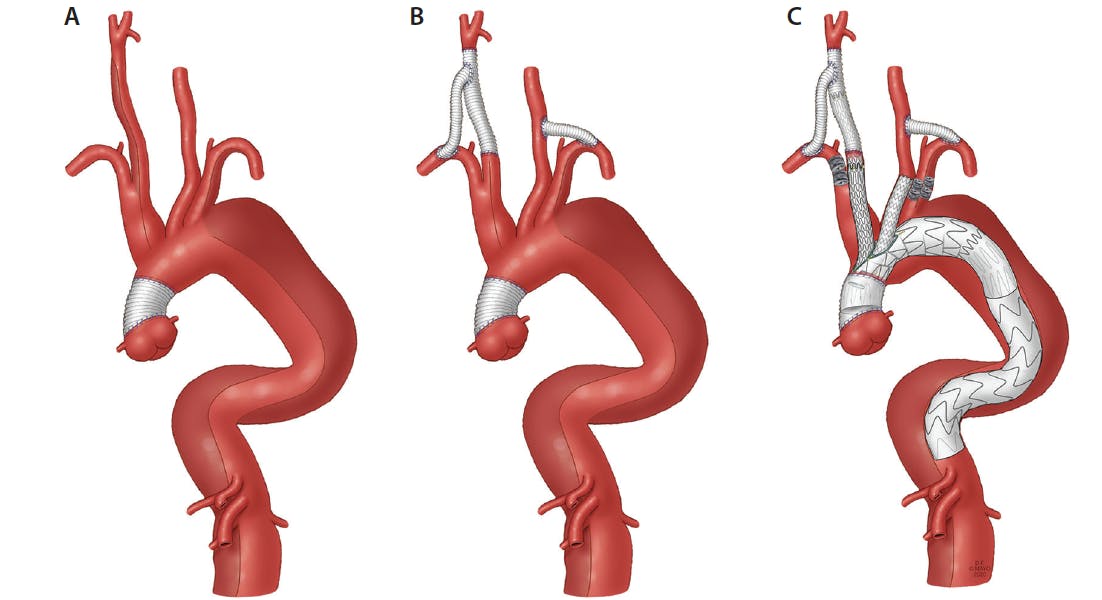
Figure 3. Illustration demonstrating staged replacement of the carotid artery and extra-anatomic bypass to optimize target vessel landing zones prior to endovascular arch repair in a postdissection aortic arch aneurysm with extension into the RCCAs and LSA (A). A right common carotid interposition graft is placed, and bilateral carotid-subclavian artery bypasses are performed (B). Embolization of the right proximal subclavian artery as well as the true and false lumens of the proximal LSA optimizes landing zones in the common carotid arteries and prevent type II endoleaks from false lumen perfusion (C).
Other failure modes and indications for reintervention after endovascular arch repair include branch vessel kink and type Ia or Ib endoleaks that require, respectively, stent realignment and proximal/distal aortic extension, but these represent a much smaller percentage of secondary procedures.
SUMMARY
Endovascular total arch repair provides a valuable alternative option for patients who are poor surgical candidates, and technical success is high with careful patient selection. However, the rate of early reinterventions is also relatively high, with the most frequent indications being cervical access site complications and endoleaks. Learning from current experiences of the multicenter collaborations, anticipation of these complications using preemptive strategies such as preparation of target vessel landing zones, and use of a total femoral approach can potentially lower reintervention rates in the future.
1. Oderich GS, Tenorio ER, Mendes BC, et al. Midterm outcomes of a prospective, nonrandomized study to evaluate endovascular repair of complex aortic aneurysms using fenestrated-branched endografts. Ann Surg. 2021;274:491-499. doi: 10.1097/SLA.0000000000004982
2. Mougin J, Charbonneau P, Guihaire J, et al. Endovascular management of chronic post-dissection aneurysms of the aortic arch. J Cardiovasc Surg (Torino). 2020;61:402-415. doi: 10.23736/S0021-9509.20.11395-8
3. Hughes GC, Vekstein A. Current state of hybrid solutions for aortic arch aneurysms. Ann Cardiothorac Surg. 2021;10:731-743. doi: 10.21037/acs-2021-taes-168
4. Dueppers P, Reutersberg B, Rancic Z, et al. Long-term results of total endovascular repair of arch-involving aortic pathologies using parallel grafts for supra-aortic debranching. J Vasc Surg. Published online October 2, 2021. doi: 10.1016/j.jvs.2021.09.020
5. Kopp R, Katada Y, Kondo S, et al. Multicenter analysis of endovascular aortic arch in situ stent-graft fenestrations for aortic arch pathologies. Ann Vasc Surg. 2019;59:36-47. doi: 10.1016/j.avsg.2019.02.005
6. Spanos K, Haulon S, Tsilimparis N, et al. Preoperative measurements and planning sheet for an endograft with 3 inner branches to repair aortic arch pathologies. J Endovasc Ther. 2019;26:378-384. doi: 10.1177/1526602819840329
7. Dake MD, Fischbein MP, Bavaria JE, et al. Evaluation of the Gore TAG thoracic branch endoprosthesis in the treatment of proximal descending thoracic aortic aneurysms. J Vasc Surg. 2021;74:1483-1490.e2. doi: 10.1016/j.jvs.2021.04.025
8. Tenorio ER, Oderich GS, Kölbel T, et al. Multicenter global early feasibility study to evaluate total endovascular arch repair using three-vessel inner branch stent-grafts for aneurysms and dissections. J Vasc Surg. 2021;74:1055-1065.e4. doi: 10.1016/j.jvs.2021.03.029
9. Verscheure D, Haulon S, Tsilimparis N, et al. Endovascular treatment of post type a chronic aortic arch dissection with a branched endograft: early results from a retrospective international multicenter study. Ann Surg. 2021;273:997-1003. doi: 10.1097/SLA.0000000000003310
10. Spear R, Hertault A, Van Calster K, et al. Complex endovascular repair of postdissection arch and thoracoabdominal aneurysms. J Vasc Surg. 2018;67:685-693. doi: 10.1016/j.jvs.2017.09.010
11. Makaloski V, Tsilimparis N, Rohlffs F, et al. Use of a steerable sheath for retrograde access to antegrade branches in branched stent-graft repair of complex aortic aneurysms. J Endovasc Ther. 2018;25:566-570. doi: 10.1177/1526602818794965
12. Bertoglio L, Mascia D, Cambiaghi T, et al. Percutaneous axillary artery access for fenestrated and branched thoracoabdominal endovascular repair. J Vasc Surg. 2018;68:12-23. doi: 10.1016/j.jvs.2017.09.053
13. Bertoglio L, Conradi L, Howard DPJ, et al. Percutaneous transaxillary access for endovascular aortic procedures in the multicenter international PAXA registry. J Vasc Surg. Published online September 30, 2021. doi: 10.1016/j.jvs.2021.08.089
14. Settembrini AM, Kölbel T, Rohlffs F, et al. Use of a steerable sheath for antegrade catheterization of a supra-aortic branch of an inner-branched arch endograft via a percutaneous femoral access. J Endovasc Ther. 2020;27:917-921. doi: 10.1177/1526602820939936
15. Watkins AC, Avramenko A, Soler R, et al. A novel all-retrograde approach for t-branch implantation in ruptured thoracoabdominal aneurysm. J Vasc Surg Cases Innov Tech. 2018;4:301-304. doi: 10.1016/j.jvscit.2018.09.002
16. Mougin J, Azogui R, Guihaire J, et al. “First in man” total percutaneous aortic arch repair with 3-inner-branch endografts: a report of two cases. Ann Surg. 2021;274:e652-e657. doi: 10.1097/SLA.0000000000005167
Advertisement
Advertisement