Advertisement
Advertisement
November 2022
Medical Management of Acute and Chronic Type B Aortic Dissection
A review of the clinical presentation and acute and long-term medical management of TBAD, including long-term use of fluoroquinolones.
By Christina L. Fanola, MD, MSc, and Eric Isselbacher, MD, MSc
An acute type B aortic dissection (TBAD) can be a life-threatening condition of the aorta with increased risk of mortality and morbidity that requires a prompt diagnosis and treatment plan. According to the Stanford classification, TBADs are those that exclude the ascending aorta. In the DeBakey classification, the type III dissections are usually distal to the subclavian artery.1 Common risk factors for TBADs include older age, hypertension, and atherosclerosis. TBAD may also occur in patients with underlying inflammatory conditions, such as giant cell aortitis or Takayasu arteritis. In addition, although more likely to present with thoracic aortic disease, TBAD can occur in hereditary conditions such as Marfan syndrome, Loeys-Dietz syndrome, and vascular Ehlers-Danlos syndrome.2 An acute rise in hemodynamic stress is often necessary to precipitate an aortic dissection, which can include drug use (cocaine, methamphetamines), hormonal abnormalities from pheochromocytoma, pregnancy, high-intensity aerobic activity, heavy weight lifting, anxiety, and pain, among others. Descending aortic dilation is not necessary to experience a TBAD, as data from the International Registry of Acute Aortic Dissection (IRAD) found that only 18.4% of patients with a TBAD had a baseline descending aortic diameter > 5.5 cm, and in 21% of patients, the aortic diameter at the time of dissection was < 3.5 cm.3,4
CLINICAL PRESENTATION AND COMPLICATIONS OF TBAD
Acute TBADs can present with a multitude of clinical signs and symptoms depending on several key factors, including proximal and distal extension of dissection, dynamic changes in flow and distal perfusion, and presence or absence of rapid expansion or rupture. The prevalence of hypertension is high in TBAD, presenting in up to 75% of patients.1,5,6 Back pain is more common in TBADs compared to type A dissections (64% vs 43%, respectively), and chest pain is still quite common (63%).6 Isolated abdominal pain, without concomitant back and/or chest pain, is a somewhat less common presentation but, when present, can lead to a delay in diagnosis of TBAD and results in higher mortality. Pulse deficits are not very sensitive in acute TBAD.6
From the IRAD registry experience, overall in-hospital TBAD-related mortality is 13%, with most deaths occurring within the first week of presentation.7 Complications that contribute to mortality in acute TBAD include end-organ malperfusion syndromes, hemodynamic instability, expansion, and rupture.6-8 Prompt identification of complications can help guide therapeutic intervention, whether medical, endovascular, open, or hybrid. In the past 20 years, medical management as the solo intervention for TBAD has decreased from 75% to 57%, whereas endovascular management has increased from 7% to 31%.7 In patients who are nonsurgical candidates and do not have suitable anatomy for endovascular stent graft treatment, medical management alone has demonstrated consistent results. Overall mortality in patients treated with medical therapy alone is estimated at 10% (vs 30% for open surgical repair; Figure 1), with age > 70 years and preoperative shock as predictors for surgical mortality.7
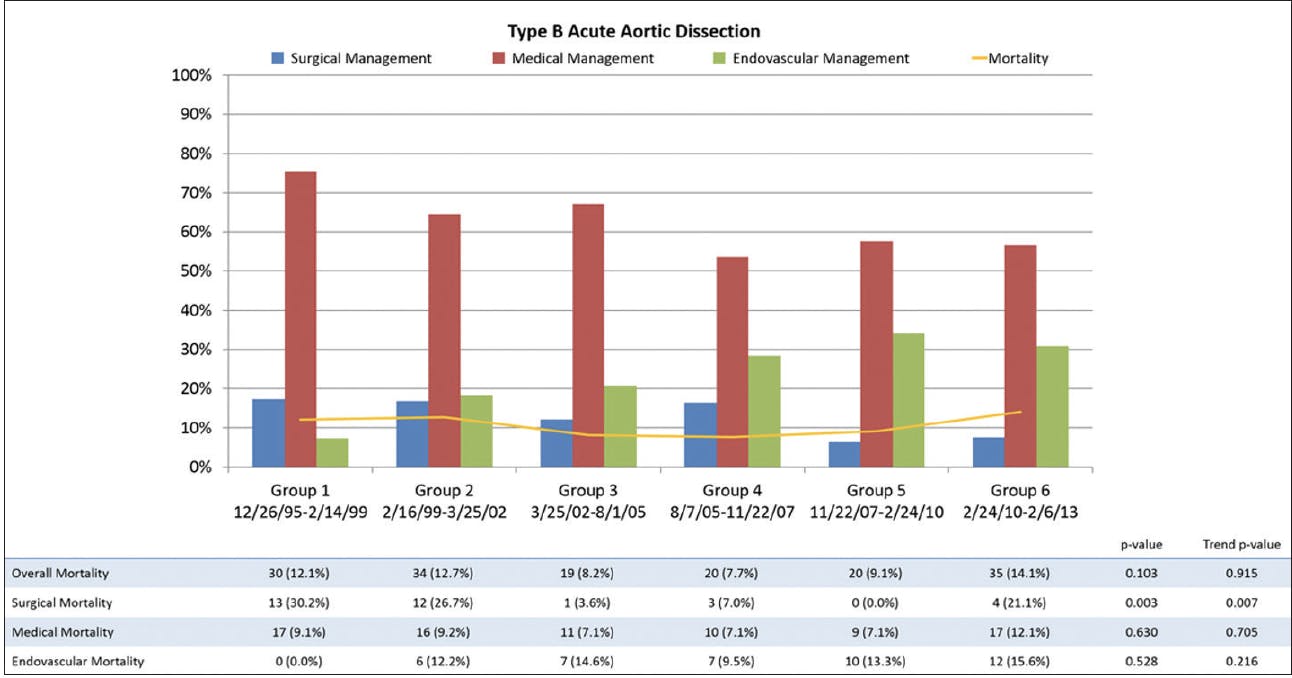
Figure 1. Mortality trends in medical management of acute TBAD from the IRAD. Adapted from Journal of the American College of Cardiology, 66, Pape LA, Awais M, Woznicki EM, et al, Presentation, diagnosis, and outcomes of acute aortic dissection: 17-year trends from the international registry of acute aortic dissection, 350-358, 2015, with permission from Elsevier.
MEDICAL MANAGEMENT OF TBAD IN THE ACUTE SETTING
The goal of medical management in all patients with TBAD, regardless of whether they are candidates for surgical or endovascular intervention, is to prevent both acute and chronic complications. Although no randomized clinical trials have evaluated the various medical therapies in preventing short-term mortality in acute TBADs, there are promising data from long-term prospective studies, both single center and from the multicenter IRAD cohort. The key management strategy in the immediate short term after initial diagnosis is to decrease the aortic wall stress, also known as anti-impulse therapy. This can usually be achieved with β-blockers and intravenous (IV) vasodilators, ideally in the intensive care unit and utilizing arterial line monitoring.8-12 Newly published 2022 American Heart Association and American College of Cardiology aortic disease guidelines have indicated use of IV β-blocker therapy (eg, esmolol, metoprolol, labetalol) as first-line treatment in acute aortic dissection as a class I recommendation.12 The use of IV vasodilators, such as nicardipine and sodium nitroprusside, are useful adjunctive therapies after the initiation of β-blocker therapy. Vasodilator therapy without concomitant β-blocker therapy increases risk of compensatory tachycardia, which increases aortic wall stress and the risk of aortic dissection complications both in the short and long term.9,10 Alternatives to the initial β-blocker therapy for control of heart rate and blood pressure (BP) are the nondihydropyridine calcium channel blockers (CCBs), which include verapamil and diltiazem. Contraindications to anti-impulse therapy, specifically β-blockers and the nondihydropyridine CCBs, include severe acute aortic regurgitation (due to retrograde extension of the dissection into the proximal aorta), cardiogenic shock and reduced left ventricular function, bradycardia, and heart block. Echocardiography is often useful in the acute setting of acute aortic dissection to help guide appropriate medical therapy.
Frequent monitoring is necessary to titrate IV anti-impulse therapy to achieve hemodynamic targets, which by updated guidelines is a systolic BP < 120 mm Hg and a heart rate < 60 to 80 bpm, while also paying attention to maintaining adequate end-organ perfusion.10,12,13 Attention must also be paid to treating any underlying mechanisms precipitating the acute hemodynamic stress that led to the aortic dissection, including thyroid disorders and other hormonal precipitants, pain, anxiety, and arterial inflammation. Pain management becomes especially crucial because it can be a primary contributor of labile hypertension and tachycardia in the acute setting, and thus IV opiates are considered useful.12
LONG-TERM MEDICAL MANAGEMENT OF TBAD
Up to 60% of patients with acute TBAD may experience aortic diameter expansion during long-term follow-up.8 As is the case with acute dissections, there are no randomized clinical trials that have evaluated specific treatments in the prevention of complications from TBAD, and guidelines are based on longitudinal data and expert consensus.12 Hemodynamic goals for long-term management mirror those in the acute setting, with a systolic BP goal of < 120 mm Hg and heart rate goal of < 80 bpm. This applies to patients who undergo medical management alone or those who underwent surgical or endovascular repair.
Oral β-blocker therapy is considered the first-line antihypertensive for long-term management of TBADs, with angiotensin-converting enzyme inhibitors and angiotensin receptor blockers as alternative adjunctive therapy unless contraindicated.9,11-13 Oral CCBs are less well understood as β-blockers for long-term outcomes in TBADs. Although there may be benefit with IV CCBs in the acute intensive care setting, oral CCBs should be used with caution in select patients with hereditary aortic disease and dissection (eg, Marfan syndrome).14 A significant proportion of TBADs are due to chronic atherosclerosis and may or may not have been precipitated by a penetrating aortic ulcer. Although there are limited data to support statin use in the prevention of aortic-specific adverse outcomes in aortic dissection,15 statins are recommended in the prevention of adverse cardiovascular outcomes in patients with aortic disease16 and may have benefit in the prevention of adverse aortic-specific outcomes in those with abdominal aortic aneurysm.17
USE OF FLUOROQUINOLONES IN PATIENTS WITH CHRONIC TBAD
Fluoroquinolones are a commonly prescribed antibiotic, especially for urinary tract infections and community-acquired pneumonia, but in small animal studies, they have been shown to stimulate metalloproteinases that can result in collagen breakdown.18 Thus, it has been theorized that fluoroquinolones can potentially cause aortic dissection or more rapid growth in those with underlying aortic aneurysm. A human observational cohort study demonstrated a 66% higher rate of aortic dissection or development of aortic aneurysm associated with fluoroquinolones when compared with amoxicillin.19 A recently published, large, nationwide, propensity-matched cohort study comparing a fluoroquinolone to azithromycin found an overall low absolute rate of aortic dissection and aneurysm of < 0.1%, although there was an increased risk associated with fluoroquinolones during the 60-day follow-up.20 The United States FDA and European Medicines Agency in 2018 released a warning of potential aortic vessel damage in particular patients at risk.21 Although ongoing longitudinal studies are needed to fully elucidate the causality of fluoroquinolone use in aortic outcomes, it is reasonable to consider alternative antibiotic therapies in select patients with chronic TBAD if risks of fluoroquinolones outweigh the benefits.
CONCLUSION
Acute TBAD is a condition that if not immediately recognized may increase risk of mortality and morbidity. Aggressive BP and heart rate control with β-blocker and vasodilator therapy is the mainstay of treatment in both acute and chronic TBAD to prevent aortic-related complications including malperfusion syndromes, expansion, and rupture. Ongoing longitudinal study evaluating the safety of fluoroquinolone use in patients with chronic TBAD is needed.
1. Braverman AC. Acute aortic dissection: clinician update. Circulation. 2010;122:184-188. doi: 10.1161/CIRCULATIONAHA.110.958975
2. Pinard A, Jones G, Milewicz D. Genetics of thoracic and abdominal aortic diseases. Circ Res. 2019;124:588-606. doi: 10.1161/CIRCRESAHA.118.312436
3. Trimarchi S, Jonker FH, Hutchison S, et al. Descending aortic diameter of 5.5 cm or greater is not an accurate predictor of acute type B aortic dissection. J Thorac Cardiovasc Surg. 2011;142:e101-e107. doi: 10.1016/j.jtcvs.2010.12.032
4. Trimarchi S, Jonker FH, Froehlich JB, et al; International Registry of Acute Aortic Dissection (IRAD) investigators. Acute type B aortic dissection in the absence of aortic dilatation. J Vasc Surg. 2012;56:311-316. doi: 10.1016/j.jvs.2012.01.055
5. Hagan PG, Nienaber CA, Isselbacher EM, et al. International Registry of Acute Aortic Dissection (IRAD): new insights from an old disease. JAMA. 2000;283:897-903. doi: 10.1001/jama.283.7.897
6. Evangelista A, Isselbacher EM, Bossone E, et al. Insights from the International Registry of Acute Aortic Dissection: a 20-year experience of collaborative clinical research. Circulation. 2018;137:1846-1860. doi: 10.1161/CIRCULATIONAHA.117.031264
7. Pape LA, Awais M, Woznicki EM, et al. Presentation, diagnosis, and outcomes of acute aortic dissection: 17-year trends from the international registry of acute aortic dissection. J Am Coll Cardiol. 2015;66:350-358. doi: 10.1016/j.jacc.2015.05.029
8. Jonker FHW, Trimarchi S, Rampoldi V, et al. Aortic expansion after acute type B aortic dissection. Ann Thorac Surg. 2012;94:1223-1229. doi: 10.1016/j.athoracsur.2012.05.040
9. Suzuki T, Isselbacher EM, Nienaber CA, et al. Type-selective benefits of medications in treatment of acute aortic dissection (from the International Registry of Acute Aortic Dissection [IRAD]). Am J Cardiol. 2012;109:122-127. doi: 10.1016/j.amjcard.2011.08.012
10. Kumar KU, Zhao Q, Bai X, et al. Controlled heart rate and blood pressure reduce the life threatening aortic events and increase survival in patients with type B aortic dissection: a single center experience. Int J Cardiol Heart Vasc. 2015;8:73-74. doi: 10.1016/j.ijcha.2015.05.008
11. Chen SW, Chan YH, Lin CP, et al. Association of long-term use of antihypertensive medications with late outcomes among patients with aortic dissection. JAMA Netw Open. 2021;4:e210469. doi: 10.1001/jamanetworkopen.2021.0469
12. Isselbacher EM, Preventza O, Black JH, et al. 2022 ACC/AHA guideline for the diagnosis and management of aortic disease: a report of the American Heart Association/American College of Cardiology Joint Committee on Clinical Practice Guidelines. J Am Coll Cardiol. Published online November 2, 2022. doi: 10.1016/j.jacc.2022.08.004
13. Lu N, Ma X, Xu T, et al. Optimal blood pressure control for patients after thoracic endovascular aortic repair of type B aortic dissection. BMC Cardiovasc Disord. 2019;19:124. doi: 10.1186/s12872-019-1107-2
14. Doyle JJ, Doyle AJ, Wilson NK, et al. A deleterious gene-by-environment interaction imposed by calcium channel blockers in Marfan syndrome. Elife. 2015;4:e08648. doi: 10.7554/eLife.08648
15. Masaki N, Kumagai K, Sasaki K, et al. Suppressive effect of pitavastatin on aortic arch dilatation in acute stanford type B aortic dissection: analysis of STANP trial. Gen Thorac Cardiovasc Surg. 2018;66:334-343. doi: 10.1007/s11748-018-0916-z
16. Grundy SM, Stone NJ, Bailey AL, et al. 2018 AHA/ACC/AACVPR/AAPA/ABC/ACPM/ADA/AGS/APhA/ASPC/NLA/PCNA guideline on the management of blood cholesterol: a report of the American College of Cardiology/American Heart Association Task Force on Clinical Practice Guidelines. Circulation. 2019;139:e1082-e1143. doi: 10.1161/CIR.0000000000000625
17. Salata K, Syed M, Hussain MA, et al. Statins reduce abdominal aortic aneurysm growth, rupture, and perioperative mortality: a systematic review and meta-analysis. J Am Heart Assoc. 2018;7:e008657. doi: 10.1161/JAHA.118.008657
18. LeMaire SA, Zhang L, Luo W, et al. Effect of ciprofloxacin on susceptibility to aortic dissection and rupture in mice. JAMA Surg. 2018;153:e181804. doi: 10.1001/jamasurg.2018.1804
19. Pasternak B, Inghammar M, Svanström H. Fluoroquinolone use and risk of aortic aneurysm and dissection: nationwide cohort study. BMJ. 2018;360:k678 doi: 10.1136/bmj.k678.
20. Gopalakrishnan C, Bykov K, Fischer MA, et al. Association of fluoroquinolones with the risk of aortic aneurysm or aortic dissection. JAMA Intern Med. 2020;180:1596-1605. doi: 10.1001/jamainternmed.2020.4199
21. US Food and Drug Administration. FDA warns about increased risk of ruptures or tears in the aorta blood vessel with fluoroquinolone antibiotics in certain patients. Updated December 21, 2018. Accessed November 1, 2022. https://www.fda.gov/drugs/drug-safety-and-availability/fda-warns-about-increased-risk-ruptures-or-tears-aorta-blood-vessel-fluoroquinolone-antibiotics
Advertisement
Advertisement