Advertisement
Advertisement
November 2022
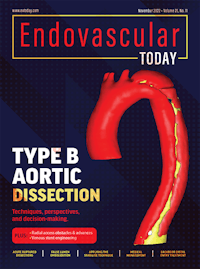
Type B Aortic Dissection: Perspectives, Techniques, and Decision-Making
By Christoph A. Nienaber, MD, PhD, FESC, FAHA, and Grace J. Wang, MD, MSCE, FACS


We are thrilled to present this very exciting issue of Endovascular Today, featuring up-to-date, innovative approaches to treating type B aortic dissection (TBAD). It is hard to believe that the results of the INSTEAD XL trial were published almost a decade ago, introducing and justifying the rationale for the treatment of uncomplicated TBAD. In this issue, experts provide their perspectives, techniques, and insights heading into 2023.
Prof. Nienaber offers his unique viewpoint on thoracic aortic dissection with lessons learned from the INSTEAD trial, which evaluated thoracic endovascular aortic repair (TEVAR) and optimal medical therapy for TBAD. Then, Germano Melissano, MD, and Daniele Mascia, MD, provide an in-depth look at the STABILISE (stent-assisted balloon-induced intimal disruption and relamination in aortic dissection repair) technique, an evolution of PETTICOAT (provisional extension to induce complete attachment), to treat acute and subacute TBAD.
Patrick R. Vargo, MD; Adam Daly, MD; and Eric E. Roselli, MD, offer their approach to treating the false lumen during TEVAR using balloon fracture fenestration and direct false lumen embolization. Ryan Gouveia e Melo, MD; Tarek Hamwi, MD; and Nikolaos Tsilimparis, MD, describe cases of acute and chronic aortic dissection ruptures to illustrate the challenges encountered and the various techniques utilized for treatment of this challenging clinical problem.
Next, Konstantinos Spanos, MD; Fiona Rohlffs, MD; Giuseppe Panuccio, MD; Ahmed Eleshra, MD; and Tilo Kölbel, MD, discuss the evolution of the candy-plug and knickerbocker techniques for distal false lumen occlusion, as well as the timing of intervention and patient anatomy considerations.
Then, Christina L. Fanola, MD, and Eric Isselbacher, MD, discuss clinical presentation and complications of TBAD, medical management of in the acute setting and over the long term, and the use of fluoroquinolones in chronic TBAD.
Our coverage of thoracic aortic dissection ends with a panel discussion with Tilo Kölbel, MD; Tara M. Mastracci, MD; Prof. Nienaber; Germano Melissano, MD; Daniele Mascia, MD; and Eric E. Roselli, MD, where they offer their insights for the treatment of uncomplicated TBAD.
This issue also includes a series of articles on the use of radial access in endovascular procedures. First, Robert J. Beaulieu, MD; William E. Beckerman, MD; and Yulanka Castro-Dominguez, MD, describe their ideal device sheath size and length for transradial access in peripheral interventions. Next, Anastasia Hadjivassiliou, MBBS; Anna Luisa Kühn, MD; and David O’Connor, MD, each provide their thoughts on the most common obstacles when performing radial access in the peripheral and neurointerventional settings.
Elsewhere in this issue, the Endovascular Today team brought together medical device engineers from BD, Boston Scientific Corporation, Cook Medical, and Medtronic in a collaborative roundtable to discuss how their efforts translate to venous practice.
We close this issue with an excellent interview with Kak Khee Yeung, MD, who talks about her work developing a biobank with live patient cells to understand abdominal aortic aneurysm pathophysiology, the capabilities of artificial intelligence for personalized medicine in vascular care, and more.
We hope you enjoy this issue as much as we enjoyed putting it together!
Christoph A. Nienaber, MD, PhD, FESC, FAHA
Grace J. Wang, MD, MSCE, FACS
Guest Chief Medical Editors
Advertisement
Advertisement