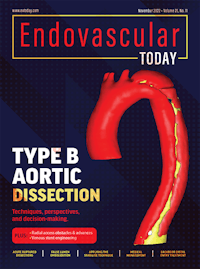
Advertisement
Advertisement
November 2022
Dissection Retrospective: Progress Since the INSTEAD Trial
Lessons learned from the first randomized trial comparing TEVAR and optimal medical therapy for type B aortic dissection.
Over the course of our careers, we have felt the impact of changes in disease prevalence and improvements in medical care. Our population is aging and surviving longer with an increasing incidence of cardiovascular conditions, ranging from atherosclerosis in general to acute aortic dissection. Even distal or type B aortic dissection (TBAD), a potentially life-threatening event, has gained traction over the last 2 decades due to better pathophysiologic understanding as well as the advent of endovascular technology. Nonsurgical endovascular management has altered the view of uncomplicated TBAD as it offers both a relatively low-risk treatment option and a real chance to initiate a scaffold for a remodeling and healing process.
RESULTS FROM THE INSTEAD TRIAL
INSTEAD was the first randomized trial comparing thoracic endovascular aortic repair (TEVAR) versus optimal medical therapy only for so-called uncomplicated TBAD.1 When the trial began, we expected we would see a difference in outcomes within 2 years. Although the mortality endpoint was not different at 2 years, the process of remodeling and progression was positively modified by early TEVAR at a significant level. The primary endpoint was not met, but both groups fared better than expected because of diligent surveillance and the option to crossover to stenting during follow-up. Moreover, many potential candidates opted for active treatment and could not be randomized. Subsequently, the trial was statistically underpowered but still showed how uncomplicated TBAD could be efficiently and safely treated.1
UPDATES AND IMPROVED OUTCOMES
With the vascular community debating these early results of INSTEAD, we extended the follow-up to a minimum of 5 years. Eventually, the study demonstrated a lack of progressive aneurysmal degeneration in the TEVAR group and absence of late mortality, with no patients lost to follow-up. This resulted in a significant survival advantage for recipients of an early TEVAR strategy within 90 days of impact (in the “window of plasticity,” which allows the dissected aorta to remodel). The positive outcome results of INSTEAD-XL came about with the use of a landmark analysis, which may have been relatively new at the time in the scientific vascular community but is now established.2
Because we carefully followed-up on our patients in the INSTEAD trial with contrast CT imaging, the fate of both the true and false lumen of the dissected aorta could be illuminated. Although it was observed that placement of a stent graft in the true lumen redirected blood flow to the true channel only and sealed proximal entry tear(s), the false lumen may not always collapse and thrombose completely; instead, it could be pressurized and receive retrograde flow from distal communications. Such observations that false lumen expansion can occur with a risk of rupture triggered the FLIRT (false lumen intervention to promote remodeling and thrombosis) concept by Yuan et al, which involves secondary false lumen intervention to eventually initiate false lumen thrombosis and support remodeling.3
A better understanding and insight into the remodeling process after stent grafting was gained from our experience using serial CT imaging to monitor our dissection patients during follow-up. In the recently published ASSIST study, a propensity score–matched analysis demonstrated that extended scaffolding of dissected aorta with an open stent distal to the stent graft down to the abdominal level improved false lumen thrombosis and remodeling at no risk of side branch obstruction or induced malperfusion.4
CONCLUSION
In retrospect, the management of TBAD has undergone a fundamental change, from open surgery with dramatic outcomes in the 1990s to a mere “wait-and-see strategy” with management of pain and hypertension and finally to an integrated strategy of combined medical and endovascular treatment adapted to individual anatomy and risk profile. If you had asked me if I could have imagined or foreseen this evolution in the management of aortic dissection over the last 2 decades, the honest answer would be, probably not! In my view, better medical care and nonsurgical endovascular technology has played a significant role in the overall improved outcomes of patients with dissection of the aorta.
1. Nienaber CA, Rousseau H, Eggebrecht H, et al. Randomized comparison of strategies for type B aortic dissection: the INvestigation of STEnt Grafts in Aortic Dissection (INSTEAD) trial. Circulation. 2009;120:2519-2528. doi: 10.1161/CIRCULATIONAHA.109.886408
2. Bose D, Konwar M. Analysis of robustness of the landmark cardiovascular outcome trials of antidiabetic drugs - a systematic review. Curr Diabetes Rev. 2022;18:e140921196472. doi: 10.2174/1573399817666210914114511
3. Yuan X, Mitsis A, Semple T, et al. False lumen intervention to promote remodelling and thrombosis-the FLIRT concept in aortic dissection. Catheter Cardiovasc Interv. 2018;92:732-740. doi: 10.1002/ccd.27599
4. Nienaber CA, Yuan X, Aboukoura M, et al. Improved remodeling with TEVAR and distal bare-metal stent in acute complicated type B dissection. Ann Thorac Surg. 2020;110:1572-1579. doi: 10.1016/j.athoracsur.2020.02.029
Advertisement
Advertisement