Advertisement
Advertisement
February 2023
Sponsored by Imperative Care, Inc.
Continued Evolution of Mechanical Thrombectomy With the Zoom Stroke Solution at a Comprehensive Stroke Center
James Milburn, MD, FACR, shares clinical experience and a case study outlining how the Zoom Stroke Solution, a complete aspiration thrombectomy system, is transforming stroke care at Ochsner Medical Center.

We have come a long way since the first-generation devices for mechanical thrombectomy (MT)—the Merci retriever (Stryker) and the Penumbra System with Separator (Penumbra, Inc.)—were developed in the 2000s. Since the demonstration of the effectiveness of MT in the landmark trials published in 2015,1 the field has witnessed an exciting transformation in thrombectomy devices and techniques.
EVOLUTION OF MECHANICAL THROMBECTOMY AT OCHSNER
I serve as the Director of Neurointerventional Services at the Ochsner Medical Center, a leading comprehensive stroke center performing nearly 200 MTs a year. Ochsner has been at the forefront of the evolution of MT technology, including guide catheters, aspiration catheters, and stent retrievers. Starting in 2013, Ochsner was one of the early adopters of the ADAPT (a direct aspiration first-pass technique) approach to MT, which yielded faster and more complete reperfusion. Our experience with aspiration thrombectomy using the 5Max Ace catheter, NeuronMax 088 long sheath, and coaxial 3Max or Velocity delivery catheters (Penumbra, Inc.) was published in 2016 and demonstrated excellent clinical outcomes with cost-savings potential compared to the stent retriever.2
After more than 6 years of refining our ADAPT approach, we wondered: Where do we go from here? Have we hit the limits of current technologies and techniques? Although our procedural outcomes had improved over the years, we felt that there was still room for improvement. In particular, we felt that higher technical success rates with the initial setup (ie, lower secondary catheters and lower bailout with the stent retriever) and shorter procedure times could lead to meaningful improvements. The rationale for the former is obvious in that it would lead to reduced device exchanges and cost, but perhaps the latter requires further discussion. There is a well-known saying in the field that “time is brain,” which means that time to stroke treatment is absolutely critical to preserving brain function. Studies have shown that longer procedure times lead to lower rates of functional independence and higher rates of symptomatic intracerebral hemorrhage and complications.3 Therefore, there is reason to believe that shorter procedure times could lead to improved patient outcomes.
We became aware of the Zoom Stroke Solution (Imperative Care, Inc.) in mid-2020. It is one of the only complete aspiration thrombectomy systems on the market (Figure 1). The system comprises guide catheters for 0.088-inch intracranial access, a portfolio of aspiration catheters for vessel-matched aspiration, and the Zoom Pump/POD System for clot aspiration and retrieval. Together, the system is designed to reach occlusions and enable fast and effective clot removal. We were specifically intrigued by the opportunity to take a large-bore guide catheter intracranially, as that was not possible with previous guide catheter technologies. We were also interested in evaluating the impact of the Zoom Stroke Solution’s unique angled TRX Tip in engaging and ingesting the clot.
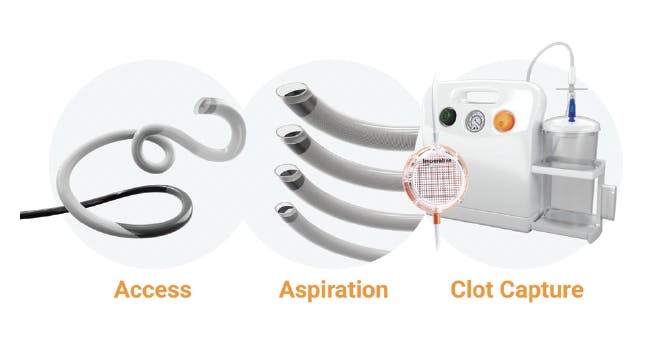
Figure 1. The Zoom Stroke Solution is a complete access-to-aspiration solution for treating ischemic strokes. Both the Zoom 88 and the Zoom RDL allow physicians to access intracranial arteries and achieve flow control near the clot. The recently cleared Zoom RDL catheter provides physicians access through the radial artery in the wrist. The Zoom 35, 45, 55, and 71 aspiration catheters provide a range of vessel-matched sizes, and the TRX Tip allows for rapid and complete clot aspiration. The Zoom Pump and Zoom POD provide the strongest-in-class vacuum pump and sterile field clot capture, providing physicians with rapid verification of clot ingestion.
During the initial evaluation, we started noticing that our procedures were smoother and quicker, with more frequent clot ingestion and a higher rate of first-pass success. The initial case series gave us the confidence to switch to the Zoom Stroke Solution. We have since utilized the system in > 200 MT procedures, and it has become the default setup for most of the neurointerventionalists in our practice. Although not every case is a success and not every anatomy can be tackled with the Zoom Stroke Solution, it has decreased our procedure time, reduced secondary catheter usage, and decreased stent retriever bailout.4
ZOOM STROKE SOLUTION OVERVIEW
With the Zoom Stroke Solution, 0.088-inch intracranial access is achieved using either the Zoom 88 Large Distal Platform or Zoom RDL Radial Access System. While Zoom 88 provides access through the femoral artery, the newly launched Zoom RDL provides a new option for physicians to achieve 0.088-inch intracranial access through the radial artery in the wrist. This new option expands the Zoom Stroke Solution by allowing physicians to treat patients based on individual anatomy.
Clot removal is accomplished using the Zoom 71, Zoom 55, Zoom 45, or Zoom 35 aspiration catheters. The variety of vessel-matched catheter sizes allows a physician to choose the best tool based on clot location and patient anatomy. In addition, every Zoom catheter features the unique TRX Tip or a soft, angled tip. The angled tip is a suction-force multiplier and provides 15% greater surface area to aspirate clots compared to flat-tip catheters. In vitro testing of the TRX Tip showed a > fourfold improvement in clot ingestion versus corking the clot.5
The final components of the Zoom Stroke Solution are the Zoom POD and Zoom Pump. The Zoom POD is the only inline clot capture device that allows for quick visual confirmation of aspirated clots during the procedure. This allows me to confirm successful clot retrieval in real time during MTs without having to fish through the canister or break the sterile field and thus interrupt the procedure. The Zoom Pump is the strongest pump on the market, providing –29.5 in Hg of suction.
EARLY CLINICAL EXPERIENCE WITH THE ZOOM STROKE SOLUTION
Our team presented two studies at the Society of NeuroInterventional Surgery annual meeting in 2022, highlighting two design features of the Zoom Stroke Solution that led to better procedural outcomes: (1) The 18.5-cm distal flexible segment of the Zoom 88 allowed for intracranial placement and resulted in improved reperfusion and shorter procedure times, and (2) the angled tips of the Zoom catheters improved technical success of MT by reducing secondary device usage.4,6 Both conclusions were drawn from retrospective analyses of our experience with the Zoom Stroke Solution at the Ochsner Medical Center.
In our first abstract, we examined the outcomes of 92 patients who presented with intracranial internal carotid (ICA) artery, M1, or M2 occlusions.6 Patients were treated by four neurointerventionalists without balloon guide catheters. Patients were assigned to the intracranial group (n = 52) based on the distal tip of the guide catheter being positioned in the petrous segment or further distal; in the control group (n = 40), the guide was catheter positioned in the cervical ICA or more proximal. Study populations were well balanced with respect to baseline and disease-related characteristics. When we compared final reperfusion of the patients, 83% of patients in the intracranial group had thrombolysis in cerebral infarction (TICI) 2C or better compared to 60% of patients in the control group (P = .019). Procedure times for the intracranial group decreased by 29%, with final reperfusion achieved in 24 minutes compared to 34 minutes in the control group (P = .011).
In our second study, we compared patients treated with either angled-tip Zoom aspiration catheters (n = 60) or conventional flat-tip catheters (n = 32).4 Quantitative evaluation of the procedures suggested that the angled tip led to increased technical success (Figure 2). Bailout procedures using stent retrievers were less common in the angled-tip group versus the control group (3.3% vs 15.6%; P = .047). Secondary aspiration catheters were required in only 10% of the procedures in the angled-tip group versus 44% of the control group (P < .001). This led to a shorter procedure time for the angled-tip group (24 minutes) compared to the control group (33 minutes; P = .023). Additionally, patients in the angled-tip group achieved TICI 2C or better reperfusion at 77% compared to 69% with conventional catheters (P = .46). Although we did not quantify the device costs in this study, future research will test the hypothesis that the Zoom Stroke Solution could lead to lower overall procedure cost by the reduced use of stent retrievers and secondary catheters.
The increased procedural control afforded by Zoom 88 and the angled tips of the Zoom aspiration catheters is notable. Having a system that gets the guide catheter directly in the intracranial space while effectively aspirating clots improves patient revascularization and reduces procedure times. This makes the Zoom Stroke Solution my default platform for treating ischemic strokes.
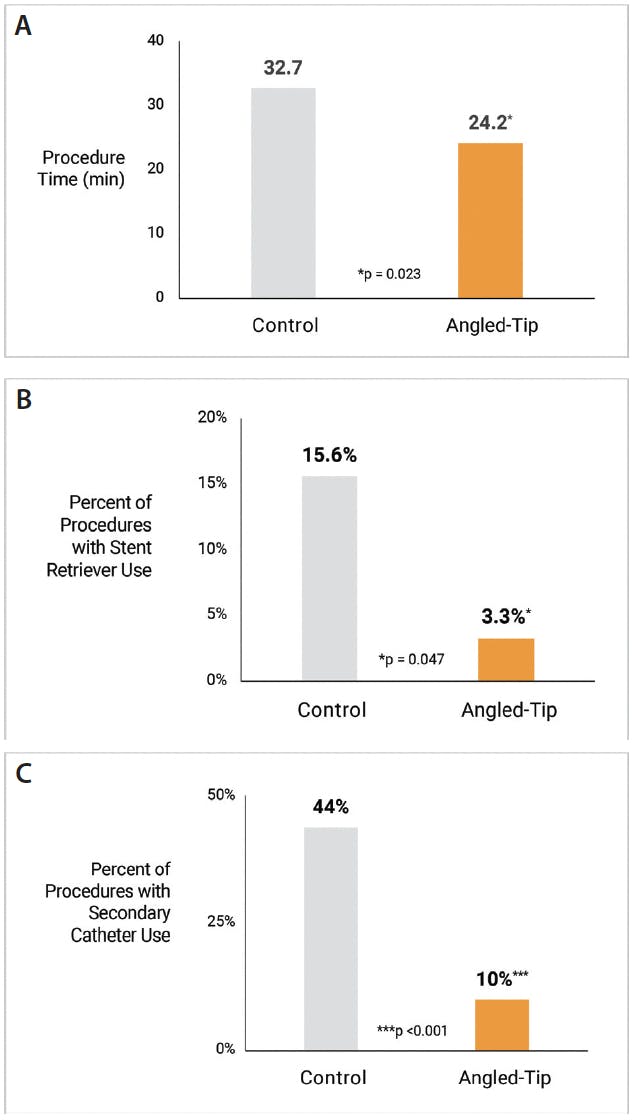
Figure 2. Angle-tipped catheters improve technical outcomes of aspiration thrombectomy. Procedure time was reduced by 26% for the angled-tip group (A). Procedures with angled-tip aspiration catheters had lower rates of stent retriever (B) and secondary catheter (C) usage.
Courtesy of Ochsner Medical Center.
CASE STUDY
A woman in her late 70s presented with a wake-up stroke at Ochsner Medical Center. She had a National Institutes of Health Stroke Scale (NIHSS) of 20 and ASPECTS (Alberta Stroke Program Early CT Score) of 6 upon arrival. Imaging revealed a right M1 occlusion on outside CTA.
Access was achieved using a 125-cm Beacon VTK angiographic catheter (Cook Medical) and a guidewire through a Zoom 88 inserted through an 8-F femoral short sheath. The Zoom 88 was taken to the petro-cavernous ICA on initial ascent. After removal of the VTK catheter and the guidewire, a Zoom 71, a Zoom 35, and the Fathom 16 guidewire (Boston Scientific Corporation) were introduced into the Zoom 88. The triaxial system of Zoom 88, Zoom 71, and Zoom 35 tracked smoothly to the M1 segment, with the Zoom 71 at the clot face and the Zoom 88 in the proximal M1 (Figure 3). Having the Zoom 88 in the middle cerebral artery helped establish flow control near the clot. It is worth mentioning that this patient had a type 2 arch with moderate cervical ICA tortuosity, and the Zoom 88 still tracked to the M1 segment without difficulty, which is remarkable.
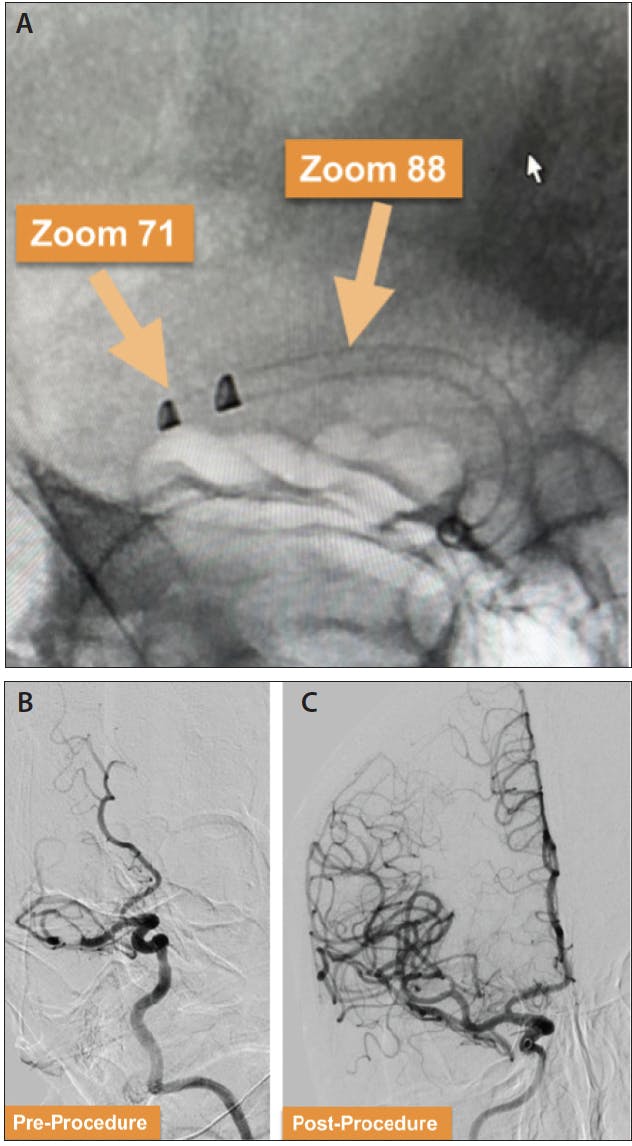
Figure 3. Case study images of the Zoom Stroke Solution in action. Using the Zoom Stroke Solution, TICI 3 revascularization was achieved in a patient with an M1 occlusion in a 13-minute procedure. The Zoom 88 can be deployed close to the clot, within the intracranial space (A). Pre- and postprocedure angiograms of the patient show TICI 3 revascularization of the brain (B, C).
Courtesy of Ochsner Medical Center.
Zoom 71 was then further advanced into the clot (ie, “french kiss” the clot). This is an important technical aspect of the ADAPT technique; here, the angled TRX Tip helped “scoop” the clot off the vessel wall. Aspiration was initiated, and first-pass TICI 3 was achieved in 13 minutes. On discharge, the patient had an NIHSS of 10 and MR similar to initial noncontrast CT.
CONCLUSION
We have found the Zoom Stroke Solution to be a turnkey solution for rapid thrombectomies in most patients. The engineering behind Imperative Care’s complete system allows for 0.088-inch intracranial access based on patient anatomy. Design features of the Zoom aspiration catheters with the TRX Tip provide efficient aspiration of the clot, and the Zoom POD permits rapid identification of the captured clot during the procedure. In total, the Zoom Stroke Solution can help reduce procedure times and increase technical success through its unique design features.
1. Munich SA, Mokin M, Snyder KV, et al. Guest editorial: an update on stroke intervention. Neurosurg. 2015;77:313-320. doi: 10.1227/NEU.0000000000000828
2. Vidal GA, Milburn JM. The Penumbra 5MAX ACE catheter is safe, efficient, and cost saving as a primary mechanical thrombectomy device for large vessel occlusions in acute ischemic stroke. Ochsner J. 2016;16:486-491.
3. Alawieh A, Vargas J, Fargen KM, et al. Impact of procedure time on outcomes of thrombectomy for stroke. J Am Coll Cardiol. 2019;73:879-890. doi: 10.1016/j.jacc.2018.11.052
4. Milburn J, Gulotta P, Fennell V, et al. E-217 Angled tip reperfusion catheters are associated with quicker access to final recanalization and reduced utilization of stent retrievers and secondary catheter usage in patients with emergent large vessel occlusion, which may reduce procedure cost. J NeuroIntervent Surg. 2022;14:A198. doi: 10.1136/neurintsurg-2022-SNIS.328
5. Vargas J, Blalock J, Venkatraman A, et al. Efficacy of beveled tip aspiration catheter in mechanical thrombectomy for acute ischemic stroke. J NeuroIntervent Surg. 2021;13:823-826. doi: 10.1136/neurintsurg-2020-016695
6. Milburn J, Vidal G, Gulotta P, et al. E-240 Intracranial large bore guide catheter placement is associated with excellent reperfusion: a single institution experience. J NeuroIntervent Surg. 2022;14:A210. doi: 10.1136/neurintsurg-2022-SNIS.351
For important safety and risk information, visit https://bit.ly/3yWkfEJ.
The Zoom Aspiration Catheters, with the Zoom Aspiration Tubing Set and Zoom Aspiration Pump (or equivalent vacuum pump), are indicated for use in the revascularization of patients with acute ischemic stroke secondary to intracranial large vessel occlusive disease (within the internal carotid, middle cerebral – M1 and M2 segments, basilar, and vertebral arteries) within 8 hours of symptom onset. Patients who are ineligible for intravenous tissue plasminogen activator (IV t-PA) or who fail IV t-PA therapy are candidates for treatment.
The Zoom 88 Large Distal Platform is indicated for the introduction of interventional devices into the peripheral, coronary, and neurovasculature.
The Imperative Care Zoom RDL Radial Access System is indicated for the introduction of interventional devices into the peripheral, coronary, and neuro vasculature.
Advertisement
Advertisement