Advertisement
Advertisement

The 2022 United States Renal Data System (USRDS) Annual Data Report tells us that in 2020 about 800,000 people in the United States had end-stage kidney disease/end-stage renal disease (ESKD/ESRD), of which nearly a half million were on hemodialysis and 65,000 adopted peritoneal dialysis.1 These numbers have grown dramatically over the past 2 decades, and despite a great deal of clinical investigation, we often lack “best-practice” approaches for the creation and maintenance of dialysis access. For example, cephalic arch stenosis often develops in brachiocephalic arteriovenous fistulae, but we still don’t know when to use standard angioplasty, drug-coated balloons, or covered stents (also called stent grafts). Even more fundamental, we aren’t sure when cephalic arch stenosis treatment is needed or if flow reduction, surgery, or ongoing monitoring are better options than catheter-based intervention.
Another example, percutaneous arteriovenous fistula (pAVF) creation, continues to evolve in clinical practice but poses new challenges. Which patients are optimal candidates for pAVF creation, what method is optimal for fistula creation, when are secondary procedures required for maturation of the fistula, and which procedures should be used? All these issues are being investigated, but there are no definitive answers. The aim of this annual Endovascular Today dialysis access issue is to explore many of these uncertainties and consider pathways that lead to clarity and best clinical practices.
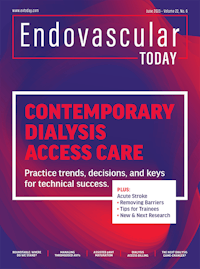
To open our series on dialysis access, Stephen E. Hohmann, MD; Vandana Dua Niyyar, MD; and Dheeraj K. Rajan, MD, converse about the research and clinical needs in dialysis access interventions, appraising dysfunctional access treatments, and ways to engage the next generation of thought leaders.
Troy Sanders, MS; Mark L. Lessne, MD; Brian Holly, MD; and Jessica K. Stewart, MD, then offer data and practical tips for thrombosed AVFs, including prevention and treatment options, managing risks, and alternative approaches.
Robert Shahverdyan, MD, answers the when, why, and how of assisted pAVF maturation. He discusses differentiating between physiological and clinical pAVF maturation and the approach to nonmaturation based on flow, lesion, and location.
We then pivot to a discussion of reimbursement for dialysis access. In an interview, Abigail Falk, MD, answers questions on common errors in coding and billing for dialysis access procedures, areas of coding confusion, potential implications of incorrect billing, and recommendations for improvement.
To close our feature on dialysis access, we ask experts Haimanot (Monnie) Wasse, MD; Neghae Mawla, MD; and Sanjay Misra, MD, to consider the next game-changer in dialysis access. Some suggestions include the application of widespread transdermal AV access monitoring, further simplified endovascular AVF devices, and improving outcomes by standardizing AVF placement.
Also featured in this issue is an exploration of acute ischemic stroke. Thabele (Bay) Leslie-Mazwi, MD; Pankajavalli Ramakrishnan, MD; and Nabeel A. Herial, MD, each provide three keys to improving barriers to access for stroke intervention. Hesham E. Masoud, MD; Bree Chancellor, MD; and Mohamad Abdalkader, MD, give their essential tips for stroke intervention trainees. Then, Johanna M. Ospel, MD, and Mayank Goyal, MD, weigh in on what’s next, what’s needed, and current trends in neurovascular research.
This issue finishes up with an interview with Memorial Sloan Kettering interventional radiologist Yolanda Bryce, MD, who discusses the intersection of cancer and peripheral artery disease and the program she founded for this population, starting the institution’s breast tumor cryoablation program, career advice, and more.
To conclude, this issue highlights areas where key thought leaders see the need for further clarity in how we create and maintain dialysis access. It is less prescriptive but more visionary in its approach than many previous annual Endovascular Today dialysis-related issues and hopefully will serve as a guide for clinicians and researchers who want to tackle these uncertainties. I hope you find the contents both provocative and forward-looking.
Finally, should you want to learn more about ESKD/ESRD and dialysis in the United States now and over the past 2 decades, please take a moment to visit the USRDS website at https://usrds-adr.niddk.nih.gov/2022/end-stage-renal-disease.1
Bart Dolmatch, MD
Guest Chief Medical Editor
1. National Institutes of Health, National Institute of Diabetes and Digestive and Kidney Diseases. United States Renal Data System. 2022 USRDS annual data report: epidemiology of kidney disease in the United States. Accessed June 5, 2023. https://usrds-adr.niddk.nih.gov/2022/end-stage-renal-disease
Advertisement
Advertisement