Advertisement
Advertisement
March 2023
AI, Automation, and Aortic Aneurysm Care
AI-assisted algorithms with accurate and automated tools for diameter and volumetric monitoring of the aorta have the potential to improve clinical outcomes and patient follow-up after EVAR.
By Dominique Fabre, MD, PhD; Thomas J. Postiglione, MD; and Stéphan Haulon, MD, PhD
Patients with aortic aneurysms require precise imaging, a key component of the care pathway. Accurate evaluation of the aortic diameter is critical for clinical decision-making—first, the initial diagnostic phase, next for the treatment indication, and finally during follow-up.1 CTA analysis with dedicated workstations allow for a three-dimensional (3D) evaluation of the complete aortic anatomy, which is mandatory to obtain accurate measurements. The manual process for analyzing the images requires expertise and is time consuming, particularly in the presence of aberrant anatomy, tortuous aorta, and significant disease within the lumen. It has been reported that up to 87% of the diameter measurements can be outside of the clinically acceptable error range (± 5 mm) in abdominal aortic aneurysms (AAAs).2 Although the maximal aortic diameter is the current standard of measurement and is used in clinical trials and everyday practice, it fails to provide information on the 3D volumetric evaluation (evolution) of the aneurysm sac.3 For example, a small increase of diameter, although minimal, can become concerning if there is an increase along the total length of the aneurysm. This would be associated with a significant increase in the sac volume, alarming clinicians of disease progression. A volumetric analysis of the aorta would improve the sensitivity of disease progression compared to maximum diameter alone.4-6 However, this requires 3D segmentation of the aorta and cross-sectional analysis, which is a comprehensive task too cumbersome for everyday clinical practice, even with the most advanced 3D workstations. Furthermore, currently available workstations only provide semiautomatic segmentation of the contrast-enhanced lumen, which is inadequate for assessment of the aorta. Although volumetric analysis of the aorta is currently popular in research, it could easily be integrated in workflows during patient follow-up if automation and standardization of its measurement could be performed accurately.7
THE EMERGENCE OF CLOUD-BASED SOFTWARE PLATFORMS
The emergence of deep neural networks associated with modern computational power has produced reliable automation of certain tasks in medical imaging, including time-consuming and tedious workflows such as organ segmentation. Segmentation produces measurements and automatic extraction of quantitative features, which cannot be performed in everyday clinical practice. These artificial intelligence (AI)–assisted algorithms require high-quality and diverse image databases to ensure robustness in real-life use. Therefore, development of relevant imaging tools requires close collaboration between clinicians and engineers.
Adopting this principle, we developed a solution for standardized and automatic measurement of the external diameter of the entire aorta, from the ascending aorta down to the iliac arteries (“augmented radiology for vascular aneurysm” or ARVA, Incepto Medical). A database of images with a large variety of aortic anatomies was used, including aneurysmal, dissected, and intact aortas with or without abdominal, thoracic, branched, and fenestrated endografts. The corresponding CTAs were segmented and measured by expert vascular surgeons and radiologists, enabling the training of highly accurate algorithms (Figure 1). A validation study compared the final output results of 62 scans with those of seven annotators, and it demonstrated that the algorithm is reliable and can effectively perform automatic cross-sectional outer–to–outer wall aortic measurements, with a median absolute error that falls within the error range of a physician’s analysis.8 More specifically, for healthy, diseased, and stented aortas, the median absolute difference for the maximum aortic diameter measurement performed by the AI-based software compared to ground truth was 0.8, 1.9, and 2.2 mm, respectively. However, for the annotators, this difference ranged from 0.9 to 1.0 mm, 1.0 to 2.0 mm, and 1.0 to 3.0 mm, respectively, when comparing annotators (Figure 2). An ongoing validation study includes hundreds of exams, multiple aortic centers, and more than 10 annotators.
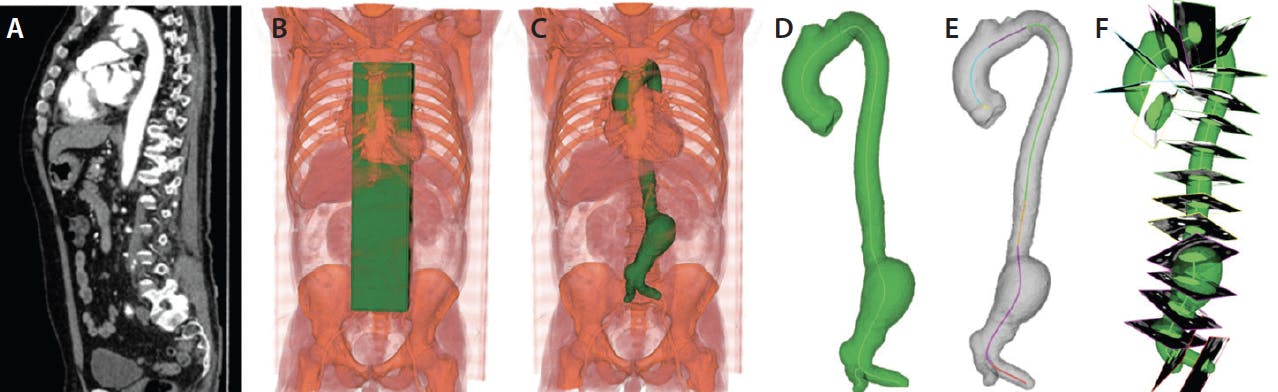
Figure 1. The proposed algorithm is composed of a pipeline of five successive steps after the CTA acquisition (A), starting with the localization of the aorta (B), then segmentation of the outer wall of the aorta (C), creation of a centerline (D), identification of seven aortic segments (E), and, finally, computation of all transverse measurements and selection of the largest diameter per aortic segment (F).
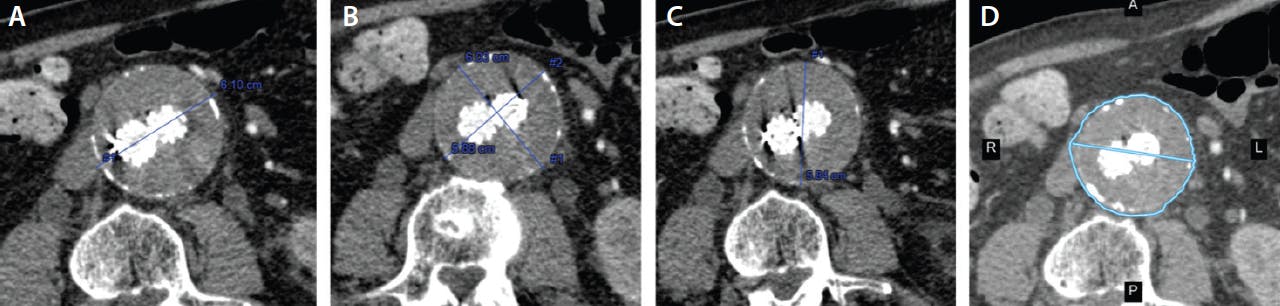
Figure 2. During the clinical validation study of the deep learning algorithm for automatic maximum transverse aortic diameter measurement, a first annotator found that the largest diameter on a postprocedural CTA was located in the infrarenal segment, measured at 61 mm (A). A second annotator measured the maximum transverse diameter for the same data set at 60 mm (B), and a third annotator at 58 mm (C), while the automatic measurement was found at 60 mm (D).
Challenges exist during routine clinical follow-up for AAAs. Longitudinal comparison of diameter measurements across consecutive CTA exams is cumbersome, requiring recall of multiple prior exams from the picture archiving and communication system (PACS) of the hospital, measuring them, and comparing measures. ARVA was designed to include automatic fetching of prior CTAs for separate analysis and automatic longitudinal comparison of each aortic segment. The use of cloud-based computing services enables processing of the multiple deidentified CTA data sets in a couple of minutes and the secure return of the report back to the hospital network within minutes. In the hospital, these reports are then automatically reidentified and placed into the patient’s hospital file in DICOM format, in the PACS, or in any review workstation. This is associated with substantial time savings during everyday aortic clinic.
Although these fully automatic tools have the potential to reduce inter-reader variability and imaging analysis time,9 they too remain susceptible to errors, such as when encountering artifacts or unusual anatomy. This limitation requires a simple way for vascular surgeons and radiologists to quickly spot segmentation errors. Therefore, ARVA provides an additional DICOM axial series in the patient’s folder including the aortic segmentation mask, as well as a report with views of the maximum diameter measurements performed for each segment of the aorta (Figure 3).
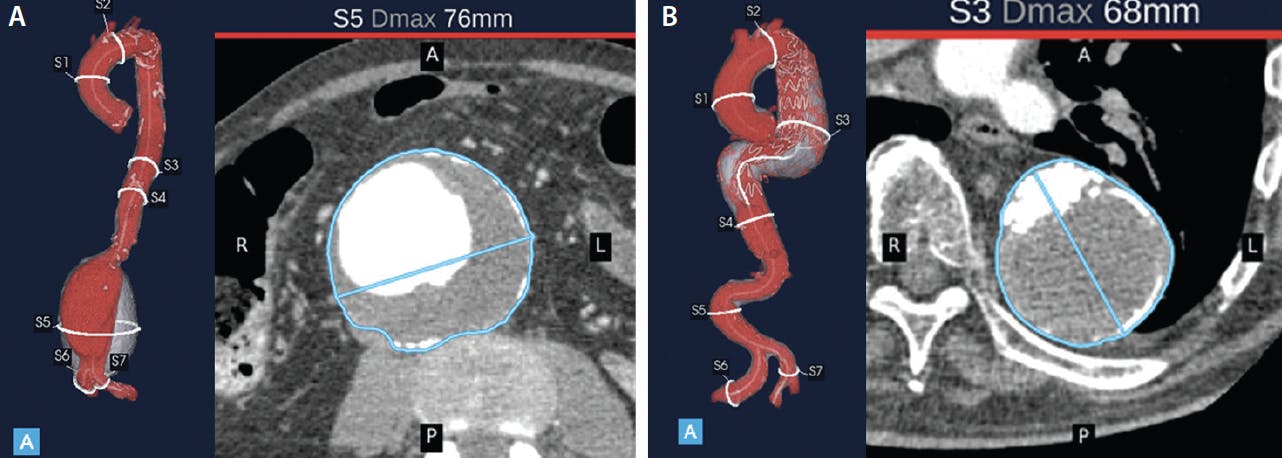
Figure 3. The result of ARVA is encapsulated in a concise and graphical report containing measurements, volume rendering, and radiographic views for instant access to the data and appropriate control by the clinician for typical infrarenal AAAs (A), as well as more complex cases such as thoracic dissected aorta (B).
Aside from automated measurements, other analyses can be performed using new imaging technologies. For example, numeric simulation allows for virtual visualization of endograft deployment ahead of the procedure. In addition to many other potential applications, precise positioning of the fenestrations during the sizing of complex endografts and prediction of complications have already been validated.10-12 Daily use in practice helps the physician to select the best-fit endograft design to anticipate and avoid intraoperative challenges and improve long-term outcomes (Figure 4). The latter will also include automatic detection and characterization of endoleaks during follow-up.
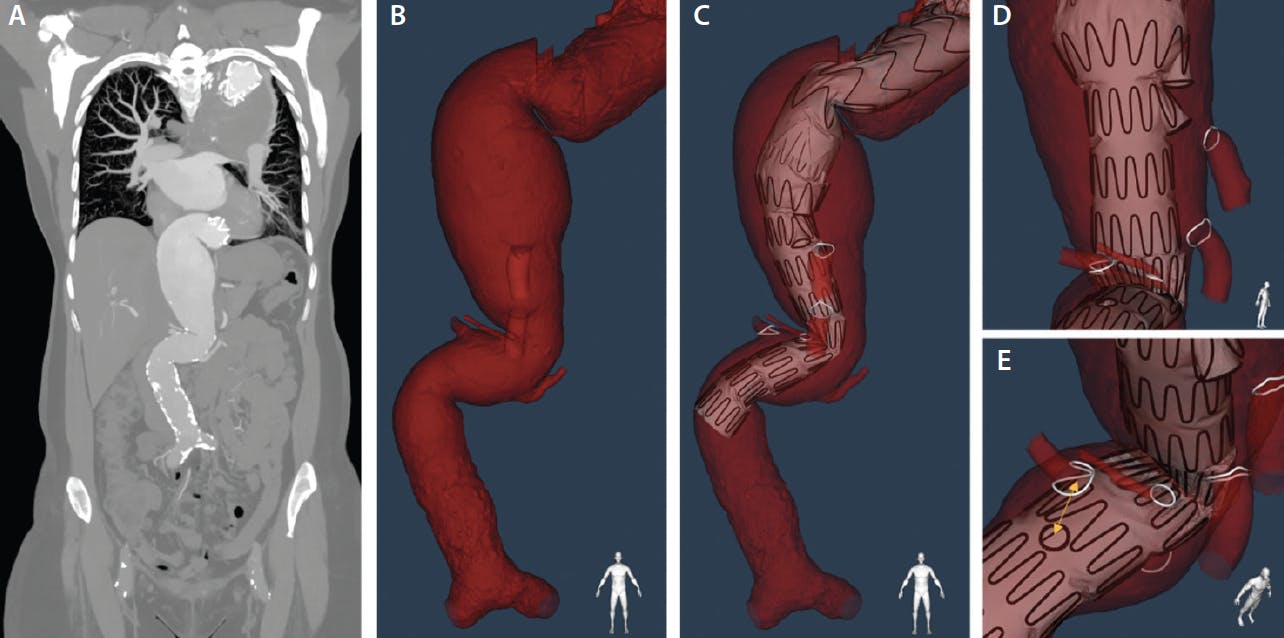
Figure 4. Based on preoperative CTA, the 3D Numerical Simulation (PrediSurge) can extract a patient-specific digital twin of the aorta (A). This digital twin has the shape of the patient aorta but also the same biomechanical properties (B). The custom fenestrated EVAR, as primarily designed by the manufacturer, is then virtually implanted into the aorta digital twin to simulate the intervention (C). Interactions between the devices and the aorta are taken into account and enable a realistic prediction of the endograft behavior. Alignments of branches and fenestrations with ostia can be assessed on the digital twin (D, E), and design changes can be recommended in case of suboptimal alignment (yellow arrow, E). Intervention simulations with different devices designs can be performed iteratively until a satisfying result is reached.
WHAT WE CAN EXPECT IN THE FUTURE
Volumetric monitoring of the aneurysm supported by accurate automated tools has the potential to improve patient follow-up after implantation of aortic endografts, allowing the potential for improved clinical outcomes. Lindquist Liljeqvist et al reported that longitudinal follow-up of aneurysm volume better predicts the aneurysm growth rate and has a stronger correlation with increased rupture risk compared with diameter alone.5 White et al demonstrated that 3D reconstruction and volumetric analysis could be useful to assess morphology changes and determine criteria for early reintervention.13 Such volumetric analysis can depict localized aortic growth, which is not always at the level of the maximum aortic diameter.14 To facilitate these future needs, ARVA has been modified to also allow computation of volumetric parameters, including full aortic volume and more selective features such as thrombus or subsegment volumes.
Access to precise and standardized aortic measurements with two-dimensional and/or 3D analysis may help support clinical research, such as postmarket evaluations of medical devices. We believe that AI-monitored assessment will be included in future regulatory pathways. High computing power is required for tools dedicated to imaging and aortic disease management, and although cloud-based solutions can overcome this limitation, there is a valid concern for risk associated to external data sharing. Fortunately, these concerns have led to an acceleration in acquiring new skill sets around privacy, secured management of imaging data, and interoperability by the health care industry. These will allow the development of improved care pathways of innovative and securely integrated numeric platforms for patients with aortic disease.*
Looking further into the future, having longitudinal data and thus an estimate of changes over time could lead to the development of AAA growth prediction algorithms. These algorithms could be enhanced by incorporating additional patient-specific data such as medical data, patient characteristics, comorbidities, gender, image anatomy, biomarkers, and lifestyle factors (smoking, blood pressures). This diversity of data sets will allow for the development of machine learning models that can base predictions on heterogeneous data and multimodality images. For endovascular aneurysm repair (EVAR), the study of virtual interactions between the aortic digital twin and endografts should help better automate the graft design and its positioning during the implantation procedure.
SUMMARY
Hurdles can be expected on the way to a more accepted use of automation and AI-based solutions in general and particularly for management of aortic patients. Machine learning techniques have greatly improved the performance of software solutions, but the risk of outliers should be balanced by the ability of clinicians to control the result of AI measurements. Further evidence of both clinical and operational outcomes is required to enable the widespread deployment of these solutions in clinical practice and to justify the investments and specific reimbursement strategies.
*Dominique Fabre, MD, PhD; Thomas J. Postiglione, MD; and Stéphan Haulon, MD, PhD, disclose that Incepto Medical and the Groupe Hospitalier Paris Saint Joseph are part of a consortium called ENDOVX, which aims to offer an innovative and integrated clinical workflow to improve the care pathway of patients undergoing endovascular aortic repair, in particular those subject to complex aortic aneurysms. This project benefits from a public grant managed by the French National Research Agency, under the 3rd PIA, and integrated into the France 2030 plan, with the following reference: ANR-21-RHUS-0011. Incepto Medical and Hôpital Marie Lannelongue are bound by a co-creation contract.
1. Isselbacher EM, Preventza O, Black JH 3rd, et al. 2022 ACC/AHA guideline for the diagnosis and management of aortic disease: a report of the American Heart Association/American College of Cardiology Joint Committee on Clinical Practice Guidelines. Circulation. 2022;146:e334-e482. doi: 10.1161/CIR.0000000000001106
2. Mora C, Marcus C, Barbe C, et al. Measurement of maximum diameter of native abdominal aortic aneurysm by angio-CT: reproducibility is better with the semi-automated method. Eur J Med. 2014;47:139-150. doi: 10.1016/j.ejvs.2013.10.013
3. Wever JJ, Blankensteijn JD, Mali WPTM, Eikelboom BC. Maximal aneurysm diameter follow-up is inadequate after endovascular abdominal aortic aneurysm repair. Eur J Vasc Endovasc Surg. 2000;20:177-182. doi: 10.1053/ejvs.1999.1051
4. Kauffmann C, Tang A, Therasse E, et al. Measurements and detection of abdominal aortic aneurysm growth: accuracy and reproducibility of a segmentation software. Eur J Radiol. 2012;81:1688-1694. doi: 10.1016/j.ejrad.2011.04.044
5. Lindquist Liljeqvist M, Hultgren R, Gasser TC, Roy J. Volume growth of abdominal aortic aneurysms correlates with baseline volume and increasing finite element analysis-derived rupture risk. J Vasc Surg. 2016;63:1434-1442.e3. doi: 10.1016/j.jvs.2015.11.051
6. Bley TA, Chase PJ, Reeder SB, et al. Endovascular abdominal aortic aneurysm repair: nonenhanced volumetric CT for follow-up. Radiology. 2009;253:253-262. doi: 10.1148/radiol.2531082093
7. Patel R, Sweeting MJ, Powell JT, et al. Endovascular versus open repair of abdominal aortic aneurysm in 15-years’ follow-up of the UK Endovascular Aneurysm Repair trial 1 (EVAR trial 1): a randomised controlled trial. Lancet. 2016;388:2366-2374. doi: 10.1016/S0140-6736(16)31135-7
8. Adam C, Fabre D, Mougin J, et al. Pre-surgical and post-surgical aortic aneurysm maximum diameter measurement: full automation by artificial intelligence. Eur J Vasc Endovasc Surg. 2021;62:869-877. doi: 10.1016/j.ejvs.2021.07.013
9. Rueckel J, Reidler P, Fink N, et al. Artificial intelligence assistance improves reporting efficiency of thoracic aortic aneurysm CT follow-up. Eur J Radiol. 2021;134:109424. doi: 10.1016/j.ejrad.2020.109424
10. Derycke L, Sénémaud J, Perrin D, et al. Patient specific computer modelling for automated sizing of fenestrated stent grafts. Eur J Vasc Endovasc Surg. 2020;59:237-246. doi: 10.1016/j.ejvs.2019.10.009
11. Derycke L, Avril S, Perrin D, et al. Computer simulation model may prevent thoracic stent-graft collapse complication. Circ Cardiovasc Imaging. 2022;15:e013764. doi: 10.1161/CIRCIMAGING.121.013764
12. Kliewer ME, Bordet M, Chavent B, et al. Assessment of fenestrated Anaconda stent graft design by numerical simulation: results of a European prospective multicenter study. J Vasc Surg. 2022;75:99-108.e2. doi: 10.1016/j.jvs.2021.07.225
13. White RA, Donayre CE, Walot I, et al. Computed tomography assessment of abdominal aortic aneurysm morphology after endograft exclusion. J Vasc Surg. 2001;33(2 suppl):S1-10. doi: 10.1067/mva.2001.111680
14. Caradu C, Spampinato B, Vrancianu AM, et al. Fully automatic volume segmentation of infrarenal abdominal aortic aneurysm CT images with deep learning approaches versus physician controlled manual segmentation. J Vasc Surg. 2021;74:246-256.e6. doi: 10.1016/j.jvs.2020.11.036
Advertisement
Advertisement