Advertisement
Advertisement
March 2023
An Interview With Elika Kashef, MBBS, MRCS, FRCR
Dr. Kashef discusses her passions for patient safety, staff well-being, and trauma and women’s health IR, as well as how the community can ensure future generations have opportunities to be exposed to IR.

With a diverse set of clinical interests and responsibilities, which aspects of your work are you most passionate about right now?
Oh goodness, tough first question! I would have to say the two aspects of my job I am passionate about the most are patient safety and staff well-being.
We are working harder than ever in the National Health Service (NHS). I am surrounded by such talented radiographers, nurses, imaging assistants, and physicians, and it would be a shame to lose any of them. We need to find new and innovative ways to ensure our teams stay focused and are taken care of and appreciated. Unfortunately, with the busy working life, these can be forgotten about. We need to take a step back and look at our workforce and see how we can let them know (and feel) that they are valued.
Patient safety speaks for itself, and I hope we can discuss it further during this interview.
Among your roles at Imperial College NHS Trust is Directorate Safety Lead. What does this entail, and how has the experience you’ve gained in this role affected your own daily practice?
This role was created after a “never event” many years ago. No harm came to the patient thankfully, but it highlighted the importance of having a dedicated role. The focus of this role is for both interventional radiology (IR) and diagnostic radiology. As part of this role, I created specific World Health Organization (WHO) safety checklists for IR and invasive procedures, a WHO spinal checklist, and an imaging-specific consent form. This changed our approach to safety, as most of the publications back then were WHO surgical–focused, and this allowed us to tailor the approach. We also reviewed the IR coagulation pathway and ensured our services all had standard operating procedures.
This might sound very boring or tedious, but it works! We have not had a “never event” since the role began, our WHO compliance is above 95%, and patient safety has really improved as a result. This also means the staff have higher confidence in their roles, knowing fail-safes are all in place. As we say at Imperial College, “Patient safety is everyone’s responsibility.”
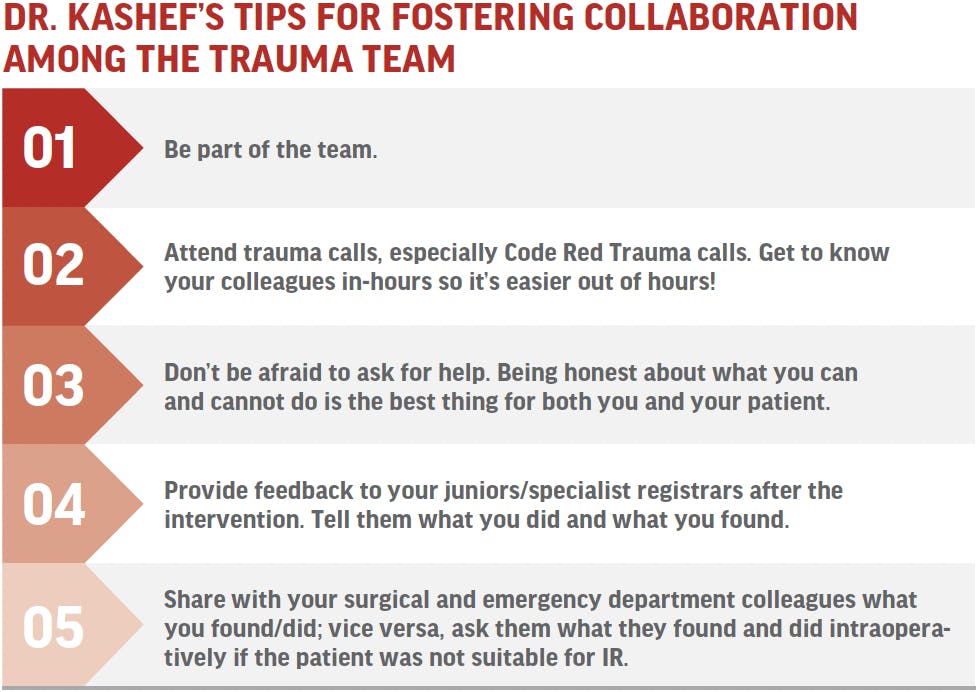
Along with trauma, you also have expertise in women’s health/gynecology IR. How did you land on this as a focus, and what do you enjoy about this work?
Thank you for this question. I think IR in trauma or any emergency allows us to practice medicine in its purest form. The focus in an emergency is one thing: to save the patient.
The discussions about porters, beds, list prioritization, and lunch breaks all stop. It’s almost like an international language that unites all specialties. Seeing a patient under duress and being able to fix their bleed or rupture is still the most valuable and satisfying job that I can do as a doctor. That and draining a good collection! I think most of my IR colleagues would agree that draining a collection is still among the most satisfying procedures, which is where my second interest started.
I was noticing that many of our pelvic inflammatory patients who were not responding to antimicrobial therapy were undergoing hot operations. This made me develop the transvaginal drainage service, which was welcomed by my gynecology colleagues. I was told I would get one to two cases every 6 months or so—we now average about one a week throughout the year!
Women’s health in IR is definitely lagging compared to other areas like heart disease or oncology. Conditions such as endometriosis, fibroids, and pelvic congestion are only recently getting the attention they deserve, and we are not fully there yet.
We need advocates to promote and develop services in their hospitals to ensure they can offer peripartum hemorrhage management, transvaginal drainage (infections and endometriomas), and fibroid and ovarian vein embolization.
The postcode lottery that currently exists nationwide for IR services needs addressing, and management of women’s health is part of that priority.
In a time when schedules are full and work/life balance is hard to come by, physician commitments to their specialty societies can pose additional challenges. How do you work society endeavors into your schedule and what can societies and employers do to foster these efforts?
I am very lucky to work in a Trust where these roles are encouraged and harbored. With Imperial’s support, I have managed to have roles in the Royal College of Radiologists (RCR), become a Fellowship of the RCR examiner, and be involved in multiple roles within the British Society of Interventional Radiology (BSIR), including the Scientific Program Committee, as well as the Radiological Society of North America and Cardiovascular and Interventional Radiological Society of Europe.
These roles take time and dedication, and thus careful job planning and time management are crucial. That is not to say I am great at time management! Far from it! But, I make time for what is important. My role in the Women and Diversity committee at BSIR (now renamed the Equality, Diversity, and Inclusivity [EDI] Committee) was an important role close to my heart, so it was with pleasure that I took on the role.
So much of what we do outside of our jobs is driven by our passion and love for IR and medicine, and that’s what propels our community forward. Mutual respect and support for one another and positive feedback from our hospitals and those societies keep us going.
You’ve talked about the importance of ensuring students from all walks of life are exposed to and have opportunities to advance in IR, for diversity, equity, and inclusion purposes as well as to combat workforce shortages. How should IR approach these outreach/retainment efforts?
This is a massive piece of work that we all need to get involved in. There are two issues:
- Improving access to medicine. This is where we all need to do our bit. Connecting with the local schools, giving small talks and seminars, and raising awareness of medicine and IR in particular are key. Work experience in hospitals is far more accessible now than when I trained; we need to open our doors, let the secondary school/high school students come and see what we are about, and then offer mentorships to help with their applications, interview practice, and so on. We need to invest in the next generation.
- Addressing the workforce crisis in IR. I know I sound like a broken record, but 60% of medical students are currently women. Yet, based on the United Kingdom Workforce Census report, only 11% of IRs are women (but 41% of diagnostic radiologists are women). This does not seem to be an issue in surgery. Lifestyle and radiation are part of it, and we need to educate our trainees on this. Good job planning and ensuring adherence to radiation safety standards means that those who wish to have families can become IRs without worry or fear. The stigma of less than full-time working is slowly withering, and there are now many trainees, male as well as female consultants, who work less than full time for an array of reasons.1
The other angle to consider is that when most teenagers know what a surgeon does, when they choose medicine, they have a love for surgery and want to be a surgeon. The love of surgery is there before anything else. Yet, not many grow up wanting to be IRs! Why is that? Because we are a young specialty, and we need to promote and advertise our specialty. The RCR and BSIR EDI have done a great job on this, and we know that the issue is no longer about “getting women into IR.” The issue is workforce planning. If most graduating doctors are women but only 10% make it into IR, you can see where the workforce crisis comes from! We need to continue to work on this, and we need to do it together.
1. The Royal College of Radiologists. Clinical Radiology UK workforce census 2019 report. Accessed March 6, 2023. https://www.rcr.ac.uk/system/files/publication/field_publication_files/clinical-radiology-uk-workforce-census-2019-report.pdf
Advertisement
Advertisement
Interested in reading more interviews?
To read more interviews with thought leaders in the vascular field, check out our Profiles & Perspectives hub.
Read More