Advertisement
Advertisement
October 2023
What Is the Most Exciting Advancement in Interventional Oncology?
Experts discuss the potential of pulsed electrical field ablation, histotripsy, robotics, transarterial microperfusion, minimally invasive fixation for musculoskeletal pain, thyroid ablative therapies, and systemic and immunotherapies to further the field of IO.
By Nadine Abi-Jaoudeh, MD, FSIR, CCRP; Ripal Gandhi, MD, FSIR, FSVM; Alan Alper Sag, MD; Rahul A. Sheth, MD; and Amanda Smolock, MD, PhD

Which technology is the most exciting? There are so many. On the ablation side, there are several new developments spanning from completely new revolutionary technology to significant improvements of existing technology. Even radiofrequency ablation (RFA), which was considered by many as a thing of the past, is having a renaissance with a new RFA machine capable of creating an ablation zone as small as 1.4 cm for thyroid ablation in < 5 minutes to an ablation > 6 cm in 12 minutes. For frugal practices, the versatility of one generator being able to treat a great variety of tumor size and indications is certainly appealing. New developments are underway in microwave ablation systems as well, including systems working to create a more predictable and reliable ablation zone with accurate estimates.
Pulsed electrical field (PEF) ablation is a monopolar irreversible electroporation (IRE). Only one needle creates a 1-cm ablation zone. Previously, only bipolar IRE was available, and it required a minimum of two parallel needles placed 1.5 to 2.5 cm for an ablation zone. Initial human trials of PEF in the lung have shown very encouraging results, whereas the use of bipolar IRE was not recommended in the lung. Why do we need another ablation technology for the lung? How many would you use on a tumor abutting the mediastinum or the aorta?
The most exciting ablative technology is histotripsy, a revolutionary ablative technology that is nonthermal and completely noninvasive. It uses ultrasound waves and cavitation to create tissue necrosis. The margin is perfectly demarcated. Although the first application and pivotal trial are in the liver, histotripsy can be used in so many other histologies and organs. There are promising data from animal studies of IRE (monopolar and bipolar) and histotripsy in terms of immunomodulation and their use in combination with systemic immunotherapies.
Another area that is very exciting to me is the combination of transarterial and percutaneous locoregional therapies and systemic therapies, specifically immunotherapies. Interventional oncology (IO) can gain a wider acceptance if we can hone the ability of our procedures to boost systemic therapies. Results of several trials combining transarterial chemoembolization (TACE) or transarterial radioembolization (TARE) with systemic therapies, mostly in primary liver cancer, are eagerly awaited. Our specialty should investigate expanding the indications where TACE and TARE are used.

IO continues to rapidly grow, evolve, and innovate at a rapid pace. Although there are many advancements in the field, I am going to focus on three innovations that are very exciting.
Pancreatic cancer has traditionally been very difficult to treat from an endovascular perspective, given that the tumors tend to be hypovascular and are without obvious arterial tumoral feeders. When given systemically, < 1% of chemotherapy actually makes it into the tumor due to dense stromal tissue. A novel approach called transarterial microperfusion isolates the artery of interest utilizing a double balloon occlusion catheter via which chemotherapy is infused. Increased intravascular pressure allows the drug to diffuse across the arterial wall and into the surrounding pancreatic cancer tissue. TIGeR-PaC is a phase 3, multicenter, randomized clinical trial evaluating intra-arterial gemcitabine versus intravenous gemcitabine and nab-paclitaxel for patients with locally advanced pancreatic cancer. The interim analysis of the first 45 patients enrolled in the trial was recently presented at World Congress on Gastrointestinal Cancer in Barcelona.1 Median overall survival (OS) was 10 months in the control arm versus 16 months in the intra-arterial chemotherapy arm (P = .08). Progression-free survival was 7 months in the control arm versus 15 months in the experimental arm. Adverse events were three times greater in the control arm, with most toxicity being hematologic (neutropenia and thrombocytopenia) followed by transaminitis. The interim results are very promising, and we look forward to a second interim look at the data at the end of 2024. Other minimally invasive therapies with potential for pancreatic cancer include IRE and pancreatic retrograde venous infusion with pressure-enabled drug delivery.
Although robotic systems have been helpful in various types of surgical procedures, their role for minimally invasive, image-guided interventions specific to IO is still at its nascency. Newer robots designed to advance needles or ablation probes for percutaneous IO interventions have recently been developed. Robotics have the potential to transform IO with faster placement of needle or probe, facilitation of out-of-plane needle insertion (especially in challenging locations such as the hepatic dome), decreased radiation exposure, reduced learning curve, and better clinical outcomes. Our own experience with the Epione robotic system (Quantum Surgical) is that it allows for more predictable placement of ablation probes, especially in difficult locations, and allows for a faster procedure. The robotic system allows for a comprehensive solution that includes planning, tumor targeting, therapeutic delivery, and ablation zone confirmation. One can envision a future world where image-guided interventions can be performed entirely robotically and even remotely.
Finally, the role of yttrium-90 (Y-90) radioembolization continues to grow, and its recent incorporation into the updated BCLC (Barcelona Clinic Liver Cancer) treatment algorithm solidifies its benefit in patients with hepatocellular carcinoma (HCC). Personalized dosimetry with a focus on tumor-absorbed dose utilizing advanced software is resulting in better outcomes with improved tumor response and OS. Additional advancements in radioembolization that may further improve outcomes include better surrogates, pressure-enabled delivery of Y-90, imageable radiomicrospheres, treatment of pathologies outside the liver including glioblastoma multiforme, and combination therapy with systemic agents including immunotherapies.
1. Pishvaian M, Zureikat A, Novelli P, et al. The phase 3 study: targeted intra-arterial gemcitabine vs. continuation of IV gemcitabine plus nab-paclitaxel following induction with sequential IV gemcitabine plus nab-paclitaxel and radiotherapy for locally advanced pancreatic cancer (TIGeR-PaC). Ann Oncol. 2023;34:S178. https://doi.org/10.1016/j.annonc.2023.04.011

Successful inclusions in the relevant National Comprehensive Cancer Network guidelines have sparked major interest in musculoskeletal IO. Among many exciting developments in this space, percutaneous osteosynthesis is one of the most exciting. Interventional radiology (IR) divisions working closely with orthopedic surgery divisions find that there is an unmet need for minimally invasive fixation in patients with mechanical pain due to osteolytic lesions, particularly in patients with cortical erosion where cement-only options may fall short. Our orthopedic surgery colleagues are actively interested in this as well; at recent major orthopedic meetings, sessions on this topic reached overtime, and some orthopedic surgeons are performing these approaches already. Major IR contributions include safe transosseous guidance with cone-beam CT, as well as same-session tumor ablation and peri-instrumentation cementoplasty (Figure 1).
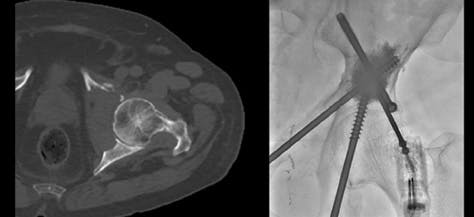
Figure 1. Preprocedural CT and intraprocedural image from single-session nerve block (pericapsular nerve group, ilioinguinal and iliohypogastric), embolization (N-butyl cyanoacrylate), tumor RFA, percutaneous tripod cannulated screw fixation, and acetabuloplasty for a patient with Enneking zone 2 acetabular metastasis ineligible for total hip arthroplasty/Harrington reconstruction.
Although musculoskeletal IO is immediately relevant, an area that is poised for major growth is the thyroid, for both benign and potentially malignant disease. An updated statement from the American Thyroid Association has completed the commenting phase with input from the Society of Interventional Radiology, among other societies. This will likely lead to an increased demand for ablation for benign thyroid hyperplasia. The literature is growing on use of RFA for small primary thyroid cancers, a space that is growing simultaneously with an understanding of the molecular biomarkers, which aim to predict long-term behavior of thyroid cancers and will likely guide patient selection. Attention at national meetings across specialties (IR, endocrinology, endocrine surgery) is increasing year-on-year. Now is the time for IR-trained early adopters and innovators to enter this space, as a major increased demand for this care (RFA, laser, cryoablation, embolization) will be realized between now and 2030.

IO has historically thrived in the absence of systemic therapies. Speaking in broad terms, IO originated in an era where systemic therapies were limited to nonexistent for the histologies that became the anchors for the specialty. This unmet need inspired the creativity of IO’s founding figures to develop the transarterial therapies that are now standard of care. Percutaneous interventions likewise arose in oncologic scenarios where either systemic therapies were unavailable or considered unnecessary, such as with localized cancers where surgical resection was expected to be curative.
The landscape of systemic therapies has evolved tremendously since the time of IO’s origin story. This is most clearly seen in cancers such as HCC, a disease that has long represented the foundation of any IO practice. The advent of immunotherapy as well as novel targeted therapies has revolutionized the treatment of HCC, with clear implications on the future of IO. Although perhaps less visible, a similar revolution is underway for localized cancers. Neoadjuvant immunotherapy has been shown in a series of recent trials to not only improve postsurgical outcomes but provide curative responses in some scenarios, obviating the need for local interventions (eg, NCT04165772).1
Thus, in my opinion the future of IO rests (and perhaps depends) upon exploring how IO interventions can be combined with systemic therapies for both localized and metastatic cancers. Regarding the latter clinical setting, the interplay between IO procedures, the tumor immune microenvironment, and immune checkpoint inhibition to achieve the ever-elusive “abscopal” response is a commonplace topic for discussion in contemporary multidisciplinary tumor boards and the subject of numerous preclinical and clinical studies. Although overcoming barriers to systemic immunotherapies through local interventions in a robust clinical trial setting remains a daunting challenge, there is no question that the readouts from ongoing studies attempting just that will have a profound impact on IO.
At the same time, it is also important to think about IO’s relationship with immunotherapy as a two-way street. Although the “abscopal” effect describes on-target locoregional therapies resulting in immune-mediated responses at off-target tumors (ie, “What can IO do for immunotherapy?”), the “adscopal” effect refers to the application of immunotherapy to improve local control of on-target tumors (ie, “What can immunotherapy do for IO?”). In other words, analogous to recent neoadjuvant trials in melanoma, head and neck cancer, and others, which have demonstrated improvements in postsurgical outcomes immunotherapy, IO practitioners should view immunotherapy as a potential tool to improve local outcomes for our local interventions.
In IO, we stand on the shoulders of giants who have allowed us to master the local delivery of anticancer therapies. We have a tool kit of imaging and interventional technologies that provide unsurpassed control over where we deliver our therapies. However, it is now time for us to apply a similar degree of creativity to the “what” and “how” aspects of IO. Within the paradigm of immunotherapy alone, we have the ability to deliver a vast armamentarium of immunomodulatory therapies, ranging from small molecules to antibodies to biologics including viruses, bacteria, and cells. Relying on our on-the-shelf IO therapies that have been designed for one purpose (ie, to obliterate tumor cells) may be a low-yield approach to boosting tumor immunity. Alternatively, repurposing existing tools and attuning them to “modulate” rather than “obliterate” tumors and their microenvironments by changing our conventional technical endpoints holds far greater promise. Furthermore, the twin revolutions in genomic therapies and biomaterials, best captured by the liposomal-encapsulated mRNA COVID-19 vaccines, provide a tremendous opportunity to expand the breadth and depth of what IO therapy looks like in the future.
The rationale for locoregional oncologic interventions remains stronger than ever. It is incumbent upon current IO clinicians and researchers to lay the foundation for the field’s future by integrating IO interventions into the landscape of systemic therapies. It is my belief that the path forward for our field rests on an open-mindedness to the “what” and “how” of IO, as well as rigorous investigations into the biological ramifications of IO interventions.
1. Study of induction PD-1 blockade in subjects with locally advanced mismatch repair deficient solid tumors (NCT04165772). Clinicaltrials.gov website. Accessed September 11, 2023. https://www.clinicaltrials.gov/study/NCT04165772

One of the most exciting advancements in IO is the emergence of histotripsy as a new focal tumor therapy. Histotripsy is a noninvasive, nonthermal, nonionizing method of focused ultrasound that mechanically destroys tissue through controlled acoustic cavitation. It has several unique characteristics that contribute to the excitement for clinical use of this technology. Histotripsy precisely destroys tissue at the focal point of therapy with a sharp margin from untreated tissue. The treatment area consists of an acellular slurry that rapidly resorbs over time. There is no gradient effect or penumbra of sublethal tissue damage. Histotripsy has tissue-selective properties, with stiffer tissues being more resistant to damage. This has the potential implication of preserving critical structures during treatment.
Early evidence exists for a potential local and systemic immune response to histotripsy, which could be harnessed for use in combination with other therapies such as immune checkpoint inhibition. The first-in-human study of histotripsy for liver cancer was published in the past year, demonstrating the feasibility of using histotripsy to treat liver tumors. Data from the #HOPE4LIVER trial evaluating histotripsy treatment of liver tumors have been submitted for FDA review. Another trial is underway evaluating histotripsy for the treatment of primary renal tumors. A commercially available histotripsy system is expected soon, and additional indications and clinical studies are anticipated.
Advertisement
Advertisement