Advertisement
Advertisement

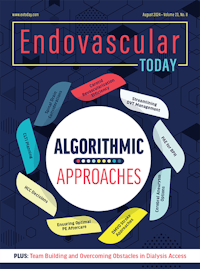
In 2024, we often associate the word “algorithm” with social media and artificial intelligence (AI) applications. Although both of these have increasing roles in the medical field, in our daily practices, more traditional algorithms continue to play a vital role in guiding best practices. This month, we focus on algorithmic approaches to providing individualized patient care across the gamut of vascular disease, focusing on where they are strongest, where data support is needed, and how to adapt with them and to them over time.
We begin our feature with a look at how three experts approach decision-making in patients with chronic limb-threatening ischemia. Drs. Tony Das, Kumar Madassery, and Leigh Ann O’Banion each share their tailored approaches to ensuring optimal, appropriate care for this challenging condition. Despite the wide variance in presentation and comorbidities in this population, it’s essential that each case be approached with a PLAN.
The field’s focus on deep venous disease continues to increase, with optimal approaches to clot management and stenting at the forefront of our discussions. We’ve engaged Drs. Steven Abramowitz, S. Jay Mathews, and Mona Ranade, and Wendy Nelson, NP, to give a closer look into their daily practice patterns with an eye toward ensuring efficient flow and care delivery. Dovetailing with this piece, we move to the rapidly evolving field of pulmonary embolism therapy, where we’ve asked experts from leading PERTs to focus on a topic that needs increased attention—posttreatment care. Drs. Vivian Bishay and Steven Pugliese describe how their PERTs follow up with patients and communicate after initial therapy, with insights into the unique psychosocial and logistical challenges to consider.
With recent changes in the reimbursement landscape, carotid revascularization is once again in the spotlight. Selecting the best therapy for each patient is key, as is ensuring preparedness for whichever option you select. Drs. Daniel Clair and Ziad Al Adas share how they work up and image patients and how they prepare the table, room, and staff for CEA, TFCAS, or TCAR—whichever is best for the patient in front of them.
In the aortic realm, Dr. Kristine Orion shares her insights on the data and real-world experiences with spinal drain use, namely when and how they should be applied, by whom, and how patients should be followed up.
Even in spaces with established, data-driven algorithms, many cases fall just outside the guidance. Drs. Altan Ahmed, Richard Kim, Daniel Anaya, and Bela Kis dive into applying the current staging systems in hepatocellular carcinoma and how they apply individualized care in cases and therapies that don’t fall within the guidance. Interest in prostate artery embolization for benign prostatic hyperplasia continues to grow, especially after recent inclusion in urologic guidelines. Drs. Raj Ayyagari and Toby Chai present algorithm-based workup and patient selection to ensure optimal outcomes in this population.
Nearly a decade ago, the field of neurointervention saw a sea change in the treatment of ischemic stroke, with key trials overwhelmingly supporting mechanical thrombectomy (MT). Although more recent trials continue to support MT and show relatively wide applicability, some types of strokes, including distal medium vessel occlusions (DMVOs) are more challenging and requiring of further research. Dr. James Milburn describes the anatomic factors he considers when treating DMVO, as well as his imaging and procedural decision-making in these cases. Staying in the neurointerventional space, Drs. João Victor Sanders, Marion Oliver, and Demetrius Lopes, and Kiffon Keigher, DNP, walk us through tips and tricks for treating cerebral aneurysms in small and distal vessels using new flow diverter technologies.
The Endovascular Today editors have also assembled a feature on dialysis access interventions that fits nicely within the cover topic. First, Drs. Robert G. Jones, Allison Tan, Robert Shahverdyan, and Bharat Sachdeva provide an in-depth review of their strategies and best practices when treating cephalic arch stenosis. Next, Drs. Ammar Almehmi and Ahmed K. Abdel-Aal detail the essential considerations for a team approach to providing ideal access for every patient.
We close the issue with an interview with Dr. Judy Wawira Gichoya, who discusses applying data science and AI to promote equity in real-world settings, from current and future capabilities to key shortcomings that must be addressed.
As you can see, we charted an ambitious path through a wide variety of vascular territories and diseases, aiming for each article to have practical insights for readers regardless of whether they are experts in the subject or don’t do that particular procedure at all. There is so much we can learn from one another via sharing our algorithms, their strengths and shallower points alike.
I hope you enjoy reading this edition as much as I’ve enjoyed working on it with the authors and panelists. I’m grateful for their generosity of time and expertise.
Nicolas J. Mouawad, MD
Guest Chief Medical Editor
Advertisement
Advertisement