Advertisement
Advertisement
August 2024
BCLC Staging and Treatment Algorithm: Does It Cover All?
The Barcelona Clinic Liver Cancer staging system is a commonly used algorithm for the management of HCC; however, there are key deviations in contemporary practice.
By Altan Ahmed, MD, MSc; Richard Kim, MD; Daniel A. Anaya, MD, MSHCT, FACS; and Bela Kis, MD, PhD, FSIR
Hepatocellular carcinoma (HCC) is the most common primary liver cancer and the third-leading cause of cancer-related death worldwide.1 At our tertiary center, all patients with HCC are reviewed by a multidisciplinary tumor board with representatives from surgical oncology, medical oncology, interventional radiology, radiation oncology, and pathology. Initial assessment includes the core elements of hepatic function, functional status, and tumor characteristics. Our treatment algorithm is informed by both national and international guidelines and institutional expertise. The Barcelona Clinic Liver Cancer (BCLC) guidelines remain among the most widely utilized in the management of HCC in Western practice and will be the primary guideline discussed.2
Treatment stage migration has been incorporated into the most recent iteration of the BCLC guidelines and involves use of an advanced-stage therapy based on a patient’s clinical assessment and/or noncandidacy for the recommended in-stage therapy or failure of that therapy.2 This principle more closely follows multidirectional treatment allocation used in clinical practice.
VERY EARLY (0) AND EARLY STAGE (A)
Patients who are liver transplant candidates are referred to a local transplant center and, in coordination with the transplant team, are simultaneously assessed for surgical resection or ablation depending on tumor location and presence or absence of clinically significant portal hypertension. In patients with ≤ 3 tumors < 3 cm in size, preference is given to thermal ablation or resection. If the tumors are not amenable to ablation or resection, then radioembolization (preferred) and transarterial bland embolization (TAE) or transarterial chemoembolization (TACE) are considered.
The current BCLC guidelines incorporate radioembolization into the algorithm for treatment of select patients in this category; however, ablative radioembolization (ie, segmentectomy and lobectomy) is not specifically discussed. The primary driver of this is a multicenter, single-arm retrospective study of 162 patients with solitary HCC ≤ 8 cm treated with ablative dosimetry that demonstrated overall survival (OS) of 86.6% at 3 years.3 This compares favorably to surgical resection, with reported 5-year OS of 56.9% to 86.2% for BCLC A and 0 patients, respectively.4 Additionally, the subset of patients who received an absorbed dose of > 400 Gy and subsequently underwent resection or transplantation demonstrated complete pathological necrosis.3 Patients with solitary tumors ≤ 8 cm who are not candidates for or have failed resection or ablation are considered for TAE, with radioembolization preferred at our institution. External beam radiation therapy is considered when tumors are not amenable to resection, ablation, or intra-arterial therapy.
Limited patients with high-risk tumors who undergo resection or ablation are also considered for adjuvant atezolizumab and bevacizumab based on improved recurrence-free survival demonstrated in the IMbrave050 trial.5 The high-risk criteria for resection is up to three tumors with the largest > 5 cm or poor differentiation with or without vascular invasion; four or more tumors ≤ 5 cm or poor differentiation with or without vascular invasion; or up to three tumors with the largest ≤ 5 cm with vascular invasion and regardless of differentiation. It is not yet known whether there is a survival benefit associated with this adjuvant regimen.5
INTERMEDIATE STAGE (B)
This group encompasses patients with unresectable multifocal disease with preserved hepatic function and no impairments in functional status. Given the significant amount of heterogeneity in the intermediate stage, the updated BCLC guidelines further characterize three subgroups to better guide management:
- Tumors within extended transplant criteria
- Well-defined multifocal disease and preserved portal flow
- Infiltrative, diffuse, and/or bilobar disease
Our patient population predominantly includes those in the second and third subgroups. TACE has been established as the standard of care for intermediate-stage HCC and is supported by randomized controlled trials (RCTs) by Lo et al and Llovet et al, demonstrating OS benefit compared with supportive care.6,7 Although TACE is widely available with more long-term data, the evidence supporting radioembolization in this setting is steadily growing and has led to its implementation as the primary intra-arterial therapy in these patients and across the BCLC spectrum at multiple centers, including ours. This is despite its omission from the BCLC algorithms beyond very early and early stage disease. We favor radioembolization in BCLC B patients with well-defined multifocal disease if selective treatment(s) are feasible with TAE/TACE as the alternative. These intra-arterial therapies may be used with or without combination systemic therapy. No randomized prospective data are available investigating the combination radioembolization and systemic therapy. Initial data from EMERALD-1 (durvalumab + bevacizumab + TACE vs TACE) demonstrate improved progression-free survival (PFS), and follow-up continues for survival data.8 The phase 2 TACTICS trial demonstrated improved PFS for TACE with sorafenib compared with TACE alone but failed to show a survival benefit, while the phase 3 LAUNCH trial demonstrated survival benefit of lenvatinib plus TACE over TACE alone.9,10
There are many considerations in selecting the most appropriate intra-arterial therapy. The phase 2 PREMIERE RCT demonstrated a significantly longer time to progression (TTP) in a group of BCLC A and B patients treated with radioembolization compared with conventional TACE (> 26 vs 6.8 months). The trial was terminated early due to slow accrual and was thus insufficiently powered to demonstrate a survival benefit.11 The phase 2 TRACE trial demonstrated improved TTP (17.1 vs 9.5 months) and OS (27.6 vs 15.6 months, when censoring for those who underwent transplantation) in 38 patients with early and intermediate-stage HCC treated with radioembolization compared with drug-eluting bead TACE. The study was terminated at the interim analysis due to meeting the primary endpoint.12 These findings are of interest when considering intra-arterial therapy to downstage patients with intermediate-stage disease into transplant criteria. Higher rates of downstaging to transplant have been observed with radioembolization compared with TACE.13 Although not explicitly discussed in the guidelines, any locoregional therapy may be incorporated to bridge patients to resection or transplant after multidisciplinary discussion.14 Of note, neither PREMIERE nor TRACE utilized personalized dosimetry for radioembolization, which is associated with improved objective response and clinical trends toward improved survival.11,12
In the setting of localized infiltrative disease (eg, unilobar), we often opt for radioembolization, if feasible, followed by systemic therapy. The remainder of these patients receive systemic therapy and are considered for consolidative locoregional therapy, if appropriate, at restaging.
ADVANCED STAGE (C)
Patients with macrovascular invasion, metastatic disease, and/or Eastern Cooperative Oncology Group performance status of 1 to 2 and with preserved liver function are managed with systemic therapy and/or intra-arterial therapy, most often radioembolization. It is essential to scrutinize categorization of patients as BCLC C solely because of functional status, particularly if their tumor burden falls into a lower category in the classification, as these patients may otherwise be suitable candidates for and benefit from an expanded set of therapeutic options.15
First-line systemic therapies include atezolizumab with bevacizumab or tremelimumab with durvalumab (particularly if high bleeding risk or otherwise ineligible for a vascular endothelial growth factor inhibitor); lenvatinib if ineligible for immunotherapy or Child-Pugh (CP) B; or pembrolizumab if CP B.16-20
Second-line systemic therapies include cabozantinib (preferred at our institution) or regorafenib in cases where first-line tyrosine kinase inhibitors (TKIs) such as lenvatinib or sorafenib have been used. However, in 2024, immunotherapy is most commonly used in the first line; therefore, lenvatinib is our choice for second-line TKI, although we recognize the lack of prospective data supporting this choice. If a first-line TKI was used but not well tolerated, pembrolizumab, nivolumab plus ipilimumab, or ramucirumab (preferred for alpha-fetoprotein > 400) are considered as alternatives.21-25
Although radioembolization has been shown to be safe and efficacious in advanced HCC, it is not included in the management of BCLC B or C disease owing to negative results of the SARAH and SIRveNIB phase 3 RCTs.26,27 A commonly encountered situation in which an advanced-stage patient may benefit from radioembolization is with portal vein invasion. Radioembolization with personalized dosimetry in the setting of portal vein invasion has demonstrated OS ranging from 15.7 to 22 months.28-31 In addition, ablative dosimetry in this setting has demonstrated median OS of 45.3 months compared with 18.2 months with conventional dosimetry.32 These survival trends approach and sometimes exceed those reported for systemic regimens in the setting of portal vein invasion.
Although systemic therapy is the mainstay of treatment for metastatic disease, there may be utility in locoregional treatment of the primary site as intrahepatic progression is one of the primary contributors to overall mortality.33 This is especially true for oligometastatic disease. This concept has also been investigated in the setting of metastatic breast, prostate, and renal cell carcinoma.34-36 Transarterial therapy may also be considered for the palliation of hepatic tumor–related pain.
Specific considerations regarding the role of surgery and resection should be highlighted for those patients with limited multifocal disease (stage A), multifocal unilobar disease in the context of preserved liver function (stage B), and portal vein invasion distal to the main portal vein and with ipsilateral involvement who are technically resection candidates (stage C). Although BCLC criteria does not typically guide these patients toward surgical treatment, highly selected patients can benefit from resection, either as an alternative to the preferred approach if not technically feasible (eg, percutaneous ablation in unilobar disease with lesions not amenable to ablation due to location or adjacent organs) or to deliver a curative-intent treatment in well-selected patients with anatomically favored tumors.37-41
TERMINAL STAGE (D)
Patients with advanced liver failure and/or significantly impaired functional status are referred for supportive care.
SUMMARY
The BCLC staging system is among the most utilized in the management of patients with HCC and has merits as a clinical framework. However, there are several limitations, including omission of ablative radioembolization, emphasis on left to right treatment stage migration, exclusion of bridging to transplantation, and lack of further stratification of advanced-stage disease, amongst others.42,43 Interestingly, a study by Matsumoto et al evaluated the outcome of deviating from the BCLC recommended therapy (2018 revision) based on multidisciplinary discussion. Although deviation occurred in upwards of three out of four cases, median OS on an intention-to-treat basis either matched or exceeded the BCLC expectations.44
In clinical practice, patient presentations are often complex and require nuanced discussion of the treatment intent and therapeutic options. No algorithm can capture all clinical scenarios, and an individualized approach with multidisciplinary discussion is essential to deliver the highest quality of care to patients with HCC (Figure 1).
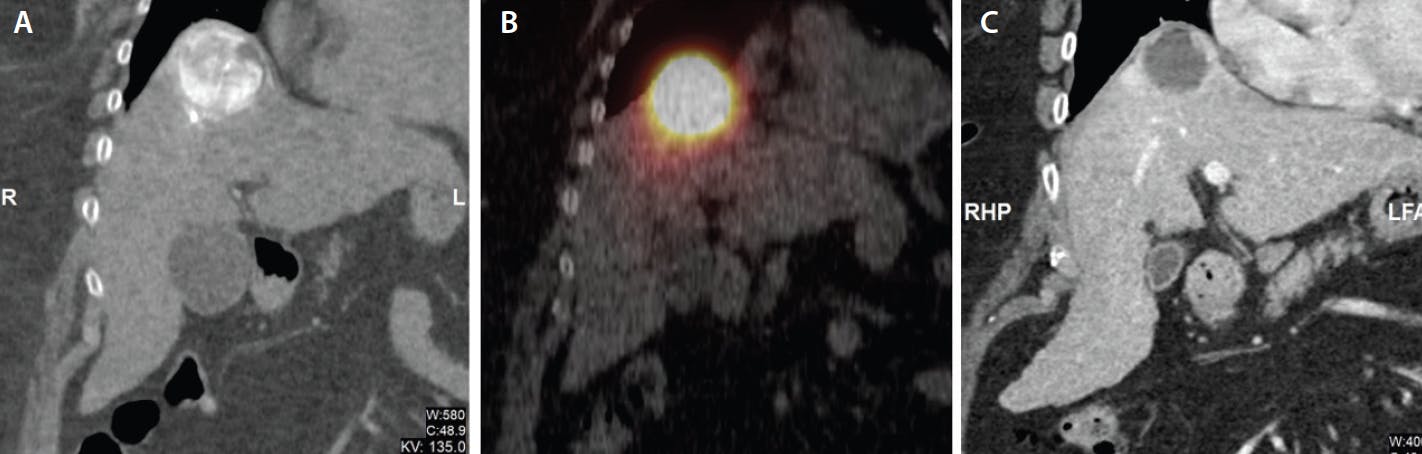
Figure 1. A woman in her mid 60s with a solitary HCC treated with radiation segmentectomy using resin yttrium-90 microspheres. Intraprocedural CT images with selective contrast injection into a segment 8 branch of the right hepatic artery showed a hyperenhancing tumor in segment 8 (A). Postradioembolization bremsstrahlung single-photon emission CT/CT images demonstrated distribution of radiomicrospheres in the target tumor (B). Follow-up contrast-enhanced CT 6.5 months after radioembolization demonstrated complete response with lack of enhancement in the treated tumor (C).
What’s on the Horizon?
Although extraordinary progress has been made in the management of HCC, many questions and areas of interest remain, including:
- What is the definition of combination therapy, and does sequencing matter?
- What role, if any, is there for adjuvant therapies after ablation or resection?
- How can intermediate-stage disease be further refined to optimize treatment allocation?
- Is there a role for hepatic perfusion therapies in HCC?
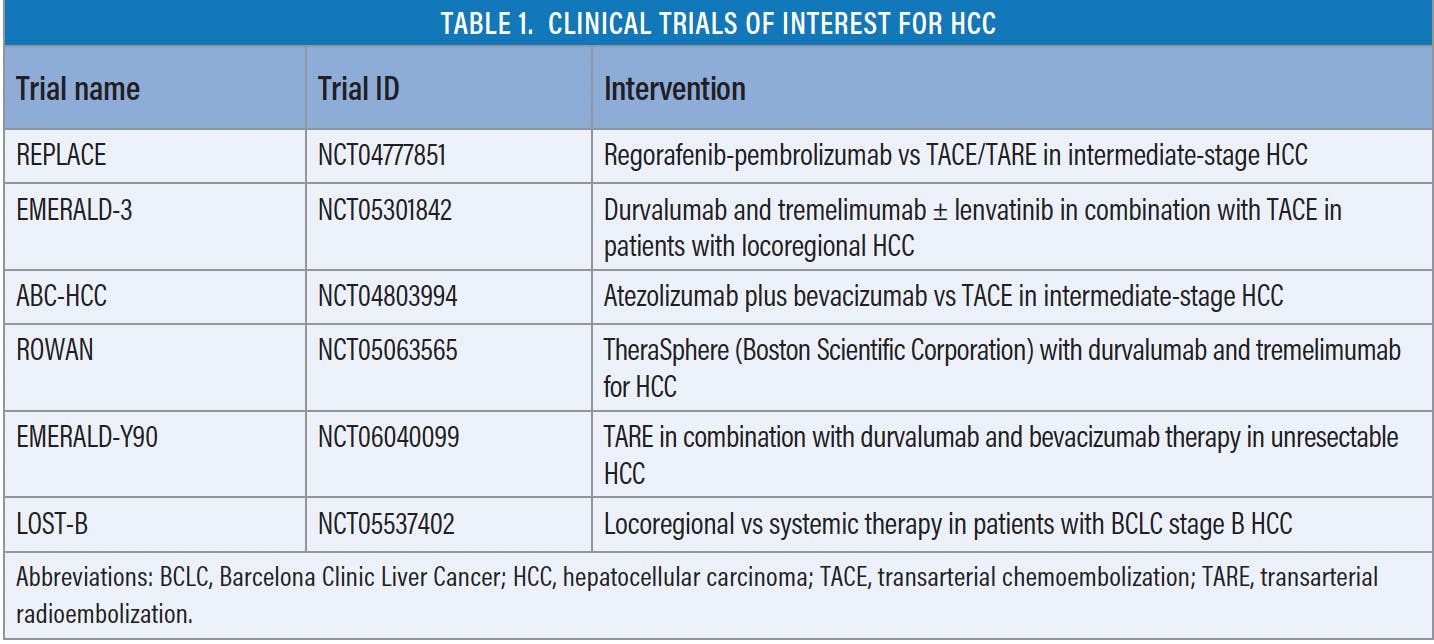
Select clinical trials of interest are outlined in Table 1.
1. Sung H, Ferlay J, Siegel RL, et al. Global cancer statistics 2020: GLOBOCAN estimates of incidence and mortality worldwide for 36 cancers in 185 countries. CA Cancer J Clin. 2021;71:209-249. doi: 10.3322/caac.21660
2. Reig M, Forner A, Rimola J, et al. BCLC strategy for prognosis prediction and treatment recommendation: the 2022 update. J Hepatol. 2022;76:681-693. doi: 10.1016/j.jhep.2021.11.018
3. Salem R, Johnson GE, Kim E, et al. Yttrium-90 radioembolization for the treatment of solitary, unresectable HCC: the LEGACY study. Hepatology. 2021;74:2342-2352. doi: 10.1002/hep.31819
4. Tsilimigras DI, Bagante F, Sahara K, et al. Prognosis after resection of Barcelona Clinic Liver Cancer (BCLC) stage 0, A, and B hepatocellular carcinoma: a comprehensive assessment of the current BCLC classification. Ann Surg Oncol. 2019;26:3693-3700. doi: 10.1245/s10434-019-07580-9
5. Qin S, Chen M, Cheng AL, et al. Atezolizumab plus bevacizumab versus active surveillance in patients with resected or ablated high-risk hepatocellular carcinoma (IMbrave050): a randomised, open-label, multicentre, phase 3 trial. Lancet. 2023;402:1835-1847. doi: 10.1016/S0140-6736(23)01796-8
6. Lo C-M, Ngan H, Tso W-K, et al. Randomized controlled trial of transarterial lipiodol chemoembolization for unresectable hepatocellular carcinoma. Hepatology. 2002;35:1164-1171. doi: 10.1053/jhep.2002.33156
7. Llovet JM, Real MI, Montaña X, et al. Arterial embolisation or chemoembolisation versus symptomatic treatment in patients with unresectable hepatocellular carcinoma: a randomised controlled trial. Lancet. 2005;359:1734-1739. doi: 10.1016/S0140-6736(02)08649-X
8. Lencioni R, Kudo M, Erinjeri J, et al. EMERALD-1: A phase 3, randomized, placebo-controlled study of transarterial chemoembolization combined with durvalumab with or without bevacizumab in participants with unresectable hepatocellular carcinoma eligible for embolization. J Clin Oncol. 2024;42:LBA432-LBA432. https://doi.org/10.1200/JCO.2024.42.3_suppl.LBA432
9. Kudo M, Ueshima K, Ikeda M, et al. Final results of TACTICS: a randomized, prospective trial comparing transarterial chemoembolization plus sorafenib to transarterial chemoembolization alone in patients with unresectable hepatocellular carcinoma. Liver Cancer. 2022;11:354-367. doi: 10.1159/000522547
10. Peng Z, Fan W, Zhu B, et al. Lenvatinib combined with transarterial chemoembolization as first-line treatment for advanced hepatocellular carcinoma: a phase III, randomized clinical trial (LAUNCH). J Clin Oncol. 2023;41:117-127. doi: 10.1200/JCO.22.00392
11. Salem R, Gordon AC, Mouli S, et al. Y90 radioembolization significantly prolongs time to progression compared with chemoembolization in patients with hepatocellular carcinoma. Gastroenterology. 2016;151:1155-1163. doi: 10.1053/j.gastro.2016.08.029
12. Dhondt E, Lambert B, Hermie L, et al. 90Y radioembolization versus drug-eluting bead chemoembolization for unresectable hepatocellular carcinoma: results from the TRACE phase II randomized controlled trial. Radiology. 2022;303:699-710. doi: 10.1148/radiol.211806
13. Lewandowski RJ, Kulik LM, Riaz A, et al. A comparative analysis of transarterial downstaging for hepatocellular carcinoma: chemoembolization versus radioembolization. Am J Transplant. 2009;9:1920-1928. doi: 10.1111/j.1600-6143.2009.02695.x
14. Crocetti L, Bozzi E, Scalise P, et al. Locoregional treatments for bridging and downstaging HCC to liver transplantation. Cancers (Basel). 2021;13:5558. doi: 10.3390/cancers13215558
15. Gordon AC, Gabr A, Riaz A, et al. Radioembolization super survivors: extended survival in non-operative hepatocellular carcinoma. Cardiovasc Intervent Radiol. 2018;41:1557-1565. doi: 10.1007/s00270-018-2008-y
16. Finn RS, Qin S, Ikeda M, et al. Atezolizumab plus bevacizumab in unresectable hepatocellular carcinoma. N Engl J Med. 2020;382:1894-1905. doi: 10.1056/NEJMoa1915745
17. Abou-Alfa GK, Lau G, Kudo M, et al. Tremelimumab plus durvalumab in unresectable hepatocellular carcinoma. NEJM Evid. 2022;1:EVIDoa2100070. doi: 10.1056/EVIDoa2100070
18. Kudo M, Finn RS, Qin S, et al. Lenvatinib versus sorafenib in first-line treatment of patients with unresectable hepatocellular carcinoma: a randomised phase 3 non-inferiority trial. Lancet. 2018;391:1163-1173. doi: 10.1016/S0140-6736(18)30207-1
19. Huynh J, Cho MT, Kim EJH, et al. Post hoc analysis in patients (PTS) with unresectable hepatocellular carcinoma (UHCC) who progressed to Child-Pugh B (CPB) liver function in the phase III REFLECT study of lenvatinib (Len). J Clin Oncol. 2021;39(3 suppl):298-298. https://doi.org/10.1200/JCO.2021.39.3_suppl.298
20. Verset G, Borbath I, Karwal M, et al. Pembrolizumab monotherapy for previously untreated advanced hepatocellular carcinoma: data from the open-label, phase II KEYNOTE-224 trial. Clin Cancer Res. 2022;28:2547-2554. doi: 10.1158/1078-0432.CCR-21-3807
21. Yau T, Park JW, Finn RS, et al. Nivolumab versus sorafenib in advanced hepatocellular carcinoma (CheckMate 459): a randomised, multicentre, open-label, phase 3 trial. Lancet Oncol. 2022;23:77-90. doi: 10.1016/S1470-2045(21)00604-5
22. Abou-Alfa GK, Meyer T, Cheng AL, et al. Cabozantinib in patients with advanced and progressing hepatocellular carcinoma. N Engl J Med. 2018;379:54-63. doi: 10.1056/NEJMoa1717002
23. Bruix J, Qin S, Merle P, et al. Regorafenib for patients with hepatocellular carcinoma who progressed on sorafenib treatment (Resorce): a randomised, double-blind, placebo-controlled, phase 3 trial. Lancet. 2017;389:56-66. doi: 10.1016/S0140-6736(16)32453-9
24. Zhu AX, Kang YK, Yen CJ, et al. Ramucirumab after sorafenib in patients with advanced hepatocellular carcinoma and increased α-fetoprotein concentrations (REACH-2): a randomised, double-blind, placebo-controlled, phase 3 trial. Lancet Oncol. 2019;20:282-296. doi: 10.1016/S1470-2045(18)30937-9
25. He AR, Yau T, Hsu C, et al. Nivolumab (Nivo) + ipilimumab (Ipi) combination therapy in patients (Pts) with advanced hepatocellular carcinoma (Ahcc): subgroup analyses from CheckMate 040. J Clin Oncol. 2020;38(4 suppl):512-512. https://doi.org/10.1200/JCO.2020.38.4_suppl.512
26. Vilgrain V, Pereira H, Assenat E, et al. Efficacy and safety of selective internal radiotherapy with yttrium-90 resin microspheres compared with sorafenib in locally advanced and inoperable hepatocellular carcinoma (SARAH): an open-label randomised controlled phase 3 trial. Lancet Oncol. 2017;18:1624-1636. doi: 10.1016/S1470-2045(17)30683-6
27. Chow PKH, Gandhi M, Tan SB, et al. SIRveNIB: selective internal radiation therapy versus sorafenib in asia-pacific patients with hepatocellular carcinoma. J Clin Oncol. 2018;36:1913-1921. doi: 10.1200/JCO.2017.76.0892
28. Garin E, Tselikas L, Guiu B, et al. Long-term overall survival after selective internal radiation therapy for locally advanced hepatocellular carcinomas: updated analysis of dosisphere-01 trial. J Nucl Med. 2024;65:264-269. doi: 10.2967/jnumed.123.266211
29. Garin E, Lenoir L, Edeline J, et al. Boosted selective internal radiation therapy with 90Y-loaded glass microspheres (B-sirt) for hepatocellular carcinoma patients: a new personalized promising concept. Eur J Nucl Med Mol Imaging. 2013;40:1057-1068. doi: 10.1007/s00259-013-2395-x
30. Garin E, Rolland Y, Pracht M, et al. High impact of macroaggregated albumin-based tumour dose on response and overall survival in hepatocellular carcinoma patients treated with 90 Y-loaded glass microsphere radioembolization. Liver Int. 2017;37:101-110. doi: 10.1111/liv.13220
31. Garin E, Tselikas L, Guiu B, et al. Personalised versus standard dosimetry approach of selective internal radiation therapy in patients with locally advanced hepatocellular carcinoma (DOSISPHERE-01): a randomised, multicentre, open-label phase 2 trial. Lancet Gastroenterol Hepatol. 2021;6:17-29. doi: 10.1016/S2468-1253(20)30290-9
32. Cardarelli-Leite L, Chung J, Klass D, et al. Ablative transarterial radioembolization improves survival in patients with HCC and portal vein tumor thrombus. Cardiovasc Intervent Radiol. 2020;43:411-422. doi: 10.1007/s00270-019-02404-5
33. Mao K, Yan Y, Zhang J, et al. The impact of liver resection on survival outcomes of hepatocellular carcinoma patients with extrahepatic metastases: a propensity score matching study. Cancer Med. 2018;7:4475-4484. doi: 10.1002/cam4.1738
34. Gnerlich J, Jeffe DB, Deshpande AD, et al. Surgical removal of the primary tumor increases overall survival in patients with metastatic breast cancer: analysis of the 1988-2003 SEER data. Ann Surg Oncol. 2007;14:2187-2194. doi: 10.1245/s10434-007-9438-0
35. Parker CC, James ND, Brawley CD, et al. Radiotherapy to the primary tumour for newly diagnosed, metastatic prostate cancer (STAMPEDE): a randomised controlled phase 3 trial. Lancet. 2018;392:2353-2366. doi: 10.1016/S0140-6736(18)32486-3
36. Zini L, Capitanio U, Perrotte P, et al. Population-based assessment of survival after cytoreductive nephrectomy versus no surgery in patients with metastatic renal cell carcinoma. Urology. 2009;73:342-346. doi: 10.1016/j.urology.2008.09.022
37. Kokudo N, Kokudo T, Hasegawa K. Role of liver resection for hepatocellular carcinoma with vascular invasion: emerging evidence from western countries. Liver Cancer. 2021;10:404-406. doi: 10.1159/000517418
38. Govalan R, Lauzon M, Luu M, et al. Comparison of surgical resection and systemic treatment for hepatocellular carcinoma with vascular invasion: national cancer database analysis. Liver Cancer. 2021;10:407-418. doi: 10.1159/000515554
39. Kokudo T, Hasegawa K, Matsuyama Y, et al. Survival benefit of liver resection for hepatocellular carcinoma associated with portal vein invasion. J Hepatol. 2016;65:938-943. doi: 10.1016/j.jhep.2016.05.044
40. Ho MC, Hasegawa K, Chen XP, et al. Surgery for intermediate and advanced hepatocellular carcinoma: a consensus report from the 5th Asia-Pacific primary liver cancer expert meeting(APPLE 2014). Liver Cancer. 2016;5:245-256. doi: 10.1159/000449336
41. Pawlik TM, Poon RT, Abdalla EK, et al. Hepatectomy for hepatocellular carcinoma with major portal or hepatic vein invasion: results of a multicenter study. Surgery. 2005;137:403-410. doi: 10.1016/j.surg.2004.12.012
42. Trevisani F, Vitale A, Kudo M, et al. Merits and boundaries of the BCLC staging and treatment algorithm: Learning from the past to improve the future with a novel proposal. J Hepatol. 2024;80:661-669. doi: 10.1016/j.jhep.2024.01.010
43. Goyal P, Salem R, Mouli SK. Role of interventional oncology in hepatocellular carcinoma: Future best practice beyond current guidelines. Br J Radiol. 2022;95:20220379. doi: 10.1259/bjr.20220379
44. Matsumoto MM, Mouli S, Saxena P, et al. Comparing real world, personalized, multidisciplinary tumor board recommendations with BCLC algorithm: 321-patient analysis. Cardiovasc Intervent Radiol. 2021;44:1070-1080. doi: 10.1007/s00270-021-02810-8
Advertisement
Advertisement