Advertisement
Advertisement
June 2024
Tips and Pitfalls of New Endosaccular Aneurysm Technology
A review of currently available intrasaccular devices for wide neck bifurcation aneurysms.
Since the introduction of the detachable coil, endovascular treatment of wide neck bifurcation aneurysms has posed a challenge.1,2 Wide neck bifurcation aneurysms are aneurysms with neck diameters > 4 mm or a dome-to-neck ratio < 1.6.3 With these dimensions, conventional coils tend to prolapse into the parent artery, increasing the risk of thromboembolic events. To try to mitigate this issue, multiple new adjunctive devices have been developed in recent years, including balloon-assisted coiling, stent-assisted coiling, and retrievable scaffolding devices.3 However, with wide neck bifurcation aneurysms, it is essential to adequately protect two vessels. Although this can be achieved using multiple stent constructs, these techniques increase the procedural risk.4,5 With these concerns in mind, intrasaccular flow disruption technology was developed, which provides solutions to the number of challenges facing alternate modalities in the treatment of wide neck bifurcation aneurysms.
Intrasaccular devices utilize both the intrasaccular blood disruption characteristic of coils and the flow diversion characteristic of flow diverters with a fine mesh density at the aneurysm neck–parent vessel interface.6-8 Flow diversion is provided with intrasaccular devices without the need for parent vessel intraluminal deployment, which necessitates antiplatelet therapy and increases the risk of hemorrhage, especially in the setting of subarachnoid hemorrhage.3 Presently, there are four intrasaccular devices available worldwide. So far, the Woven EndoBridge (WEB) device (MicroVention Terumo), Artisse embolization device (Medtronic), and Contour neurovascular system (Stryker) are CE Mark approved for use in the European market. In the United States, only the WEB device is approved by FDA. However, the NECC and SEAL IT trials are ongoing clinical trials aiming to assess safety and efficacy of the Contour and Saccular Endovascular Aneurysm Lattice (SEAL; Galaxy Therapeutics, Inc.) devices, respectively.
CURRENT INTRASACCULAR DEVICES
WEB Device
The first FDA-approved intrasaccular device is the WEB device, which is a single layer of 114 to 216 nitinol/platinum braided wires bound with radiopaque platinum markers at each end.9 Early European studies demonstrated the efficacy and safety profile of the WEB device with 79.3% to 85.4% adequate occlusion rates from 6 to 12 months, 0% to 4% morbidity rates, and 0% to 3% mortality rates.10 The WEB-IT study, a multicenter, prospective, single-arm study including both ruptured and unruptured aneurysms, was performed in the United States and demonstrated 53.8% complete and 84.6% adequate occlusion rates at 1-year follow-up and 58.1% complete and 87.2% adequate occlusion rates at 5-year follow-up.11 During these 5 years of follow-up, the retreatment rate was 9.8%, one (0.7%) patient underwent parent artery stenting for stenosis, and one (0.7%) patient had an intraparenchymal hemorrhage 22 days after the procedure.11 These studies have not only proven the efficacy of the WEB device in treating wide neck bifurcation aneurysms but also showed that the favorable safety results compared to previously published complication rates of alternate wide neck bifurcation aneurysm treatment modalities, ranging from 2.4% to 10%.9,12,13 Ongoing trials include the CLARYS study assessing WEB treatment of ruptured aneurysms, the WEB-IT China study, and the CLEVER study assessing the WEB 17 devices (Figure 1).
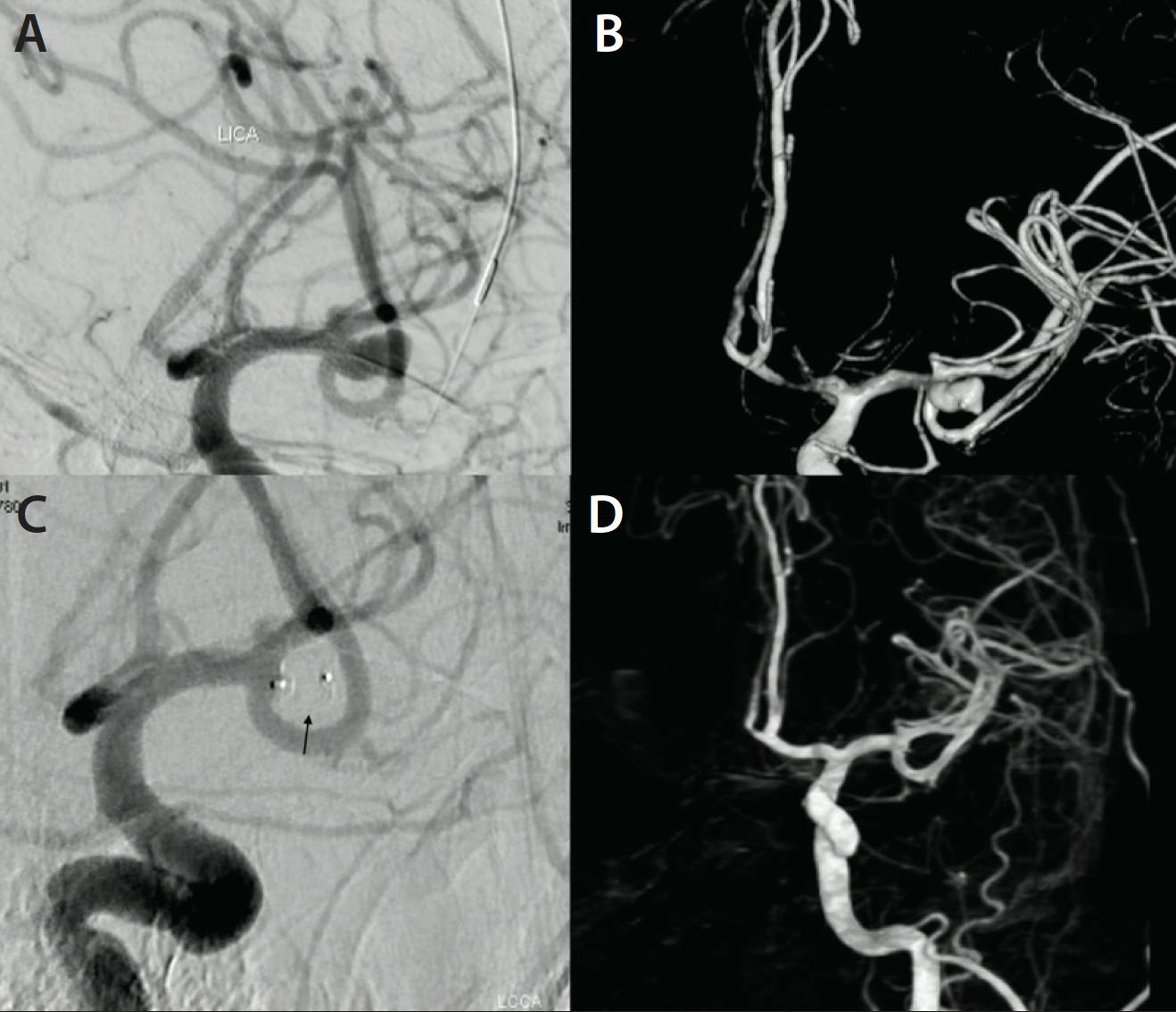
Figure 1. Anteroposterior (AP) angiogram of the left internal carotid artery (ICA) showing a left MCA bifurcation aneurysm (A). Three-dimensional (3D) angiogram of the left ICA showing a left MCA bifurcation aneurysm (B). Six-month follow-up angiogram showing complete occlusion of the MCA aneurysm and the WEB device inside the aneurysm (black arrow) (C). Six-month follow-up 3D angiogram showing complete occlusion of the MCA aneurysm (D).
Artisse Embolization Device
The Artisse embolization device is a double-layered, braided mesh device that comes in two shapes: spheroid and flared (like an acorn). Similar to the WEB device, the Artisse device is made of nitinol and platinum radiopaque markers (Figure 2).14 The largest series of the Artisse device was reported in Europe in 2018 and included 63 patients.15 Piotin et al demonstrated a 95% successful deployment rate, 78% adequate occlusion rate at 1-year follow-up, 8% periprocedural morbidity rate, and a 1.6% periprocedural mortality rate.15 Moreover, a 79.2% adequate occlusion rate, 4.8% retreatment rate, and 1.8% morbidity rate were observed at 3-year follow-up.15
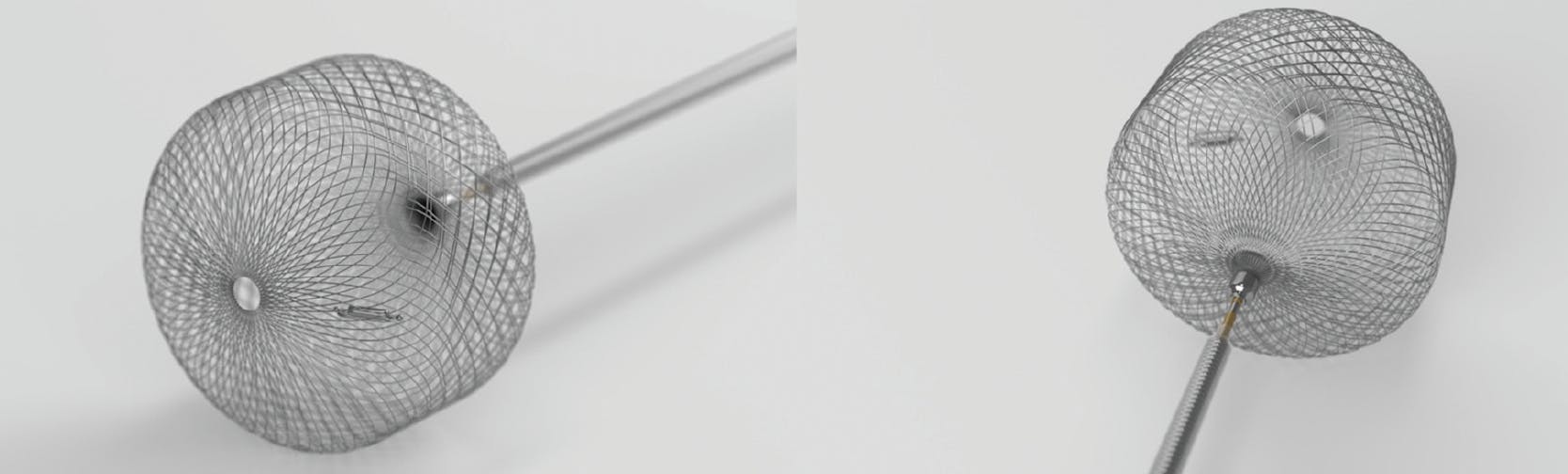
Figure 2. The Artisse device.
(Courtesy of Medtronic.)
Contour Neurovascular System
The Contour neurovascular system is another dual-layered mesh device. One difference between the Contour and the two aforementioned devices is that the Contour device targets the aneurysm neck such that it conforms to the aneurysm neck once it’s deployed (Figure 3).3,16 In addition to some small European case series that studied the Contour device,17 the largest series was performed by Biondi et al in 2023.18 The study included 60 unruptured aneurysms and demonstrated a 90% successful deployment rate, 89.3% adequate occlusion at 1-year follow-up, 3.3% technical complication rate, and 8.4% morbidity rate.18 Another study by Hecker et al directly compared outcomes of aneurysms treated with the Contour and WEB devices.19 The study showed that although both devices achieved comparable rates of adequate occlusion at last follow-up, complete aneurysm occlusion rates were significantly higher in the Contour cohort, while the WEB was associated with significantly higher rates of retreatment and longer median deployment times.19 The device is being evaluated in the United States through the NECC trial.
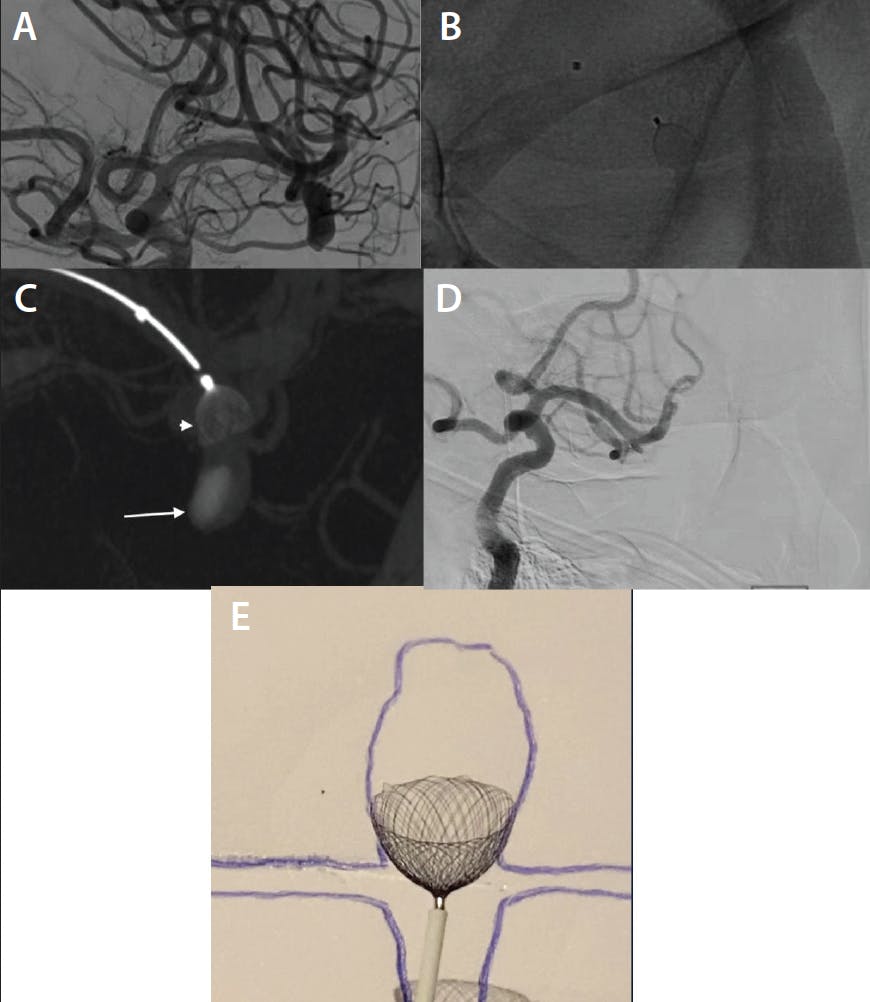
Figure 3. Oblique angiogram of the left ICA showing a left MCA bifurcation aneurysm (A). Fluoroscopic x-ray showing the deployed Contour device (B). CT showing the Contour device (arrowhead) with stasis of contrast in the aneurysm dome (white arrow) (C). Six-month follow-up angiogram showing complete occlusion of the MCA aneurysm (D). Live photo of a Contour device (E).
SEAL Device
The most recent device is the SEAL. This new-generation intrasaccular device is self-expanding, dual layered, and consists of nitinol and a core platinum wire mesh, braided implant.20 The SEAL device comes in two configurations: One configuration is an ovoid upper loop with a base bridging component (SEAL Arc) and the other includes only the base portion (SEAL Base) (Figure 4).20 Pabón et al introduced the SEAL device with a case report of a ruptured shallow trilobed middle cerebral artery (MCA) aneurysm.20 The SEAL Base configuration was used to treat the aneurysm and complete occlusion was achieved from 2- to 12-month follow-up.20 To further demonstrate the feasibility, efficacy, and safety profile of the SEAL device, Pre‐SEAL IT is an ongoing, prospective, interventional, core lab–adjudicated, single‐arm study taking place in Medellín, Colombia. Preliminary data were presented by Pabon et al at the BRAIN (Barts Research and Advanced Interventional Neuroradiology) conference, reporting a 100% technical success rate, 76.9% and 84.6% complete and adequate occlusion at 1-year follow-up, respectively, and an 8% recurrence rate (Figure 5).21 Preliminary data showed a 9% morbidity rate where complications were minor and transient.21
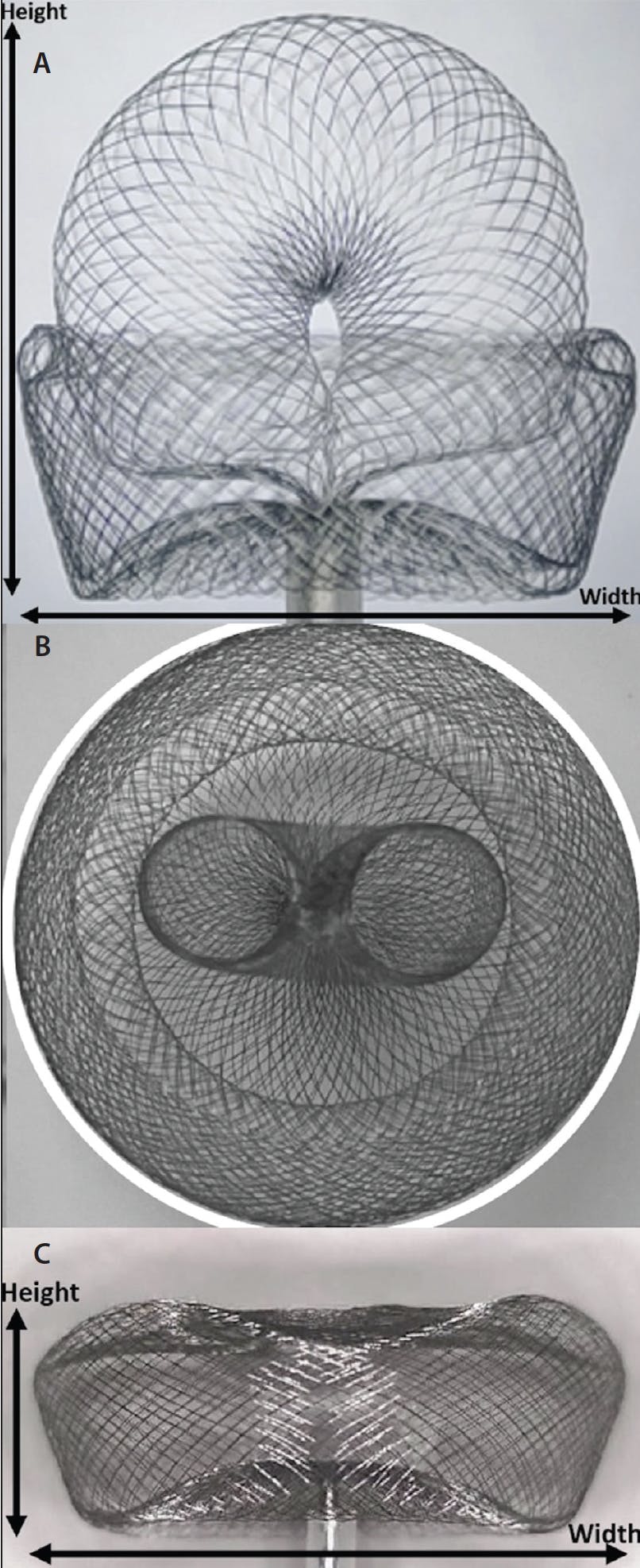
Figure 4. Lateral view of the SEAL Arc (A). Top-bottom view of the SEAL Arc (B). Lateral view of the SEAL Base (C).
(Courtesy of Dr. Boris Pabón.)
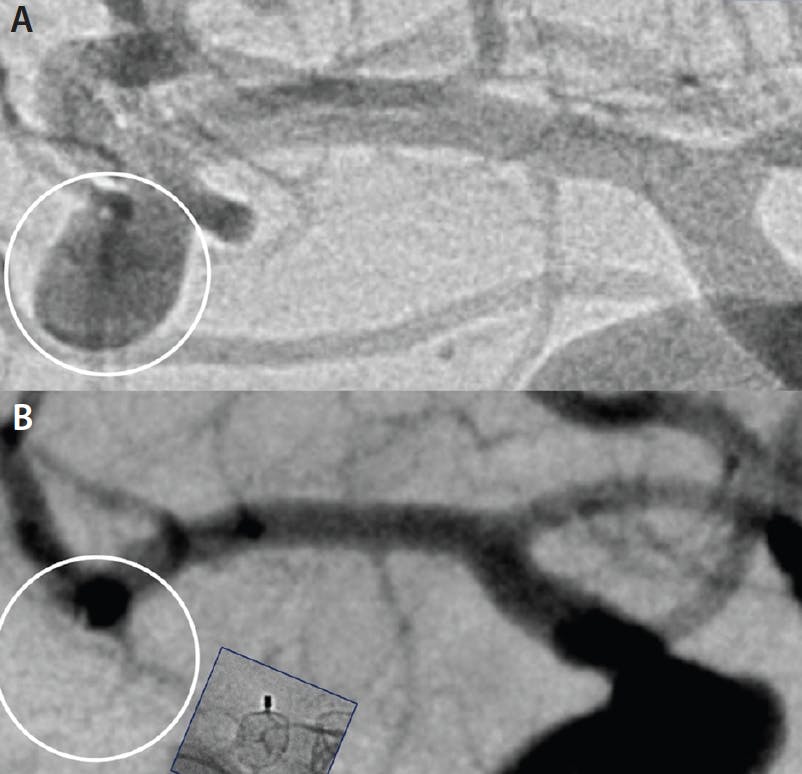
Figure 5. AP angiogram showing an MCA bifurcation aneurysm (A). AP angiogram showing complete occlusion of the aneurysm 1 year after deployment of the SEAL Arc (B).
(Courtesy of Dr. Boris Pabón.)
CONCLUSION
The latest paradigm shift in aneurysm treatment has been the introduction of intrasaccular devices. Several devices have been introduced targeting different types of aneurysms. The introduction of intrasaccular devices is another testament to the technologic advancements revolutionizing the neuroendovascular field where the wide array of treatment options is enabling neurointerventionalists to treat a larger spectrum of aneurysms with different characteristics and architecture.
1. Fiorella D, Molyneux A, Coon A, et al. Safety and effectiveness of the Woven EndoBridge (WEB) system for the treatment of wide necked bifurcation aneurysms: final 5-year results of the pivotal WEB intra-saccular therapy study (WEB-IT). J Neurointerv Surg. 2023;15:1175-1180. doi: 10.1136/jnis-2023-020611
2. Pierot L, Biondi A. Endovascular techniques for the management of wide-neck intracranial bifurcation aneurysms: a critical review of the literature. J Neuroradiol. 2016;43:167-175. doi: 10.1016/j.neurad.2016.02.001
3. Heiferman DM, Goyal N, Inoa V, et al. A new era in the treatment of wide necked bifurcation aneurysms: Intrasaccular flow disruption. Interv Neuroradiol. 2024;30:31-36. doi: 10.1177/15910199221094390
4. Fiorella D, Arthur AS, Chiacchierini R, et al. How safe and effective are existing treatments for wide-necked bifurcation aneurysms? literature-based objective performance criteria for safety and effectiveness. J Neurointerv Surg. 2017;9:1197-1201. doi: 10.1136/neurintsurg-2017-013223
5. Johnson AK, Munich SA, Tan LA, et al. Complication analysis in nitinol stent-assisted embolization of 486 intracranial aneurysms. J Neurosurg. 2015;123:453-459. doi: 10.3171/2014.10.JNS141361
6. Klisch J, Sychra V, Strasilla C, et al. The Woven EndoBridge cerebral aneurysm embolization device (WEB II): Initial clinical experience. Neuroradiology. 2011;53:599-607. doi: 10.1007/s00234-011-0891-x
7. Akhunbay-Fudge CY, Deniz K, Tyagi AK, Patankar T. Endovascular treatment of wide-necked intracranial aneurysms using the novel contour neurovascular system: a single-center safety and feasibility study. J Neurointerv Surg. 2020;12:987-992. doi: 10.1136/neurintsurg-2019-015628
8. Kwon SC, Ding YH, Dai D, et al. Preliminary results of the Luna aneurysm embolization system in a rabbit model: a new intrasaccular aneurysm occlusion device. AJNR Am J Neuroradiol. 2011;32:602-606. doi: 10.3174/ajnr.A2314
9. Naamani KE, Chen C, Abbas R, et al. Woven EndoBridge versus stent-assisted coil embolization of cerebral bifurcation aneurysms. J Neurosurg. 2022;137:1786-1793. doi: 10.3171/2022.3.JNS2217
10. Pierot L, Costalat V, Moret J, et al. Safety and efficacy of aneurysm treatment with WEB: results of the WEBCAST study. J Neurosurg. 2016;124:1250-1256. doi: 10.3171/2015.2.JNS142634
11. Arthur AS, Molyneux A, Coon AL, et al. The safety and effectiveness of the woven EndoBridge (WEB) system for the treatment of wide-necked bifurcation aneurysms: final 12-month results of the pivotal WEB intrasaccular therapy (WEB-IT) study. J Neurointerv Surg. 2019;11:924-930. doi: 10.1136/neurintsurg-2019-014815
12. Cagnazzo F, Limbucci N, Nappini S, et al. Y-stent-assisted coiling of wide-neck bifurcation intracranial aneurysms: a meta-analysis. AJNR Am J Neuroradiol. 2019;40:122-128. doi: 10.3174/ajnr.A5900
13. Chalouhi N, Jabbour P, Singhal S, et al. Stent-assisted coiling of intracranial aneurysms: predictors of complications, recanalization, and outcome in 508 cases. Stroke. 2013;44:1348-1353. doi: 10.1161/STROKEAHA.111.000641
14. Kwon SC, Ding YH, Dai D, et al. Preliminary results of the luna aneurysm embolization system in a rabbit model: a new intrasaccular aneurysm occlusion device. AJNR Am J Neuroradiol. 2011;32:602-606. doi: 10.3174/ajnr.A2314
15. Piotin M, Biondi A, Sourour N, et al. The LUNA aneurysm embolization system for intracranial aneurysm treatment: Short-term, mid-term and long-term clinical and angiographic results. J Neurointerv Surg. 2018;10:e34-013767. doi: 10.1136/neurintsurg-2018-013767
16. Bhogal P, Lylyk I, Chudyk J, et al. The contour-early human experience of a novel aneurysm occlusion device. Clin Neuroradiol. 2021;31:147-154. doi: 10.1007/s00062-020-00876-4
17. Akhunbay-Fudge CY, Deniz K, Tyagi AK, Patankar T. Endovascular treatment of wide-necked intracranial aneurysms using the novel contour neurovascular system: a single-center safety and feasibility study. J Neurointerv Surg. 2020;12:987-992. doi: 10.1136/neurintsurg-2019-015628
18. Biondi A, Primikiris P, Vitale G, Charbonnier G. Endosaccular flow disruption with the contour neurovascular system: angiographic and clinical results in a single-center study of 60 unruptured intracranial aneurysms. J Neurointerv Surg. 2023;15:838-843. doi: 10.1136/jnis-2022-019271
19. Hecker C, Broussalis E, Pfaff JAR, et al. Comparison of the contour neurovascular system and woven EndoBridge device for treatment of wide-necked cerebral aneurysms at a bifurcation or sidewall. J Neurosurg. 2023;139:563-572. doi: 10.3171/2022.12.JNS222268
20. Pabón B, Torres V, Woodward K, et al. Treatment of a ruptured shallow trilobed cerebral aneurysm with the novel saccular endovascular aneurysm lattice (SEAL) device: a case report with one year follow-up. Interv Neuroradiol. 2023;29:481-487. doi: 10.1177/15910199231187048
21. Pabón B, Torres V, Patiño M, et al. Abstract number 5: interim results of PRE-SEAL IT saccular endovascular aneurysm lattice system first in human interventional trial. Stroke Vasc Interv Neurol. 2023;3:e12440. https://doi.org/10.1161/SVIN.03.suppl_1.005
Advertisement
Advertisement