Advertisement
Advertisement
June 2024
Venous Stenting for Pulsatile Tinnitus: The St. Michael’s Hospital Experience
Insights from a dedicated PT clinic, including indications and technique, as well as a review of the current literature and a look toward the future.
By Natália Vasconcellos de Oliveira Souza, MD, MSc; Nicolle Cancelliere; and Vitor Mendes Pereira, MD, MSc
Pulsatile tinnitus (PT) can underlie a vascular pathology in up to 70% of cases. Arterial and arteriovenous (AV) causes such as dural AV fistulas (AVFs) and facial or brain AV malformations can be life-threatening and deserve an assertive, immediate workup. Venous abnormalities may be the underlying cause of PT in up to 60% of cases; however, although potentially treatable, they are often neglected. Correct diagnosis and management are very important for patient quality of life, as PT can be associated with higher rates of depression, poor sleep, and suicide risk. Venous stenting has emerged as a successful treatment for venous PT, converting a turbulent flow into a laminar flow, and is efficacious for a range of venous abnormalities (lateral sinus stenosis, sigmoid sinus dehiscence, diverticulum, etc). Literature on venous stenting currently consists primarily of idiopathic intracranial hypertension (IIH) cases, and data considering isolated disabling venous PT are still scarce. In this article, we share our center’s PT experience, focusing on indications, technique, success rate, and potential complications, followed by a brief discussion on remaining questions and future perspectives for venous PT.
THE PULSE CLINIC: A DEDICATED PT PROGRAM AT ST. MICHAEL’S HOSPITAL, UNIVERSITY OF TORONTO
Clinical Workup and Indications
First and foremost, clinical characterization of PT is fundamental. A venous PT is usually a low-pitch (buzzing, humming, whooshing, synchronous to the heartbeat), intermittent sound that improves with certain positions during sleep, head extension, Valsalva maneuver, or turning the head ipsilateral to the tinnitus (due to the ipsilateral compression of the jugular or emissary veins). Contralateral internal jugular vein (IJV) compression, exercise, and pregnancy may increase the sound.1 A higher-pitch PT (usually a whooshing or heartbeat sound) that does not improve with jugular vein compression but diminishes with carotid compression suggests arterial PT.
Usually, patients are referred to our clinic after a first otorhinolaryngology examination with otoscopy and audiometry, but there are some self-referrals from our website. Patients are always screened for venous congestion symptoms, including headache and visual assessment, and an ophthalmologic evaluation with fundoscopy and campimetry. To help assess the impact of PT on a patient’s quality of life, we apply the Tinnitus Functional Index and Tinnitus Handicap Index.2,3
After a clinical examination suggestive of venous PT, our first complementary exam has changed from MRI/MRA to CTA and CT venography (CTV) of the head and neck combined, with a temporal bone ultra-thin slice. Patients with venous PT may have multiple abnormalities,4 and we believe this strategy provides a good assessment for most of them in a timely manner, including venous stenosis, sigmoid sinus abnormalities (sigmoid sinus dehiscence and diverticulum), high jugular bulb, jugular bulb diverticulum, and jugular vein stenosis (Figure 1). Transverse sinus stenosis (TSS) may be extrinsic or intrinsic (usually in the context of an enlarged arachnoid granulation or previous sinus thrombosis) and, in a recent meta-analysis, has been found to be the leading cause of isolated PT, followed by sigmoid sinus abnormalities.5 Although some cohorts show that extrinsic stenosis is more common than intrinsic stenosis in IIH patients, intrinsic stenosis seems to be more prevalent in the context of isolated venous PT.6-8
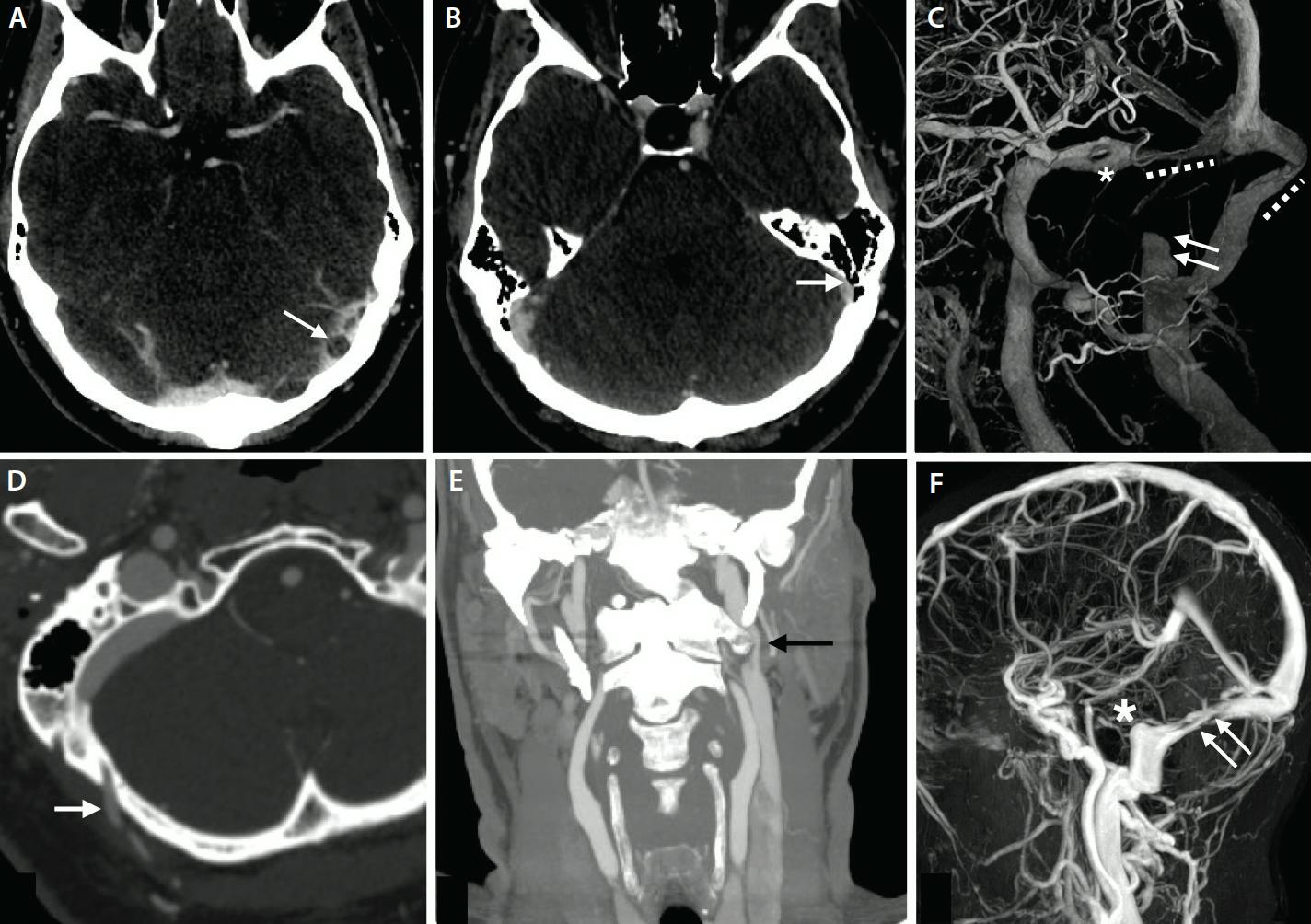
Figure 1. Venous causes of PT: A large arachnoid granulation (white arrow) causing left lateral sinus intrinsic stenosis (A). Left sigmoid sinus dehiscence (white arrow) (B). Left lateral sinus fenestration (white asterisk) and bilateral lateral sinus extrinsic stenosis (white dashed lines), with a prominent right high jugular bulb (double white arrows) (C). Enlarged mastoid vein (white arrow) (D). Left jugular vein stenosis due to compression by C1 and an elongated styloid process (black arrow) (E). Sigmoid sinus diverticulum (white asterisk) and left lateral sinus stenosis (double white arrows) (F).
Other potential causes of venous PT that frequently coexist with lateral sinus stenosis and sigmoid sinus abnormalities include enlargement of the emissary veins (mastoid, condylar, suboccipital) and diploic vein (DV) variations. An enlarged DV may pass through mastoid air cells in a dehiscent canal and communicate directly with the mastoid air cells, which can be a cause of venous PT.
For lesions other than TSS or for patients with multiple venous abnormalities,9 we often consider a balloon test occlusion. In this procedure, patients remain blinded for the actual inflation or deflation of the balloon, while we ask them if the PT stopped, improved, or worsened. Although it may be time-consuming, this allows us to assess PT improvement in real time, which we see as a valuable tool for estimating the probability of successful treatment and evaluating the patient’s tolerability to the hemodynamic changes brought about by the occlusion.10
Preliminary data from a 1-year study of patients in our clinic with isolated venous PT and without IIH showed that a majority had one or more venous abnormalities and the causes of venous PT were varied, including lateral sinus stenosis, prominent arachnoid granulation, sigmoid sinus abnormalities, enlarged marginal sinus, emissary vein anomalies, high jugular bulb, and jugular vein stenosis (unpublished data, 2024).
Technique
All procedures in our center are performed under general anesthesia with intravenous heparin.
Traditionally, our procedures were done with an 8-F short sheath in the right femoral vein for venous access and a 5-F arterial introducer in the right radial artery, and a complete arterial angiogram was obtained through a diagnostic catheter, including a cervical view of the IJVs from both sides. Arterial angiography allows us to rule out dural AVFs before proceeding with the venous treatment, followed by a three-dimensional (3D) rotational venous-phase angiogram to better evaluate irregular TSS, which can be missed on anteroposterior and lateral projections. Then, the 5-F arterial catheter is placed in the common carotid artery on the side of the dominant venous drainage, with a venous roadmap to navigate a 6-F long introducer over a 6-F diagnostic catheter and a 0.035-inch Glidewire Advantage guidewire (Terumo Interventional Systems). Venous pressure measurement is performed with a 2.3-F Progreat microcatheter (Terumo Interventional Systems), measuring from the right atrium and cervical IJV to the intracranial sinuses to describe a brain-to-heart gradient and a post-/prestenosis gradient if present. After pressure measurement, the venous abnormalities are targeted with a stent (Wallstent, Boston Scientific Corporation; Zilver, Cook Medical) in cases of TSS or coil-assisted stenting in cases of concomitant sigmoid sinus diverticulum, enlarged emissary vein, jugular bulb diverticulum, and enlarged DV. For sigmoid sinus diverticulum and jugular bulb diverticulum, we have recently been using Woven EndoBridge (WEB)-assisted stenting (MicroVention Terumo) as well. Patients with isolated PT typically don’t have a pressure gradient, so we don’t rely on that for the procedure indication. When the patient wakes, we consistently verify immediate symptom improvement.
More recently, most of our venous stenting cases have been done with the BosStent (Sonorous), a novel braided, closed-cell, self-expandable stent composed of highly visible nitinol drawn filled tubing wires specifically designed for treatment of venous sinus stenosis in patients with PT. Its optimal radial force diminishes the need for balloon angioplasty in every case. Additionally, it is delivered through a 5-F distal access catheter, which increases trackability. The stents are available in 7- and 9-mm sizes and 60- and 80-mm lengths, with < 20% surface area for all four sizes. This is desirable for minimizing occlusion risk in cases of intracranial vein coverture, such the vein of Labbé. For guiding and delivery catheters, we usually use a 90-cm Benchmark BMX96 (Penumbra, Inc.) and a 5-F, 115-cm Navien (Medtronic) or Catalyst 5 (Stryker), respectively (Figure 2).
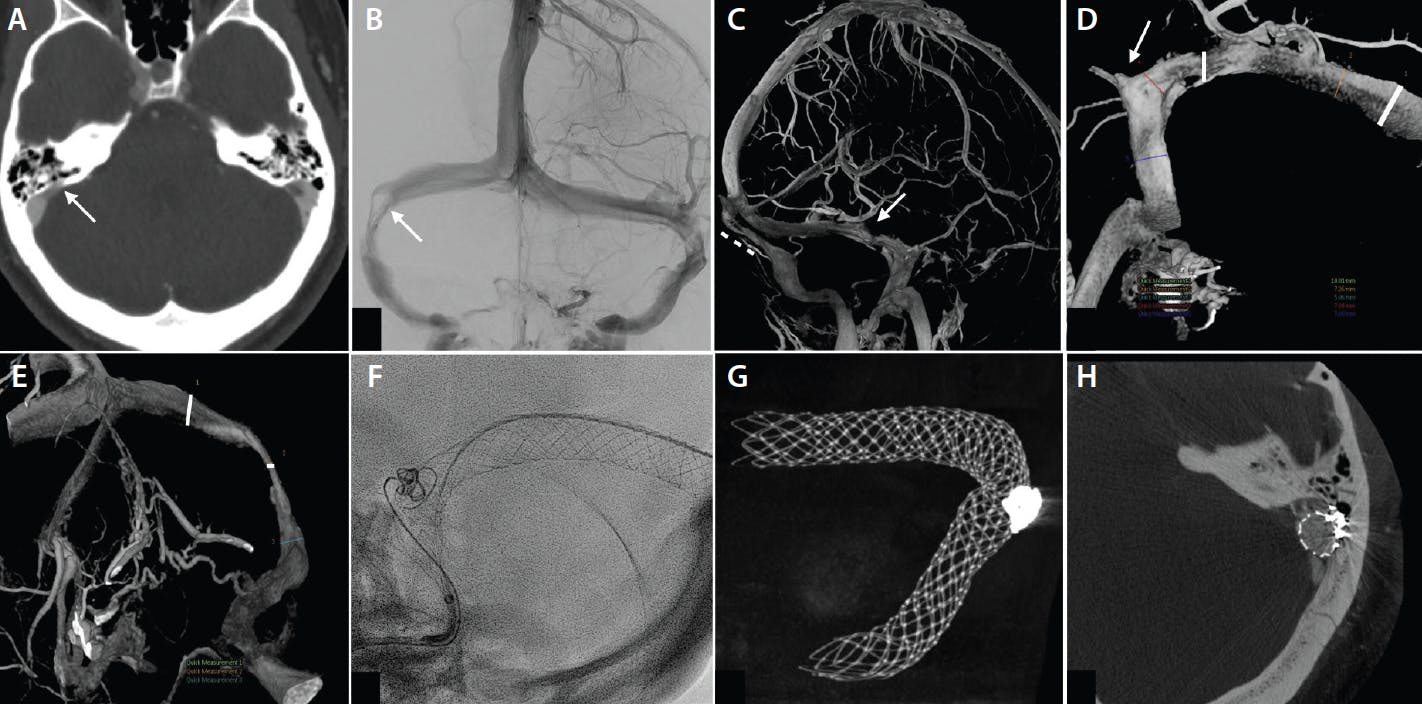
Figure 2. Venous stenting case with the BosStent: A middle-aged female presented with disabling left-side PT and moderate headaches; a thorough workup was done to rule out IIH. Fundoscopy, campimetry, and lumbar puncture were unremarkable. CTV showed bilateral sigmoid sinus stenosis with a left sigmoid sinus dehiscence (A). Anteroposterior digital subtraction angiography confirmed left lateral sinus intrinsic stenosis with a prominent arachnoid granulation (white arrow) (B). A 3D venous-phase angiogram showed bilateral lateral sinus stenosis: intrinsic on the right side (white arrow), extrinsic on the left side (dashed line) (C). A 3D view of the left lateral sinus measurements: Percent of stenosis was 1 minus diameter of the stenosis/normal diameter. This was 1 – 5.06 mm/7.86 mm = 0.36 = 36% of stenosis; also note a small sigmoid sinus diverticulum (white arrow) (D). A 3D view of the right side stenosis: 1 – 1.56 mm/6.14 mm (1 – diameter of the stenosis/normal diameter) = 0.75 = 75% stenosis; the left lateral sinus is dominant and was chosen for stent-assisted diverticulum coiling (E). Unsubtracted oblique view showing partial deployment of the BosStent with jailing technique for coiling of the sigmoid sinus diverticulum (F). Postprocedure VasoCT reconstruction of the stent (wide open) and coil mesh (G). Postprocedure VasoCT showing a well-apposed stent in the left lateral venous sinus (H). The patient reported immediate postprocedure PT improvement with no symptom recurrence at 1-year follow-up.
TREATMENT SUCCESS, FAILURE, RESTENOSIS, AND COMPLICATION RATE
Most of the venous stenting data we have from the literature are related to IIH cohorts, with three published meta-analysis in the last 5 years. In their meta-analysis, Nicholson et al reported a 90.3% (95% CI, 83.8%-96.7%) improvement in PT after venous sinus stenting for IIH. There was an overall 1.9% rate of major complications (ie, intracranial hemorrhage) (95% CI, 0.07%-3.1%) and a 9.8% restenosis rate (95% CI, 6.7%-13%).11 Lim et al reported 43.3% PT improvement (95% CI, 31.1%-60.4%), with 17.7% restenosis (95% CI, 14.9%-20.9%) but only a 0.9% rate of intraprocedural complications (minor and major complications were pooled together).12 More recently, Azzam et al reported a 95% rate of PT improvement (95% CI, 90%-98%), with 0.38% mortality (4/1,066 patients) and 3.93% major complications (42/1,066 patients; subdural hematoma, subarachnoid hemorrhage, visual impairment, worsening of papilledema, blindness, arterial dissection, and mortality).13 The restenosis rate wasn’t reported.
Regarding isolated disabling venous PT, Yang et al published a systematic literature review of venous sinus stenting with or without coiling (n = 41), with 95.1% complete resolution of the PT and a median follow-up of 7 months.5 There was one major complication (cerebellar infarct with transient ataxia) and no mortality. In a 42-patient prospective cohort, Patsalides et al found PT improvement in 97.6% of patients immediately after the procedure, without symptom recurrence at 5-month follow-up.14 Lenck et al evaluated a 14-patient cohort of isolated PT caused by lateral sinus stenosis (78.6% intrinsic stenosis); investigators found a 92.8% treatment success rate, without recurrence in 31-month follow-up.8
Although evidence is still scarce, persistent symptom freedom in isolated PT cohorts contrasts with a high restenosis rate and high symptom recurrence rate in IIH populations, as recently reported in the IIH cohort of Midtlien et al, which demonstrated almost 60% symptom recurrence at 1-year follow-up.15 As proposed by Fargen et al,16 the IIH population is a diverse group with a variable range of underlying pathologic processes; for this reason, a shift from IIH nomenclature to “chronic intracranial hypertension” may be more appropriate.
For instance, although patients with a diagnosis of “IIH” and intrinsic stenosis may be excellent candidates for stenting and show lower rates of restenosis and symptom recurrence, some IIH patients have multiple underlying causes for their chronic intracranial hypertension and would rather benefit from a multidisciplinary strategy involving not only venous sinus stenting but also weight loss, bariatric surgery, and closer follow-up with campimetry and ophthalmoscopy. Additionally, some IIH patients have other concomitant diseases such as connective tissue disease, which may increase the symptom recurrence rate if the underlying disease is not well controlled.17 Still, a small group of IIH patients with fulminant presentation (imminent visual loss risk) without venous sinus stenosis may be better candidates for initial cerebrospinal fluid diversion rather than venous sinus stenting.
In IIH, targeting the correct underlying pathologic process for each patient is of utmost importance, keeping in mind that stenting may be the best available treatment for one patient but only a part of the therapeutic arsenal for others.18 Practically, we see that IIH cohorts with a higher proportion of intrinsic stenosis exhibit a lower restenosis and symptom recurrence rate (closer to 10% than 20%). For instance, in a recent cohort of 200 IIH patients (66% extrinsic stenosis), Labeyrie et al reported 81% PT improvement and 84% papilledema improvement but only a 10% recurrence rate in 26-month follow-up.7
CONCLUSION AND FUTURE PERSPECTIVES
TSS stenting with or without coiling is a safe and effective endovascular treatment for isolated disabling venous PT with high cure rates. The evidence for venous stenting for PT is growing, but longer follow-ups are needed. Notably, because patients frequently have multiple venous abnormalities and may have underdiagnosed IIH, a comprehensive workup is necessary to target the implicated venous lesion and avoid early recurrent symptoms. Specifically, treatment for IIH should carefully evaluate other underlying comorbidities, such as obesity and connective tissue disorders. This is fundamental to minimizing symptom recurrence. In the near future, new braided stents specifically designed for venous stenosis promise higher rates of treatment success with lower restenosis rates.
1. Sismanis A. Pulsatile tinnitus: contemporary assessment and management. Curr Opin Otolaryngol Head Neck Surg. 2011;19:348-357. doi: 10.1097/MOO.0b013e3283493fd8
2. Meikle MB, Henry JA, Griest SE, et al. The tinnitus functional index: development of a new clinical measure for chronic, intrusive tinnitus. Ear Hear. 2012;33:153-176. doi: 10.1097/AUD.0b013e31822f67c0
3. Newman CW, Jacobson GP, Spitzer JB. Development of the tinnitus handicap inventory. Arch Otolaryngol Head Neck Surg. 1996;122:143-148. doi: 10.1001/archotol.1996.01890140029007
4. Dong C, Zhao PF, Yang JG, et al. Incidence of vascular anomalies and variants associated with unilateral venous pulsatile tinnitus in 242 patients based on dual-phase contrast-enhanced computed tomography. Chin Med J (Engl). 2015;128:581-585. doi: 10.4103/0366-6999.151648
5. Yang IH, Pereira VM, Lenck S, et al. Endovascular treatment of debilitating tinnitus secondary to cerebral venous sinus abnormalities: a literature review and technical illustration. J Neurointerv Surg. 2019;11:841-846. doi: 10.1136/neurintsurg-2019-014725
6. Sundararajan SH, Ramos AD, Kishore V, et al. Dural venous sinus stenosis: why distinguishing intrinsic-versus-extrinsic stenosis matters. AJNR Am J Neuroradiol. 2021;42:288-296. doi: 10.3174/ajnr.A6890
7. Labeyrie MA, Fantoni M, Vever U, et al. Intracranial venous sinus stenting for the treatment of lateral sinus stenoses: an analysis of 200 patients. Diagn Interv Imaging. 2021;102:619-627. doi: 10.1016/j.diii.2021.05.008
8. Lenck S, Labeyrie MA, Vallee F, et al. Stent placement for disabling pulsatile tinnitus caused by a lateral sinus stenosis: a retrospective study. Oper Neurosurg (Hagerstown). 2017;13:560-565. doi: 10.1093/ons/opx026
9. Dong C, Zhao PF, Yang JG, et al. Incidence of vascular anomalies and variants associated with unilateral venous pulsatile tinnitus in 242 patients based on dual-phase contrast-enhanced computed tomography. Chin Med J (Engl). 2015;128:581-585. doi: 10.4103/0366-6999.151648
10. Charbonnier G, Cancelliere NM, Rustici A, et al. Venous balloon test occlusion for pulsatile tinnitus assessment: a clinical feasibility study. Interv Neuroradiol. Published online May 25, 2023. doi: 10.1177/15910199231178160
11. Nicholson P, Brinjikji W, Radovanovic I, et al. Venous sinus stenting for idiopathic intracranial hypertension: a systematic review and meta-analysis. J Neurointerv Surg. 2019;11:380-385. doi: 10.1136/neurintsurg-2018-014172
12. Lim J, Monteiro A, Kuo CC, et al. Stenting for venous sinus stenosis in patients with idiopathic intracranial hypertension: an updated systematic review and meta-analysis of the literature. Neurosurgery. 2024;94:648-656. doi: 10.1227/neu.0000000000002718
13. Azzam AY, Mortezaei A, Morsy MM, et al. Venous sinus stenting for idiopathic intracranial hypertension: an updated meta-analysis. J Neurol Sci. 2024;459:122948. doi: 10.1016/j.jns.2024.122948
14. Patsalides A, Santillan A, Sundararajan SH, et al. Venous sinus stenting for the treatment of isolated pulsatile tinnitus: results of a prospective trial. Interv Neuroradiol. 2021;27:266-274. doi: 10.1177/1591019920974185
15. Midtlien JP, Kittel C, Klever LA, et al. Redefining treatment expectations: exploring mid- and long-term outcomes of venous sinus stenting in idiopathic intracranial hypertension. J Neurointerv Surg. Published online March 7, 2024. doi: 10.1136/jnis-2023-021336
16. Fargen KM. Idiopathic intracranial hypertension is not idiopathic: proposal for a new nomenclature and patient classification. J Neurointerv Surg. 2020;12:110-114. doi: 10.1136/neurintsurg-2019-015498
17. Midtlien JP, Curry BP, Chang E, et al. Characterizing a new clinical phenotype: the co-existence of cerebral venous outflow and connective tissue disorders. Front Neurol. 2024;14:1305972. doi: 10.3389/fneur.2023.1305972
18. Fargen KM, Coffman S, Torosian T, et al. “Idiopathic” intracranial hypertension: an update from neurointerventional research for clinicians. Cephalalgia. 2023;43:033310242311613. doi: 10.1177/03331024231161323
Advertisement
Advertisement