Advertisement
Advertisement
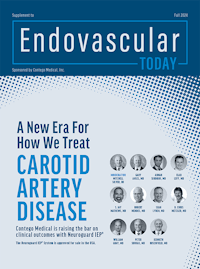
November 2024 Supplement
Sponsored by Contego Medical, Inc.
Introduction

This focused supplement to Endovascular Today comes on the heels of the recent FDA approval of the Neuroguard IEP® System, a 3-in-1 carotid stent + dilation balloon + Integrated Embolic Protection (IEP) system (Contego Medical). This FDA approval is supported by unprecedented safety outcomes from the PERFORMANCE I and II trials, which will be reviewed herein. In addition, other key milestones have been reached recently, including the national coverage decision on carotid stenting reimbursement and the completion of the important CREST-2 trial. Collectively, all these flash points are strong considerations for why carotid stenting should become part of the armamentarium of all physicians who manage carotid artery disease.
Recognized experts in the field of carotid artery disease have been asked to provide their perspectives specific to the procedural advantages of the Neuroguard IEP System, the importance of 40-µm IEP filter, the timing of stroke during carotid stenting, stent design, and the results of the PERFORMANCE I and II trials. Dr. Peter Soukas comments on why the clinical outcomes from utilizing periprocedural IEP should set a new standard for carotid stenting procedures. We have asked Dr. D. Chris Metzger to provide specific feedback on some technical performance details. With his background in engineering, Dr. S. Jay Mathews reviews the design features of the Neuroguard stent. As a renowned clinical trialist in carotid stenting, Dr. William Gray provides his viewpoint on the overall impact of the results of the PERFORMANCE I and II trials.
Dr. Gary Ansel, who has been involved with carotid stenting since its inception, provides some perspective on the timing of stroke during carotid stenting and mitigation strategies. As stroke centers of excellence proliferate across the country, in combination with the favorable evidence for acute endovascular stroke intervention, we felt it would be important to also discuss this treatment pathway with two internationally recognized endovascular neurosurgeons. Drs. Adnan Siddiqui and Elad Levy discuss the potential role of IEP and the Neuroguard IEP System when treating tandem lesions in the acute stroke patient.
The field of carotid stenting has appropriately evolved to a multidisciplinary approach to carotid artery disease, and to help drive best patient outcomes, transcarotid artery revascularization has become an important component of the shared decision-making conversation when discussing treatment options with patients. Drs. Sean Lyden and Robert Mendes provide an update and some initial observations from the actively enrolling PERFORMANCE III trial, which is evaluating the Neuroguard IEP System with a next-generation direct transcarotid access and protection system.
Lastly, Dr. Kenneth Rosenfield comments on the importance of carotid stenting training and education programs to ensure both safety and best patient outcomes, as well as how data from the PERFORMANCE I and II trials might affect the field of carotid stenting.
Through multidisciplinary collaboration and innovation, our sincere goal is to achieve “getting to zero” strokes in carotid stenting for our patients.
Mitchell J. Silver, DO, FACC, FSVM, RPVI
Chief Medical Officer, Contego Medical
Advertisement
Advertisement