Advertisement
Advertisement
August 2025 Supplement
Sponsored by Merit Medical Systems, Inc.
Real-World Experience With the WRAPSODY® Cell-Impermeable Endoprosthesis (CIE): Results From a Multicenter Registry in Brazil
A summary of clinical outcomes from the Vascular and Endovascular Access Society (SAVE)* patient registry in Brazil, implications for practice, and notable features of the WRAPSODY CIE that are changing the reality of dialysis management.
It is estimated that 10% of the global population has some degree of kidney failure.1 In Brazil, the incidence of dialysis patients is approximately 214 per million population, and the prevalence is 758 per million population, totaling approximately 160,000 people requiring dialysis therapy.2 According to the Brazilian Society of Nephrology, the main modality of dialysis in Brazil is hemodialysis (95%), and health care is divided into public (70%–80%) and private (20%–30%) assistance, bringing significant disparities between these systems.2 In public health care, there are challenges in access creation and management, culminating in an elevated number of patients who depend on temporary catheters, mainly in poor regions. On the other hand, in private health care, patients usually have better management and access to new technologies. Nevertheless, over 90% of patients have hemodialysis initiated through a catheter in an emergency. These realities bring significant challenges to the physicians involved in the management of vascular access.3
In contrast with the United States and Europe, vascular access care is a recent development in Brazil. Until a few years ago, most patients on hemodialysis just underwent catheter implantations and arteriovenous fistula (AVF) or arteriovenous graft (AVG) creations, as there were few to no dedicated vascular surgeons or vascular centers focused on dialysis patients to perform open and endovascular procedures.4
SAVE GROUP
SAVE is a Portuguese acronym that stands for Vascular Access and Endovascular Symposium.* The main objective of SAVE is to create, preserve, and save dialysis access to prolong the life of patients with chronic kidney disease in Latin America.
Currently, the SAVE group is a reference for vascular access care, research, and professional training in Latin America. Over the last few years, the group has performed hands-on training, created courses, contributed to the Brazilian vascular access guidelines,4 and planned six international symposia. This year, the 6th annual SAVE Symposium took place in São Paulo City, Brazil, with more than 600 attendees, including 15 international speakers.
SAVE REGISTRY
Contributing to best practices in vascular access care, the SAVE group has been involved with the development of new technologies, the Brazilian vascular access guidelines, and research programs, such as the WRAPSODY Arteriovenous Access Efficacy (WAVE) trial and the global WRAPSODY (WRAP) Registry.4-6
Recently, the SAVE group published clinical outcomes from its SAVE Registry, which is evaluating real-world outcomes following use of the WRAPSODY CIE (Merit Medical Systems, Inc.) in the treatment of vascular access outflow stenosis.7 Stenosis in the outflow of the access circuit is an important cause of AVF/AVG dysfunction, thrombosis, and abandonment of the vascular access, mainly in upper-arm AVFs and AVGs, that negatively impacts the quality of life for patients on hemodialysis. The first-in-human clinical trial on the WRAPSODY CIE provided evidence regarding various benefits associated with the use of the device in outflow lesions, chiefly high target lesion primary patency (TLPP) rates and access circuit primary patency (ACPP) rates.8 However, understanding how the WRAPSODY CIE performs outside of the clinical trial setting is key. Results from the SAVE Registry address this knowledge gap by describing the device’s safety and effectiveness in real-world practice.
Outcome Measures and Results
The SAVE Registry was a retrospective, multicenter, single-arm analysis of 113 hemodialysis patients with clinically dysfunctional AVFs and AVGs due to significant outflow obstruction or occlusion, treated with the WRAPSODY CIE. The primary study outcome measure was the TLPP rate at 12 months and 30-day safety performance. Additional endpoints evaluated were ACPP, target lesion secondary patency, technical success (ie, successful device deployment), and procedural success (< 30% restenosis following the procedures and resolution of clinical indicators of dysfunction). Among the patients analyzed, 34% presented with recurrent lesions, and 35% had thrombosis at the initial presentation. The types of stenoses treated were 33 central venous lesions,† 25 venous graft anastomosis stenoses, 20 cephalic arch obstructions, 20 stenoses in the venous outflow, and 15 basilic swing point lesions (Table 1).7 During the follow-up period, all patients were evaluated at 1, 3, 6, and 12 months. All patients experienced technical and procedural success. TLPP and ACPP at 6 and 12 months were 86% and 70% and 71% and 56%, respectively (Figure 1).7 Considering that this study included real-world patients with thrombosis and challenging lesions, these results are encouraging. Although results cannot be directly compared, the patency rates reported were higher than studies evaluating prior-generation stent grafts (SGs).9-11
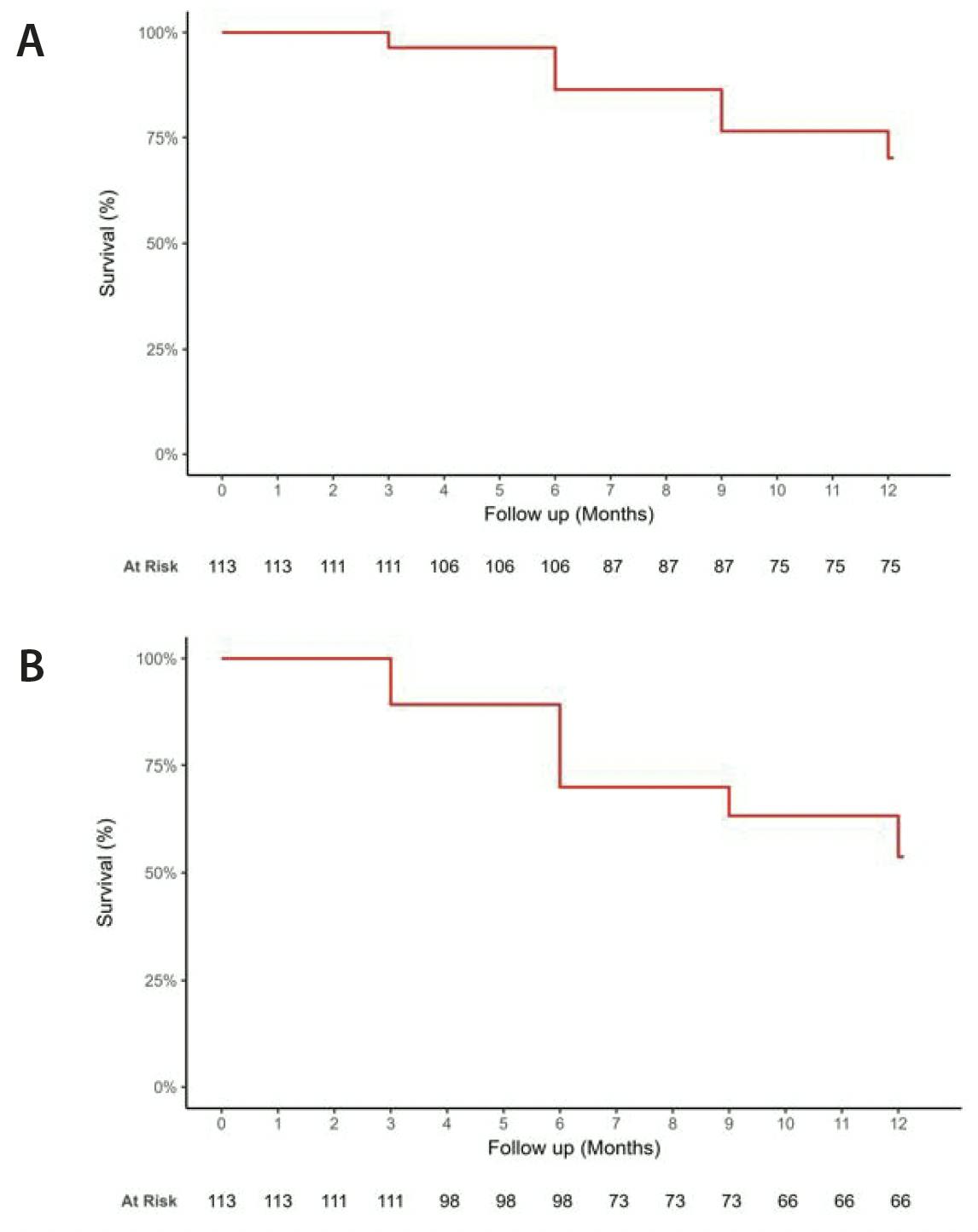
Figure 1. TLPP rate at 12 months (A). ACPP rate at 12 months (B). Reprinted from Harduin LO, Barroso TA, Guerra JB, et al. Safety and performance of a cell-impermeable endoprosthesis for hemodialysis vascular access outflow stenosis: a Brazilian multicenter retrospective study. Cardiovasc Intervent Radiol. 2024;47:1057-1065. doi: 10.1007/s00270-024-03790-1
IMPLICATIONS FOR CLINICAL PRACTICE
Stenosis along the vascular access circuit can be caused by different pathophysiologies, and response to treatment may differ. In general, vascular access stenosis can occur due to multiple factors, including intimal hyperplasia, fibrosis, ischemia, torsions, valves, external compression, and turbulence/high flow. These factors can present in combination as a cause of vascular access obstruction, making the choice for treatment challenging. This fact provides a better understanding as to why stenoses in the vascular access circuit, such as cephalic arch stenosis, basilic swing point lesions, and venous graft anastomosis stenosis, demonstrate variable results after endovascular treatment.
The SAVE Registry evaluated TLPP rates according to the location of stenosis. Across the segments, TLPP rates at 12 months in the outflow segment, basilic swing point lesions, cephalic arch stenosis, and venous graft anastomosis stenosis were 89%, 75%, 63%, and 45%, respectively. Notably, the 12-month TLPP rate at the basilic swing point segment after treatment with the WRAPSODY CIE was considerably higher than patencies following other endovascular treatment options (eg, SGs, drug-coated balloons).12,13 Performance at the cephalic arch also demonstrated interesting results, with at least 25% improvement in the 6-month TLPP rate compared to rates reported with other SGs.14,15
ACPP is considered an important indicator of effectiveness of an endovascular intervention in vascular access. Improvements in ACPP are associated with a lower number of interventions to maintain patency of the access circuit and thus more cost-effective in dialysis care. Previous studies of covered stents noted ACPP rates ranging from 28% to 42%.10,11,15 These results were lower than the 56% ACPP rates described in the SAVE Registry at 12 months. Recently, Razavi et al published the 6-month results from the WAVE trial and described a very similar performance compared to the data published by the SAVE group, supporting the improvement in vascular access survival with use of the WRAPSODY CIE.5,7 The clinical benefits of the WRAPSODY CIE in all the segments, considering both TLPP and ACPP rates, suggest that the WRAPSODY CIE may be considered a safe and durable option in the treatment of outflow disorders (Figure 2 and Figure 3).

Figure 2. Cephalic arch stenosis (A). After deployment of an 8-mm X 75-mm WRAPSODY CIE (B). Angiography 24 months later showing minimal intimal hyperplasia (C).
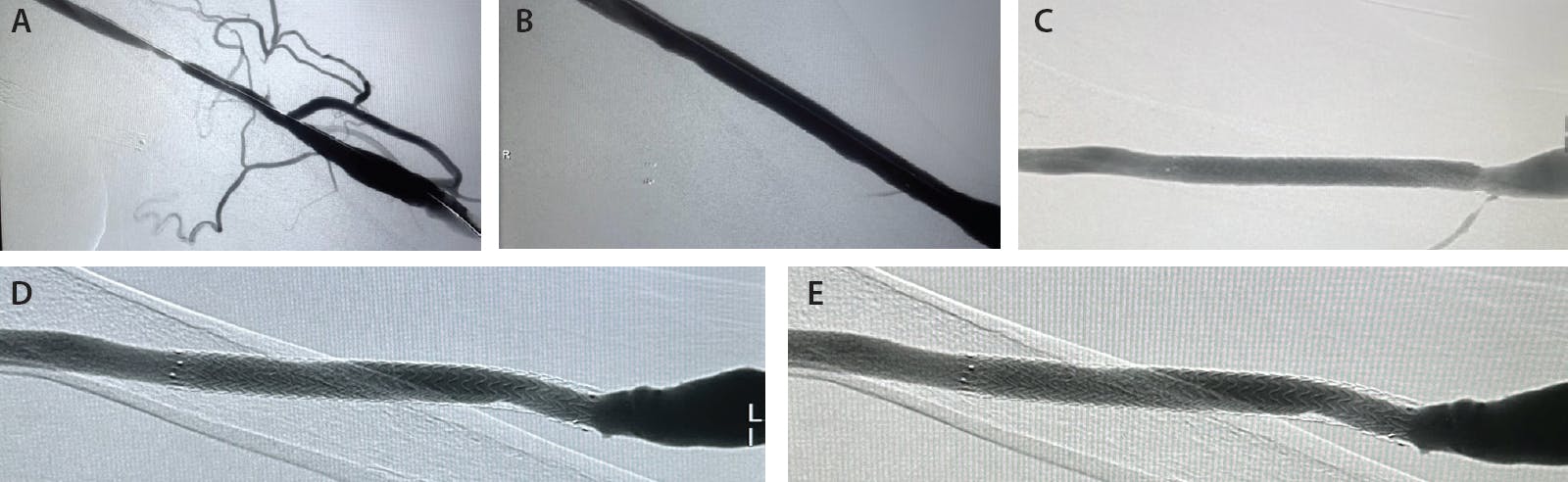
Figure 3. Stenosis in the cephalic vein after the cannulation zone (A). After deployment of a 9-mm X 100-mm WRAPSODY CIE (B). Angiography 12 months later without restenosis (C). Angiography at 30-month follow-up (D, E).
NOTABLE FEATURES OF THE WRAPSODY CIE
The WRAPSODY CIE prolongs functionality of vascular access because of two notable design features. First, the device produces a reduced radial force on both edges, resulting in less trauma on the vessel wall and thereby reducing the intimal hyperplasia and restenosis in this segment. Another important feature is the middle cell-impermeable graft layer designed to prevent transmural cellular migration and avoid stenosis within the lumen of the device.16
CONCLUSION
Based on these encouraging data and new design features, an increasing number of physicians have been adopting the WRAPSODY CIE as their first choice in the treatment of vascular access outflow stenosis since 2021, when the device was launched in Brazil. This trend is improving the reality for hemodialysis patients in our country—reinterventions, thrombosis, and catheter dependence are decreasing, bringing a better quality of life for this population.
1. National Kidney Foundation. Global facts: about kidney disease. Accessed June 30, 2025. https://www.kidney.org/global-facts-about-kidney-disease
2. Nerbass FB, Lima HDN, Moura-Neto JA, et al. Brazilian dialysis survey 2022. J Bras Nefrol. 2024;46:e20230062. doi: 10.1590/2175-8239-JBN-2023-0062en
3. Castro-Santos G. Challenges of maintaining hemodialysis in Brazil. HSJ. 2024;14:e1543. https://doi.org/10.21876/hsjhci.v14.2024.e1543
4. Harduin LO, Barroso TA, Guerra JB, et al. Guidelines on vascular access for hemodialysis from the Brazilian Society of Angiology and Vascular Surgery. J Vasc Bras. 2023;22:e20230052. doi: 10.1590/1677-5449.202300522
5. Razavi MK, Balamuthusamy S, Makris AN; WAVE trial investigators. Six-month safety and efficacy outcomes from the randomized-controlled arm of the WRAPSODY Arteriovenous Access Efficacy (WAVE) trial. Kidney Int. 2025;107:740-750. doi: 10.1016/j.kint.2025.01.006
6. Rajan DK, Kitrou PM. Prospective, multicenter, observational study to evaluate a cell-impermeable endoprosthesis for treatment of stenosis or occlusion within the dialysis outflow circuit of an arteriovenous (AV) fistula or AV graft (the WRAP Registry). Cardiovasc Intervent Radiol. 2023;46:1285-1291. doi: 10.1007/s00270-023-03531-w. Published correction appears in Cardiovasc Intervent Radiol. 2023;46:1655. doi: 10.1007/s00270-023-03565-0
7. Harduin LO, Barroso TA, Guerra JB, et al. Safety and performance of a cell-impermeable endoprosthesis for hemodialysis vascular access outflow stenosis: a Brazilian multicenter retrospective study. Cardiovasc Intervent Radiol. 2024;47:1057-1065. doi: 10.1007/s00270-024-03790-1
8. Gilbert J, Rai J, Kingsmore D, et al. First clinical results of the Merit WRAPSODY™ Cell-Impermeable Endoprosthesis for treatment of access circuit stenosis in haemodialysis patients. Cardiovasc Intervent Radiol. 2021;44:1903-1913. doi: 10.1007/s00270-021-02953-8
9. Haskal ZJ, Trerotola S, Dolmatch B, et al. Stent graft versus balloon angioplasty for failing dialysis-access grafts. N Engl J Med. 2010;362:494-503. doi: 10.1056/NEJMoa0902045
10. Vesely T, DaVanzo W, Behrend T, et al. Balloon angioplasty versus Viabahn stent graft for treatment of failing or thrombosed prosthetic hemodialysis grafts. J Vasc Surg. 2016;64:1400-1410.e1. doi: 10.1016/j.jvs.2016.04.035
11. Dolmatch B, Cabrera T, Pergola P, et al; AVeNEW trial investigators. Prospective, randomized, multicenter clinical study comparing a self-expanding covered stent to percutaneous transluminal angioplasty for treatment of upper extremity hemodialysis arteriovenous fistula stenosis. Kidney Int. 2023;104:189-200. doi: 10.1016/j.kint.2023.03.015
12. Nassar GM, Beathard G, Rhee E, et al. Management of transposed arteriovenous fistula swing point stenosis at the basilic vein angle of transposition by stent grafts. J Vasc Access. 2017;18:482-487. doi: 10.5301/jva.5000770
13. Trerotola SO, Saad TF, Roy-Chaudhury P; Lutonix AV clinical trial investigators. The Lutonix AV randomized trial of paclitaxel-coated balloons in arteriovenous fistula stenosis: 2-year results and subgroup analysis. J Vasc Interv Radiol. 2020;31:1-14.e5. doi: 10.1016/j.jvir.2019.08.035
14. Miller GA, Preddie DC, Savransky Y, Spergel LM. Use of the Viabahn stent graft for the treatment of recurrent cephalic arch stenosis in hemodialysis accesses. J Vasc Surg. 2018;67:522-528. doi: 10.1016/j.jvs.2017.08.018
15. Jones RG, Willis AP, Tullett K, Riley PL. Results of stent graft placement to treat cephalic arch stenosis in hemodialysis patients with dysfunctional brachiocephalic arteriovenous fistulas. J Vasc Interv Radiol. 2017;28:1417-1421. doi: 10.1016/j.jvir.2017.06.023
16. Dolmatch BL, Hall JW, Mower WL, Rousselle SD. Evaluation of a novel spun polytetrafluoroethylene stent graft in an ovine external iliac artery model. J Vasc Interv Radiol. 2020;31:494-502. doi: 10.1016/j.jvir.2019.07.036
*The SAVE Group was created by Drs. Leonardo Harduin, Thiago Barroso, Leonardo Cortizo, and Márcio Filippo.
† The WRAPSODY CIE is not approved for use in central veins in the United States.

Before using refer to Instructions for Use for indications, contraindications, warnings, precautions, and directions for use.
The Merit WRAPSODY® Cell-Impermeable Endoprosthesis (CIE) is a flexible, self-expanding endoprosthesis indicated for use in hemodialysis patients for the treatment of stenosis or occlusion within the dialysis access outflow circuit, including stenosis or occlusion:
- in the peripheral veins of individuals with an arteriovenous fistula (AVF),
- and/or at the venous anastomosis of a synthetic arteriovenous graft (AVG).
Advertisement
Advertisement