Advertisement
Advertisement
August 2025 Supplement
Sponsored by Merit Medical Systems, Inc.
WRAPSODY® Clinical Trial Program
A discussion of the WAVE trial’s methods and insights gained, impactful results from the 6-month AVF cohort, and the unique features of the WRAPSODY Cell-Impermeable Endoprosthesis (CIE).
With moderator Dr. Dheeraj Rajan and panelists Drs. Mahmood Razavi and Robert Jones



Long-term vascular access remains a major determinant of morbidity and mortality for hemodialysis-dependent patients. Although percutaneous transluminal angioplasty (PTA) remains the gold standard for treating vascular stenosis—the most common cause of dysfunction—recent studies have shown that stent grafts and drug-coated balloons offer improved outcomes over PTA. However, most, if not all, of these available devices were originally designed for arterial use.
The WRAPSODY CIE (Merit Medical Systems, Inc.) is the first purpose-built device for the treatment of obstructions in the venous outflow circuit of patients with an arteriovenous fistula/graft (AVF/AVG) on hemodialysis. Key characteristics unique to the device include a cell-impermeable middle layer and a novel-spun, inner polytetrafluoroethylene (PTFE) layer. Additionally, the device has been designed with softened end rows, and higher outward radial force in the central region of the device. Although these design features are innovative, a key question is whether these characteristics translate into improved outcomes over PTA and other devices.
Results from the investigational device exemption trial provide key evidence in support of improved outcomes following use of WRAPSODY CIE. Published outcomes from the investigational device exemption, randomized controlled arm involving 245 AVF patients demonstrated superiority of the WRAPSODY CIE over PTA for both target lesion primary patency (TLPP) and access circuit primary patency (ACPP) at 6 months (89.8% vs 62.8% and 72.6% vs 57.9%, respectively).1 At 12 months, this superiority was maintained for TLPP and ACPP (70.1% vs 41.6% and 58.1% vs 34.4%, respectively).2 For the nonrandomized single cohort of patients with AVG obstruction, 6-month TLPP was significantly greater than the effectiveness performance goal based on benchmark stent graft outcomes (81.4% vs 60%), with publication of results forthcoming.3 The primary safety outcomes favored the WRAPSODY CIE in the AVG cohort compared to the safety performance goal (95.4% vs 89%). In the AVF cohort, no significant differences were observed for patients treated with the WRAPSODY CIE versus PTA (96.6% vs 95%).1
In addition, the global postmarket approval WRAP Registry study has enrolled 450 of 500 patients to date, and the North American registry study with an enrollment population of up to 250 patients will be initiated this year. Overall, more than 1,000 patients will have had the WRAPSODY CIE device implanted within these studies, with favorable results that have been published and presented.
In this roundtable discussion, I ask Co-Global Principal Investigators Drs. Mahmood Razavi and Robert Jones to comment on the study design, endpoints, and insights gained from the WRAPSODY Arteriovenous Access Efficacy (WAVE) trial; the most impactful 6-month results observed for the AVF cohort; and the unique features of the WRAPSODY CIE.
Dr. Rajan: Dr. Razavi, as one of the Principal Investigators for the WAVE trial, tell us a little bit about the study design and key primary/secondary endpoints.
Dr. Razavi: The WAVE trial was a two-arm pivotal trial designed to assess the safety and efficacy of the WRAPSODY CIE device to treat malfunctioning arteriovenous (AV) access in patients on hemodialysis. The first arm of WAVE was an international, prospective, multicenter, randomized trial of WRAPSODY CIE versus PTA alone to treat patients with malfunctioning AVFs due to venous outflow stenosis or occlusion. The second arm was a multicenter, single-arm cohort treating obstructions of the venous anastomosis in patients with AVGs. The safety and efficacy of the AVG cohort were compared to performance goals from prior published studies using covered stents.
The primary efficacy endpoint of the trial was TLPP at 6 months, defined as freedom from clinically driven target lesion revascularization or thrombosis. The primary safety endpoint was the proportion of patients without a local or systemic safety event affecting the access or venous outflow circuit and resulting in reintervention, hospitalization, or death within 30 days of the index procedure.
As is usual with these types of pivotal studies, a number of secondary endpoints were examined, which provided a better understanding of both the technical and clinical performance of the device. Key among these secondary endpoints was an analysis of the ACPP.
Dr. Rajan: Dr. Razavi, what did you find most impactful about the 6-month AVF study results recently published in Kidney International?1
Dr. Razavi: Management of malfunctioning AV access due to venous outflow disease in this patient population has been a challenging task. Traditional balloon angioplasty, which remains the most common intervention in such patients, has had poor outcomes, leading to multiple repeat interventions and eventual abandonment of the access site. The socioeconomic impact of this is significant and has been well documented in the literature.
Advances in interventional techniques and devices in recent years have had a meaningful impact on outcomes of all endovascular interventions, and it appears the same can be said about failing AVF.
The WAVE trial confirmed the promising results of the previously published first-in-human (FIH) study of the WRAPSODY CIE device,4 in which use of the device was associated with a TLPP of 89.8% as compared with 62.8% observed in the PTA group with no significant difference in safety. Similarly, the 6-month ACPP was also superior to that of PTA (72.6% vs 57.9%, respectively). The positive results of the FIH and WAVE clinical studies led to the FDA approval of the WRAPSODY CIE, which is one of only two covered stents with randomized data and an FDA indication in AVF. The other FDA-approved covered stent, Covera™* Vascular Covered Stent (BD Interventional), had a 6-month TLPP of 78.7% and ACPP of 50.7% in the AVeNEW trial (Figure 1).5
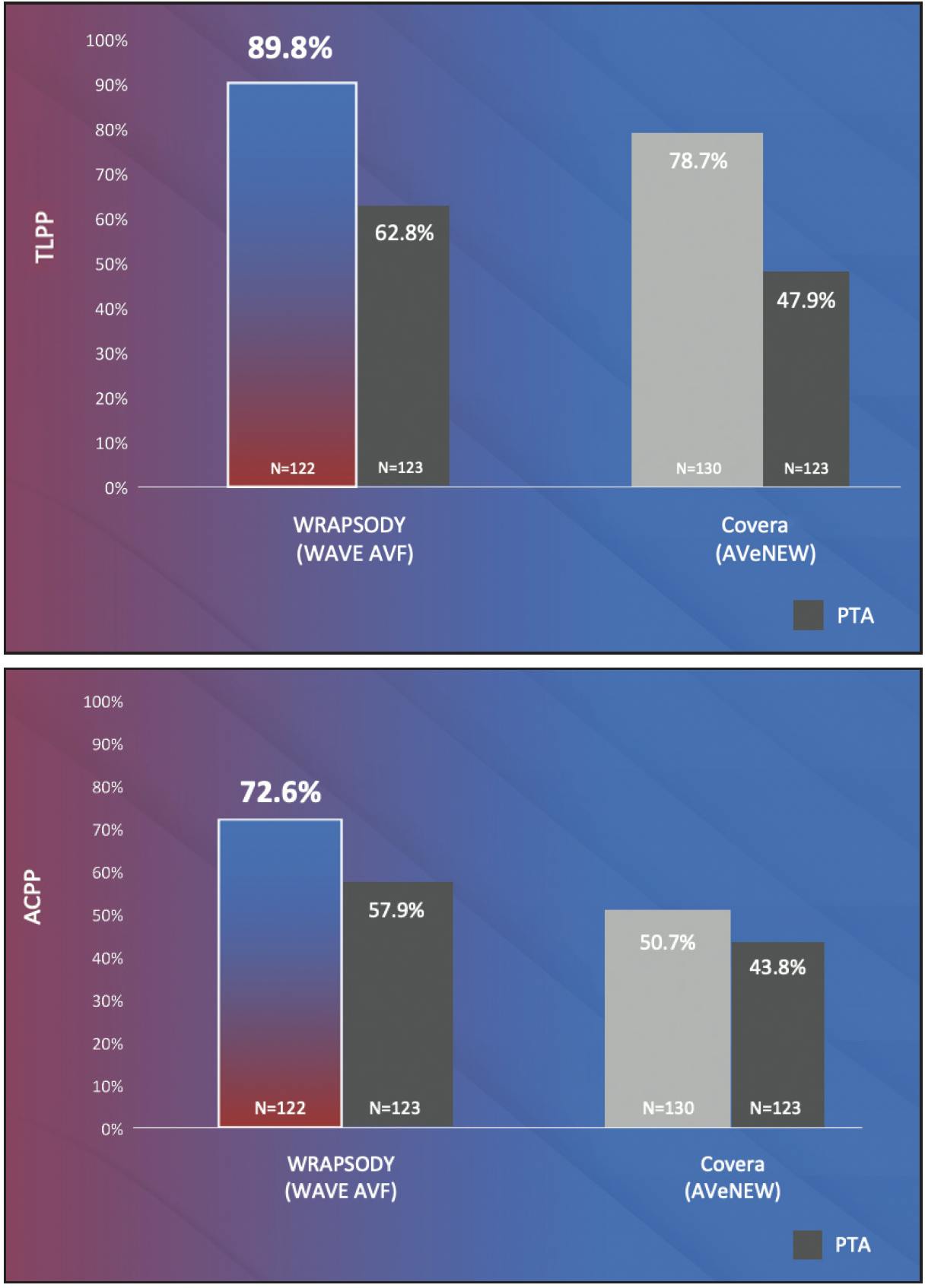
Figure 1. TLPP and ACPP rates at 6 months for WRAPSODY CIE and Covera. Note: Patency rates are defined differently; results are from different studies and may vary in head-to-head comparison, graphics are for illustrative purposes only.
Dr. Rajan: Dr. Razavi, why is ACPP so important for the dialysis access patient population?
Dr. Razavi: In the setting of clinical trials testing the outcome of medical devices, it is important to carefully control the inclusion/exclusion criteria and choose focused primary outcomes to gain a clearer understanding of performance of a new device. This is especially true in disease states where there are multiple confounding variables affecting outcome, such as malfunctioning dialysis access sites in patients on hemodialysis, which is why TLPP is the usually selected as the primary efficacy endpoint.
Beyond the arguments regarding focused primary endpoints, what is important to this patient population and the physicians caring for them is the proper functioning of the entire access circuit, not just the target lesion. Although the access circuit will likely not be usable in the absence of target lesion patency, the patency of a target lesion in absence of a functioning access circuit is also of little relevance to these patients. Hence, one could argue that ACPP is a more clinically relevant measure than TLPP.
Dr. Rajan: Dr. Jones, as the Co-Principal Investigator for the WAVE trial, is there any interesting insight specific to the safety data collected between the WRAPSODY CIE arm and the PTA arm of the study?
Dr. Jones: First, it’s important to remind ourselves that 30-day safety was a primary endpoint for the WAVE study. The data analysis demonstrated no significant difference in safety events to 30 days between the two groups (WRAPSODY CIE and PTA) in the randomized, native AVF cohort of the study. It’s also important to point out that the introducer sheath size for the WRAPSODY CIE is typically 1 to 2 F size larger than is necessary for comparator devices and even more so for comparable PTA balloon catheter sizes. This is particularly true of the 14-mm and 16-mm diameter devices, which are not available from competitors. Therefore, these safety data are reassuring when considering these sheath size differences.
Dr. Rajan: Dr. Jones, what are your thoughts on the correlation between ACPP and reintervention rates from the 12-month WAVE study results? What might this mean for these patients who already spend 10+ hours in the dialysis center each week?
Dr. Jones: ACPP is arguably the more important parameter to the patient, as it reflects the number of reinterventions they require in the whole access circuit, and this in turn determines the amount of disruption to them in terms of returning to the hospital for additional procedures. The 12-month AVF outcome data demonstrated ongoing statistically superior ACPP compared to the PTA group (58.1% vs 34.4%), and 44.6% fewer reinterventions were required in the WRAPSODY CIE arm overall at 12 months (compared to PTA), which was also statistically significant.2 No other randomized study comparing similar devices and PTA in native fistulas has shown this significant difference in ACPP at 12 months.
This finding is really of some magnitude when you consider that dialysis patients can already spend ≥ 10 hours per week on dialysis, before factoring in time for additional maintenance procedures.
Dr. Rajan: Dr. Jones, tell us more about the unique features of the WRAPSODY CIE and the correlation to excellent patency results.
Dr. Jones: The WRAPSODY CIE was designed and engineered specifically with vascular access circuit stenosis in mind. There are several unique features in the design that have undoubtedly contributed to the performance of the device in this study. Let’s remind ourselves that PTFE is to some extent porous, but the WRAPSODY CIE device has a unique triple-layer design with an impermeable middle layer, which prevents cellular migration from the vessel wall into the lumen, thereby preventing in-stent restenosis. Furthermore, the novel-spun PTFE inner layer is designed to be less thrombogenic without the need for drugs or coatings.
One of the most important and impressive design features of the WRAPSODY CIE is the softened end rows at the extremities of the device. We know that edge stenosis is a common mode of failure for covered stents. These end rows were engineered to reduce vessel trauma at the interface with the normal adjacent vein wall to reduce the development of edge stenosis. With that, there is no compromise in the radial force of the main body of the device, which has optimized compression resistance. The device is also enclosed with the delivery catheter and has excellent trackability through the vessels when advancing the device to the target lesion.
Disclosures
Dr. Rajan: Paid consultant to Becton Dickinson, WL Gore, and Merit Medical Systems, Inc.
Dr. Razavi: Receives consulting fee from Merit Medical Systems, Inc.; institution receives research grants from Merit Medical Systems, Inc.
Dr. Jones: Receives honorarium from Merit Medical Systems, Inc. for educational events.
1. Razavi MK, Balamuthusamy S, Makris AN, et al. Six-month safety and efficacy outcomes from the randomized-controlled arm of the WRAPSODY Arteriovenous Access Efficacy (WAVE) trial. Kidney Int. 2025;107:740-750. doi: 10.1016/j.kint.2025.01.006
2. Rajan D. 12-month outcomes from the randomized arm of the Merit WRAPSODY AV Access Efficacy (WAVE) trial. Presented at: the Society of Interventional Radiology (SIR) 2025 annual scientific meeting; March 30, 2025; Nashville, Tennessee.
3. Jones R. 12-month outcomes from the WAVE study. Presented at: the Charing Cross international symposium; April 23, 2025; London, England.
4. Gilbert J, Rai J, Kingsmore D, et al. First clinical results of the Merit WRAPSODY™ cell-impermeable endoprosthesis for treatment of access circuit stenosis in haemodialysis patients. Cardiovasc Intervent Radiol. 2021;44:1903-1913. doi: 10.1007/s00270-021-02953-8
5. Dolmatch B, Cabrera T, Pergola P, et al. Prospective, randomized, multicenter clinical study comparing a self-expanding covered stent to percutaneous transluminal angioplasty for treatment of upper extremity hemodialysis arteriovenous fistula stenosis. Kidney Int. 2023;104:189-200. doi: 10.1016/j.kint.2023.03.015
*All trademarks and brand names are the property of their respective owners.
Advertisement
Advertisement