Advertisement
Advertisement

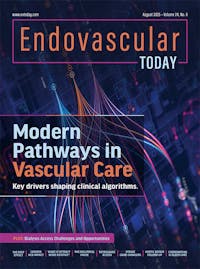
Vascular disease treatment has changed dramatically over the past 10 years. This is a growing and dynamic field characterized by simultaneous advances, including new medications, technologies, approaches, and clinical science in both the arterial and venous systems. One of the hallmarks of this dynamic specialty area is that there remain many unanswered or partially answered questions about the best practice or most efficacious approach in any given clinical situation. This issue of Endovascular Today touches upon current developments in algorithms of vascular care. Because our work in the development of vascular care is far from complete, this is not the last time that such algorithms will be discussed. However, there is much to report and consider, and this issue covers numerous topics of high interest to all vascular practitioners.
Kenneth Rosenfield, MD; Krunal H. Patel, MD; Parth Rali, MD; and Patrick Muck, MD, lead us off by sharing their views on how mechanical thrombectomy and PERTs (pulmonary embolism response teams) have helped shape current PE care. PE is the silent killer, and its management has changed more in the past few years than at any time since it was recognized as a clinical syndrome.
Meghan Dermody, MD, and Adnan Siddiqui, MD, then discuss how the 2023 National Coverage Determination for carotid artery stenting has changed patient discussions and decision-making.
Suresh Vedantham, MD, reflects on the outcomes from the ATTRACT trial and its larger takeaways and hypothesizes on how positive data may have impacted deep vein thrombosis practice. Then, Eric A. Secemsky, MD, offers his thoughts on how the pause in paclitaxel use impacted the care of patients with lower extremity arterial occlusive disease and discusses observed clinical effects during that period.
Next, we ask John H. Rundback, MD; Venita Chandra, MD; and S. Jay Mathews, MD, to comment on how the use of retrograde access has altered their algorithms and treatment of chronic limb-threatening ischemia (CLTI). This is an access-and-crossing technique that has become mainstream in CLTI care in the past few years.
Michael Chen, MD; Ameer Hassan, DO; and James Milburn, MD, then offer their opinions on which recent trials in stroke care have led to revisions in their treatment algorithms.
After 25 years of endovascular aneurysm repair (EVAR), thousands of patients require precise follow-up, and our approaches continue to evolve. Behzad S. Farivar, MD, and Margaret C. Tracci, MD, examine the paradigm shift from uniform imaging schedules to risk-adapted, patient-specific follow-up protocols in the contemporary landscape of surveillance for EVAR.
Finally, Alborz Feizi, MD; Rahul Patel, MD; Kirema Garcia-Reyes, MD; and Aaron Fischman, MD, provide an overview of their strategy for managing gastrointestinal bleeds, from initial patient presentation through diagnostic evaluation and therapeutic intervention.
Dialysis access requirements are also evolving; we have a focused subfeature on dialysis access, which highlights practical insights and emerging considerations in the planning, initiation, and ongoing management of dialysis-related care. To start, Vandana Dua Niyyar, MD, talks through myriad topics related to the landscape of dialysis access care, touching on current trends and challenges. Building on this foundation, Ahmed K. Abdel-Aal, MD, and colleagues describe the placement of urgent peritoneal dialysis catheters, covering patient selection, cost, and procedural considerations. To round out the discussion, Bart Dolmatch, MD; Dheeraj K. Rajan, MD; Dalia Zaky Dawoud, MD; and Theodore H. Yuo, MD, each share three current factors that impact decision-making for dialysis access maintenance.
Our featured interview this month is with Pascal Jabbour, MD, who discusses the evolution of transradial access for neurointervention, intra-arterial chemotherapy for pediatric patients with retinoblastoma, keys to a robust research practice, and more.
As we reach for answers to many challenging clinical questions, it remains highly valuable and pertinent to hear from our colleagues about their experiences, concerns, and data that helped shape their algorithms. We thank all the contributors to this issue!
Peter A. Schneider, MD
Guest Chief Medical Editor
Advertisement
Advertisement