Advertisement
Advertisement
May 2025
CLTI Imaging: What’s New and What’s Next?
Use of noncontrast MRA with the quiescent-inflow single-shot technique and photon-counting CTA in the evaluation of patients with chronic limb-threatening ischemia.
To achieve limb salvage and improve prognosis of patients with chronic limb-threatening ischemia (CLTI), accurate and timely diagnosis is essential.1 The role of angiography as the primary diagnostic tool in the management of patients with CLTI has largely been taken over by noninvasive tests, including duplex ultrasound, CTA, and MRA. However, these alternative modalities have limitations. Duplex ultrasound is operator dependent, and assessment presents challenges in the below-the-knee (BTK) vessels because of their small size and the presence of calcifications, making it very time consuming. CTA also has limitations due to the presence of calcifications, and it is oftentimes difficult to judge luminal patency in the presence of diffuse calcification. In addition, most patients with CLTI also have renal insufficiency, and therefore administration of iodinated contrast medium is impossible or only possible with reduced amounts of iodine. MRA performed with gadolinium-based contrast medium can produce images that are not hampered by the presence of calcium, but patients with end-stage renal disease can develop systemic nephrogenic fibrosis related to gadolinium. Image quality can be compromised due to a rapid venous return, which renders proper evaluation of the arterial system difficult (Figure 1A). This article describes two imaging modalities that have become available more recently, noncontrast MRA using the quiescent-inflow single-shot (QISS) technique and photon-counting CTA; both have the potential to address the shortcomings of standard CTA and contrast-enhanced MRA.
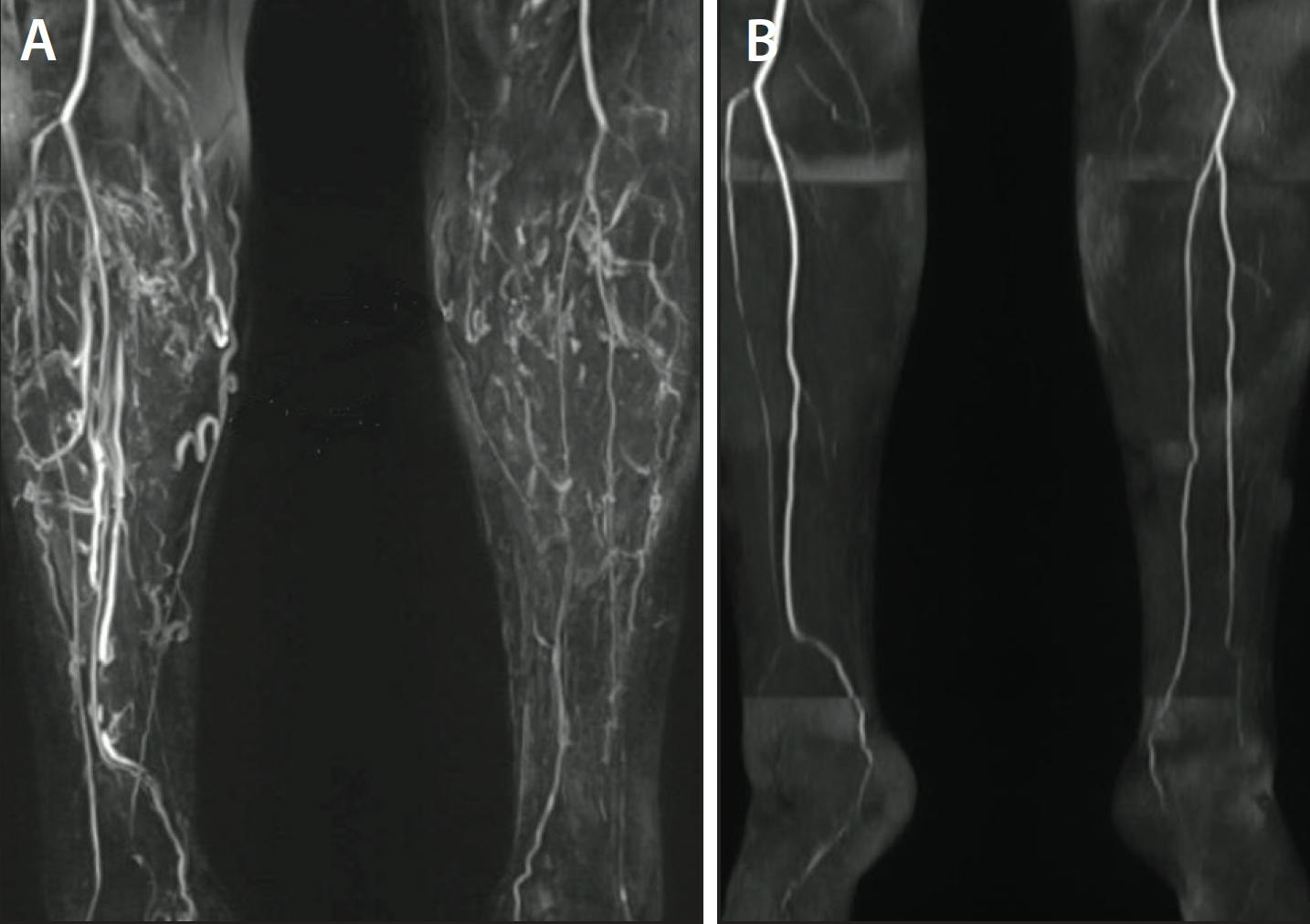
Figure 1. Contrast-enhanced MRA (A) of the lower legs and QISS image (B) in the same patient demonstrating differences in image quality. In the QISS image, no venous filling is observed, and arterial visualization is enhanced.
NONCONTRAST MRA
The technique of noncontrast MRA using the QISS sequence has been described in detail in a previous Endovascular Today article.2 In brief, the QISS technique uses an initial saturation pulse to suppress the background signal and one pulse that is applied below the slice to suppress the venous signal. The quiescent interval that occurs before the signal is read allows the inflow of unsaturated arterial spins into the imaging plane. Stacks of axial slices are acquired throughout the region of interest, and these are then processed automatically to maximum intensity projection (MIP) images. The technique has several potential pitfalls. First, image quality can degrade when cardiac rhythm is highly irregular. Second, because the QISS technique relies on adequate and uniform fat suppression, which cannot always be achieved at the level of the feet and groin, image quality may be compromised in these areas. The QISS technique is also more sensitive to magnetic susceptibility artifacts caused by metallic implants (eg, hip and knee prostheses, stents, surgical clips) and bowel gas. Reversed arterial flow cannot be depicted because QISS uses magnetic venous saturation. This is especially an issue when it occurs over a long segment, as in cases where flow to the distal arterial system occurs through collaterals that exhibit caudal-cranial–directed flow in part of their course. An advantage of using venous saturation is that the technique is less susceptible to so-called venous contamination of the image, which is a common problem seen in contrast-enhanced MRA and especially in patients with CLTI (Figure 1B). QISS MRA provides high diagnostic accuracy compared with digital subtraction angiography (DSA) and is less prone to image artifacts than CTA while better visualizing heavily calcified segments with impaired flow.3,4 Pooled sensitivity and specificity of QISS on a per-segment basis with DSA/contrast-enhanced MRA as reference standard was 0.88 and 0.94, respectively, with a high accuracy of 0.96.5
More recently, a new iteration of this technique has become available, QISS MRA with arterial spin labeling (QISS ASL). QISS ASL can be used to optimize imaging of the BTK vessels and foot and has demonstrated a good accuracy in diabetic patients with a high BTK disease burden.6 Thus, QISS MRA obviates the need for contrast administration in patients with peripheral artery disease (PAD) and can be considered a good alternative for patients with contraindications to contrast-enhanced MRA.
PHOTON-COUNTING CTA
Photon-counting CTA uses photon-counting detectors (PCDs) instead of energy-integrating detectors (EIDs). In “standard” CT imaging, EIDs use a scintillator (gadolinium oxide or gadolinium oxysulfide) that absorbs the x-ray photons and converts the energy into visible light. The light is subsequently recorded by a photodiode and converted into an electrical current. The detected signal is proportional to the cumulative photon energy without the ability to differentiate between individual photons. The spatial resolution of a CT detector is primarily determined by the size of the detector elements (ranging from 0.8 X 0.8 mm2 to 1 X 1 mm2). Increasing spatial resolution of EIDs beyond this point is limited due to the physical characteristics of the detector that require septa to prevent crosstalk between neighboring photodiodes.7,8 PCDs use a semiconductor (cadmium telluride, cadmium zinc telluride, or silicon) that absorbs the x-ray photons. Electron-hole pairs are created in a number proportional to the detected photon energy, and this results in a direct conversion of the detected signal into an electric current. Using this approach, counting of individual photons is possible and their respective energy can be measured.
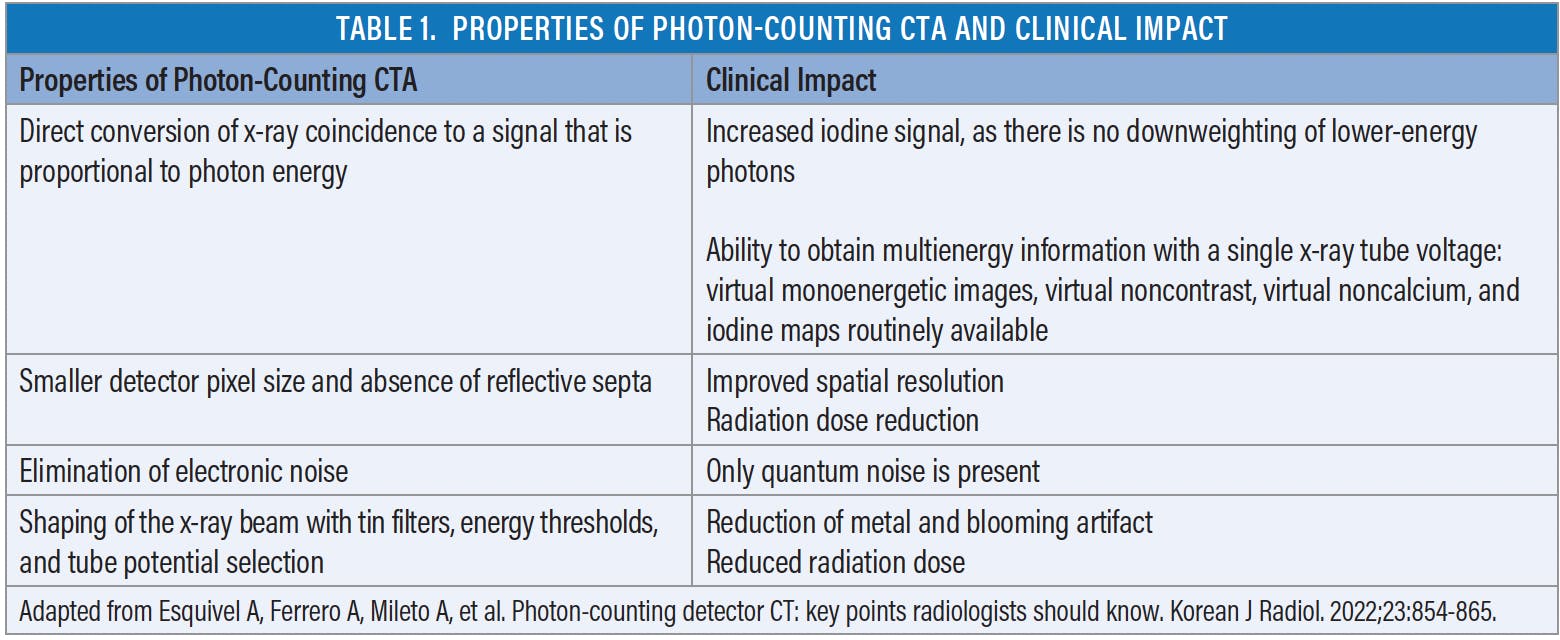
The design of the PCD itself allows improvements in spatial resolution via smaller detector pixel design and iodine signal, which facilitates examinations with a reduced amount of contrast medium (Table 1).9 Detector elements in PCDs range in size from 0.11 X 0.11 mm2 to 0.5 X 0.5 mm2. Therefore, PCDs are capable of ultra-high-resolution imaging (both spatial and temporal: 110 µm and 66 ms, respectively, with a slice thickness as low as 200 µm10), while reducing “noise” and enhancing contrast-to-noise-ratio (CNR). An additional benefit of using a smaller pixel size is that routine imaging can be obtained at lower radiation doses. In a small series looking at quality of images for runoff vessels, subjective image quality was substantially higher at lower keV levels with substantially higher signal-to-noise ratio and CNR than standard CT with EIDs.11 The potential for contrast material savings has been confirmed in an animal model (six mini-pigs), where low tube voltage PCD CTA allowed substantial reductions in radiation and dose of contrast medium while maintaining a stable and improved CNR.12 Similar results were seen in a study that evaluated aortoiliac imaging with a ultra-low iodine dose using a mixture of sodium chloride (80%) and (20%) contrast with 370 mg/mL. A total iodine dose of 9.5 to 9.8 g was delivered across all patients, and in most cases, 32 mL of the mixture was administered at a flow rate of 3.5 mL/second, followed by a 30-mL saline flush at the same rate.13
Another clinical benefit of PCD CT is the reduction of commonly occurring image artifacts, such as streaks, beam hardening, metal, and calcium blooming. Blooming is an important challenge in cardiovascular imaging, particularly in small vessels like the BTK arteries with vessel calcifications and/or stents. Identifying the contrast-filled lumen is known to be difficult because, due to blooming, calcific plaques and metallic stents appear larger than their true size, thus leading to an overestimation of luminal stenosis. Finally, it is possible to differentiate between calcium and contrast medium, because PCDs can weigh all photons and thus can improve material “decomposition” to produce calcium, iodine, and water image maps (Figure 2).7
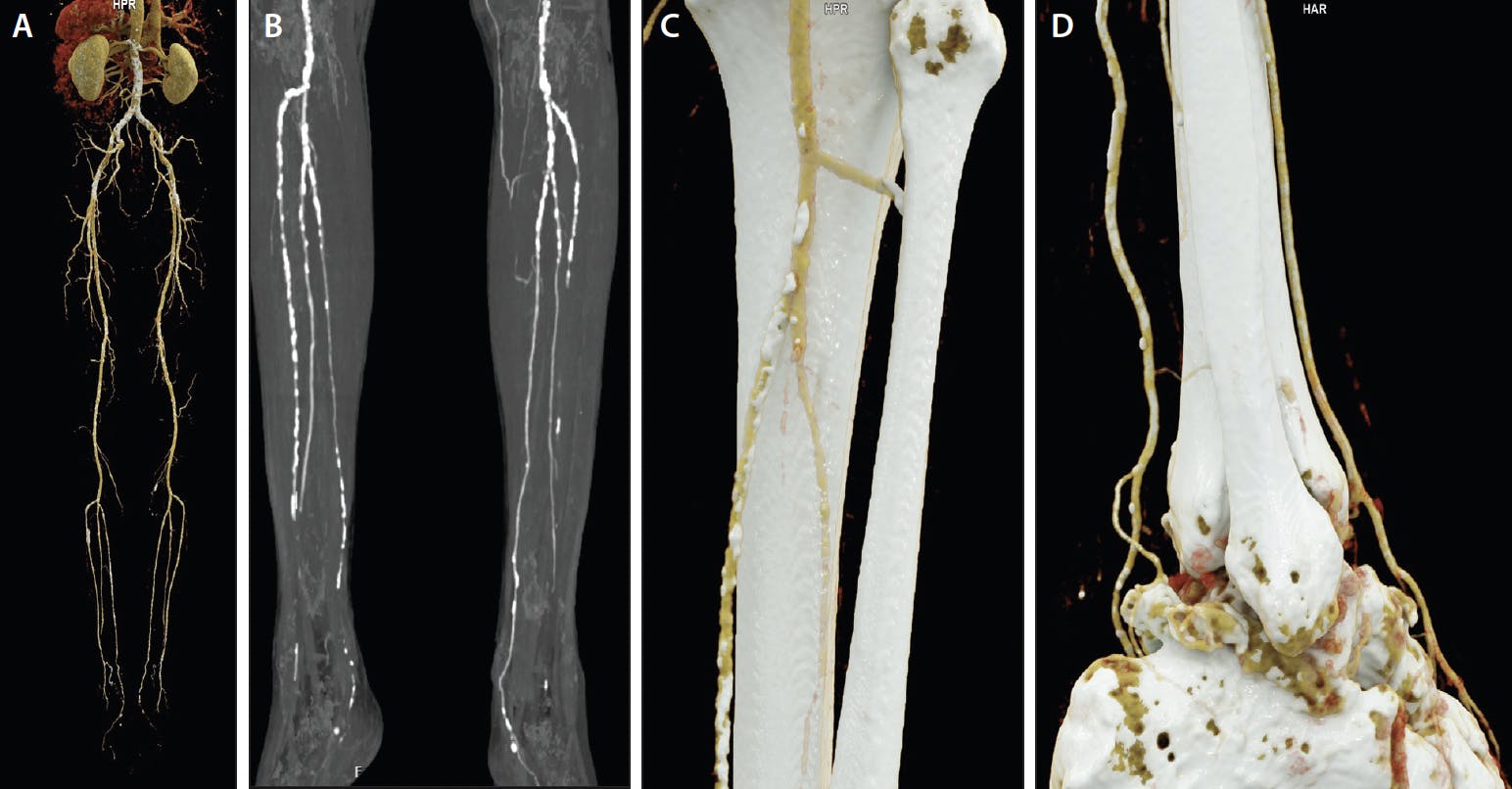
Figure 2. Volume-rendered (VR) image of aortoiliac and infrainguinal arteries obtained with photon-counting CTA (A). MIP image using a “classic” reconstruction algorithm demonstrating the inability to evaluate the patent vessel lumen due to the presence of severe calcification (B). VR reconstruction of photon-counting CTA at the level of the popliteal trifurcation allows for differentiation of iodinated contrast (yellow) and calcium (white; C). VR reconstruction at the level of the ankle demonstrating the high-resolution images that can be obtained with photon-counting CTA (D).
(Courtesy of Daniel A.F. van den Heuvel, MD.)
In a study evaluating the diagnostic performance of photon-counting CTA in PAD compared to DSA as the gold standard, photon-counting CTA demonstrated high sensitivity (91%) and specificity (95%) for detecting and diagnosing stenotic lesions.14 Photon-counting CTA has also been shown to improve small vessel detection and can assist in characterizing calcific plaque and vessel patency.15 Another recently published study (using DSA as reference) also showed that photon-counting CTA facilitates reliable assessment of the lower limb arteries even in the presence of severe vessel calcifications and advanced PAD.16 The authors demonstrated that improved vessel sharpness and less calcium blooming with an acceptable increase of image noise led to a better diagnostic performance and confidence while reducing the overestimation of stenosis.
CONCLUSION
New imaging technologies such as noncontrast-enhanced MRA and photon-counting CTA have already shown their benefit in evaluating patients with CLTI. Both technologies can provide high-resolution images either without contrast (noncontrast-enhanced MRA) or with a significantly reduced amount of iodinated contrast (photon-counting CTA) and are not hampered by vessel wall calcification, which is important in this patient population that typically presents with impaired renal function and intimal and medial arterial calcium.
1. Nair PK, Wiechmann BN, Tahara RW, et al. Noninvasive evaluation of patients with chronic limb-threatening ischemia. J Crit Limb Ischem. 2023;3:E127-E39. doi: 10.25270/jcli/CLIG23-00026
2. van den Berg JC. Utility of noncontrast-enhanced MRA in patients with critical limb ischemia. Endovasc Today. 2017;16:74-78. https://evtoday.com/articles/2017-may/utility-of-noncontrast-enhanced-mra-in-patients-with-critical-limb-ischemia
3. Hanrahan CJ, Lindley MD, Mueller M, et al. Diagnostic accuracy of noncontrast MR angiography protocols at 3T for the detection and characterization of lower extremity peripheral arterial disease. J Vasc Interv Radiol. 2018;29:1585-1594.e2. doi: 10.1016/j.jvir.2018.06.015
4. Varga-Szemes A, Wichmann JL, Schoepf UJ, et al. Accuracy of noncontrast quiescent-interval single-shot lower extremity MR angiography versus CT angiography for diagnosis of peripheral artery disease: comparison with digital subtraction angiography. JACC Cardiovasc Imaging. 2017;10:1116-1124. doi: 10.1016/j.jcmg.2016.09.030
5. Verma M, Pandey NN, Singh V, Jagia P. A meta-analysis of the diagnostic performance of quiescent-interval-single-shot magnetic resonance angiography in peripheral arterial disease. Eur Radiol. 2022;32:2393-2403. doi: 10.1007/s00330-021-08349-z
6. Lam A, Perchyonok Y, Ranatunga D, et al. Accuracy of non-contrast quiescent-interval single-shot and quiescent-interval single-shot arterial spin-labelled magnetic resonance angiography in assessment of peripheral arterial disease in a diabetic population. J Med Imaging Radiat Oncol. 2020;64:35-43. doi: 10.1111/1754-9485.12987
7. Meloni A, Cademartiri F, Pistoia L, et al. Dual-source photon-counting computed tomography-part III: clinical overview of vascular applications beyond cardiac and neuro imaging. J Clin Med. 2023;12:3798. doi: 10.3390/jcm12113798
8. Stein T, Rau A, Russe MF, et al. Photon-counting computed tomography–basic principles, potential benefits, and initial clinical experience. Rofo. 2023;195:691-698. doi: 10.1055/a-2018-3396
9. Esquivel A, Ferrero A, Mileto A, et al. Photon-counting detector CT: key points radiologists should know. Korean J Radiol. 2022;23:854-865. doi: 10.3348/kjr.2022.0377
10. Kotronias RA, de Maria GL, Xie C, et al. Benchmarking photon-counting computed tomography angiography against invasive assessment of coronary stenosis: implications for severely calcified coronaries. JACC Cardiovasc Imaging. Published online February 11, 2025. doi: 10.1016/j.jcmg.2024.11.005
11. Rippel K, Decker JA, Wudy R, et al. Evaluation of run-off computed tomography angiography on a first-generation photon-counting detector CT scanner—comparison with low-kVp energy-integrating CT. Eur J Radiol. 2023;158:110645. doi: 10.1016/j.ejrad.2022.110645
12. Klambauer K, Flohr T, Moser LJ, et al. Reducing contrast media and radiation dose in CT angiography at low tube voltage: animal study with photon-counting detector CT. Eur Radiol Exp. 2025;9:37. doi: 10.1186/s41747-025-00577-y
13. Oechsner T, Soschynski M, Schlett CL, et al. Feasibility of very low iodine dose aortoiliac CT angiography using dual-source photon-counting detector CT. Eur J Radiol 2025;183:111919. doi: 10.1016/j.ejrad.2025.111919
14. Ghibes P, Hagen F, Weissinger M, et al. Diagnostic performance of photon-counting CT angiography in peripheral artery disease compared to DSA as gold standard. Eur J Radiol. 2025;182:111834. doi: 10.1016/j.ejrad.2024.111834
15. Yalon M, Inoue A, Thorne JE, et al. Infrapopliteal segments on lower extremity CTA: prospective intraindividual comparison of energy-integrating detector CT and photon-counting detector CT. AJR Am J Roentgenol. 2024;222:e2329778. doi: 10.2214/AJR.23.29778
16. Augustin AM, Hartung V, Grunz JP, et al. Photon-counting detector CT angiography versus digital subtraction angiography in patients with peripheral arterial disease. Acad Radiol. 2024;31:2973-2986. doi: 10.1016/j.acra.2024.02.008
Advertisement
Advertisement