Advertisement
Advertisement

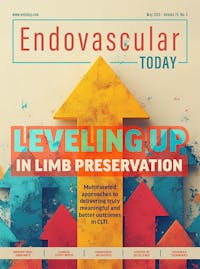
This May edition of Endovascular Today is, as usual for over a decade, entirely dedicated to chronic limb-threatening ischemia (CLTI)/critical limb ischemia (CLI). In this year’s issue, a diverse range of topics are discussed by experts in the field.
There has been ever-increasing attention on CLTI and amputation prevention over the last few years, with multiple societal initiatives, clinical research, media attention, and even proposed Congressional bills. Although the first awareness programs started in the mid-1990s, major gaps in awareness both for patients and primary care providers still exist today. This problem is tackled in a panel discussion with Naseer Ahmad, MBChB; Anahita Dua, MD; Foluso Fakorede, MD (and his team); Carlos Mena-Hurtado, MD; and Kim G. Smolderen, PhD. Topics for discussion include what does and doesn’t work for targeting those at risk for CLTI, common misconceptions and blind spots for CLTI patients as well as primary care providers, and what research is needed.
Another issue CLTI care providers need to be aware of is related to the CLTI trial space, specifically appropriate endpoints for CLTI trials and whether these should be different from other trials in the peripheral vascular space. Ido Weinberg, MD, and Mitchell D. Weinberg, MD, consider the question: “Why is it so hard to study CLTI?” They outline some of the challenges associated with studying CLTI and present recommendations for future studies, including how we can simplify and standardize the way we define trial outcomes while also focusing on the outcomes most important to patients.
The direction of future research in CLTI is the second problem that we are facing, and another panel with Marianne Brodmann, MD; Kumar Madassery, MD; Sabine Steiner, MD; Zola N’Dandu, MD; and Matthew Menard, MD, ponders the next phases of CLTI trials now that major trials like BEST-CLI and BASIL-2 are complete. They share potential areas of focus and predictions for the most clinically impactful data.
The wide variety and complexities in CLTI presentations necessitate a tailored revascularization approach to maximize symptom improvement and limb preservation. Peter A. Schneider, MD, and Ahmed A. Naiem, MD, were asked to summarize their approach for one of these complex scenarios: profunda femoris artery (PFA) revascularization. They discuss how the PFA fits into the CLTI management strategy, strategies for open or endovascular treatment of PFA disease, and more.
Next, new imaging technologies that are already showing their benefit in evaluating patients with CLTI are discussed by the undersigned. This article highlights the use of noncontrast MRA with the quiescent-inflow single-shot technique and photon-counting CTA in patients with CLTI.
Our Literature Highlights article summarizes a recent publication in JACC: Cardiovascular Interventions that found high variability in revascularization strategies and associated outcomes for CLTI intervention. Study authors Aishwarya Raja, MD; Fadi Saab, MD; and Eric A. Secemsky, MD, then participate in a Q&A, discussing possible contributors to this wide variation, how the results can be applied to real-world practice, and more.
Closing out our cover stories is an interview with Mehdi H. Shishehbor, DO, on CLTI centers of excellence. He tells us about the primary goals of the new Lorraine and Bill Dodero Limb Preservation Center at University Hospitals Harrington Heart & Vascular Institute and also offers some key advice on running a CLTI center, including necessary staffing positions, community engagement initiatives, and education and training needs.
Also included in this issue is a featured interview with Efthymios “Makis” Avgerinos, MD, on differences between running a vascular practice in Greece versus the United States, the scope of his current deep venous research, priorities for chronic venous obstruction, and the potential for artificial intelligence–guided compression sonography.
I am very grateful to the authors and panelists who have contributed to this issue of Endovascular Today. As seen from the contents of this issue, CLTI remains an important health care problem, with many open questions despite the progress that has been made over the last decades. Therefore, it is important to level up on limb preservation, not only this year, but also the years to come.
Jos C. van den Berg, MD, PhD
Guest Chief Medical Editor
Advertisement
Advertisement