Advertisement
Advertisement
May 2025
Sponsored by Medtronic
Optimizing CLTI Outcomes With the Woundosome Concept

Chronic limb-threatening ischemia (CLTI) represents the most advanced form of lower extremity peripheral artery disease and is associated with high rates of amputation and mortality.1 Timely revascularization is key to improving limb perfusion and limiting the risk of amputation.2 In recent years, there have been tremendous advances in endovascular revascularization strategies, including atherectomy, drug-coated balloons (DCBs), and specialty balloons such as the Chocolate™* PTA balloon catheter (Medtronic).
The “woundosome” refers to increasing perfusion to the three-dimensional (3D) area around the wound, either via direct arterial flow or good-quality collaterals to the wound.3 This article features two examples of patients with CLTI presenting with nonhealing ulcers and gangrene who underwent successful revascularization with the woundosome concept in mind. The resultant change in perfusion and tissue oxygenation near the wound was assessed by pedal acceleration time (PAT) and near-infrared spectroscopy (NIRS), respectively.
CASE 1
Case Presentation
A man in his mid 70s who was a previous heavy smoker was referred by podiatry for a slow-to-heal (> 3 months) hallux ulceration. MRI was positive for osteomyelitis and rest pain of the left dorsal foot. Ankle-brachial index (ABI) on the left was 0.29. The patient had an additional history of right above-the-knee (ATK) amputation secondary to complications after a thrombosed right femoral-to-ATK polytetrafluoroethylene graft bypass 3 years earlier. The patient underwent angiography, which showed a long P2 to P3 popliteal artery segment with 50% to 60% stenosis, leading to a 95% stenosis just before the takeoff of the left anterior tibial (AT) artery. The AT artery had a 95% orifice lesion and was occluded after the first 2 cm, never reconstituting. In a similar fashion, the tibioperoneal trunk (TPT) had a 95% proximal stenosis, the posterior tibial (PT) artery was absent, and the peroneal artery had an ostial 95% stenosis with a 5-cm proximal occlusion (Figure 1A and 1B). The PT artery was reconstituted only at the mid foot distal plantar bifurcation. The AT and PT arteries could not be recanalized. The patient was profoundly ischemic from an angiographic and clinical standpoint.
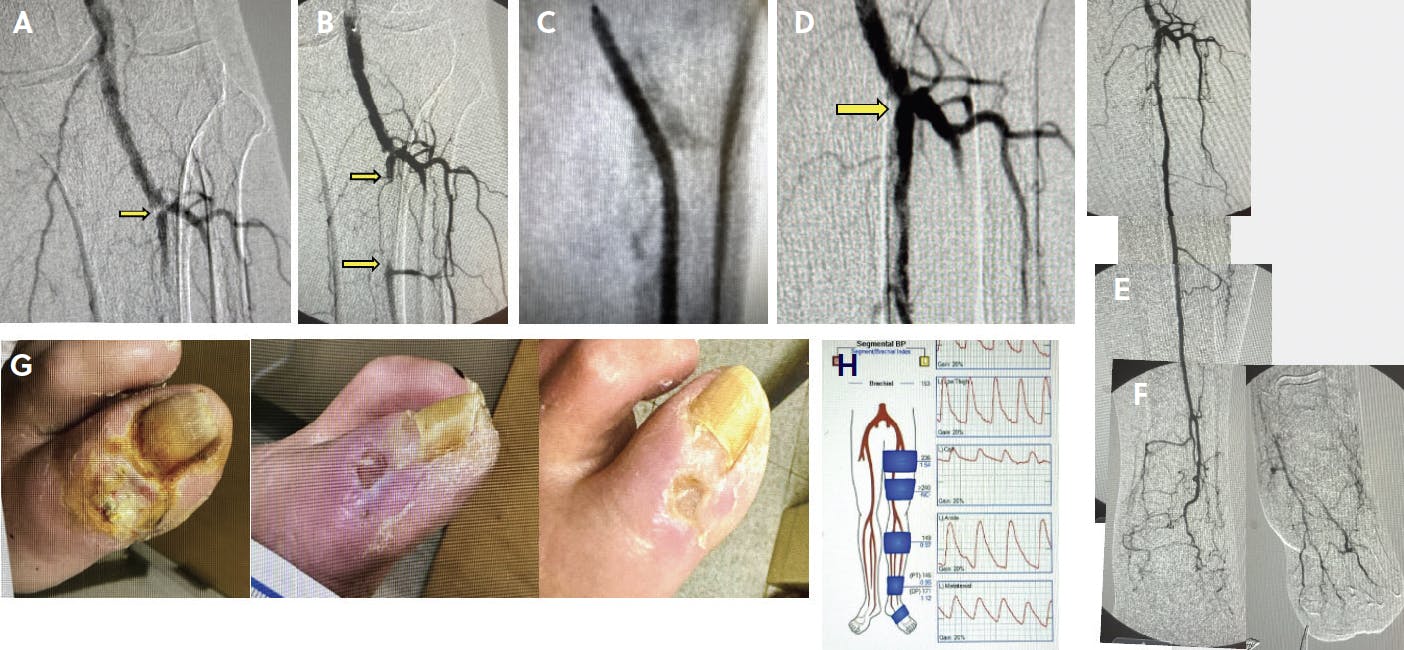
Figure 1. Case 1: Preintervention imaging of the popliteal artery, AT artery, TPT, peroneal artery lesions (A, B). Treatment with the Chocolate balloon (C). Completion angiogram (D-F); note the increased perfusion at the area of the wound (E). Progress of wound healing over 6 weeks (G). Postprocedure ABI (H).
Using a contralateral approach with a 6-F, 90-cm Pinnacle™* Destination™* sheath (Terumo Interventional Systems), the distal P3 lesion, TPT lesion, and peroneal artery occlusion were crossed with a guidewire and a TrailBlazer™ support catheter (Medtronic). The P3 lesion and the peroneal artery occlusion were predilated with a NanoCross™ Elite balloon catheter (Medtronic). The P3 lesion, AT, and peroneal artery ostial lesions were treated with a 3- X 40-mm Chocolate balloon (Medtronic) (Figure 1C). The previously occluded segment of the predilated peroneal artery was prepped with a HawkOne™ S directional atherectomy system (Medtronic) for lumen augmentation. The P2 and P3 popliteal artery segments at the end were treated with a 5- X 60-mm IN.PACT™ Admiral™ drug-coated balloon (Medtronic) for inflow augmentation. At the completion angiogram (Figure 1D-1F), the increased inflow to the peroneal artery revealed new robust medial and lateral malleolar collateral branches, with a significant increase in the dorsal and plantar perfusion of the first toe. The augmentation created an indirect increase in perfusion near the wound area. The final denominator was the increased perfusion in the periphery of the wound, as described in the woundosome concept (Figure 1F).3
The patient’s ABI improved to 1.12 postprocedure. At 7-week follow-up, repeat MRI was negative for acute osteomyelitis, and the wound was almost healed (Figure 1G and 1H). PAT and NIRS showed very high values of oxygenated hemoglobin at the tissues up to 5-mm deep around the wound.
Procedure Rationale and Procedural Tips
This patient had a contralateral previous ATK amputation. Patients with an initial toe amputation have a 34% probability of another amputation on the same limb within 1 year, including a 10% chance of a major ipsilateral amputation.4 It is therefore paramount to avoid even a toe amputation. In cases of absent inline flow options to a wound, direct or indirect revascularization that focuses on supplying targeted robust direct branches or collaterals toward the 3D area of the wound (described as the “woundosome” concept) can achieve results similar to direct revascularization, even in cases of occluded inline arterial flow.5 Predilatation with a 2- to 2.5-mm balloon before vessel preparation with the HawkOne S system is recommended, because the device has a 2.2-mm crossing profile. Chocolate balloon inflation provides 1:1 vessel sizing, with the pillows applying force to create small dissections necessary for effective dilatation and the grooves relieving the stress and stopping dissections from propagating.
CASE 2
Case Presentation
A patient in their mid 60s presented with a 3-day history of constant, intense pain on the left dorsal foot. The pain worsened after a recent first toenail procedure. At that point, the nail bed and the entire left first toe became gangrenous. The forefoot became pale, toes two to four started looking ischemic, and the base of the fifth toe was gangrenous with numbness and decreased range of motion (Figure 2A). This was preceded by 1 year of short-distance left calf claudication. The patient also had stage 3 renal disease and arrived with uncontrolled diabetes and acute kidney injury (creatinine, 2.62 g/dL; estimated glomerular filtration rate, 26 mL/min/1.73 m2). Vein mapping showed no suitable conduits.
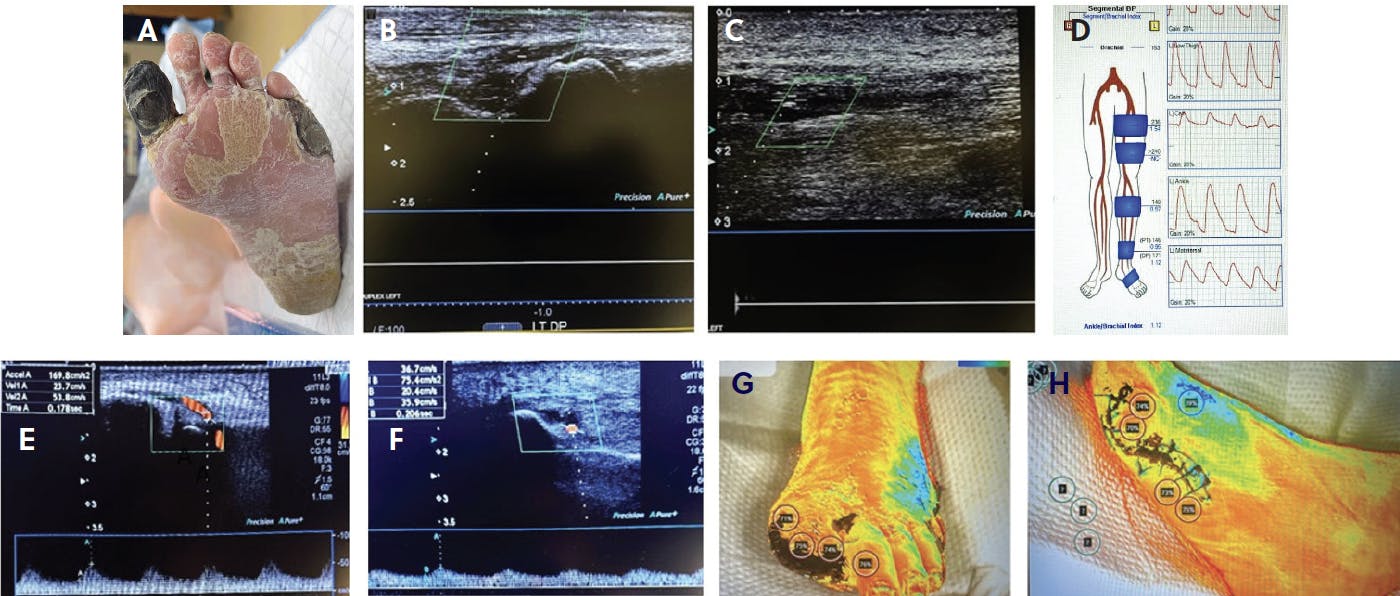
Figure 2. Case 2: Left foot with gangrenous toe (A). Flat-line dorsalis pedis and PT pedal waveforms (B, C). Postprocedure ABI (D). PAT assessment of arcuate artery, 178 ms (E). PAT assessment of lateral plantar, 206 ms (F). Note that PAT values are after removal of the first toe and the partial fifth-ray amputation. NIRS showing high percentages of tissue oxygen saturation at the periwound of the two incisions after removal of the first toe and partial fifth-ray amputation (G, H).
There was no detectable flow below the knee by duplex ultrasound (Figure 2B and 2C) and no obtainable ABIs, indicating Rutherford 2b acute limb ischemia. A left lower extremity angiogram showed an approximately 18-cm-long mid superficial femoral artery (SFA) occlusion and a patent proximal popliteal artery with abrupt occlusion at the P3 segment. After the knee joint, there was essentially no other named artery to the foot apart from a weak network of suprageniculate-based collaterals (Figure 3A).
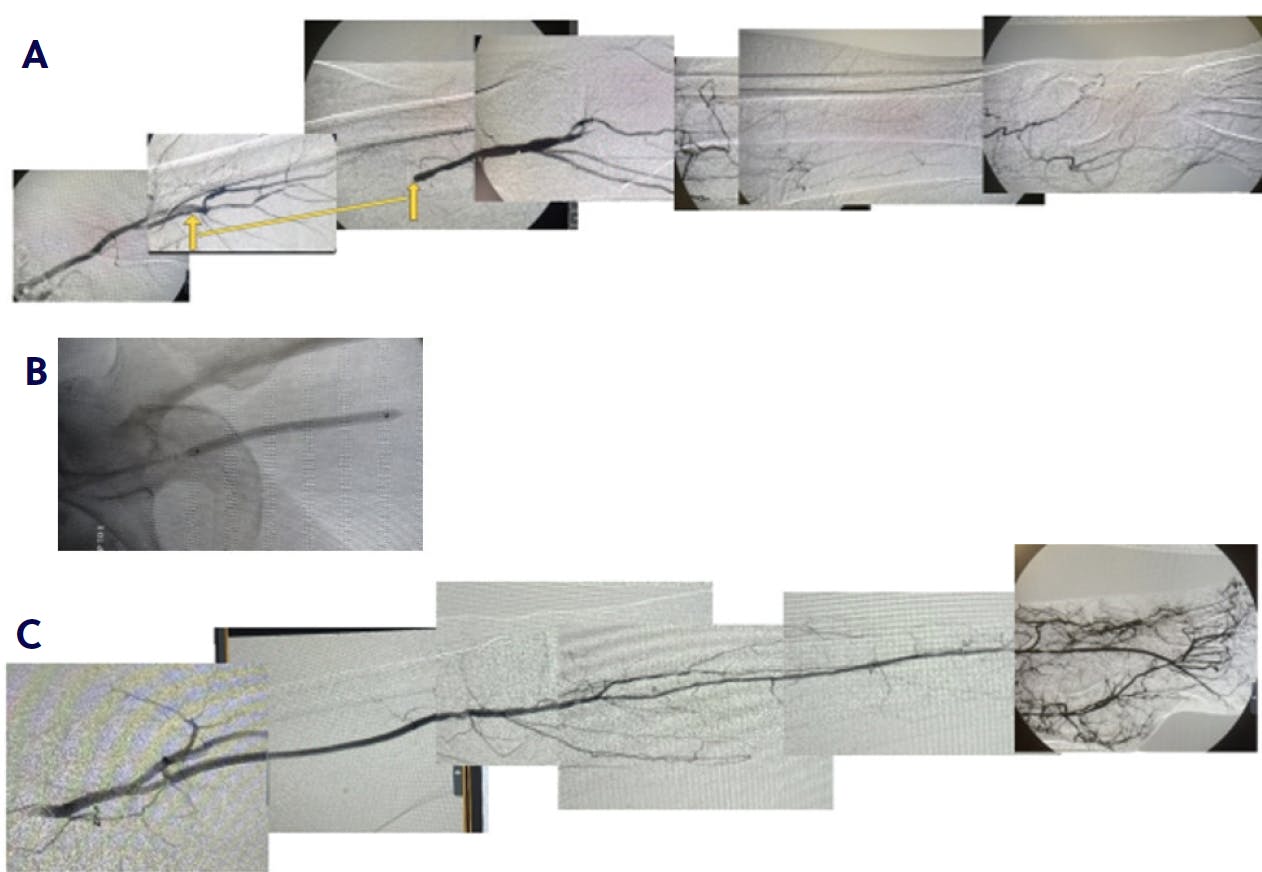
Figure 3. Case 2: Preintervention angiography (A). Treatment of the SFA occlusion with the IN.PACT Admiral DCB (B). Completion angiography (C).
A 6-F, 90-cm Pinnacle Destination sheath was placed. The left SFA was crossed with a guidewire and a TrailBlazer support catheter. The occluded area was predilated with a 4- X- 20-mm NanoCross balloon, and the left distal popliteal artery and the AT artery were then crossed with the same combination. The AT artery was treated with a 2- X 150-mm NanoCross balloon and the popliteal artery with a 4- X 80-mm Chocolate balloon. The peroneal artery and the TPT trunk were crossed and treated with a 2- X 10-mm NanoCross balloon, and the peroneal artery to the ankle was treated with a 2.5/1.5- X 200-mm NanoCross balloon. The popliteal artery and SFA were treated with 5- X 100-mm and 6- X 150-mm IN.PACT Admiral balloons (Figure 3B) for inflow and 6- X 150-mm and 6- X 80-mm EverFlex™ self-expanding peripheral stent systems (Medtronic).
The completion angiogram showed no residual stenosis (Figure 3C). The patient’s ABI improved from nonrecordable to 1.12 after the procedure (Figure 2D). On day 8, the patient had first-toe and fifth-ray partial amputation. Following these procedures, PAT assessment showed 178 ms (PAT category 2) and 206 ms (PAT category 3) (Figure 2E and 2F). NIRS showed high percentages of tissue oxygen saturation at the periwound of the two incisions (Figure 2G and 2H). Of note, the dorsolateral mid foot on NIRS was less revascularized due to the inability to recanalize the AT artery.
Procedure Rationale and Procedural Tips
Due to the acute-on-chronic renal failure, the procedure was staged. The staging strategy involved initial establishment of mild distal perfusion (to avoid ongoing critical ischemia) with the smallest contrast volume possible and then hydration, followed by the second and third staged procedures, with further augmentation of inflow and outflow. In all three stages, one-third-strength contrast was used; the total amount of contrast used on this patient in all three stages was 108 mL in 9 days. The final result shows significant reversal of the medial and lateral forefoot ischemia, indirectly by the peroneal artery, as shown on imaging and based on the woundosome concept.
The first stage established continuity of the SFA, popliteal artery, TPT, and peroneal artery. The patient remained on heparin; 4 days later, they had further distal peroneal artery work as a second stage. Then, 4 days after the second stage, they underwent the third stage: repeat TPT and peroneal artery lumen augmentation with balloon angioplasty via the NanoCross and Chocolate balloons.
1. Ventoruzzo G, Mazzitelli G, Ruzzi U, et al. Limb salvage and survival in chronic limb-threatening ischemia: the need for a fast-track team-based approach. J Clin Med. 2023;12:6081. doi: 10.3390/jcm12186081
2. Farber A. Chronic limb-threatening ischemia. N Engl J Med. 2018;379:171-180. doi: 10.1056/NEJMcp1709326
3. Patrone L, Pasqui E, Conte MS, et al. The “Woundosome” concept and its impact on procedural outcomes in patients with chronic limb-threatening ischemia. J Endovasc Ther. Published online March 25, 2024. doi: 10.1177/15266028241231745
4. Littman AJ, Tseng CL, Timmons A, et al. Risk of ipsilateral reamputation following an incident toe amputation among U.S. military veterans with diabetes, 2005-2016. Diabetes Care. 2020;43:1033-1040. doi: 10.2337/dc19-2337
5. Varela C, Acín F, de Haro J, et al. The role of foot collateral vessels on ulcer healing and limb salvage after successful endovascular and surgical distal procedures according to an angiosome model. Vasc Endovascular Surg. 2010;44:654-60. doi: 10.1177/1538574410376601
Disclosures
Dr. Koullias: Consultant to Medtronic.
NanoCross™ Elite 0,014” OTW PTA balloon catheter
Reference Statement
Important Information: Indications, contraindications, warnings and instructions for use can be found in the product labeling supplied with each device.
CAUTION: Federal (USA) law restricts this product for sale by or on the order of a physician.
TrailBlazer™ support catheter
Reference Statement
Important Information: Indications, contraindications, warnings and instructions for use can be found in the product labeling supplied with each device.
CAUTION: Federal (USA) law restricts these devices to sale by or on the order of a physician.
HawkOne™ directional atherectomy system
Reference Statement
Indications for Use: The HawkOne directional atherectomy system is intended for use in atherectomy of the peripheral vasculature. The HawkOne catheter is indicated for use in conjunction with the SpiderFX™ embolic protection device in the treatment of severely calcified lesions.
HawkOne catheter is NOT intended for use in the coronary, carotid, iliac or renal vasculature.
CAUTION: Federal (USA) law restricts this product for sale by or on the order of a physician.
Chocolate™* PTA balloon catheter
Reference Statement
Important Information: Indications, contraindications, warnings and instructions for use can be found in the product labelling supplied with each device.
Caution: Federal (USA) law restricts this product for sale by or on the order of a physician
EverFlex™ self-expanding peripheral stent system
Brief Statement
Indication: The EverFlex self-expanding peripheral stent system is intended to improve luminal diameter in the treatment of symptomatic de novo or restenotic lesions up to 180 mm in length in the native superficial femoral artery and/or proximal popliteal arteries with reference vessel diameters ranging from 4.5 mm – 7.5 mm.
The EverFlex self-expanding peripheral stent system is indicated for improving luminal diameter in patients with atherosclerotic disease of the common and/or external iliac arteries up to and including 100 mm in length, with a reference vessel diameter of 4.5 mm - 7.5 mm.
The Protégé™ EverFlex™ self-expanding biliary stent system is intended as a palliative treatment of malignant neoplasms in the biliary tree.
Contraindications: Use of the EverFlex self-expanding peripheral stent system is contraindicated in patients with known hypersensitivity to nickel titanium and in patients contraindicated for anticoagulant and/or antiplatelet therapy, patients who are judged to have a lesion that prevents complete inflation of an angioplasty balloon or proper placement of the stent or stent delivery system.
Potential Adverse Events: Potential adverse events which may be associated with the use of a stent in the SFA and proximal popliteal arteries include, but are not limited to: Allergic reaction, Amputation, Artery perforation or rupture, Bleeding requiring transfusion, Infection, Pseudoaneurysm, Restenosis, Stent collapse or fracture, Stent migration, Surgical or endovascular intervention, Thrombosis/occlusion of the stent.
See the Instructions for Use provided with the product for a complete list of warnings, precautions, adverse events and device information.
CAUTION: Federal (USA) law restricts these devices to sale by or on the order of a physician.
IN.PACT™ Admiral™ Paclitaxel-coated PTA Catheter
Brief Statement
Indications for Use:
The IN.PACT™ Admiral™ Paclitaxel-coated PTA Balloon Catheter is indicated for percutaneous transluminal angioplasty, after appropriate vessel preparation, of de novo, restenotic, or in-stent restenotic lesions with lengths up to 360 mm in superficial femoral or popliteal arteries with reference vessel diameters of 4-7 mm.
Contraindications
The IN.PACT Admiral DCB is contraindicated for use in:
- Coronary arteries, renal arteries, and supra-aortic/cerebrovascular arteries
- Patients who cannot receive recommended antiplatelet and/or anticoagulant therapy
- Patients judged to have a lesion that prevents complete inflation of an angioplasty balloon or proper placement of the delivery system
- Patients with known allergies or sensitivities to paclitaxel
- Women who are breastfeeding, pregnant or are intending to become pregnant or men intending to father children. It is unknown whether paclitaxel will be excreted in human milk and whether there is a potential for adverse reaction in nursing infants from paclitaxel exposure.
Warnings
- Use the product prior to the Use-by Date specified on the package.
- Contents are supplied sterile. Do not use the product if the inner packaging is damaged or opened.
- Do not use air or any gaseous medium to inflate the balloon. Use only the recommended inflation medium (equal parts contrast medium and saline solution).
- Do not move the guidewire during inflation of the IN.PACT Admiral DCB.
- Do not exceed the rated burst pressure (RBP). The RBP is 14 atm (1419 kPa) for all balloons except the 200 and 250 mm balloons. For the 200 and 250 mm balloons the RBP is 11 atm (1115 kPa). The RBP is based on the results of in vitro testing. Use of pressures higher than RBP may result in a ruptured balloon with possible intimal damage and dissection.
- The safety and effectiveness of using multiple IN.PACT Admiral DCBs with a total drug dosage exceeding 34,854 µg of paclitaxel in a patient has not been clinically evaluated.
Precautions
- This product should only be used by physicians trained in percutaneous transluminal angioplasty (PTA).
- This product is designed for single patient use only. Do not reuse, reprocess, or resterilize this product. Reuse, reprocessing, or resterilization may compromise the structural integrity of the device and/or create a risk of contamination of the device, which could result in patient injury, illness, or death.
- Assess risks and benefits before treating patients with a history of severe reaction to contrast agents.
- The safety and effectiveness of the IN.PACT Admiral DCB used in conjunction with other drug-eluting stents or drug-coated balloons in the same procedure or following treatment failure has not been evaluated.
- The extent of the patient’s exposure to the drug coating is directly related to the number of balloons used. Refer to the Instructions for Use (IFU) for details regarding the use of multiple balloons and paclitaxel content.
- The use of this product carries the risks associated with percutaneous transluminal angioplasty, including thrombosis, vascular complications, and/or bleeding events
- Vessel preparation using only pre-dilatation was studied in the clinical study. Other methods of vessel preparation, such as atherectomy, have not been studied clinically with IN.PACT Admiral DCB.
- This product is not intended for the expansion or delivery of a stent.
Potential Adverse Effects
- The potential adverse effects (e.g. complications) associated with the use of the device are: abrupt vessel closure; access site pain; allergic reaction to contrast medium, antiplatelet therapy, or catheter system components (materials, drugs, and excipients); amputation/loss of limb; arrhythmias; arterial aneurysm; arterial thrombosis; arteriovenous (AV) fistula; death; dissection; embolization; fever; hematoma; hemorrhage; hypotension/hypertension; inflammation; ischemia or infarction of tissue/organ; local infection at access site; local or distal embolic events; perforation or rupture of the artery; pseudoaneurysm; renal insufficiency or failure; restenosis of the dilated artery; sepsis or systemic infection; shock; stroke; systemic embolization; vessel spasms or recoil; vessel trauma which requires surgical repair.
- Potential complications of peripheral balloon catheterization include but are not limited to the following: balloon rupture; detachment of a component of the balloon and/or catheter system; failure of the balloon to perform as intended; failure to cross the lesion.
- Although systemic effects are not anticipated, potential adverse events that may be unique to the paclitaxel drug coating include, but are not limited to: allergic/immunologic reaction; alopecia; anemia; gastrointestinal symptoms; hematologic dyscrasia (including leucopenia, neutropenia, thrombocytopenia); hepatic enzyme changes; histologic changes in vessel wall, including inflammation, cellular damage, or necrosis; myalgia/arthralgia; myelosuppression; peripheral neuropathy.
- Refer to the Physician’s Desk Reference for more information on the potential adverse effects observed with paclitaxel. There may be other potential adverse effects that are unforeseen at this time.
- Please reference appropriate product Instructions for Use for a detailed list of indications, warnings, precautions and potential adverse effects. This content is available electronically at www.manuals.medtronic.com.
CAUTION: Federal (USA) law restricts this device to sale by or on the order of a physician.
501713 ©2025 Medtronic. Medtronic, Medtronic logo are trademarks of Medtronic. TM* third party brands are trademarks of their respective owner. All other brands are trademarks of Medtronic. For global distribution. 05/2025
Advertisement
Advertisement