Advertisement
Advertisement
May 2025
Sponsored by Inari Medical
The Artix™ Thrombectomy System: A Safe, Efficient, and Versatile All-in-One Solution
Physician insights highlight how Artix’s dual thrombectomy approach—combining mechanical and aspiration—enhances thrombus removal efficiency, minimizes thrombus migration risk, and expands treatment options for peripheral arterial occlusions.
With Neil Desai, DO, FACS; Nathan Thompson, MD; and Carleen Cho, MD
Managing peripheral arterial occlusions, particularly acute limb ischemia, remains a critical priority in vascular care. Rapid restoration of perfusion is essential to preserving limb viability, yet existing treatment options—ranging from anticoagulation and thrombolysis to surgical or endovascular intervention—each present limitations related to patient suitability, procedural risk, and time to efficacy.
Artix™ Thrombectomy System
With its innovative dual thrombectomy approach, Artix is redefining the standard for arterial revascularization. Its ability to remove thrombus efficiently while providing flow arrest makes it an invaluable tool for physicians looking to optimize patient outcomes. This all-in-one, dual mechanical + aspiration solution is designed to address a broad spectrum of arterial thrombus cases.
All-in-One System Components include:
- AX aspiration catheter
- Thin-walled sheath
- Covered funnel catheter
- MT mechanical thrombectomy device
Availability:
FDA approved and commercialized in the United States
Highlights:
- Proximal flow arrest via a covered funnel catheter
- Mechanical thrombectomy element
- Blood conservation with FlowSaver™ Blood Return System
The Artix™ Thrombectomy System (Inari Medical; Figure 1) emerges as a next-generation, all-in-one system engineered to address these clinical challenges with a focus on safety, procedural efficiency, and adaptability. Designed specifically for peripheral arterial thrombectomy by Inari Medical, now part of Stryker, Artix combines aspiration and mechanical thrombus disruption in a single over-the-wire platform, enabling physicians to treat thrombotic lesions of varying lengths and chronicity.* A key feature includes a proximal flow-control mechanism using a covered funnel catheter, helping to reduce the risk of thrombus migration.** Additionally, when paired with FlowSaver Blood Return System (Inari Medical), Artix supports significant blood conservation—an important factor in minimizing procedural blood loss. Together, these features position Artix as a highly versatile and efficient tool for managing complex thrombotic presentations in the peripheral arteries.
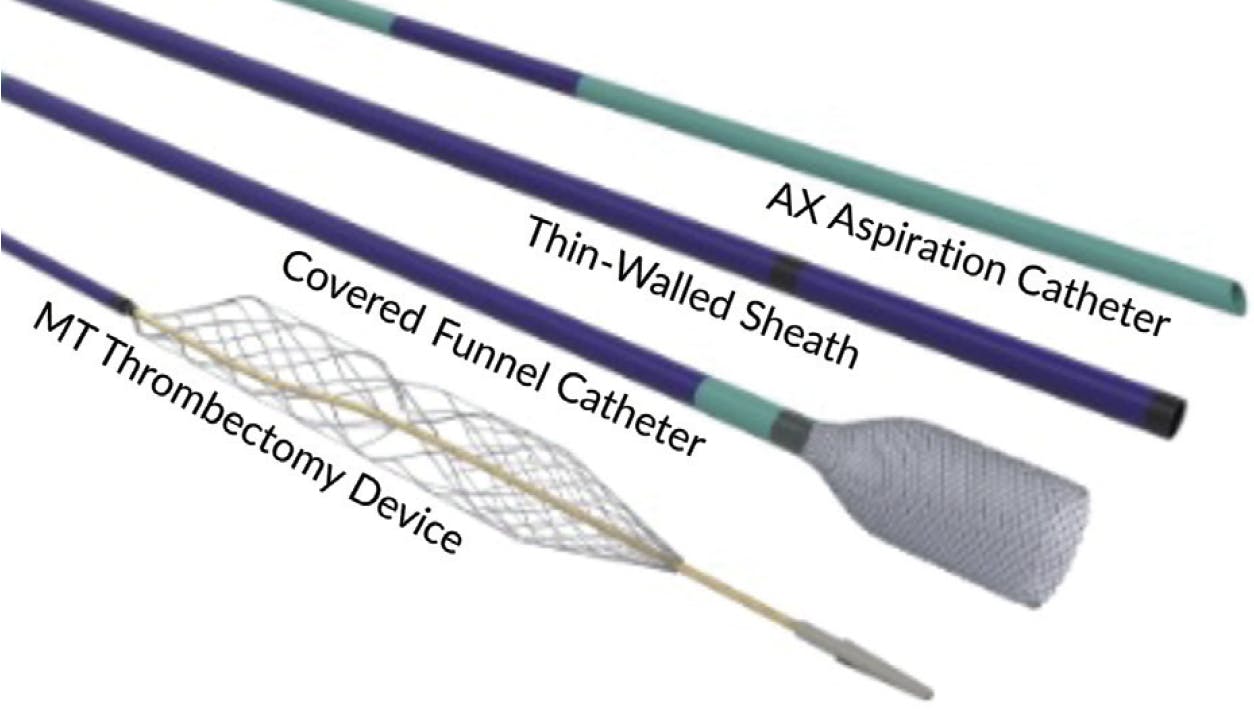
Figure 1. The Artix Thrombectomy System: (1) AX aspiration catheter—an 8F catheter with beveled tip for aspiration thrombectomy; (2) a thin-walled sheath—8F aspiration-capable sheath with 7F access; (3) covered funnel catheter—funnel deployment restricts proximal flow to reduce the risk of thrombus migration; and (4) MT thrombectomy device available in two sizes: MT6 for 3- to 6-mm vessels and MT8 for 4- to 8-mm vessels, with an expandable nitinol element for mechanical thrombectomy.
To provide deeper insights into the clinical application of the Artix system, this article features an interview with Neil Desai, DO, with Vascular Surgeons of Houston Cypress, who shares his first-hand experience with the device and showcases a case. We also highlight two additional cases from Nathan Thompson, MD, with Aurora Wells Allis Memorial Hospital, and Carleen Cho, MD, with LECOM Medical Center, illustrating the system’s efficiency.
EXPERT INSIGHTS With Dr. Desai: CLINICAL APPLICATION OF ARTIX
Can you walk us through your practice; how often do you encounter arterial occlusions? Do you ever see an occlusion that appears more chronic than the patient’s symptoms?
Dr. Desai: I perform 30 to 50 endovascular procedures per month, treating patients with critical limb ischemia and acute limb ischemia. I often address failed bypasses and patients with some degree of chronic thrombosis with mixed morphology occlusive disease. Removing chronic thrombus has usually been an endovascular challenge. Before Artix, I often opted for surgery or thrombolytics to clear acute thrombus and subsequent stenting.
What treatment approaches did you use before Artix?
Dr. Desai: I’ve tried everything—thrombolytics, open surgery, and the multitude of commercially available endovascular options. We have good endovascular devices that clear acute thrombus quite well. However, treating more complex chronic thrombus with continuous antegrade flow has been a challenge.
What were your initial impressions of Artix, and how has the device changed your approach to treating arterial thrombosis?
Dr. Desai: The dual aspiration and mechanical design provide a comprehensive approach to thrombus removal, increasing the ability to capture emboli and improving first-pass success. The device can remove all thrombus burden—acute and nonacute—while minimizing procedural complexity. Removing all thrombus is critical to reducing the risk of rethrombosis and preventing embolization. Additionally, Artix has two unique features that make it very appealing: (1) an over-the-wire system ensures wire access throughout the procedure and use of embolic protection devices, and (2) a covered funnel catheter provide proximal flow arrest. Overall, the system is intuitive, effective, and allows for quick, multiple passes in a short time frame.
Have you used both Artix AX and MT in the same case? How would you have handled similar cases before Artix?
Dr. Desai: Yes, in certain cases I’ve utilized both configurations. Before Artix, I not only had to often use two separate systems to achieve the same outcome but would also encounter embolic issues with those systems. Artix offers the ability to switch between aspiration and mechanical thrombectomy within one platform—and this is a game-changer. This versatility can significantly reduce procedure time and lower costs associated with using multiple systems.
How frequently do you need to use adjunctive thrombolytics with Artix compared to previous treatments?
Dr. Desai: Rarely now. Historically, surgical thrombectomy was the first option. This was followed by lytics, particularly in those who had thrombosis of fixed disease where we are able to gain luminal access through the lesion. With the breadth of available thrombectomy devices and now Artix, I’ve significantly reduced my reliance on thrombolytics, leading to faster procedures and lower bleeding risks for patients.
Case 1: Artix Avoided Bypass and Successfully Salvaged the Limb in Acute-on-Chronic Occlusion

Patient Presentation
A woman in her early 70s with a history of hypertension, hyperlipidemia, coronary artery disease, and diabetes mellitus presented with acute-on-chronic ischemia of the right lower extremity with gangrene of the right second toe. She was placed on catheter-directed thrombolysis (CDT) for an occluded left superficial femoral artery (SFA). After 28 hours of CDT, angiography showed marginal improvement in the SFA (Figure 2A). There was improvement in acute thrombus, but chronic thrombus was occlusive on intravascular ultrasound (IVUS).
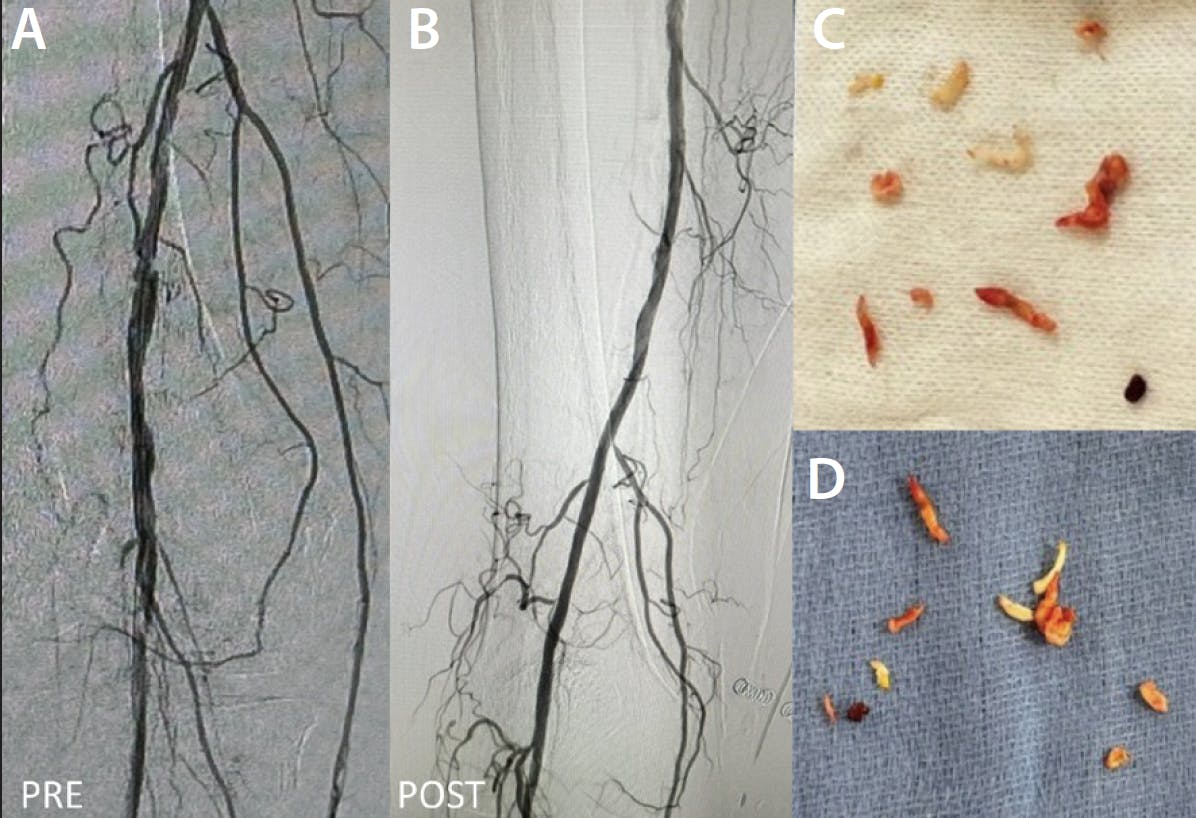
Figure 2. Angiogram after overnight CDT showing marginal improvement of the SFA occlusion (A). Postprocedural angiogram demonstrating widely patent SFA resulting from thrombus clearance with Artix (B). Photographs of extracted thrombi (C, D).
Procedural Overview
Mechanical thrombectomy with the Artix system restored flow while providing proximal flow arrest using the Artix covered funnel catheter deployed below the profunda femoris artery (Figure 2B). A large amount of chronic-appearing thrombus was removed using Artix (Figure 2C and 2D). The patient tolerated the procedure well without complications and ultimately underwent right second toe amputation with excellent bleeding at the surgical site.
Conclusion
The patient’s wound from the toe amputation healed without complications. This case highlights the ability to avoid revascularization of the popliteal occlusion with either bypass or a stent. We were able to perform thrombectomy and limit the stent to the SFA with only angioplasty of the popliteal artery.
How does Artix compare to Penumbra’s Bolt 7 system?
Dr. Desai: Unlike aspiration-only devices, Artix combines mechanical and aspiration thrombectomy, which improves thrombus engagement and clearance, leading to better overall efficiency and more complete thrombus removal. The beauty of a system like Artix is that it takes a lot of the guesswork out of which device to use for percutaneous treatment. The embolic risks are low with the flow arrest feature of Artix, and you can determine the quality of “back bleeding” as we do in open surgery. Additionally, the ability to return blood with the FlowSaver is attractive. Repeat passes of aspiration-only thrombectomy can result in significant blood loss. This is not a problem with Artix. Although Artix is an 8F system, we routinely close access sites using commercially available 7F closure devices with success.
Where do you see Artix fitting into your practice long term?
Dr. Desai: Artix is becoming my go-to device for arterial thrombectomy. The versatility of Artix allows me to treat a broader range of occlusions more effectively, and it’s shifting my approach toward more endovascular solutions. In open surgery, we can prevent embolization by clamping the artery—with its flow arrest feature, Artix effectively enables this in a percutaneous approach. It allows me to achieve the benefits of open surgery while staying endovascular.
Case 2: Artix Swiftly Cleared Thrombus and Restored Patency

Patient Presentation
A woman in her late 70s presented with no pedal pulses 1 day after total knee replacement surgery. An angiogram showed an acute occlusion in her left popliteal artery (Figure 3A).
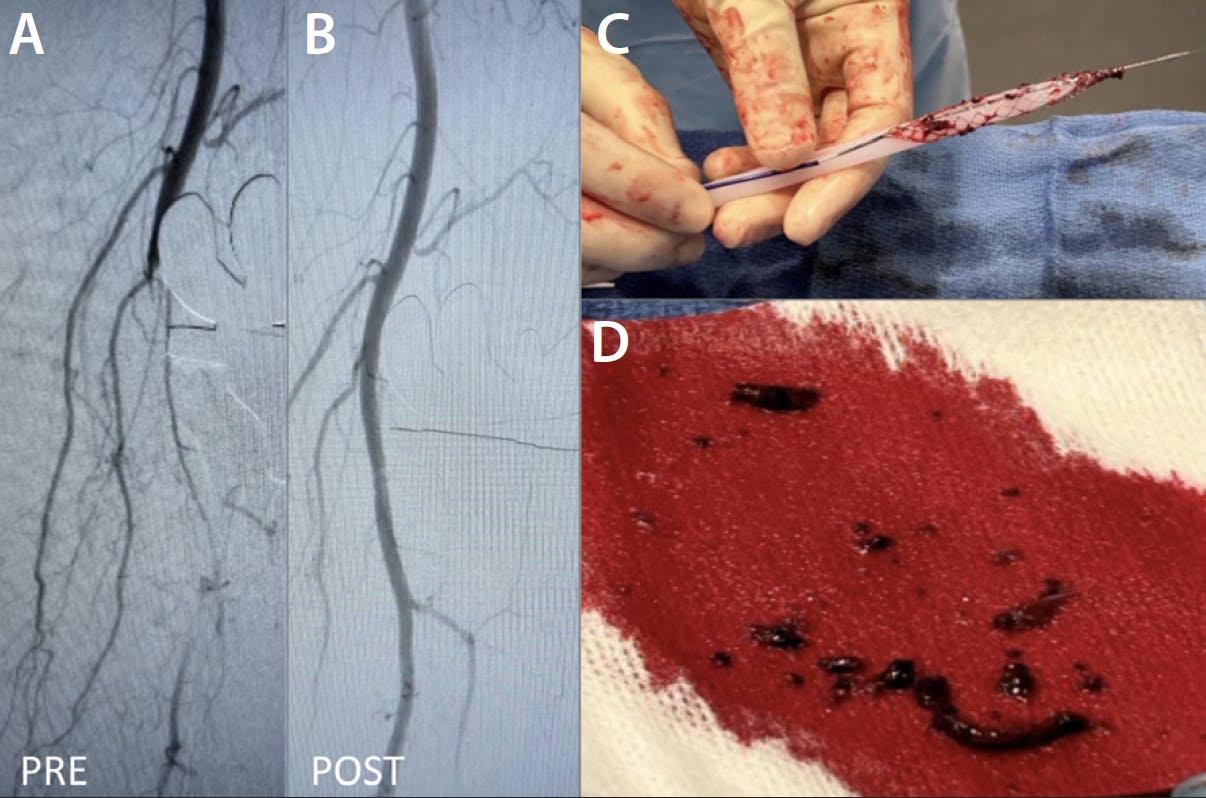
Figure 3. Preprocedural angiogram revealing an acute popliteal artery occlusion (A). Postprocedural angiogram confirming restored inline blood flow to the foot (B). Photographs of extracted thrombi (C, D).
Procedural Overview
Mechanical thrombectomy with the Artix system was performed. Briefly, the Artix thin-walled sheath was inserted antegrade via the common femoral artery. The Artix covered funnel catheter was then advanced and deployed distal to the sheath to provide proximal flow arrest. One pass with the Artix MT thrombectomy device followed by aspiration through the sheath yielded inline flow restoration to the foot after thrombus clearance (Figure 3B-D). The Artix device time was 2 minutes and estimated blood loss was 15 mL. Importantly, no thrombolytics were required, and no complications were observed. The patient was discharged the following day.
Conclusion
At the 3-month follow-up visit, complete resolution of symptoms was sustained, and duplex ultrasound confirmed a widely patent left popliteal artery and three-vessel runoff with normal multiphase waveforms.
What does the future of arterial thrombectomy look like and how does Artix fit into that evolution?
Dr. Desai: The field is moving toward single-session, highly efficient thrombectomy solutions that reduce procedure time and complications. For those of us who have had a thrombolysis complication, it is something you’ll never forget. The key requirements for my go-to endovascular arterial procedure are proximal flow arrest and effective mechanical and aspiration thrombectomy. Artix addresses all these needs in a single system, and coupling it with IVUS takes this procedure a step toward more personalized treatment. My goal is to be able to evaluate thrombus morphology in real time in order to customize the therapy to each patient’s anatomy and disease severity. Artix is an essential part of this evolution.
What aspects of Artix do you think will resonate most with vascular surgeons?
Dr. Desai: Vascular surgeons can appreciate the ability to replicate open surgery principles in an endovascular approach. Features like flow arrest and the mechanical element make Artix an effective solution and a natural fit for our specialty. We also can rely on principles of open surgery such as assessing “back bleeding” that is easily assessed using the Artix sheath while flow is arrested with the funnel. Artix allows us to push the boundaries of what can be done percutaneously, reducing the need for open interventions while maintaining the procedural control (from an embolic standpoint) we are accustomed to in the operating room.
Case 3: Artix Delivered Rapid Symptom Relief and Recovery

Patient Presentation
An 80-year-old obese woman presented with gangrene of the left digit.
Procedural Overview
Following a deep vein arterialization procedure of the left lower extremity, the Artix AX aspiration catheter was utilized to remove the residual thrombus in the profunda (Figure 4A). After removing the thrombus load, a postprocedural angiogram revealed a widely patent profunda (Figure 4B-D). Postoperatively, the patient had strong palpable pulses. Total case time was 30 minutes with estimated blood loss around 70 mL. The patient was discharged the next morning.
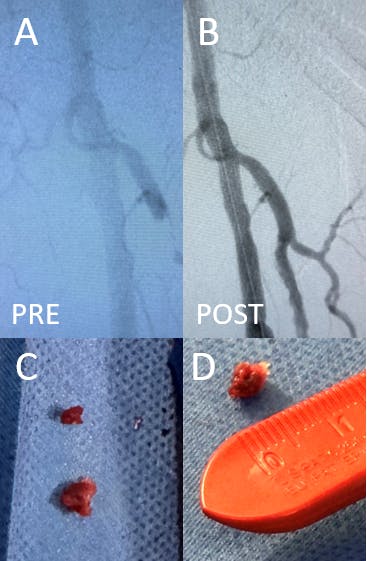
Figure 4. Preprocedural angiogram showing lack of flow in the left lower extremity (A). Postprocedural angiogram demonstrating restored flow and a widely patent profunda after Artix removed residual thrombus (B). Photographs of extracted thrombi (C, D).
Conclusion
At the 1-month follow-up visit, the patient’s toe showed signs of healing. A duplex ultrasound showed no evidence of rethrombosis. The Artix AX enabled us to avoid open surgery to retrieve the residual thrombus and instead allowed an endovascular approach without any significant morbidity risk added to the procedure.
Indications for Use:
The Artix Thin-Walled Sheath is indicated for: (1) The non-surgical removal of emboli and thrombi from blood vessels. (2) Injection, infusion, and/or aspiration of contrast media and other fluids into or from a blood vessel. (3) Use as a conduit for endovascular devices. (4) Use in facilitating the insertion and guidance of an intravascular catheter into a selected blood vessel. The funnel provides temporary vascular occlusion during these and other angiographic procedures. The Artix Thin Walled Sheath is intended for use in the peripheral vasculature. The Artix MT thrombectomy device is indicated for (1) the non-surgical removal of emboli and thrombi from a blood vessel; and (2) injection, infusion, and/or aspiration of contrast media and other fluids into or from a blood vessel. The Artix MT thrombectomy device is intended for use in the peripheral vasculature. The Artix AX aspiration catheter is indicated for (1) the non-surgical removal of emboli and thrombi from blood vessels; and (2) injection, infusion, and/or aspiration of contrast media and other fluids into or from a blood vessel. The Artix AX aspiration catheter is intended for use in the peripheral vasculature. The FlowSaver Blood Return System is used with Inari Medical catheters and sheaths for autologous blood transfusion.
Review complete Instructions for Use, Indications for Use, Warnings, Precautions, Possible Adverse Effects and Contraindications prior to use of the product.
For all non-Inari products, please refer to manufacturer Instructions for Use/Intended Purpose for complete indications for use, contraindications, warnings and precautions.
Caution: Federal (USA) law restricts this device to sale by or on the order of a physician. All trademarks are property of their respective owners.
PRO-2240-USA-EN-v1
Disclaimers:
*Designed to remove acute to chronic arterial clots. According to benchtop testing compared to control. Internal data on file. Narula et al. JACC 2018;72:2153-63
**According to benchtop testing compared to control. Internal data on file.
NOTE: To attempt to minimize risk of arterial embolization of blood clots, use of a device that entraps clots may potentially be helpful, but this has not yet been demonstrated to be effective in the arterial system.
The physicians featured are sharing their views and opinions and are expressing their experience with Inari Medical devices. Their opinions and experiences using these devices were created independently of Inari Medical and may not represent every experience or outcome with the devices.
Advertisement
Advertisement