Advertisement
Advertisement
May 2025
The Profunda Femoris Artery: The Importance of Stand-Alone Revascularization in CLTI
Considerations for PFA revascularization as a stand-alone or concomitant strategy for CLTI symptom improvement and limb preservation.
The profunda femoris artery (PFA) is well-known as a source of collateral circulation. It is one of the main sources of collateral circulation for patients with femoropopliteal occlusive disease, but it also provides important collaterals to the pelvic structures, spinal cord, and abdominal wall. We depend on the PFA for long-term stability of the limb, and fortunately, it is often preserved among patients with multilevel occlusive disease and chronic limb-threatening ischemia (CLTI). However, among patients with diabetes, the PFA is more likely to develop segmental disease than in nondiabetic patients. As diabetes increases as an associated factor with CLTI worldwide, consideration of PFA revascularization will likely also increase as a factor in decision-making.
The PFA is relatively poorly studied but widely revered. The hemodynamic results of profunda revascularization include potential for resolution of rest pain, healing of minor foot and lower leg ulcers, and healing of major amputation stumps. The PFA has been used as the primary outflow for both endovascular and open aortoiliac revascularization, including aortofemoral bypass. Likewise, the PFA has been used as inflow for femoropopliteal and femorocrural bypasses.
There are some similarities between the profunda femoris in the thigh and the peroneal artery below the knee. Both vessels may be relatively preserved among patients with multilevel occlusive disease and form collaterals to named vasculature distal to occlusions of inline flow. Another similarity with the peroneal artery is that it is very challenging to predict the hemodynamic benefits of its revascularization. We do not currently have a satisfactory method of assessing the quality of collateral flow between the PFA and the distal inline vasculature.
HOW DOES THE PFA FIT INTO A CLTI MANAGEMENT STRATEGY?
Situations in which the PFA should be considered for revascularization are listed in Table 1. The key factor to keep in mind is the patient’s hemodynamic needs and matching that with anatomic patterns of disease and degree of foot damage. For patients with rest pain or minor tissue loss, mild to moderate improvement in foot perfusion will likely improve the clinical syndrome. The likelihood is high that stand-alone revascularization of the PFA would be satisfactory in this situation. In the setting in which the patient does not achieve clinical improvement, the clinician must be prepared to perform additional revascularization.
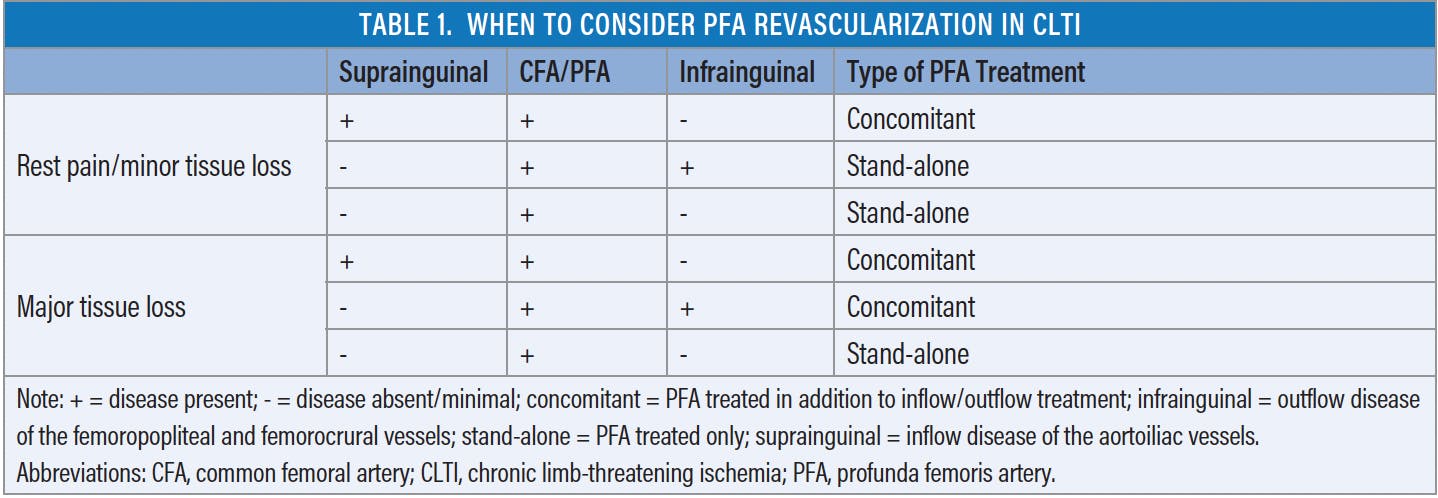
Many patients present with more extensive tissue loss and gangrene, posing significant risk of limb loss. In this setting, restoring inline flow to the foot is vital and would not be possible with isolated revascularization of the PFA. Despite this, most operators still repair concomitant PFA disease as a safety-net strategy to maintain flow in the limb and stability in the long term should the inline infrainguinal reconstruction eventually fail.
OPTIONS FOR OPEN OR ENDOVASCULAR TREATMENT OF PFA DISEASE
PFA disease may be treated using either endovascular or open surgical techniques. Key factors in deciding how to treat the PFA are disease burden in the common femoral artery (CFA), extent of femoral bifurcation involvement, and location of disease in the PFA. In our practice, higher disease burden in the CFA and extensive femoral bifurcation involvement is better managed with open surgical endarterectomy and patch angioplasty. However, there are patients with this disease pattern who may be poor candidates for open surgery, and there is also mounting evidence for endovascular intervention via plaque modification and stent-based therapy of the CFA and its bifurcation. The TECCO trial was a randomized controlled trial performed at multiple sites in the European Union that demonstrated a similar patency at 2 years between endarterectomy versus stenting of the femoral bifurcation.1 Nevertheless, the long-term behavior of stents in the femoral bifurcation is not as clear as the long-term performance of endarterectomy and patching. In one series of femoral endarterectomy, patency was 96.1% at 7 years.2 CFA disease tends to be bulky; therefore, lumen gain becomes an issue, and directional atherectomy may be required if endovascular therapy is selected. Because most profunda disease is at the origin of the artery, the lack of a T-shaped stent is also a disadvantage in consideration of endovascular therapy. How the artery is treated is usually determined by assessing the location of disease, with open surgery favored at the origin of the artery and endovascular techniques favored for more distal lesions.
Strategies for Open Repair
Open repair typically involves thorough exposure of the CFA, proximal superficial femoral artery (SFA), and proximal PFA (Figure 1). Exposure distance along the PFA depends on the extent of disease identified prior to the procedure. It is quite common for occlusive disease at the origin of the PFA to extend to the first major branch point. This usually involves exposure of each major proximal profunda branch so it can be clamped separately and an acceptable endpoint can be achieved in the proximal PFA. If there is any doubt about the integrity of the end point, then tacking sutures are useful. The incision in the vessel may be extended to the origin of the PFA (ie, profundoplasty), to the origin of the SFA, or both. A patch angioplasty is created based on the length and size of the incision and may be constructed of vein, bovine pericardium, or prosthetic, with similar patency. A tissue patch is likely slightly more resistant to infection. It is best to keep the bifurcation intact and avoid ligation of an occluded SFA. This preserves the potential for subsequent endovascular treatment of SFA occlusive disease if required later.
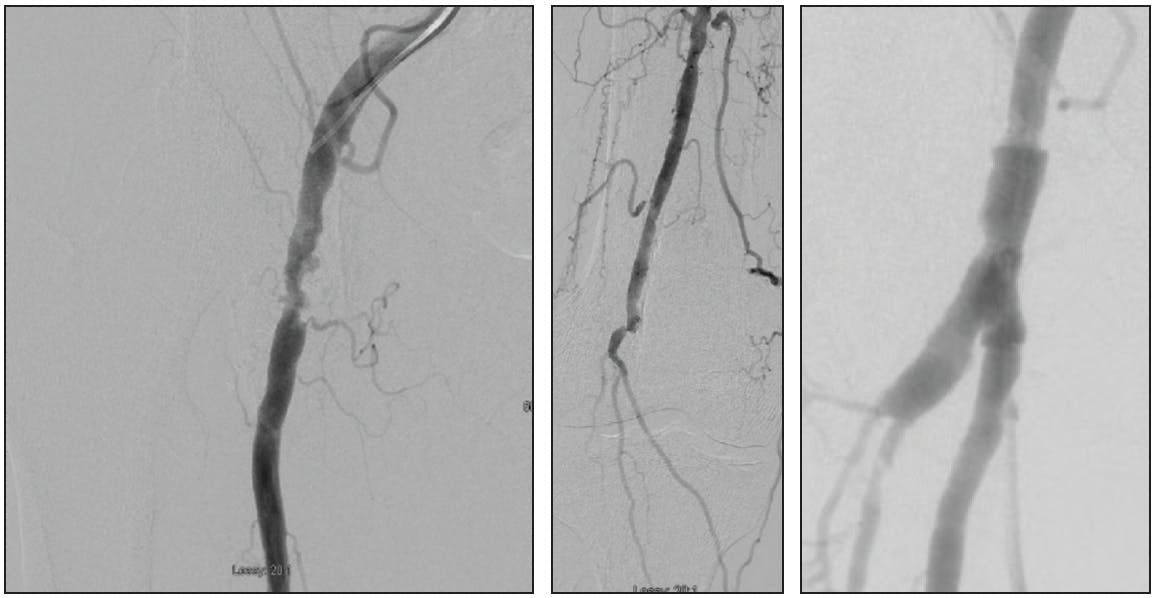
Figure 1. A man in his early 80s with rest pain, profunda occlusion, and popliteal occlusion extending to the trifurcation underwent PFA revascularization with endarterectomy and patching.
Strategies for Endovascular Treatment
Disease that develops distal to the origin of the PFA, not infrequently seen in diabetic patients, is more straightforward to treat with endovascular therapy. Regarding endovascular techniques, it is usually best to place an up-and-over sheath. The sheath tip is advanced to the CFA. Small-caliber wires are typically used to cross the profunda femoris lesion. Lesions in this area are typically focal. Occlusions and long lesions are challenging to treat with endovascular means because the artery dissects quite easily into the subintimal space and reentry is challenging. It is a soft artery with numerous branches that tends to form medial calcification, adding more difficulty to lesion reentry. We prefer specialty balloons for vessel preparation in this situation to avoid stent placement, as well as definitive treatment using drug-coated balloons. Because it is a relatively soft and tortuous artery, short self-expanding stents are usually preferred if stent placement is required for bailout.
BRIEF REVIEW OF DATA
Isolated PFA revascularization for limb salvage is not common compared to other types of endovascular and open reconstructions of inline perfusion. However, there are some publications with intermediate-term data. In a series published in 1985, 56 patients with CLTI underwent profundaplasty, and the rate of limb salvage was 60% at 24 months.3 More recently, in a Vascular Quality Initiative study of > 105,000 patients undergoing lower extremity revascularization from 2013 to 2018, isolated profunda endovascular revascularization was reported in < 1% of patients. Rest pain or tissue loss was present in 55% of patients, and patency was 92.9% at 13 months, with 66.8% of patients clinically improved.4 A single-center study from 2009 to 2019 of 51 patients with CLTI who underwent surgical profundoplasty alone included 51 patients (53% with rest pain and 47% with tissue loss). As expected, freedom from major adverse limb events was higher among patients with rest pain than those with tissue loss at 1 year (81% vs 43%; P = .009).5
CONCLUSION
The wide variety of CLTI presentations requires a tailored revascularization approach to maximize improvement of symptoms and limb preservation. An important consideration is PFA revascularization, which has proven its utility as a stand-alone or concomitant strategy. Endovascular PFA treatment is on the rise, and it can be used in selected patient anatomy with high anticipated success.
1. Gouëffic Y, Della Schiava N, Thaveau F, et al. Stenting or surgery for de novo common femoral artery stenosis. JACC Cardiovasc Interv. 2017;10:1344-1354. doi: 10.1016/j.jcin.2017.03.046
2. Ballotta E, Gruppo M, Mazzalai F, Da Giau G. Common femoral artery endarterectomy for occlusive disease: an 8-year single-center prospective study. Surgery. 2010;147:268-274. doi: 10.1016/j.surg.2009.08.004
3. Rollins DL, Towne JB, Bernhard VM, Baum P. Isolated profundaplasty for limb salvage. J Vasc Surg. 1985;2:585-590. doi: 10.1067/mva.1985.avs0020585
4. Qato K, Nguyen N, Bouris V, et al. Outcomes of endovascular management of isolated profunda femoris artery occlusive disease. Ann Vasc Surg. 2021;72:244-252. doi: 10.1016/j.avsg.2020.08.138
5. Elsharkawi M, Elkassaby M, McVeigh N, et al. Clinical outcomes from profundoplasty performed as a sole procedure for revascularization in critically ischaemic limbs. Vascular. 2021;29:396-403. doi: 10.1177/1708538120963901
Advertisement
Advertisement