Advertisement
Advertisement
May 2025
Why Is It Hard to Study Chronic Limb-Threatening Ischemia?
Challenges associated with studying CLTI, pros and cons of common endpoints, hurdles in study design, and recommendations for future studies.
Chronic limb-threatening ischemia (CLTI) is the most advanced form of peripheral artery disease (PAD). Patient presentation is variable, from rest pain to nonhealing wounds to gangrene. This condition is associated with a high rate of major adverse cardiovascular events (MACE), major adverse limb events (MALE), and death within 1 year from the time of presentation. These poor outcomes often occur despite best medical therapy and interventions. Thus, there is an incentive to study interventions for CLTI to improve these negative outcomes. Unfortunately, the literature on this subject is fraught with heterogeneity and confusing results.
There are many factors that contribute to the difficulty in studying CLTI (Sidebar). First, patient presentation is heterogeneous. Although risk factors for PAD and CLTI are well delineated, they do not present uniformly in all patients. Also, limb presentation and anatomy of lesions vary considerably among patients (eg, a small wound is not the same as a larger one, but both may be categorized as a Rutherford 5 presentation). Thus, recruiting a homogeneous population to study is difficult, and incorporating more complex stratification schemes (eg, the Wound, Ischemia, and foot Infection [WIfI] system) can make a study impractical.
Challenges Associated With STUDYING CLTI
- Heterogeneous patient presentation and anatomy
- Local availability and logistical challenges of providing best treatment through multidisciplinary teams
- Nuanced and complex interventions
- Socioeconomic constraints on a sick patient population
- Different trial designs have divergent designs and choose different outcomes
- Outcome definitions vary greatly between trials
- Choice of outcome varies among trials
Making matters even more complex, treatment varies among study participants. This is most pronounced in clinical trials, where medical therapy is not standardized, operators are often encouraged to offer local standard of care, and nonpharmacologic ancillary treatments differ among patients. But even in investigational device exemption (IDE) trials, variable anatomy often dictates divergent interventions, whether in a nuanced fashion or altogether different. Furthermore, lesion characteristics in CLTI patients are often complex. Options may be available for one patient but limited in another. For example, in some patients who require a bypass graft, choice of the distal anastomoses can be limited, often dictating a tibial target, which is associated with worse outcomes compared to more proximal grafts. Other factors pertaining to intervention are questionable, including whether one can treat by relevant angiosomes or knowing when to stop a procedure.
Next, the treatment of CLTI goes beyond the procedure; it is a team effort. Many specialized medical professionals contribute to best outcome. Examples of these include the interventionalist, the physician who optimizes medical therapy, wound care specialists, podiatrists, nursing staff who often need to visit patients at home, social workers, and more. However, there is also much responsibility that falls on the patients and families. Best wound care, nutrition, medical compliance, smoking cessation, and off-loading of the affected foot all need to be optimized to achieve best outcomes.
Adding to this complex potpourri of providers, some outcomes are objectively hard to follow. A classic example is wound closure, often cited as an impetus for intervention. Wound healing is affected by factors such as infection, available dressings, frequency of wound care, off-loading, nutrition, and smoking cessation. Thus, while this is an important metric to follow, standardizing care across trial patients can be challenging.
Also, as alluded to previously, we can divide the study of CLTI into two groups: clinical trials and IDE trials. The purpose, structure, data collected, size, and follow-up time differ greatly between these categories. Although clinical trials are rare, comparatively large, and involve granular data gathering and long follow-up, IDE studies are focused on achieving regulatory approval for a device. Thus, IDE studies tend to be smaller, follow patients for shorter periods of time, and collect less data about each patient, focusing on what the sponsors need to gain approval.
Even across the same trial category (eg, clinical trials), the choice of primary outcome may not be the same, resulting in confusion as to how to interpret the results. This was exemplified when the two largest contemporary trials (BEST-CLI and BASIL-2) seemed to have come to different conclusions about the comparison of endovascular-first or open surgical–first interventions.
Finally, as we published previously, even the definitions of common outcome measures, such as mortality, amputation-free survival, and patency rate, often differ across studies.1 Although we should not compare two devices that were studied in separate trials, an astute clinician should know that even understating a single trial’s results is not straightforward.
POTENTIAL STUDY OUTCOMES
Most practitioners consider CLTI trial outcomes to be confusing. We find that viewing the utility of potential outcomes through the lens of the revascularized patient provides a strong foundation on which to build (Table 1).
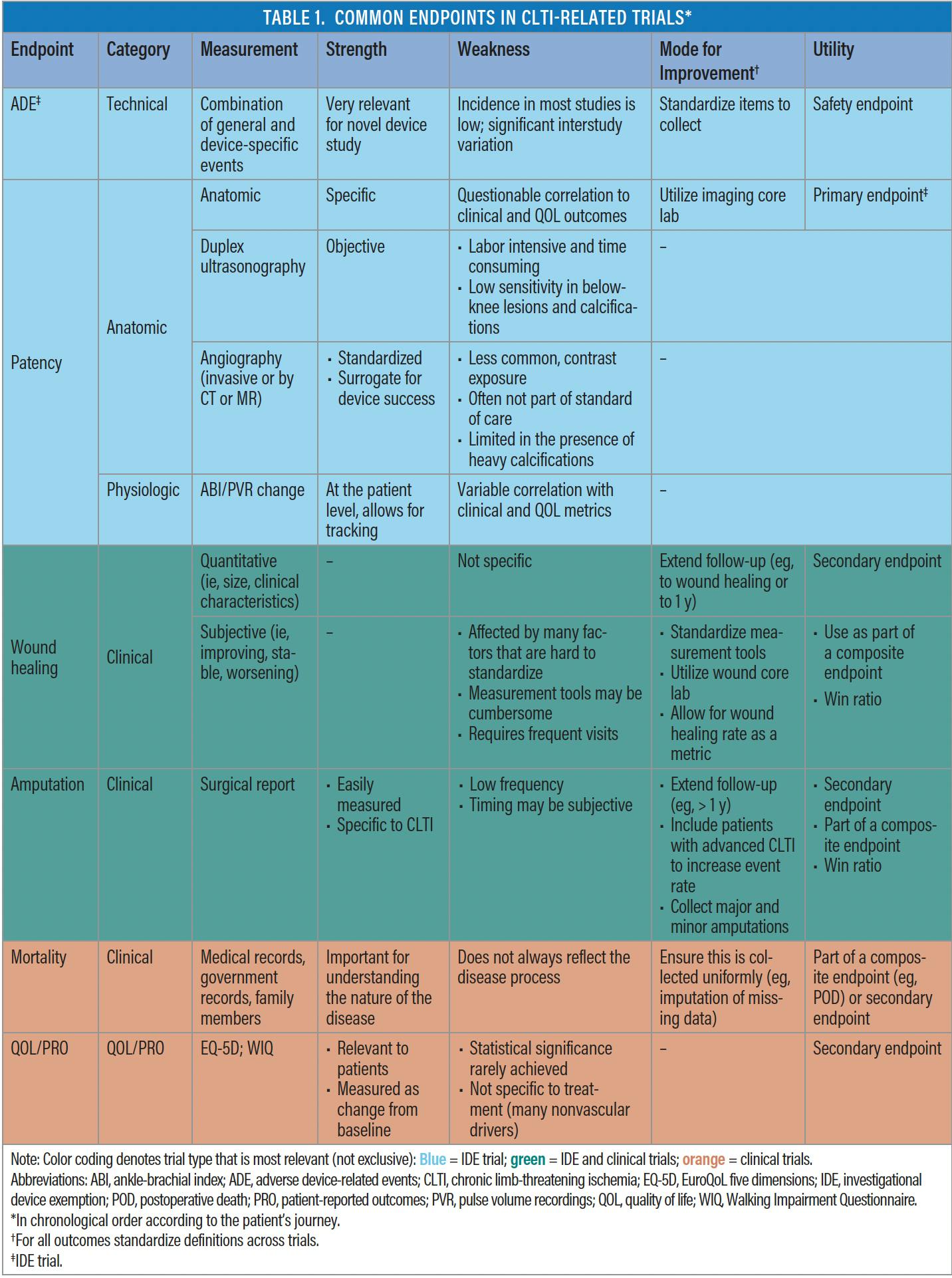
An ideal patient pathway can be described as follows. During the intervention, technical success is achieved. There are no complications postprocedure, and the patient leaves the hospital. Early assessment in the first 30 days yields improved ankle-brachial index/toe-brachial index/transcutaneous oxygen pressure, and an arterial duplex ultrasound confirms patency of the interventional site. The patient’s wounds close rapidly and ultimately heal. Pain resolves. The patient’s ambulatory status improves and with that, so does their Rutherford classification. Thankfully, no amputation is required. The patient’s previously abysmal quality of life (QOL) is now remarkably improved. The patient never requires another intervention.
Potential study outcomes (Table 1) are drawn from each stage of the patient course, in chronological order.
Confounding Variables to Interpreting Study Outcomes
It is worth noting that the periprocedural technical results, postprocedural patency, and its related hemodynamic effects are simple to study but less important than clinically patient-centric outcomes. Yet, the correlation of wound healing, limb status, cardiovascular events, QOL, and longevity is limited, as these outcomes are impacted by an array of variables external to revascularization success. Wound healing, for example, is impacted not just by vascular status but also by a variety of patient-specific and ancillary care–related factors. Although limb compromise might drive earlier cardiovascular illness and mortality, so might other risk factors, even in the setting of a successful revascularization with a durably patent artery. Last, a patient’s subjective QOL is impacted by evolving CLTI-related clinical variables, as well as a wide array of unrelated factors.
Due to relatively low incidence, to achieve statistical significance (especially in trials of limited duration), clinical and patency-related outcomes are often combined into composite endpoints. Typically, a composite primary efficacy endpoint and composite primary safety endpoint are established (Table 2). A clinical efficacy composite endpoint will be a combination of desired procedural and clinical results (eg, patency, wound healing, limb salvage). Conversely, clinical safety composite endpoints reflect the avoidance of undesirable outcomes (eg, freedom from amputation, freedom from perioperative death). Unfortunately, many argue that such composite outcomes are flawed. To achieve statistical significance, they inappropriately equalize endpoints. For example, mortality is clearly more significant than vessel reocclusion or even amputation. One clever way to try to overcome this obstacle is the win ratio. When done properly, the win ratio prioritizes outcomes by their importance. However, this methodology can also skew results if an outcome is chosen for its expected favorable profile rather than its clinical relevance.
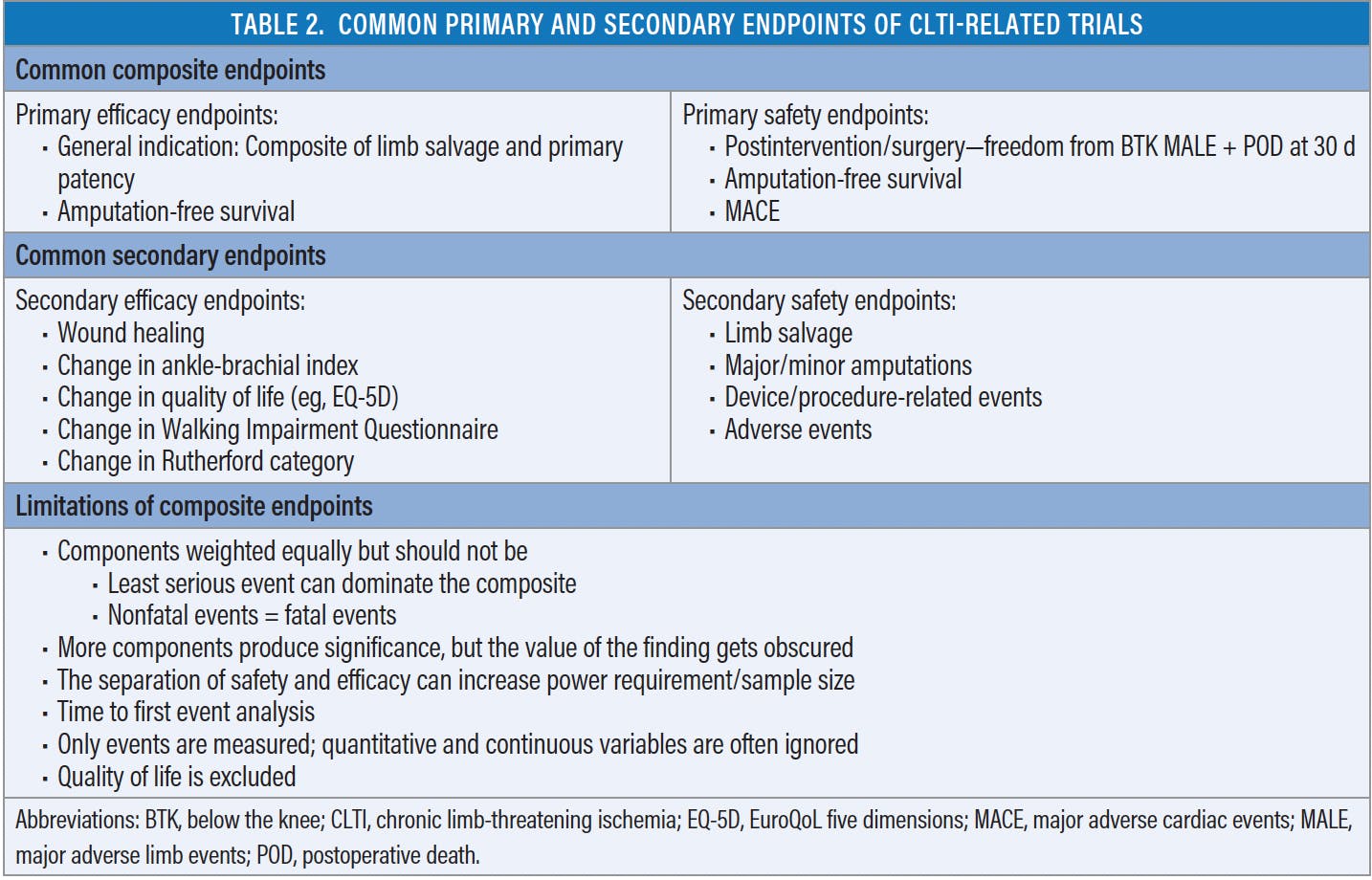
Shockingly, there is considerable interstudy divergence as to the definition of certain endpoints. For instance, amputation-free survival, a common outcome in CLTI trials, may mean time to “major amputation or death from any cause” in one trial but only “major amputation” in another. Thus, it can be difficult to decipher the results of studies with apparently similar outcomes without truly taking into account the nuances of the outcome definitions.
CHALLENGES RELATED TO STUDY DESIGN
There are challenges to the study of CLTI that are more specific to trial design. In IDE trials, the goal is to have regulatory bodies approve the use of a device for clinical use. Therefore, when designing an IDE trial, the goal is to follow patients for the shortest period that will suffice for gaining approval. Given this narrow goal, the choice of outcome measures often also is limited to avoid complicated results that may result in delays, encourage speedy recruitment, and limit cost. Furthermore, when reading their results, we must remember that IDE trials strive to recruit a homogeneous patient population with the least complicated disease process.
On the other hand, clinical trials can theoretically optimize our understanding of a disease process by recruiting more patients than an IDE trial and studying a wide range of potential outcomes over a long follow-up period. However, clinical trials are usually funded by public grants. Thus, like IDE trials, financial restrictions often still limit clinical trials, both in size and duration. Nonetheless, some limitations are still inherent to clinical trials. First, by allowing for recruitment of a diverse patient population and “real-world” treatment, they invariably introduce heterogeneity among patients and interventions. While hopefully allowing for top-level analysis, clinical trials are often underpowered to hone in on a particular homogeneous subset of patients to study various aspects of clinical applicability. In other words, to make these trials practical, clinical trial design involves compromise.
RECOMMENDATIONS
How do we reconcile these challenges into a pragmatic approach to the study of CLTI? In a perfect world, we would study all outcomes in all patients, but that is not possible for the various reasons outlined previously.
IDE trials of devices utilized during revascularization, including balloons, stents, lesion modification tools, and others, are best served by a focus on patency. Even more so, the homogeneity of the IDE patient populations, lesion subsets, and presence of core lab adjudication make patency a reasonable choice. Although companies and investigators often include wound- and amputation-based secondary outcomes in such trials, the utility of doing so is marginal, given the small sample size and limited duration of IDE studies.
However, even a primary patency endpoint (perhaps the least complex of endpoints) still presents a variety of challenges and questions. Practically, a subset of successful procedures requires early reintervention to secure durable patency (ie, primary assisted patency). Additionally, another subset of postrevascularization patients experiences reocclusion or restenosis early, requiring immediate reintervention that when successful can produce a long-term, durable result (ie, secondary patency). Angiography, the gold standard, is no longer a viable trial option as it exposes patients to procedural risk. Also, CTA offers only limited assessment of the infrapopliteal vessels (frequently the area of interest) and is often confounded by calcification. MRA capabilities vary extensively by center expertise and scanner quality. Ultrasound, probably the most popular method to assess patency, is safe and inexpensive but requires significant technical expertise and time. Even more so, the duplex ultrasonography technique used in clinical trials is often more meticulous than in clinical practice. In fact, to rely on duplex ultrasonography for the purpose of assessing patency and degree of patency, multiple measurements need to be acquired, and core lab adjudication is recommended. Confining IDE studies to centers with such expertise is not always feasible and may limit the pace of enrollment. Nevertheless, although imperfect, patency remains the best option, assuming it is rigorously standardized, performed in skilled centers, and core lab adjudicated.
Compared to IDE trials, clinical trials include a larger, clinically and anatomically heterogeneous, often sicker set of patients. As a result, we believe that patency is of minimal utility in the presence of a higher mortality rate, differing lesion characteristics, and variations in medical and interventional therapy. Primarily, such studies focus on major limb-related outcomes and death. Clinical trials also produce information about secondary outcomes such as MACE, QOL, functional status, wound healing, and wound healing rate. Finally, regarding the incorporation of wound healing, we suggest that wounds be stratified according to their presentation (eg, by using the WIfI classification). We as vascular specialists must standardize the definitions of the various outcomes. In fact, we believe that a multisocietal collaboration to identify and define the most common and useful outcome measures could greatly benefit the field.
SUMMARY
Advancing our understanding of CLTI is fraught with challenges. Still, there is a great need for robust studies that will generate useful information that will, in turn, benefit CLTI patients, who as a whole have a very poor prognosis. To achieve this goal, we must focus on the outcomes that are most important to patients. We must enhance our understanding of best medical and ancillary therapies, while simplifying and standardizing the way we define trial outcomes. Hopefully, we will be able to step up as a field for the good of our patients.
1. Lakhter V, Weinberg MD, Galmer A, et al. Objective outcome measures for trials in patients with chronic limb-threatening ischemia across 2 decades: analysis and recommendations. JACC Cardiovasc Interv. 2021;14:2584-2597. doi: 10.1016/j.jcin.2021.08.079
Advertisement
Advertisement