Advertisement
Advertisement
November 2025 Supplement
Sponsored by Surmodics, Inc.
Spin It to Win It: Using the Sublime™ Microcatheter to Facilitate Recanalization of Chronically Thrombosed Veins
A conversation with Dr. Eric C. Smuclovisky.
Eric C. Smuclovisky, MD, is an interventional radiologist affiliated with Elkhart General Hospital in Elkhart, Indiana. He completed a Harvard Medical School fellowship in Vascular and Interventional Radiology at Massachusetts General Hospital and Early Specialization in Interventional Radiology at the Baylor College of Medicine in Houston, Texas. Dr. Smuclovisky’s practice encompasses the full scope of interventional radiology, including advanced arterial and venous interventions; aortic and carotid endovascular therapy; venous and arterial thromboembolism management; and comprehensive hepatobiliary, genitourinary, oncologic, and musculoskeletal/pain procedures. We spoke with Dr. Smuclovisky about his approach to treating chronic lower extremity venous thrombosis and his use of the Sublime™ Microcatheter (Surmodics, Inc.).
How do you manage patients with chronic venous disease who present with acute symptoms?
Patients with long histories of venous disease and lower extremity interventions often present with acute symptoms of deep vein thrombosis (DVT), but they may require recanalization to restore blood flow through their chronically occluded and fibrosed veins in addition to thrombus removal.1 In these cases, their acute symptoms are typically secondary to thrombosis of a lower extremity collateral or centrally located pelvic outflow vein.2 If we simply perform thrombectomy in the deep veins in these patients and do nothing more, we may be overlooking outflow or inflow issues that put patients at risk of rethrombosis and persistence or recurrence of symptoms.3,4 Femoral and/or iliac venous recanalization can substantially improve quality of life, especially for patients suffering from life-limiting symptoms of venous insufficiency or chronic venous wounds.3
How do you cross chronically thrombosed veins?
To open scarred, fibrotic veins densely obstructed by synechiae, you need support from a crossing catheter to place your guidewire at the site of treatment. This requires a catheter with robust pushability and torqueability to navigate these diseased vessels, as well as the ability to steer the catheter into the true lumen of native vessel and away from parallel collaterals or perforators.
Can you describe your experience with the Sublime™ Microcatheter?
I’ve found the Sublime™ Microcatheter to be second to none. At first touch, the catheter feels remarkably compliant and malleable, but the device has powerful capabilities embedded in its technology. Once you start spinning this catheter, it delivers exceptional torque and pushability, more so than any other crossing catheter I’ve used to date. I attribute this to its distinctive double-braided design (see here). Compared with other crossing catheters I’ve used, the Sublime™ Microcatheter’s pushability and torqueability make it easier for me to reach and cross difficult crossing points. In fact, I can reach these points without necessarily having to use an extra-long sheath, which allows me to keep my primary access very low-profile until I have secured wire access across the segments I want to treat. I can then escalate my access appropriately for treatment with other devices.
In long-segment chronic occlusions, a catheter must contend with a tremendous amount of friction along its length. That’s where the Sublime™ Microcatheter really shines—as one of my mentors used to say, you can “spin it to win it” to decrease the coefficiency of friction and get a catheter to advance. When I turn this catheter clockwise or counterclockwise, it turns efficiently, with minimal lag between the distal end of the catheter and the hub.
This controlled torqueability also gives the Sublime™ Microcatheter excellent steerability, particularly with the angled tip. Ordinarily, steering in patients with chronic disease can be really challenging; for example, when you’re trying to steer through an open vessel distal or central to a chronic occlusion you’ve just crossed. Other catheters I’ve used just don’t translate the torque you apply with your hands into tip deflection the way the Sublime™ Microcatheter does. We’ve been able to make do with other crossing catheters, but the Sublime™ Microcatheter makes life easier.
Regarding the case you provided for this supplement, what was the patient’s clinical background and progression prior to recanalization?
This was a patient with a history of pulmonary embolism (PE) and multiple prior interventions to treat DVT in his right leg. I had previously seen him for a PE, at which time he also presented with a typical diagnosis of DVT in his right leg. After we performed thrombectomy for his PE, I decided to treat his leg in supine with frog-legged position. When I obtained popliteal access, I quickly realized we were dealing with a chronically occluded lower extremity deep venous system rather than acute DVT. Ultimately, I was unable to negotiate wire access via the true lumen in native vessel through the chronically occluded iliac venous system. Given procedure time and the unlikelihood that prolonging the intervention would mitigate any further PE risk, I decided to conclude the procedure—his PE was definitively treated, and I felt that his right lower extremity was unlikely to be the source of the thromboembolic PE. The contralateral limb was negative for DVT on Doppler exam.
Sometime later, he again presented to our practice and in the interim had developed a wound on his anterior shin. It was clear that revascularization was now imperative for limb preservation. In my experience, thrombectomy or lysis alone does not lead to a good clinical outcome for this kind of patient.
Why did you use the “body flossing” technique described in the case?
The patient’s venogram again demonstrated chronic occlusion of his popliteal and femoral veins. This time I knew the challenges that awaited in the pelvis; therefore, I achieved right internal jugular (RIJ) vein access, advanced a sheath as far down into the native right iliac vein as I could, and then placed that patient into the prone position for planned through-and-through wire access if needed. I used the Sublime™ Microcatheter to navigate from popliteal access through that long-segment chronic disease to meet up with the sheath I’d advanced from RIJ access. Intravenous ultrasound demonstrated true lumen wire access and mixed eccentric thrombus and synechiae occupying the lumen.
Caution: Federal (US) law restricts the Sublime™ Radial Access Guide Sheath, the Sublime™ Radial Access .014 and .018 RX PTA Dilatation Catheters, and the Sublime™ Radial Access .014, .018, and .035 Microcatheters to sale by or on the order of a physician. Please refer to each product’s Instructions for Use for indications, contraindications, warnings, and precautions. SURMODICS, SUBLIME, and SURMODICS and SUBLIME logos are trademarks of Surmodics, Inc. and/or its affiliates. Third-party trademarks are the property of their respective owners.
1. Taha MAH, Busuttil A, Bootun R, et al. A clinical guide to deep venous stenting for chronic iliofemoral venous obstruction. J Vasc Surg Venous Lymphat Disord. 2022;10:258-266.e1. doi: 10.1016/j.jvsv.2020.12.087
2. Harris M, Lim CS. Chronic venous outflow obstruction: an important cause of chronic venous disease. Cleve Clin J Med. 2021;88:680-688. doi: 10.3949/ccjm.88a.21068
3. Vedantham S, Weinberg I, Desai KR, et al. Society of Interventional Radiology position statement on the management of chronic iliofemoral venous obstruction with endovascular placement of metallic stents. J Vasc Interv Radiol. 2023;34:1643-1657.e6. doi: 10.1016/j.jvir.2023.06.013
4. Pouncey AL, Kahn T, Morris RI, et al. Risk factors and classification of reintervention following deep venous stenting for acute iliofemoral deep vein thrombosis. J Vasc Surg Venous Lymphat Disord. 2022;10:1051-1058.e3. doi: 10.1016/j.jvsv.2022.03.006
Case Report:
Long-Segment Iliofemoral Venous Recanalization Facilitated by the Sublime™ Microcatheter
By Eric C. Smuclovisky, MD
PATIENT PRESENTATION
A man in his mid-70s with history of pulmonary embolism (PE) and multiple prior right lower extremity (RLE) venous interventions presented with RLE leg swelling and an above-ankle venous wound.
DIAGNOSTIC FINDINGS
Ultrasound-guided access was first achieved via the right internal jugular vein (RIJV) and secured with an 8 Fr, 70 cm guiding sheath advanced into the right common iliac vein (RCIV) (Figure 1). A generous length of the RIJV sheath was left externalized to ensure continued operator access when repositioning the patient from supine to prone. With the patient in prone position, right popliteal venous access was achieved using a microaccess system and sheath. The microaccess was then exchanged for a 6 Fr, 23 cm introducer sheath. Venography performed from popliteal and IJ access demonstrated pronounced flow limitation in the right common femoral vein (RCFV) (Figure 2A) and RCIV (Figure 2B). A true lumen channel was identified medial to extravascular contrast in the pelvis (Figure 2C).
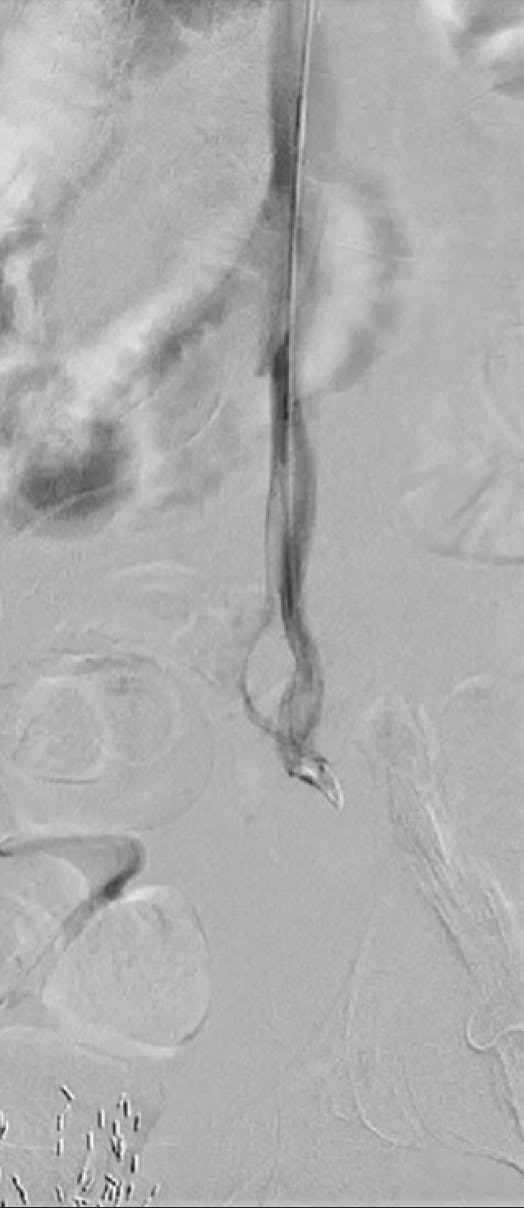
Figure 1. Guiding sheath positioned into the RCIV via RIJV access.
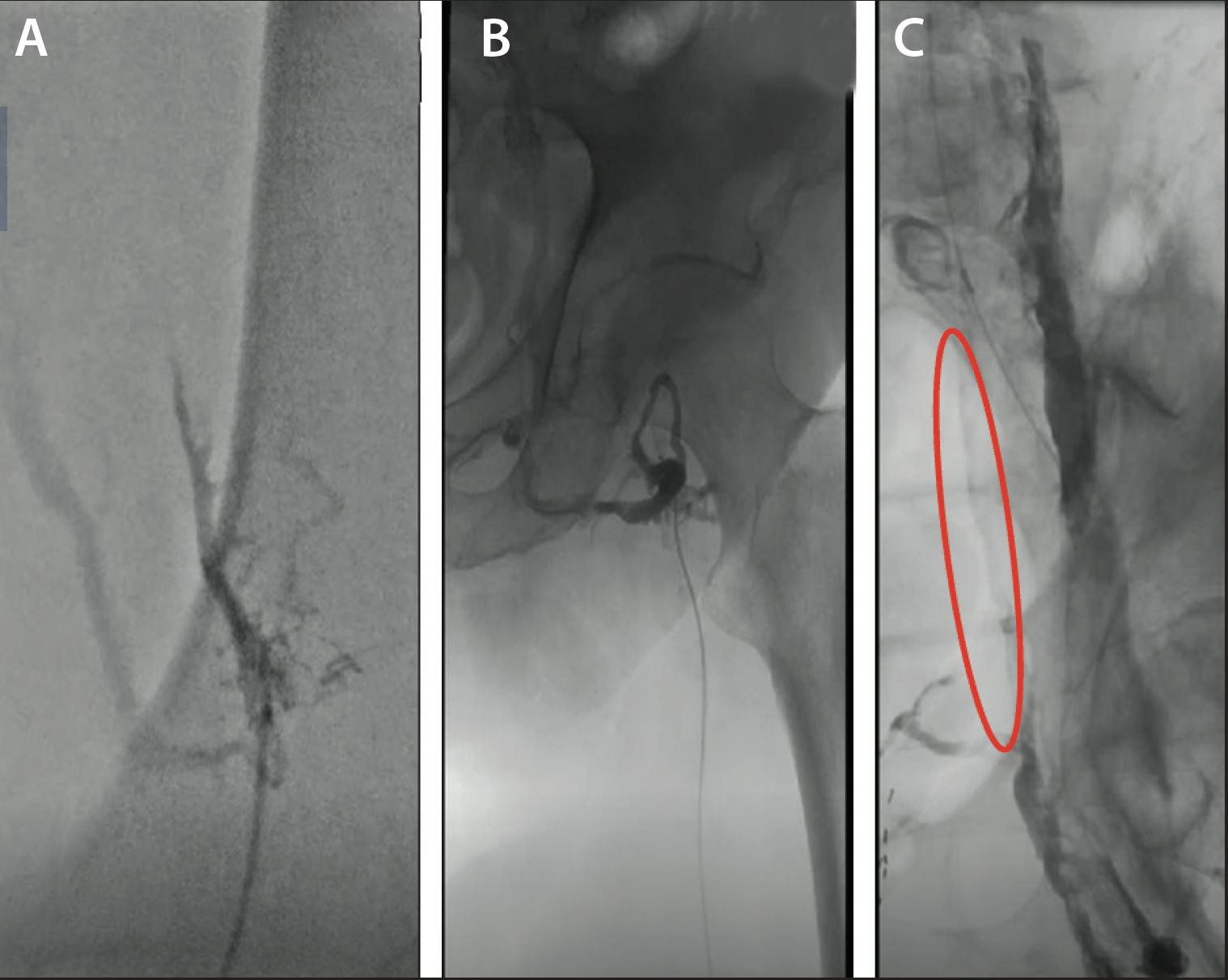
Figure 2. Venography performed from popliteal and IJ access demonstrated pronounced flow limitation in the RCFV (A) and RCIV (B). A true lumen channel was identified medial to extravascular contrast in the pelvis (C).
TREATMENT
From popliteal access, the chronically diseased iliofemoral venous system was successfully traversed using a .035, 90 cm Sublime™ Microcatheter (angled tip) in combination with a .035 stiff hydrophilic wire. With support from the catheter, the guidewire was advanced to within proximity of the guidewire placed via IJ access (Figure 3). A wire externalization (“body flossing”) strategy between the two access sites was used to secure wire access and enhance device pushability for reestablishing inline flow. Plain balloon angioplasty from popliteal access was performed to 10 mm in the right femoral vein, 12 mm in the RCFV, and 14 mm in the RCIV and right external iliac vein. Contrast injection from popliteal access showed reestablishment of inline flow across the femoral vein (Figure 4A and 4B) and the entire iliofemoral system (Figure 4C), although with an atretic and diminutive iliac venous system. Self-expanding venous stents were deployed across the right iliofemoral venous system from the RCIV to RCFV. Final imaging of the iliac veins demonstrated a recanalized system with adequate luminal gain and no flow limitation (Figure 5).
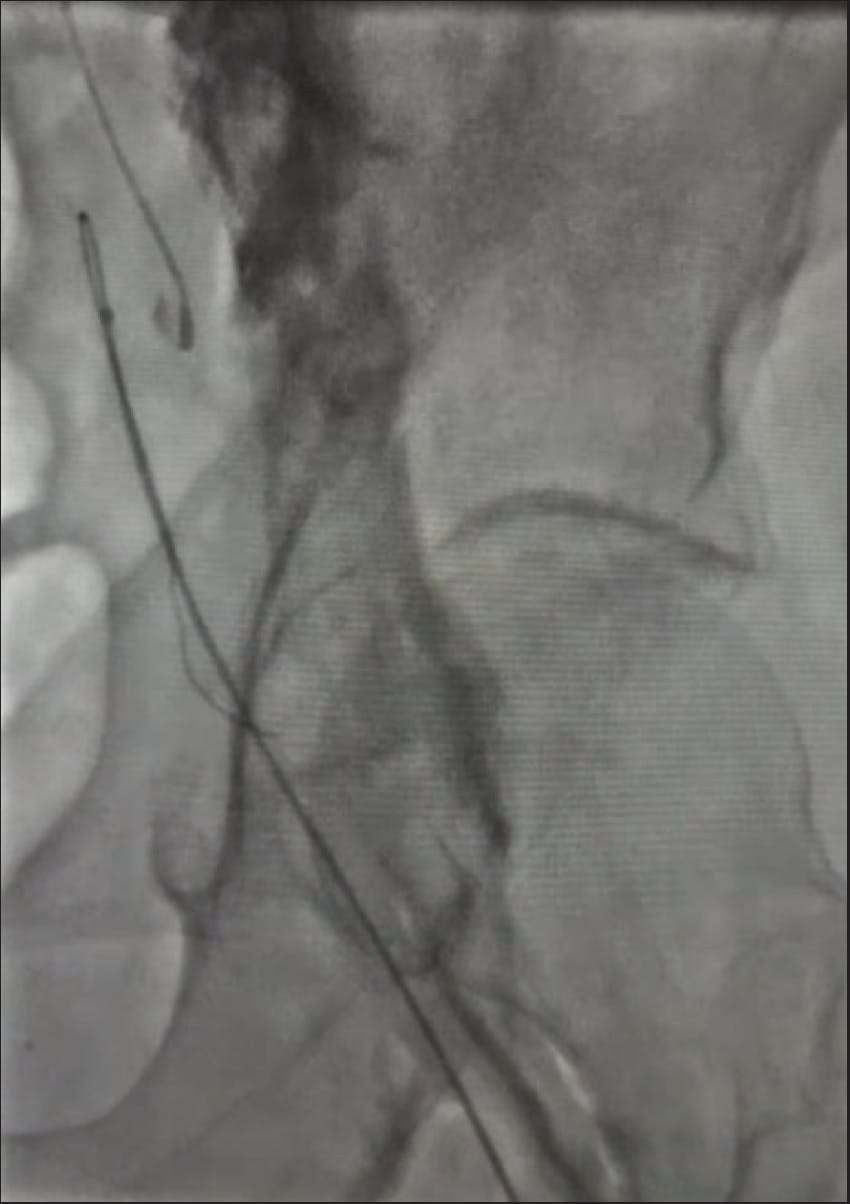
Figure 3. Guidewire supported by Sublime™ Microcatheter advanced from popliteal access to within proximity of the guidewire placed via IJ access.
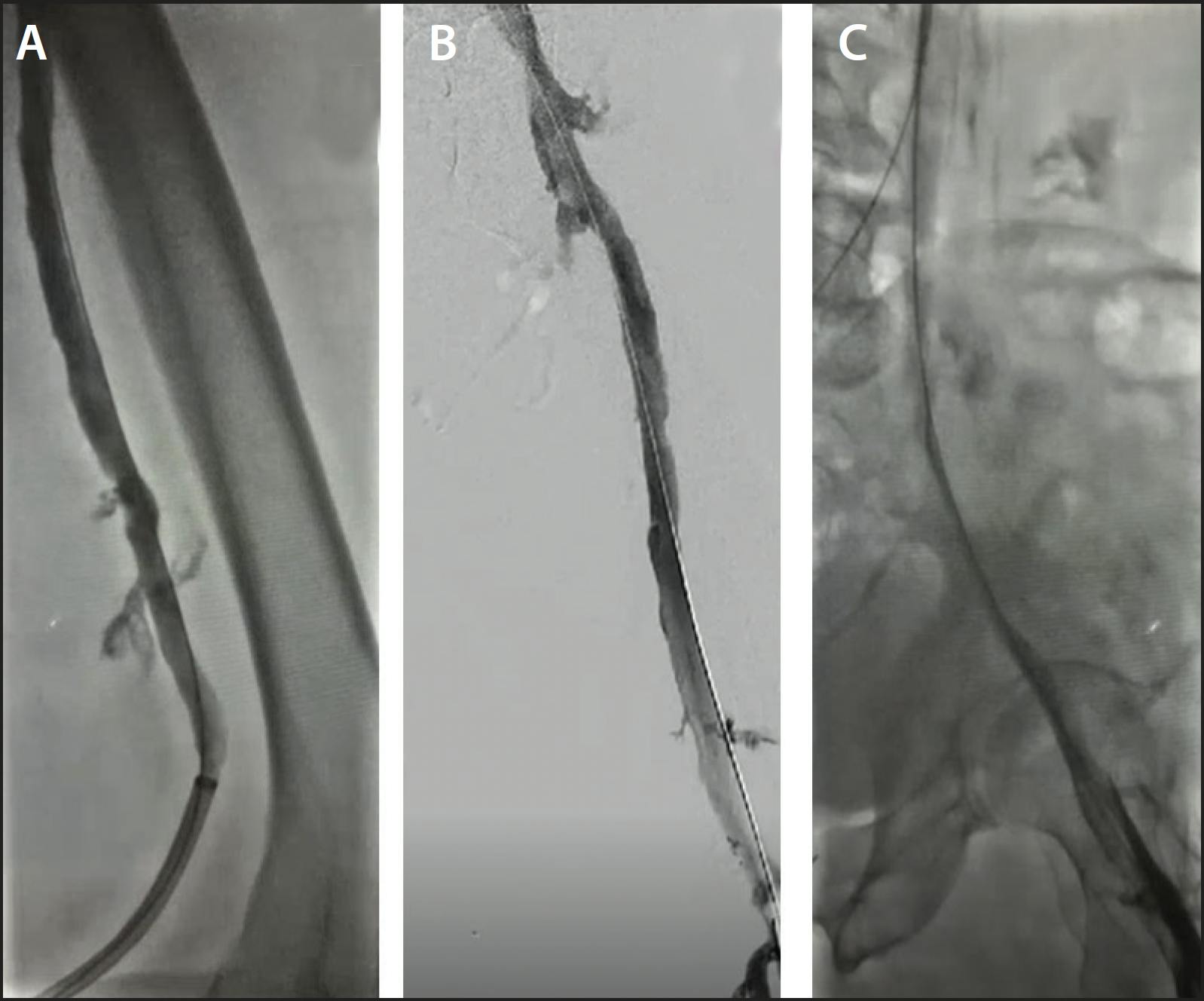
Figure 4. Contrast injection after balloon angioplasty demonstrated reestablishment of inline flow across the femoral vein (A, B) and the entire iliofemoral system (C), although with an atretic and diminutive iliac venous system. Panel A shows reestablishment of inline flow across the femoral vein with adequate luminal gain and no flow limitation, while panel B shows imaging of the femoral vein more centrally, again demonstrating a recanalized vessel without flow limitation.
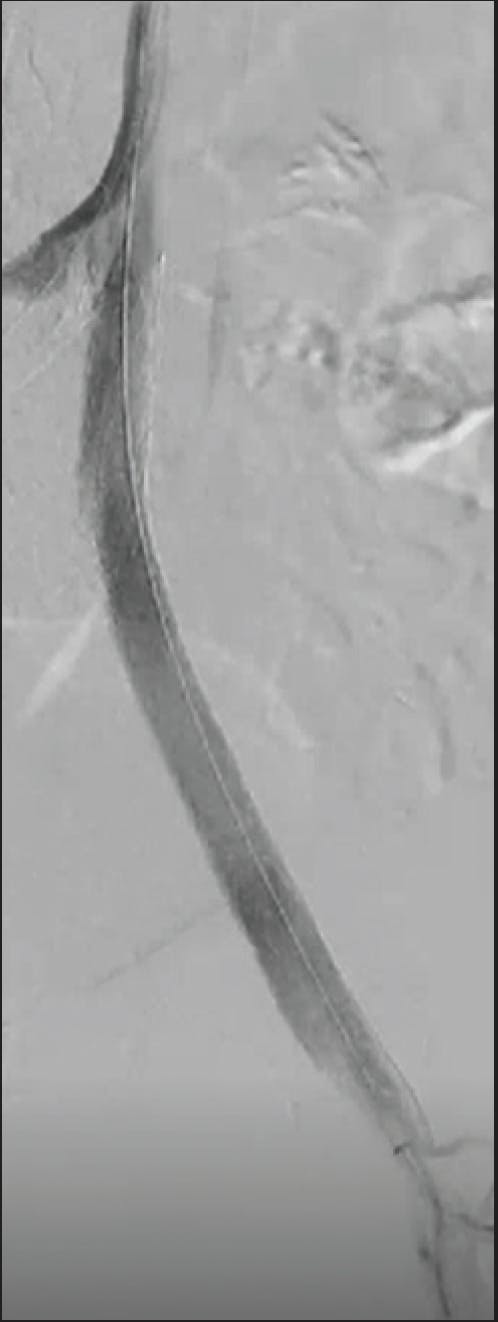
Figure 5. Final imaging of the iliac veins demonstrated a recanalized system with adequate luminal gain and no flow limitation.
PHYSICIAN OBSERVATIONS
The patient remained hospitalized after the procedure for monitoring and transition to oral anticoagulation. The Sublime™ Microcatheter was instrumental in securing guidewire placement through a chronically diseased iliofemoral venous system, leading to restoration of inline flow.
Caution: Federal (US) law restricts the Sublime™ Radial Access Guide Sheath, the Sublime™ Radial Access .014 and .018 RX PTA Dilatation Catheters, and the Sublime™ Radial Access .014, .018, and .035 Microcatheters to sale by or on the order of a physician. Please refer to each product’s Instructions for Use for indications, contraindications, warnings, and precautions. SURMODICS, SUBLIME, and SURMODICS and SUBLIME logos are trademarks of Surmodics, Inc. and/or its affiliates. Third-party trademarks are the property of their respective owners.

Advertisement
Advertisement