Advertisement
Advertisement
April 2026 Supplement
Sponsored by Terumo Interventional Systems
Why Access Matters: The Case for Going Radial
Reducing complications, expanding options, and improving outcomes—the core benefits of a transradial approach for peripheral vascular intervention.
Transfemoral access (TFA) has historically been the default approach for peripheral vascular intervention (PVI). Although familiar and widely practiced, TFA is associated with a meaningful burden of access site complications, including retroperitoneal bleeding, hematoma, pseudoaneurysm, arteriovenous fistula, and arterial thrombosis.1,2 These complications are not trivial; they contribute to increased morbidity, prolonged hospitalization, and higher resource utilization. Importantly, patients with peripheral artery disease (PAD)—the very population undergoing PVI—are disproportionately affected, experiencing a 2.5-fold higher risk of surgical intervention when TFA complications occur.3
Efforts to mitigate TFA risk have yielded only modest gains. Even with routine ultrasound guidance, access site complication rates after TFA remain clinically significant. In one contemporary analysis, the access site complication rate was 3.5%, and notably, 10% of these patients required surgical repair.4 These findings underscore that technical refinements alone may not fully address the intrinsic risks of TFA, particularly in complex PAD patients.
Beyond complication rates, TFA is frequently inappropriate or contraindicated. Patients with prior femoral surgery, prosthetic endografts, severe iliac tortuosity, or morbid obesity may face technical challenges or unacceptable risk with TFA. Additionally, transfemoral PVI does not readily permit treatment of bilateral lower extremity disease without obtaining a second access site or staging procedures, increasing cumulative risk and patient inconvenience.5,6 TFA is also problematic in fully anticoagulated patients, where the bleeding risk is substantially amplified.7
In contrast, transradial access (TRA) has emerged as a compelling alternative for PVI (Table 1),4,6,8-10 mirroring the paradigm shift already established in coronary intervention. Accumulating evidence demonstrates that TRA is associated with significantly lower rates of major bleeding and vascular complications, reported as low as 2.1% in contemporary series.8 Procedural success rates with TRA are high and comparable to femoral approaches, reaching 98.5% in experienced centers.8 These data challenge the notion that TRA is merely an adjunct or niche technique.
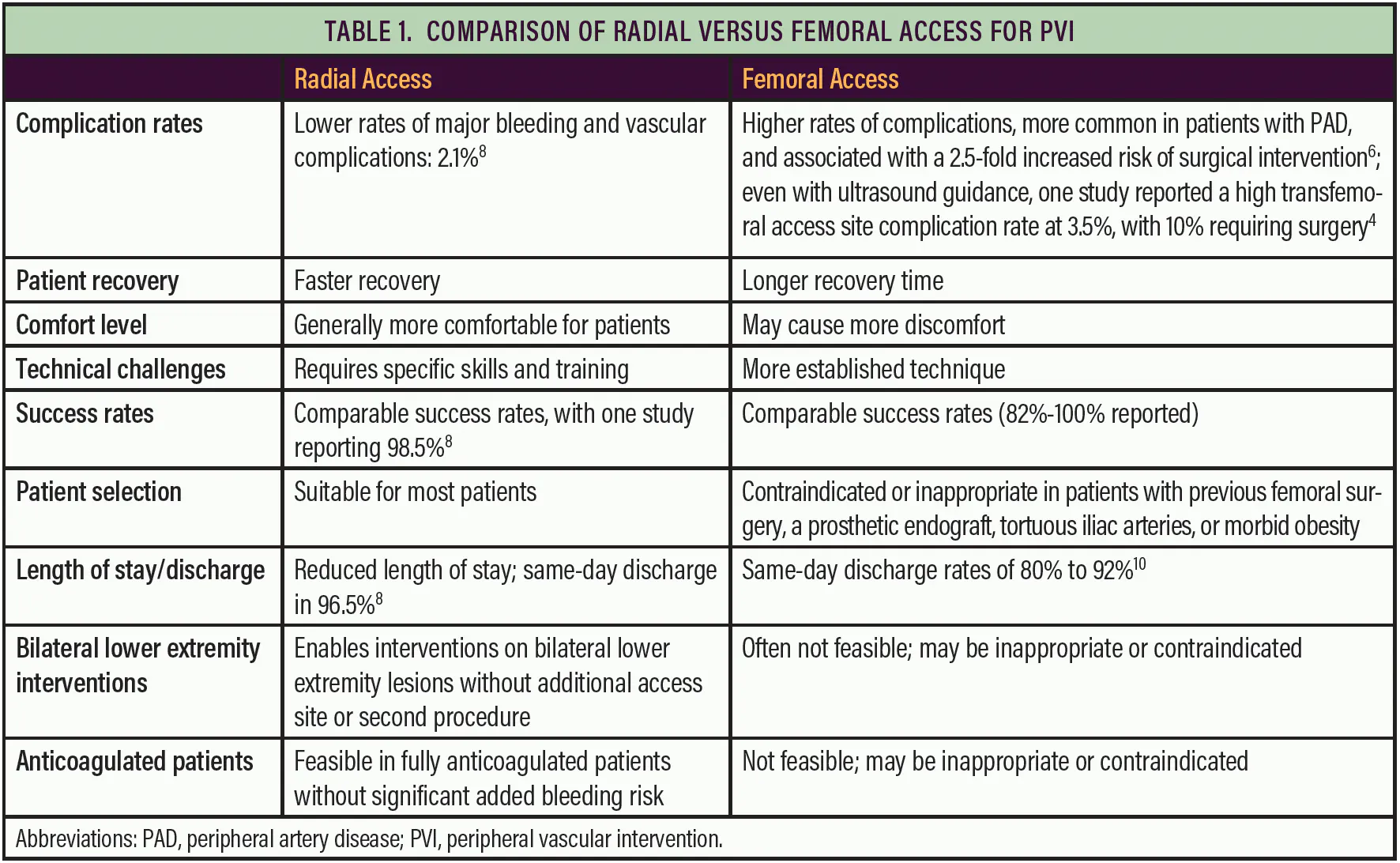
From a patient-centered perspective, the advantages of TRA are substantial. TRA allows for faster ambulation, greater comfort, and reduced postprocedural immobility. These benefits translate directly into operational efficiencies, including shorter length of stay and high rates of same-day discharge—reported at 96.5% in radial PVI cohorts compared with 80% to 92% for femoral approaches.8,10 Moreover, TRA enables treatment of bilateral lower extremity lesions through a single access site, avoiding additional punctures or repeat procedures.5,6 This capability is particularly valuable in patients with multilevel or bilateral disease.
TRA also expands treatment eligibility. Patients who are fully anticoagulated can safely undergo PVI via TRA without the same magnitude of bleeding risk observed with TFA.7 Although radial interventions require dedicated training, familiarity with longer devices, and thoughtful procedural planning, these technical considerations are increasingly addressed through growing operator experience and device innovation.
Ultimately, radial-to-peripheral intervention represents more than a technical trend—it reflects a patient-centered evolution in vascular therapy. By reducing access-related complications, improving comfort, enabling outpatient care, and expanding treatment options for complex and high-risk patients, TRA is redefining the standard approach to PAD intervention. As evidence continues to mature, access choice should be viewed not as a matter of convenience but as a critical determinant of patient outcomes.
1. Doyle BJ, Rihal CS, Gastineau DA, Holmes DR Jr. Bleeding, blood transfusion, and increased mortality after percutaneous coronary intervention: implications for contemporary practice. J Am Coll Cardiol. 2009;53:2019-2027. doi: 10.1016/j.jacc.2008.12.073
2. Seto AH, Abu-Fadel MS, Sparling JM, et al. Real-time ultrasound guidance facilitates femoral arterial access and reduces vascular complications: FAUST (femoral arterial access with ultrasound trial). JACC Cardiovasc Interv. 2010;3:751-758. doi: 10.1016/j.jcin.2010.04.015
3. Dencker D, Pedersen F, Engstrøm T, et al. Major femoral vascular access complications after coronary diagnostic and interventional procedures: a Danish register study. Int J Cardiol. 2016;202:604-608. doi: 10.1016/j.ijcard.2015.09.018
4. Ortiz D, Jahangir A, Singh M, et al. Access site complications after peripheral vascular interventions: incidence, predictors, and outcomes. Circ Cardiovasc Interv. 2014;7:821-828. doi: 10.1161/CIRCINTERVENTIONS.114.001306
5. Sher A, Posham R, Vouyouka A, et al. Safety and feasibility of transradial infrainguinal peripheral arterial disease interventions. J Vasc Surg. 2020;72:1237-1246.e1. doi: 10.1016/j.jvs.2020.02.016
6. Castro-Dominguez Y, Li J, Lodha A, et al. Prospective, multicenter registry to assess safety and efficacy of radial access for peripheral artery interventions. J Soc Cardiovasc Angiogr Interv. 2023;2:101107. doi: 10.1016/j.jscai.2023.101107
7. Posham R, Young LB, Lookstein RA, et al. Radial access for lower extremity peripheral arterial interventions: do we have the tools? Semin Intervent Radiol. 2018;35:427-434. doi: 10.1055/s-0038-1676341
8. Khraisat A, Abood Z, Mewissen MW, et al. Procedural utility, reliability, and success of endovascular intervention for peripheral arterial disease utilizing transradial access. J Soc Cardiovasc Angiogr Interv. 2025;4:103992. doi: 10.1016/j.jscai.2025.103992
9. Hanna L, Rodway AD, Garcha P, et al. Safety and procedural success of daycase-based endovascular procedures in lower extremity arteries of patients with peripheral artery disease: a systematic review and meta-analysis. EClinicalMedicine. 2024;75:102788. doi: 10.1016/j.eclinm.2024.102788
10. Akopian G, Katz SG. Peripheral angioplasty with same-day discharge in patients with intermittent claudication. J Vasc Surg. 2006;44:115-118. doi: 10.1016/j.jvs.2006.03.025

Advertisement
Advertisement