Advertisement
Advertisement
April 2026
Building a Modern Neurovascular Center of Excellence: Experience at the Gates Vascular Institute and the University at Buffalo Neurosurgery
Lessons from a multidisciplinary, high-volume center integrating clinical care, translational science, technologic innovation, and scientific investigation across the full continuum of neurovascular care.
By Jaims Lim, MD; Gustavo M. Cortez, MD; Devan Patel, MD; Matthew Moser, MD; Rosalind Pui Man Lai, MD; Jason M. Davies, MD, PhD; Kenneth V. Snyder, MD, PhD; Adnan H. Siddiqui, MD, PhD; and Elad I. Levy, MD, MBA
Neurovascular disease represents a major global health burden with profound consequences for mortality, long-term disability, and quality of life. In the United States, a stroke occurs approximately every 40 seconds. More than 3% of adults have experienced a clinical stroke, and population-based imaging studies suggest that silent cerebral infarctions may affect more than 25% of older adults.1-3 As the prevalence of cerebrovascular disease continues to rise with an aging population, the demands placed on health systems to deliver rapid, coordinated, and effective neurovascular care have grown substantially.
Meeting these challenges requires more than procedural expertise alone. Modern neurovascular care depends on an integrated ecosystem capable of rapidly diagnosing and treating complex cerebrovascular disease while simultaneously advancing innovation in device development, imaging technologies, clinical trials, and translational science. Originally envisioned by the late Dr. Leo Nelson “Nick” Hopkins, a pioneer and founding figure in endovascular neurosurgery, the Gates Vascular Institute (GVI) was designed to bring clinicians, engineers, and researchers together within a purpose-built facility dedicated to the treatment of vascular disease. Today, GVI functions as a high-volume comprehensive neurovascular center and regional referral hub for complex neurovascular disease4 under the leadership of Elad I. Levy, MD, MBA, Chair of the Department of Neurosurgery at the University at Buffalo, and Adnan H. Siddiqui, MD, PhD, Vice Chair of the Department and CEO of the Jacobs Institute (JI).
A FACILITY DESIGNED AROUND VASCULAR CARE
Unlike traditional hospital environments where vascular specialties operate in separate departments, GVI was designed specifically to promote multidisciplinary collaboration. The institute houses advanced procedural laboratories shared across all vascular specialties, including neurointerventional surgery, interventional radiology, vascular surgery, and cardiovascular intervention. This shared infrastructure facilitates efficient use of resources and promotes real-time collaboration among specialists managing complex vascular conditions.
When caring for patients with neurovascular pathologies, coordination amongst many medical and surgical specialties is of paramount importance. Complex cerebrovascular disease often requires coordination of many teams, including neurosurgery, neurology, neurocritical care, advanced imaging teams, and specialized nursing and technical staff. The physical design of the institute allows these interactions to occur seamlessly, enabling rapid decision-making and coordinated care for patients presenting with acute stroke or other emergent vascular conditions.
As a comprehensive stroke center, GVI maintains the infrastructure necessary to rapidly evaluate and treat patients with time-sensitive neurovascular emergencies. The integrated structure of the institute allows patients to move efficiently from emergency evaluation and advanced imaging to intervention, intensive care, and follow-up within a coordinated system designed to minimize treatment delays and optimize patient outcomes (Figure 1).
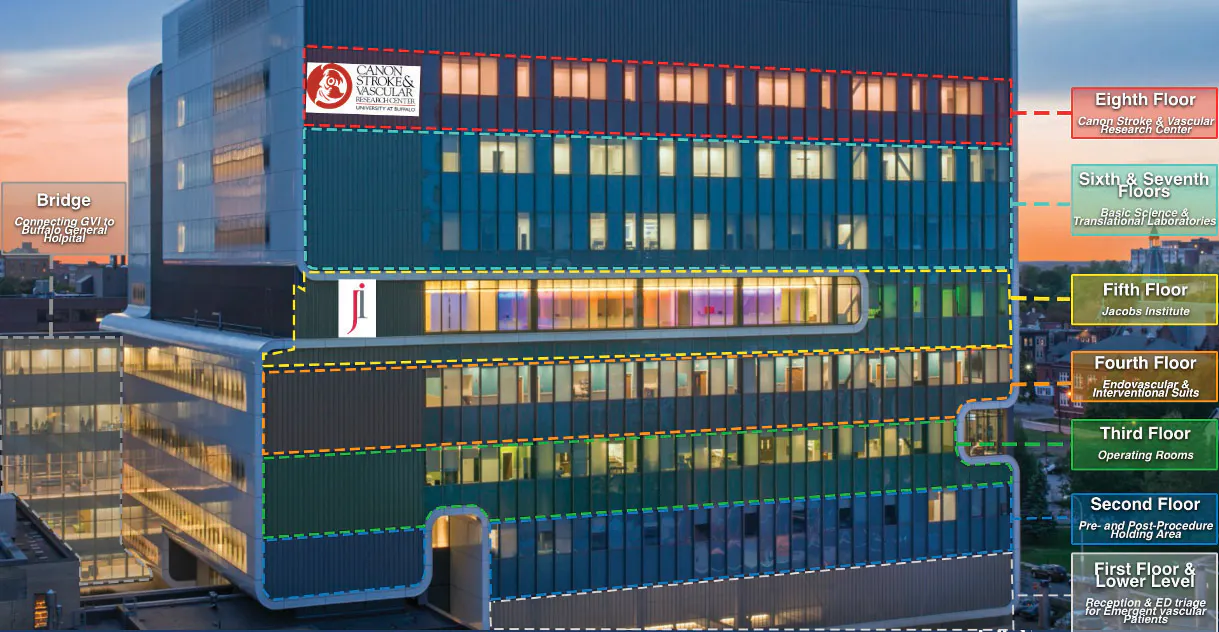
Figure 1. The Gates Vascular Institute.
HIGH-COMPLEXITY NEUROVASCULAR PRACTICE
The neurointerventional program at GVI maintains a high-volume practice, performing > 20,000 vascular procedures annually, including > 2,500 neuroendovascular procedures. These include a broad spectrum of diagnostic and therapeutic interventions: mechanical thrombectomy for acute ischemic stroke, endovascular treatment of intracranial aneurysms (ICAs), embolization of arteriovenous malformations (AVMs) and dural arteriovenous fistulas, venous sinus stenosis, cerebrospinal fluid–venous fistulas, and treatment of carotid and intracranial atherosclerotic disease.
In addition to routine cerebrovascular interventions, the center serves as a regional referral hub for complex neurovascular pathology. Many patients present with challenging vascular lesions requiring advanced endovascular strategies, including transvenous embolization approaches, staged vascular reconstruction of chronically occluded carotid arteries, and combined endovascular and open cranial-microsurgical management. Despite the heavy innovation in the endovascular realm, open microsurgical procedures—including carotid endarterectomies and craniotomies (especially of aneurysms), AVMs, and conditions requiring a bypass—remain a major focus of the neurosurgical team.
The ability to treat these complex conditions is supported by access to advanced endovascular technologies and state-of-the-art angiography suites and operating rooms designed for neurovascular interventions and surgeries. Combined with the collaborative environment within the institute, where expertise from neurosurgery, interventional neuroradiology, vascular surgery, and cardiology can be mobilized when needed, this infrastructure enables the program to deliver highly specialized patient care while continuing to expand the boundaries of neurointerventional treatment.
ACCELERATING NEUROVASCULAR INNOVATION: THE JACOBS INSTITUTE
Advancing innovation in neurovascular medicine remains a complex and often protracted process. The development and regulatory approval of new diagnostics, drugs, and devices in this field have historically progressed slowly, reflecting the challenges inherent in evaluating technologies designed for high-risk cerebrovascular disease. Fragmented regulatory pathways, evolving trial methodologies, and the technical complexity of cerebrovascular interventions can all delay the translation of promising technologies into clinical practice.5
Within the Buffalo neurovascular ecosystem, led by Dr. Siddiqui, the JI serves as a collaborative hub for the development and advancement of endovascular technologies. Located within GVI, this integration within the clinical environment enables close interaction between physicians, engineers, and industry partners. This proximity allows procedural challenges encountered in the angiography suite to directly inform the design, refinement, and evaluation of emerging technologies.
Founded by Dr. Hopkins, the institute was established to accelerate innovation by creating an environment in which clinicians, engineers, and medical device companies collaborate throughout the technology development process. In this setting, ideas generated in clinical practice can be translated into device design, procedural simulation, and physician training, while external innovators work closely with practicing neurointerventionalists to refine and advance emerging technologies.
Central to this effort is the Idea to Reality Center, which provides infrastructure for the development and testing of novel medical technologies. Through this program, clinicians collaborate directly with engineers and device developers to refine concepts, create and evaluate rapid prototypes, and advance promising technologies toward clinical implementation. Dr. Hopkins believed that a single transformative medical device could change the lives of millions of patients. Today, this philosophy continues to guide the institute’s work, fostering collaboration across clinical, engineering, and industry domains to advance the field of endovascular medicine.
TRANSLATIONAL SCIENCE: THE CANON STROKE & VASCULAR RESEARCH CENTER
Scientific discovery represents another cornerstone of the Buffalo neurovascular model. The Canon Stroke & Vascular Research Center (CSVRC), established by Dr. Hopkins in 1991, serves as a hub for basic and translational research focused on cerebrovascular disease. The center brings together PhD scientists, physician-investigators, postdoctoral fellows, and graduate trainees from multiple disciplines (eg, pathology, biomedical engineering, medical physics, neuroscience, computational science) to collaborate closely with clinicians working within GVI. This proximity enables continuous interaction between clinical practice and laboratory investigation, allowing questions arising during complex patient care to rapidly evolve into targeted research initiatives aimed at improving the fundamental understanding of these maladies as well as diagnostics, imaging technologies, and therapeutic strategies.
Several research programs focus on advancing the understanding of major cerebrovascular conditions, including ischemic stroke and ICAs. One line of investigation analyzes gene expression profiles of thrombi retrieved during mechanical thrombectomy to better characterize stroke etiology and inform strategies for secondary stroke prevention.6-8 These studies are particularly relevant given that nearly one in four strokes occurs in individuals with a prior cerebrovascular event.2 Complementary work investigates the molecular and biological mechanisms underlying ICA formation, growth, and rupture, integrating circulating gene expression signatures with advanced imaging biomarkers to improve aneurysm risk stratification.9-11
In addition to disease-focused research, the center supports a broad portfolio of technologic innovation aimed at improving neurovascular diagnosis and treatment. Current initiatives include artificial intelligence–based imaging analysis for treatment guidance and outcome prediction, development of blood-based biomarkers for noninvasive detection of ICAs, and computational modeling of vascular flow dynamics to evaluate endovascular treatment strategies. Ongoing work in imaging science includes the development of ultra-high-speed angiography systems, advanced x-ray detector technologies, and real-time radiation dose monitoring platforms designed to improve procedural safety.
Through these multidisciplinary efforts, the CSVRC continues to expand the scientific understanding of cerebrovascular disease while facilitating the translation of new discoveries and technologies into clinical practice.
SEAMLESS PATIENT CARE UPON PRESENTATION
When a patient presents with stroke-like symptoms, they are evaluated on the first floor of the GVI where the emergency department is located. They are then swiftly transferred to the CT scanner for head and neck vascular imaging and cranial perfusion imaging, also located on the first floor of the GVI. This is a unique room with an advanced, all-in-on 720-slice CT scanner and high-definition fluoroscopic system (four-dimensional room), designed by Canon Medical Systems to specifically reduce door-to-revascularization time. If a large vessel occlusion or intervention-appropriate lesion is identified, the patient simply remains on the CT scanner; the scanner is then withdrawn, the fluoroscopic system is brought in, and stroke thrombectomy is performed. The patient, prior to intervention, is also being evaluated in real time for eligibility to the latest cutting-edge clinical trials. If eligible and consenting, the patient would be enrolled, with the help of the research coordinators and personnel who are all under the “same roof” in the JI on the fifth floor. Additional data for translational studies of the CSVRC can be collected during procedures and postprocedurally. For example, there is an active stroke thrombectomy clot analysis study being performed by the Tutino Lab. Clots collected during thrombectomies are transferred to the eighth floor CSVRC for further analysis on clot composition and cellular makeup to better understand individual patient etiologies of stroke. The geographic proximity of the emergency department, angiography suites, operating rooms, and translational research labs under the roof of the GVI allows seamless patient care, research, and innovation to all synergistically occur.
TRAINING THE NEXT GENERATION
Education represents a central component of the Buffalo neurovascular program. The neurosurgery residency and neuroendovascular fellowship programs provide trainees with exposure to a high volume and broad spectrum of complex cerebrovascular cases within a collaborative, multidisciplinary environment. This clinical experience allows residents and fellows to develop advanced technical skills while participating in the management of challenging neurovascular conditions.
Beyond clinical training, trainees benefit from direct engagement with the program’s broader research and innovation ecosystem. Close interaction with the JI and the CSVRC provides opportunities to participate in projects ranging from basic and translational science to device development and imaging innovation. Within the research center, residents and fellows collaborate with PhD investigators, postdoctoral researchers, and graduate students working across disciplines such as biomedical engineering, medical physics, and computational science.
This integration of clinical care, scientific research, and technologic innovation creates a uniquely immersive educational environment. By exposing trainees to both the scientific foundations of cerebrovascular disease and the processes involved in developing new medical technologies, the program fosters the development of physician-scientists and future leaders in neurovascular surgery. Ultimately, this model supports the academic and professional growth of trainees while contributing to continued advances in patient care through innovation and discovery.
CONTINUING THE LEGACY
The GVI reflects the enduring vision of Dr. Hopkins, whose pioneering work helped shape the field of endovascular neurosurgery. His belief that meaningful innovation arises from close collaboration among clinicians, engineers, and scientists remains central to the Buffalo neurovascular model.
Today, that vision is realized through the integration of a high-volume comprehensive stroke center with a robust ecosystem for innovation and discovery. The site provides the rarest of environments where a clinical focus on neurologic and vascular diseases by physicians at GVI is cohabitating with leading translational scientists investigating the pathogenesis and therapeutic directions at CSVRC; also integrated in this rich ecosystem are engineers, regulators, entrepreneurs, trialists, and educators performing rapid prototyping, clinical trial design, device testing, validation and verification, and advanced three-dimensional model simulation. The close collaboration between the GVI, JI, and CSVRC enables a continuous exchange between clinical care, technologic development, and scientific investigation. This trifecta of excellence in clinical care, translational science, and entrepreneurial innovation is the special potion that makes this ecosystem unlike any other in the world.
Establishing and sustaining such a multidisciplinary environment requires significant institutional commitment, including coordination across multiple specialties, investment in advanced clinical and research infrastructure, and continuous adaptation to rapidly evolving technologies and treatment paradigms. Within this framework, patients benefit from an integrated system designed to support the full continuum of neurovascular care, from rapid diagnosis and intervention to research-driven improvements in treatment strategies.
The legacy of Dr. Nick Hopkins is continued by Drs. Levy and Siddiqui who are at the forefront of both endovascular neurosurgical innovation as well as training the endovascular neurosurgeons of tomorrow. As endovascular therapies continue to evolve and the complexity of cerebrovascular disease grows, models that combine clinical excellence with innovation, multidisciplinary collaboration, and physician training will play an increasingly important role in shaping the future of neurovascular care and innovation worldwide.
1. Benjamin EJ, Muntner P, Alonso A, et al; American Heart Association Council on Epidemiology and Prevention Statistics Committee and Stroke Statistics Subcommittee. Heart disease and stroke statistics-2019 update: a report from the American Heart Association. Circulation. 2019;139:e56-e528. Published correction appears in Circulation. 2020;141:e33doi: 10.1161/CIR.0000000000000659.
2. Tsao CW, Aday AW, Almarzooq ZI, et al; American Heart Association Council on Epidemiology and Prevention Statistics Committee and Stroke Statistics Subcommittee. Heart disease and stroke statistics-2023 update: a report from the American Heart Association. Circulation. 2023;147:e93-e621. Published corrections appear in Circulation. 2023;147:e622 and Circulation. 2023;148:e4. doi: 10.1161/CIR.0000000000001123.
3. Vermeer SE, Longstreth WT Jr, Koudstaal PJ. Silent brain infarcts: a systematic review. Lancet Neurol. 2007;6:611-619. doi: 10.1016/S1474-4422(07)70170-9
4. Cappuzzo JM, Waqas M, Housley SB, et al. A rapid multidisciplinary hybrid approach to stroke care at University at Buffalo Neurosurgery. Endovasc Today. 2023;22:37-43. https://evtoday.com/articles/2023-jan/a-rapid-multidisciplinary-hybrid-approach-to-stroke-care-at-university-at-buffalo-neurosurgery
5. Liebeskind DS, Jadhav AP. Neurovascular innovation at the FDA: pivotal strategies to effectively modernize the realization of diagnostic, drug, and device products. Stroke Vasc Interv Neurol. 2025;5:e001806. doi: 10.1161/SVIN.125.001806
6. Santo BA, Poppenberg KE, Ciecierska SK, et al. Hybrid clot histomic-transcriptomic models predict functional outcome after mechanical thrombectomy in acute ischemic stroke. neurosurgery. 2024;95:1285-1296. doi: 10.1227/neu.0000000000003003
7. Tutino VM, Fricano S, Chien A, et al. Gene expression profiles of ischemic stroke clots retrieved by mechanical thrombectomy are associated with disease etiology. J Neurointerv Surg. 2023;15:e33-e40. doi: 10.1136/neurintsurg-2022-018898
8. Tutino VM, Fricano S, Frauens K, et al. Isolation of RNA from acute ischemic stroke clots retrieved by mechanical thrombectomy. Genes (Basel). 2021;12:1617. doi: 10.3390/genes12101617
9. Tutino VM, Lu Y, Ishii D, et al. Aberrant whole blood gene expression in the lumen of human intracranial aneurysms. Diagnostics (Basel). 2021;11:1442. doi: 10.3390/diagnostics11081442
10. Veeturi SS, Poppenberg KE, Pinter NK, et al. Evaluation of radiogenomics for risk stratification of intracranial aneurysms: a pilot study. Neuroradiology. 2025;67:2425-2435. doi: 10.1007/s00234-025-03702-1
11. VVeeturi SS, Poppenberg KE, Pinter NK, et al. Evaluation of radiogenomics for risk stratification of intracranial aneurysms: a pilot study. Neuroradiology. 2025;67:2425-2435. doi: 10.1007/s00234-025-03702-1
Advertisement
Advertisement