Advertisement
Advertisement
August 2026
Three Keys to Creating and Maturing pAVFs for Successful Cannulation Safety
Beyond access creation alone, favorable pAVF outcomes hinge on optimized inflow, flow redirection, and development of a cannulation-ready vein.
The evolution of percutaneous arteriovenous fistula (pAVF) has expanded the possibilities of hemodialysis access by offering patients a minimally invasive alternative to surgically created fistulas. Contemporary pAVF systems have demonstrated high technical success rates, favorable patient satisfaction, and reduced procedural morbidity.1,2 As the Ellipsys system (Ellipsys Medical, Inc.) re-enters the market, the WavelinQ system (BD Interventional) maintains a notable presence, and the Velocity system (Venova Medical) continues to evolve, achieving reliable and functional maturation remains one of the most critical factors in successful pAVF creation and long-term management. It is well known that minimizing catheter dwell time is tantamount to clinical outcomes, and techniques to promote this timeline are ideal for the end-stage renal disease patient.3 A staged maturation strategy (Table 1) emphasizes active hemodynamic optimization rather than passive observation, with the goal of rapidly creating a durable, catheter-free dialysis access.
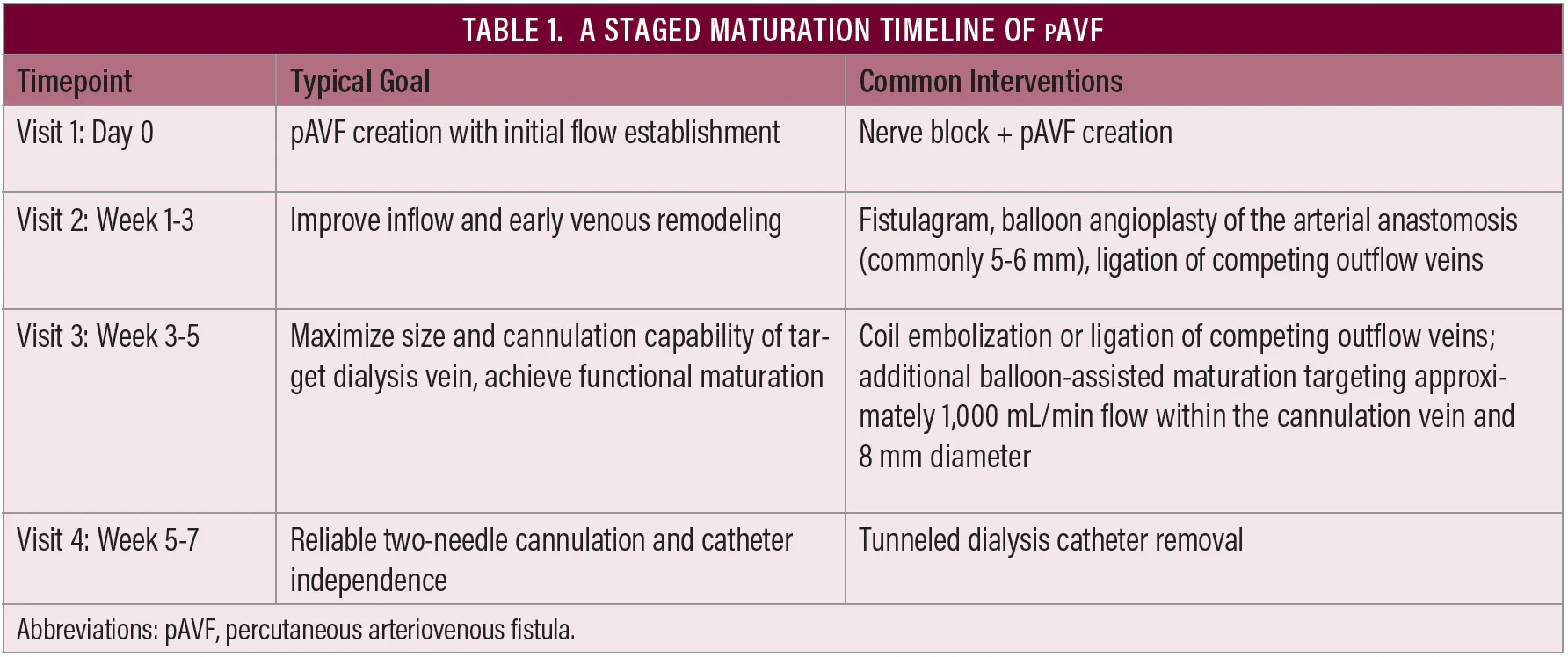
Technical success in access creation alone does not guarantee dialysis success. While fistula creation may be reproducible, long-term outcomes ultimately depend on whether the access becomes reliably cannulation-ready, supports adequate dialysis delivery, and achieves catheter independence. Once an operator has developed a strong understanding of pAVF anatomy and the technical aspects of intervention, the required maturation procedures can often be completed during the initial maturation visit, with a second visit reserved for those cases that need additional balloon-assisted maturation to promote safe cannulation. Interventionalists who consistently achieve favorable outcomes generally focus on three critical principles: optimizing inflow, flow redirection, and maximizing cannulation capability of the cannulation vein (Figure 1).
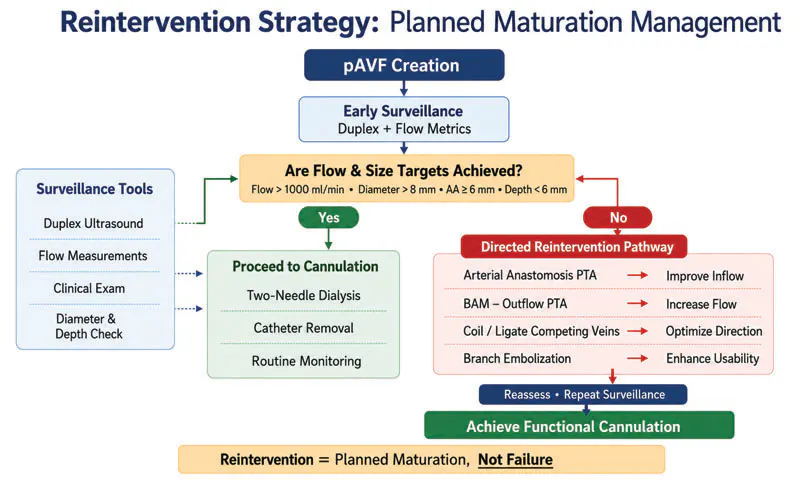
Figure 1. Reintervention strategy: Success with cannulation has been found when inflow is optimized, cannulation target vein is an adequate size, and adequate flow is diverted to the cannulation vein. BAM, balloon-assisted maturation; PTA, percutaneous transluminal angioplasty. Created with assistance from ChatGPT 5.5.
1. OPTIMIZE THE ARTERIAL ANASTOMOSIS
A functional pAVF begins with adequate inflow. One of the most important determinants of maturation is optimizing the arterial anastomosis to support sufficient access flow and downstream venous remodeling. Residual, or development of, anastomotic stricture may limit fistula development despite technically successful access creation.
Intervention of the anastomosis has therefore become a central component of pAVF maturation strategies. Angioplasty performed to approximately 5 to 6 mm may significantly improve access hemodynamics, increase flow volumes, and promote enlargement of the target outflow vein. The goal goes beyond simply creation of a patent arteriovenous connection; also crucial is development of sustained inflow capable of supporting a mature superficial cannulation conduit. As use of additional therapeutic options such as cutting/scoring balloons and kinetic microincisions increase, studies demonstrating their effect on maturation of pAVFs are likely to yield a positive impact.
2. REDIRECT FLOW INTO THE PREFERRED SUPERFICIAL CANNULATION VEIN
Traditionally, fistula flow was determined by brachial artery flow volume. However, this metric is nonviable in a multioutflow fistula due to the inherent outflow pathways, including the brachial, cephalic, and median cubital (basilic) veins. Diversion into deeper venous channels likely prevents adequate enlargement and arterialization of the superficial cannulation vein despite otherwise acceptable brachial artery access flow volumes. Recent literature increasingly emphasizes that functional maturation depends not simply on total brachial artery flow but also on achieving sufficient flow within the target cannulation vein itself.4
For this reason, successful maturation often requires intentional redistribution of the outflow toward a preferred superficial vein: ideally, the cephalic vein. This minimizes the need for additional surgical superficialization (eg, basilic dominant fistula) and promotes cannulation of a vein that is well understood and commonly utilized in dialysis centers.
Flow diversion strategies include coil embolization, surgical branch ligation, or ultrasound-guided ligation of competing venous pathways. Addressing the median cubital and deep brachial venous systems to preferentially augment cephalic vein maturation is well-published and should be a priority.4 Recently published techniques, ideal for interventionalists, demonstrate percutaneous ultrasound-guided approaches for selective venous flow diversion designed to redirect flow into preferred superficial outflow pathways while minimizing tissue disruption.5 These allow for targeted hemodynamic modification through very small access points under local anesthesia, minimizing infectious risks and maximizing the types of operators to perform said procedures.
Redirecting flow into a superficial, straight, cannulation-accessible conduit is critical to long-term access usability.
3. CREATE A CANNULATION-READY VEIN
The ultimate goal of pAVF maturation is creation of a reliable cannulation segment capable of supporting efficient two-needle dialysis. Functional maturation requires development of a superficial vein with adequate diameter, depth, and flow characteristics to allow predictable needle placement and sustained dialysis adequacy.
Although the “rule of sixes” is well known within the interventional arena, successful cannulation is commonly achieved when the target vein matures to approximately 7 to 8 mm in diameter, with target vein flow volumes approaching 1,000 mL/min and a vein depth < 6 mm. These size and flow metrics within the cannulation segment can facilitate reliable two-needle access and reduce catheter dependence.
Importantly, a fistula with acceptable patency but inadequate vein size, insufficient superficialization, or poor cannulation characteristics may still fail clinically despite technically successful creation. Functional maturation is therefore defined not simply by the presence of flow but by the development of a durable, predictable, cannulation-ready access conduit.6
pAVFs have undeniably transformed the vascular access landscape. Although these technologies have simplified access creation, consistently reproducible outcomes require dedicated algorithms focused on creating a functional fistula. Ultimately, the greatest impact of these programs will be expanding access to access.
1. Hull JE, Jennings WC, Cooper RI, et al. The pivotal multicenter trial of ultrasound-guided percutaneous arteriovenous fistula creation for hemodialysis access. J Vasc Interv Radiol. 2018;29:149-158.e5. doi: 10.1016/j.jvir.2017.10.015
2. Rajan DK, Ebner A, Desai SB, et al. Percutaneous creation of an arteriovenous fistula for hemodialysis access. J Vasc Interv Radiol. 2015;26:484-490. doi: 10.1016/j.jvir.2014.12.018
3. Lok CE, Huber TS, Lee T, et al. KDOQI clinical practice guideline for vascular access: 2019 update. Am J Kidney Dis. 2020;75(4 suppl 2):S1-S164. doi: 10.1053/j.ajkd.2019.12.001
4. Wasse H, Alvarez AC, Brouwer-Maier D, et al. Patient selection, education, and cannulation of percutaneous arteriovenous fistulae: an ASDIN white paper. J Vasc Access. 2020;21:810-817. doi: 10.1177/1129729819889793
5. Razdan R, Sharaf R, Torgbenu M, et al. Real-time angio zonal diversion via acoustic navigation: a retrospective evaluation of 154 patients using a novel ligation technique to divert flow and maximize cannulation success in pAVF. J Vasc Access. 2026;27:1310-1318. doi: 10.1177/11297298251375173
6. Shahverdyan R. Assisted pAVF maturation: when, why, and how I do it. Endovasc Today. 2023;22:51-53, 60. https://evtoday.com/articles/2023-june/assisted-pavf-maturation-when-why-and-how-i-do-it
Advertisement
Advertisement