Early Career Insights
Advertisement
Advertisement
Early Career Insights Part 4
Keys to Creating and Maintaining Healthy Habits From the Start
Strategies for building sustainable habits, avoiding burnout, and recognizing approaches that don't work.
With Eri Fukaya, MD, PhD, FSVM, and Bella Hausen, MD, MBChB, MRCS, DipEd, FRCR

A colleague recently introduced me to the Eisenhower Matrix, and it helped clarify something I have struggled with throughout my career: Burnout isn’t always caused by doing too many important things. Often, it comes from allowing urgent but unimportant things to consume our time.
The Eisenhower Matrix divides our activities into four categories (Table 1).
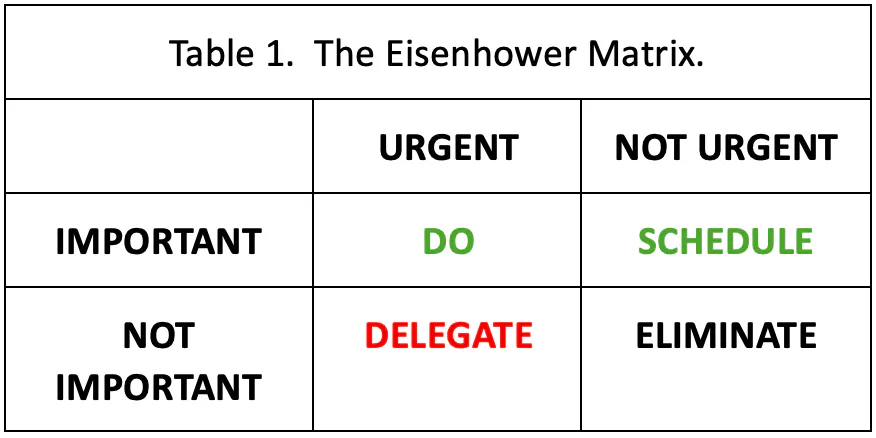
In medicine, the “urgent but not important” quadrant can become enormous. There is always another email to answer, form to complete, meeting to attend, administrative request to address, or small problem that someone needs resolved immediately. Each task may take only a few minutes, but together they can completely take over our lives. I am not particularly good at this myself. I can easily find myself drowning in urgent, relatively unimportant tasks simply because they are in front of me and need an immediate response. However, as our careers become busier, I think we have to become better at recognizing these tasks and asking, “Does this really need to be done by me? Can I delegate it? Can I say no? Does it need to be done at all?”
At the same time, we need to deliberately protect the important but not urgent quadrant. Ironically, these are often the things that matter most over the long term but are easiest to neglect because there is no immediate consequence to postponing them. Exercise does not have a deadline. Neither does spending time with family and friends, reading a book, pursuing a hobby, mentoring someone, or working toward a long-term professional goal. We can always tell ourselves we will get to these things when life becomes less busy. But for most of us, life does not become less busy.
If I had to identify three keys to preventing burnout, they would be (1) know what is truly important to you, (2) intentionally make time for the important things that are not urgent, and (3) become comfortable delegating or saying no to things that are urgent but not important. What does not work is trying to do everything. This is something I continue to work on myself. The busier we become, the more important it is to distinguish between what demands our attention and what actually deserves it. Ultimately, how we spend our time reflects our priorities—and making room for what is genuinely meaningful is what allows us to build not only a sustainable career but a fulfilling life.

1. Build your village. You cannot do this alone. Surgery/interventional careers often attract the people who feel they should be able to handle everything on their own, without asking for help. That instinct will burn you out. Line up family, coresidents, mentors, childcare—whoever your “village” is—before you are in crisis, not after. Try to live in your village and don’t miss out too much on life: weddings, graduations, birthdays.
What doesn’t work: Waiting until you’re drowning to ask for help or treating the need for support as a weakness to hide from attendings and peers. Isolation turns fatigue into burnout.
2. Train your body like it’s part of the job, especially posterior chain strength. Vascular/endovascular means long cases, standing for hours, leaning over tables, wearing lead, etc. That load lands on your back, hips, and glutes. Strength training, not just cardio, is what protects your spine and allows you to keep operating pain-free for decades. Use the latest tools and technologies to minimize your radiation exposure and time in lead.
What doesn’t work: Treating exercise as optional “when I have time,” or only doing cardio while ignoring strength. By the time your back hurts during a case, the damage is already underway.
3. Be consistent, especially with sleep—the body keeps score. Habits compound. Skipping sleep, eating badly, and pushing through pain in your 20s and 30s doesn’t disappear because you’re young; it accrues quietly and shows up later as chronic pain, poor decision-making, or early burnout. Especially as females, we go through various hormonal cycles and stages in life. Good cortisol levels, adequate sleep, and weight training are essential, and I wish someone told me sooner.
What doesn’t work: The “I’ll fix it later” mindset. There is no version of this career where sleep debt or physical neglect becomes free just because you got away with it once.
Advertisement
Advertisement
Find more Early Career Insights
Read more career reflections and practical advice for residents, fellows, and early career physicians in the Early Career Insights hub.
Read More