Advertisement
Advertisement
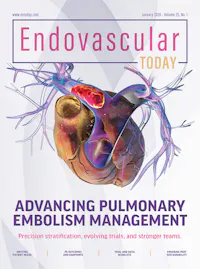
It is without question an exciting time in the field of pulmonary embolism (PE), a serious and often life-threatening condition that has long been underrecognized and undertreated. Recent years have seen true innovation in dedicated tools for clot removal or dissolution in this vascular territory. Equally important, there are now substantive efforts underway to produce meaningful data in this challenging clinical setting. These efforts promise to help fill the long-standing evidence gap that has made it challenging for clinicians managing patients with PE. Perhaps the most notable development has been the development and embrace of the team-based approach to PE, which has resulted in renewed focus on collaborative care pathways. Multidisciplinary rapid-acting PE response teams (PERTs) are now in place and functioning around the world. By refining processes, collaborating on decision-making, and tracking outcomes, these teams are raising the bar for PE management. The designation of PERT Centers of Excellence by The National PERT Consortium, achieved by programs that fulfill rigorous criteria, represents the culmination of a decade of rapid advancement in the care of PE.
At MGH, I have been fortunate to be part of multidisciplinary teams dedicated to specific conditions from head to toe. Team-based initiatives have included the vascular center, heart team meetings, the stroke program, and others. Joining like-minded colleagues from different backgrounds over 10 years ago to create The PERT Consortium, I’ve seen firsthand the value of collaboration, both for patients and providers. Working together, sharing knowledge, and combining the expertise of multiple specialties to address the needs of individual patients is not only highly rewarding but also elevates the care delivered to that patient.
In compiling this PE-themed edition of Endovascular Today, we started with the patient and worked our way back to the practitioner. What has been learned about the needs, experiences, and preferences of PE patients, and how can we better meet them? What are the most pressing remaining questions? As you can imagine, the unanswered questions outnumber the areas of clear certainty, but we are—at long last—truly making great progress. New guidelines from our societies, expansion of the PERT Database (already with data from nearly 25,000 patients), and programs like the new PERT PRISM initiative and the promulgation of PERT Centers of Excellence all promise to further improve care and outcomes for patients with PE.
We kick off our feature with a deep dive on one of the most important challenges facing front-line clinicians: risk stratification. Drs. Frances Mae West, Thomas Todoran, Andrew Klein, and James Horowitz highlight the advantages and limitations of current tools and historic models, algorithmic approaches, and potential future directions. Next, we’ve invited an expert panel to share opinions on what they perceive to be the most meaningful endpoints. Drs. Wissam Jaber, Soophia Naydenov, and Peter Monteleone explore the relative strengths, drawbacks, and nuances of the various outcomes measures. They offer ideas regarding what we may look to explore in the next phases of clinical study.
Dovetailing with this article is a quick-hitting Q&A in which experienced trialists Drs. Amir Darki, Pavan Kavali, and Mona Ranade each share their personal clinical trial wishlists. I hope to see each of these questions explored in our next “PE chapter.” Finally, I moderate a panel exploring the needs and goals of next-generation PERTs, specifically, how to ensure their sustainability. I was delighted to gain the insights of Drs. Vivian Bishay, Patrick Muck, and Sameh Sayfo, three inspiring physicians and friends who are dedicated to raising the bar for PERTs while also taking care of their team members. PE care will never be simple, nor easy, for those providing it. The more resources and “hands on deck” we can engage to support these teams, the more enduring will be the high level of care multidisciplinary PERTs provide.
It is a humbling experience to assemble a PE-themed conference, and I have found the same to be true of guest editing this issue of Endovascular Today. The number of topics that come to mind is mind-boggling, and each is as vital and interesting as the next. Beyond this is the brilliant work being done in this area by our many talented colleagues. I am grateful for their time, effort, and extraordinary expertise that has brought so many advances to the treatment of PE, in such a short time. I encourage you to let their work be an inspiration in your own efforts. Please do not hesitate to contact me with your ideas and questions, especially if you would like to join the PERT movement to improve PE care at your hospital. The future is bright!
Kenneth Rosenfield, MD, MHCDS
Guest Chief Medical Editor
Advertisement
Advertisement